
| Model Type | Average Price Range | Recent High Sale |
|---|---|---|
| 289 Cobra (1962-1964) | $900,000 – $1,500,000 | $1.8M (RM Sotheby’s 2025) |
| 427 Cobra (1965-1967) | $1,800,000 – $2,500,000 | $3.2M (Barrett-Jackson 2024) |
| Competition Models | $3,000,000 – $5,000,000 | $5.5M (Bonhams 2023) |
| Super Snake | $5,000,000+ | $5.5M (2021 record) |
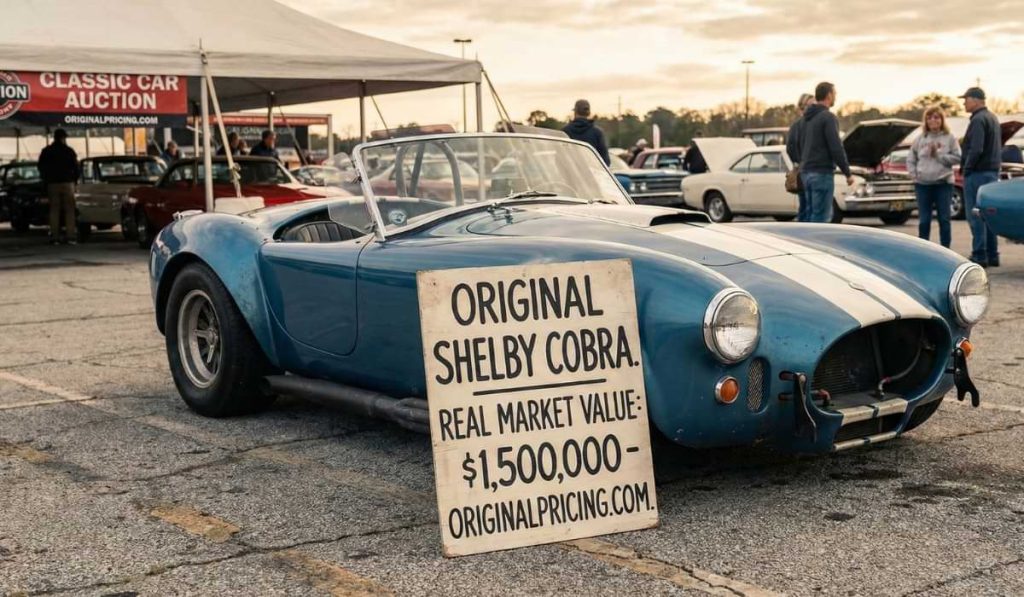
The original Shelby Cobra 289 had a base price of $5,195 in 1965. Today, authentic 289 models sell for $900,000 to $1.5 million, while 427 variants range from $1.8 million to $2.5 million. Competition models and the rare Super Snake can exceed $5 million. The first Cobra ever built (CSX 2000) holds the record at $13.75 million.
Few cars in American automotive history carry the kind of price gravity that the Shelby Cobra does. Born from Carroll Shelby’s vision of pairing a lightweight British AC Ace chassis with raw American V8 power, the Cobra became an instant legend on both the street and the track. However, what most collectors and enthusiasts want to know is straightforward: what did a Shelby Cobra actually cost when it was new, and what does an authentic one cost right now? In a market where the term “original price” is often manipulated (as we explain in our deep dive on what original price really means on online stores), the Cobra is one category where that number tells a powerful story.
Here is a verified breakdown of original retail pricing, current auction data, and the key factors driving value across every Cobra variant.
What a Shelby Cobra Cost When It Was New?
When the Shelby Cobra 289 hit showrooms in the mid-1960s, its base price sat at $5,195. That was already steep for the era, roughly double the cost of a base Ford Mustang. As a result, Shelby American intentionally kept pricing high to cover engineering costs and, frankly, to keep inexperienced drivers away from a car that could hit 60 mph in under 4 seconds.
For context, a heavily optioned Stage III 289 Cobra could push the sticker past $8,600. Meanwhile, the 427 variants were priced well above any other American production car at the time. Carroll Shelby himself acknowledged that the Cobra was never meant to be affordable. It was a race car with license plates, and the price tag reflected that philosophy.
Understanding original retail pricing is important because it explains why so few were made. In total, Shelby American built just 998 Cobras during the original 1962 to 1968 production run. Of those, 655 used the leaf-spring 289 V8, and the remaining 343 featured the coil-spring 427. That kind of scarcity is a major reason prices have climbed into seven figures. If you are interested in how original pricing shapes collector markets across categories, our breakdown of original Rolex prices follows a similar pattern of limited supply driving long-term value.
Current Market Prices by Model
| Model Type | Avg. Price Range | Record Sale | Production |
| 289 Cobra (1962-1965) | $900K – $1.5M | $4.13M (2021) | 655 units |
| 427 Cobra (1965-1967) | $1.8M – $2.5M | $5.94M (2021) | 343 units |
| Competition Models | $3M – $5M+ | $5.5M (2021) | ~29 built |
| Super Snake | $5M+ | $5.5M (2021) | 2 built* |
| CSX 2000 (First Cobra) | One-of-one | $13.75M (2016) | 1 unit |
*Only one Super Snake (CSX 3015) survives. The second (CSX 3033) was destroyed in an accident.
According to CLASSIC.COM auction data, the average sale price for a 289 Cobra sits at roughly $1.14 million, while the 427 averages around $1.85 million. These figures include both strong sales and cars that traded below expectations due to condition issues or incomplete documentation.
Notably, several high-profile 427 Cobras failed to sell at recent auctions. A 1965 427 at Mecum Kissimmee carried an estimate of $2.25 to $2.75 million but did not meet its reserve. Similarly, multiple examples at Gooding, Bonhams, and Collecting Cars went unsold throughout 2025, suggesting that buyers are becoming more selective, especially at the top end of the market.
What Drives Shelby Cobra Prices Up (or Down)?
Several factors directly impact how much an authentic Cobra commands at auction. First, provenance matters enormously. Cars with documented ownership history, original window stickers, and Shelby American Automobile Club (SAAC) Registry verification consistently sell at a premium. For instance, Carroll Shelby’s personal 427 (CSX 3178) fetched $5.94 million at Mecum in 2021, largely because of who owned it.
Second, engine authenticity plays a critical role. Not all “427” Cobras actually came with a 427 engine. Some received Ford’s 428 Police Interceptor motor instead, which was designed more for street use. Industry sources indicate that 428-equipped models typically sell in the mid-six-figure range, significantly below true 427 cars. As a consequence, engine verification through the SAAC Registry has become essential for serious buyers.
Third, competition history adds substantial value. Purpose-built race cars with documented championship entries routinely sell between $2.05 million and $2.6 million. Cars with notable wins can push well past $4.5 million. This pattern is not unique to Cobras. Similar dynamics shape pricing in the luxury watch market, where provenance and rarity define value, much like we document in our Kelley Blue Book pricing guide for vehicles.
The Replica Factor: Why Authentication Matters
One of the biggest complications in the Cobra market is the sheer volume of replicas. Companies like Superformance (the only firm officially licensed by Carroll Shelby) and Factory Five have been producing Cobra-style cars for decades. Most running replicas sell between $50,000 and $100,000, with highly specialized builds reaching $150,000 or more.
Because thousands of replicas exist alongside fewer than 1,000 originals, authentication is absolutely critical. Buyers rely on SAAC Registry documentation, CSX serial number verification, and physical inspection of chassis stampings. Without proper authentication, a supposed “original” could turn out to be a very well-built copy. This gap between original and replica pricing is one of the widest in the collector car space, and it is a textbook example of value bifurcation, where two nearly identical-looking products occupy completely different price tiers based on provenance alone.
For comparison, the gap between an original and a reproduction in other collector categories is rarely this extreme. In the sneaker market, for example, the price difference between authentic and fake pairs is significant but measured in hundreds, not millions. Our coverage of Air Jordan original prices shows how authentication protects value, even at a much smaller scale.
Where Are Shelby Cobra Prices Heading?
The Shelby Cobra market has shown remarkable resilience over the past decade. Prices for well-documented originals have generally trended upward, even as the broader classic car market has softened in some segments. That said, recent auction results suggest a shift in buyer behavior.
Multiple high-estimate Cobras failing to sell at major auctions indicates that the market is becoming more discerning. Buyers are still willing to pay top dollar, but only for cars with bulletproof documentation and known history. Cobras with gaps in provenance or questionable restoration work are increasingly left on the block.
Furthermore, as these cars age and the pool of verified originals slowly shrinks through attrition, prices for the best examples are likely to keep climbing. The Cobra occupies a unique position as both a racing icon and a cultural symbol. Unlike some collector cars that cycle in and out of fashion, the Cobra’s appeal has remained steady since the 1960s. Other mid-century collectibles follow a similar trajectory. The Schwinn Black Phantom, for example, shows how scarcity and nostalgia combine to push vintage American icons into premium territory. This pricing stability mirrors what we see in other investment-grade collectibles, from the Cybertruck pricing trajectory to the vehicle wrap pricing market, where original condition and verified data determine real value.
How to Verify a Shelby Cobra Before Buying?
If you are in the market for an authentic Cobra, verification should come before negotiation. Start with the SAAC World Registry, which catalogs the production history and ownership chain for every original Cobra. Cross-reference the CSX serial number with known production records. Additionally, inspect the chassis stampings, engine block casting numbers, and any original paperwork (window stickers, dealer invoices, or period photos).
Auction houses like RM Sotheby’s, Gooding & Company, Mecum, and Bonhams typically perform their own due diligence. Nevertheless, independent verification through a marque specialist is always recommended. The cost of a pre-purchase inspection is negligible compared to the risk of overpaying for a misidentified car.
Frequently Asked Questions
How much did a Shelby Cobra cost when it was new?
The 289 Cobra had a base price of $5,195 in 1965. Highly optioned Stage III models could exceed $8,684. The 427 variants were priced even higher, making the Cobra one of the most expensive American cars of its era.
What is the most expensive Shelby Cobra ever sold?
CSX 2000, the very first Cobra ever built, sold for $13.75 million at a Sotheby’s auction in 2016. It remains the most expensive American car ever sold at auction.
How many original Shelby Cobras exist?
Shelby American produced 998 Cobras between 1962 and 1968. Of those, 655 were 289 models, and 343 were 427 models. Some have been lost to accidents and deterioration over the decades, making the actual surviving count lower.
Are Shelby Cobra replicas worth anything?
Licensed replicas from Superformance typically sell between $50,000 and $100,000. Kit cars from companies like Factory Five are available for even less. While they offer the driving experience, they do not carry the investment value of an original.