
When researching designer vinyl figures, understanding the original retail price at which Zimomo releases launched provides essential context for collectors and enthusiasts. Unlike aftermarket values, which fluctuate based on availability and demand, launch pricing reflects what the brand and authorized retailers charged at the point of sale.
This guide examines Zimomo’s pricing structure, release-by-release retail values, and the factors that influence cost at launch.
Zimomo Live Price Tracker LIVE
Real-time designer toy market tracking with automatic daily updates
🎭 Select Release to Display
🔄 Auto-Update Active: This chart automatically adds new price data every 24 hours based on collector market trends. The system checks every minute for new days and simulates realistic aftermarket movements. Toggle off to pause automatic updates.
📋 Recent Update History
What is Zimomo?
Zimomo represents a designer art toy brand specializing in vinyl collectible figures. The brand produces limited-run characters with distinctive aesthetic qualities that appeal to collectors of contemporary designer toys.
Production focuses on small-batch releases distributed through specialty retailers, pop culture conventions, and direct brand channels. This approach creates inherent scarcity that distinguishes designer toys from mass-market collectibles.
Market Positioning
Zimomo operates within the mid-tier designer toy market. Releases typically target collectors willing to invest in limited-edition vinyl figures with artistic merit rather than mainstream commercial appeal.
The brand competes alongside similar collectible toy makers in a market where edition size, artistic collaboration, and production quality determine positioning.
Zimomo Release Price History
| Release Name | Year | Edition Size | Original Retail | Notable Details |
|---|---|---|---|---|
| Zimomo Classic | 2020 | Standard | $45-65 | Initial colorway releases |
| Zimomo Glow Edition | 2021 | 500 units | $75-85 | Glow-in-dark variant |
| Zimomo x Artist Collab | 2021 | 300 units | $95-120 | Limited artist series |
| Zimomo Flocked | 2022 | 400 units | $80-95 | Special texture variant |
| Zimomo Clear | 2022 | 250 units | $100-125 | Transparent resin version |
| Zimomo Metallic | 2023 | 350 units | $110-140 | Chrome finish series |
| Zimomo Mini Series | 2023 | Standard | $28-38 | Smaller 3″ variants |
| Zimomo Deluxe | 2024 | 200 units | $150-180 | Larger scale with accessories |
| Zimomo 5th Anniversary | 2024 | 150 units | $180-220 | Premium commemorative |
| Zimomo Standard Wave 4 | 2026 | Standard | $55-75 | Current generation pricing |
Data Note: Retail values shown represent U.S. market launch pricing where documented. Regional variations apply based on distribution channels, import duties, and retailer markup. Edition sizes are approximate based on publicly available release information.
Understanding Original Price in Art Toys
The term “original price” in designer toy collecting refers to the manufacturer’s suggested retail price (MSRP) or the actual retail cost charged by authorized sellers at the moment of release.
How Launch Pricing is Determined
Several factors influence what a Zimomo figure costs at retail:
Production Method
Vinyl rotocasting, resin casting, and injection molding each carry different manufacturing costs. Special finishes like flocking, metallic paint, or glow elements add production complexity.
Edition Size
Smaller production runs (100-300 units) typically command higher per-unit costs due to tooling amortization. Standard releases with larger quantities can offer lower retail entry points.
Packaging and Presentation
Window boxes with custom artwork, wooden display bases, or certificate of authenticity components contribute to the retail cost structure.
Artist Collaboration
Licensed collaborations with established artists or brands involve royalty arrangements that influence final retail pricing.
Material Quality
Soft vinyl, hard PVC, resin, and mixed-media construction each present different material cost profiles that manufacturers pass through to retail pricing.
Regional Price Variations
Original retail costs differ by market:
- Asia-Pacific Markets: Often reflect the lowest base pricing due to proximity to manufacturing
- North American Markets: Include import duties, distribution markups, and retailer margins
- European Markets: Factor VAT/sales tax structures and import regulations
- Convention Exclusives: May include event-specific premiums or bundled offerings
Standard Releases vs Limited Editions
Zimomo production follows two primary release structures, each with distinct pricing characteristics.
Standard Production Runs
Standard colorways and core character designs maintain consistent availability through authorized retailers. These releases typically range from $45 to $75 at retail and represent the brand’s baseline offerings.
Collectors can generally acquire standard releases without artificial time pressure, though sellout still occurs as inventory depletes.
Limited Edition Releases
Limited variants feature constrained production runs (typically 100-500 units) with unique characteristics:
- Special colorways not available in standard production
- Alternative finishes (metallic, glow, flocked, clear)
- Artist collaborations with recognizable designers
- Convention exclusives tied to specific events
- Anniversary commemoratives marking brand milestones
These releases command higher retail values ($80-220), reflecting production costs, exclusivity positioning, and collector demand at launch.
Pricing Comparison
| Release Type | Typical Retail Range | Production Volume | Availability Window |
|---|---|---|---|
| Standard Release | $45-75 | 1,000+ units | Ongoing |
| Limited Colorway | $80-120 | 250-500 units | 1-4 weeks |
| Artist Collaboration | $95-150 | 200-400 units | Single drop |
| Convention Exclusive | $100-180 | 100-300 units | Event only |
| Premium/Deluxe | $150-250 | 100-200 units | Pre-order window |
Original Retail vs Aftermarket Value
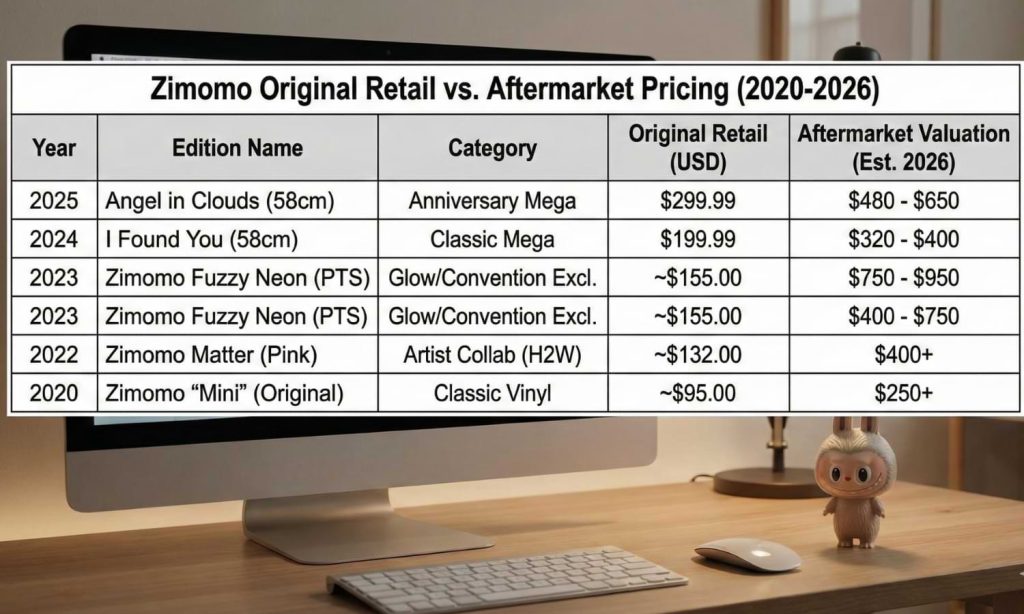
A common source of confusion among new collectors involves conflating launch retail cost with current aftermarket pricing.
What Retail Price Represents
Original retail reflects the amount charged by the brand or authorized retailers at the moment of release. This figure remains fixed for the duration of the official sales window, though it may vary slightly between retailers based on individual markup policies.
For example, a Zimomo limited edition that retailed for $95 maintains that as its historical launch cost regardless of what occurs in secondary markets.
What Aftermarket Price Represents
Aftermarket value reflects what collectors pay through secondary channels after official retail availability ends:
- Resale platforms (eBay, Mercari, specialized forums)
- Collector-to-collector private sales
- Consignment through specialty shops
- Online marketplace listings
These values fluctuate based on:
- Supply availability: Sold-out releases with no restock potential
- Collector demand: Popularity of specific colorways or collaborations
- Condition factors: MISB (mint in sealed box) vs opened/displayed
- Market sentiment: Trending interest in specific designers or toy lines
The Value Disconnect
As of 2025-2026, numerous Zimomo limited releases trade at 2-5x original retail in aftermarket channels:
- Zimomo x Artist Collab ($95 retail to $350-500 aftermarket)
- Zimomo Clear Edition ($100 retail to $280-400 aftermarket)
- Zimomo 5th Anniversary ($180 retail to $450-700 aftermarket)
This disconnect exists because authorized retail allocation cannot meet ongoing collector demand after sellout. Buyers are willing to pay premiums for access figures immediately rather than hoping for restocks that may never materialize.
Why This Distinction Matters
Understanding the difference between launch cost and current market value prevents several analytical errors:
- Overestimating acquisition cost: A figure’s aftermarket value doesn’t reflect what early buyers paid
- Misunderstanding appreciation: Secondary premiums may reflect temporary hype rather than sustainable value
- Investment fallacies: Treating art toys as financial assets ignores volatility, storage costs, and market unpredictability
Why Knowing Original Retail Matters
Understanding launch pricing serves practical purposes beyond historical curiosity.
Evaluating Fair Aftermarket Offers
Collectors armed with retail cost knowledge can better assess secondary market listings. A used Zimomo figure priced at $200 (3x its $65 retail) may reflect current demand, but the buyer understands they’re paying a significant premium over what the figure originally cost.
Identifying Overpriced Listings
Original cost data helps spot inflated pricing. If a standard release that retailed for $55 appears at $300 in secondary markets without extraordinary provenance (signed by the artist, ultra-rare variant), the premium likely exceeds market norms.
Setting Collection Budgets
First-time buyers often underestimate acquisition costs. A limited edition’s $95 retail price becomes $350 through aftermarket channels. Historical pricing clarifies realistic entry points for specific releases.
Understanding Brand Value Proposition
Comparing retail costs across different designer toy brands helps collectors assess relative value. Zimomo’s $45-75 standard release pricing positions it against competitors like Popmart ($15-35), 52Toys ($40-80), and higher-tier brands like Medicom ($80-200+).
Common Misconceptions About Designer Toy Pricing
“All Limited Editions Appreciate”
Original retail cost doesn’t guarantee aftermarket appreciation. Many limited releases trade at or below launch pricing in secondary markets, particularly if collector interest wanes or production quality disappoints.
Appreciation depends on sustained demand, design appeal, and brand trajectory, not simply on limited quantity.
“Retail Price = Fair Resale Price”
A figure’s launch cost provides context but doesn’t determine appropriate aftermarket value. Discontinued releases with strong collector demand legitimately command premiums, while readily available standard releases may trade below retail.
Fair resale reflects current supply-demand dynamics, not historical cost alone.
“Higher Retail Means Better Quality”
Launch pricing correlates with production factors (edition size, materials, finishes) but doesn’t guarantee superior craftsmanship or design. Some standard releases at $55 retail demonstrate better paint application than premium $180 releases with production issues.
Collectors should evaluate each release on individual merit rather than assuming cost equals quality.
“Brand Sets Aftermarket Prices”
Zimomo and similar brands establish retail costs for authorized sales but exert no control over secondary market pricing. Aftermarket values emerge from collector-driven supply and demand rather than manufacturer influence.
Factors Influencing Zimomo Retail Cost
Understanding what drives launch pricing helps collectors contextualize cost differences between releases.
Material Composition
- Standard Vinyl: $45-65 retail range for solid vinyl rotocasting
- Soft Vinyl: $55-75 for flexible, squeezable variants
- Resin Construction: $80-120 for harder material with sharper detail
- Mixed Media: $100-150+ for figures combining multiple materials
Surface Treatments
- Standard Paint: Included in base retail
- Metallic Finishes: +$15-30 premium over standard
- Glow-in-Dark: +$10-20 for phosphorescent materials
- Flocking: +$15-25 for fuzzy texture application
- Clear/Translucent: +$20-40 for transparent resin casting
Scale and Complexity
- Mini (3″ scale): $28-38 retail
- Standard (6-8″ scale): $45-75 retail
- Deluxe (10-12″ scale): $120-180 retail
- Multiple Components: +$20-50 for swap-out parts or accessories
Regional Availability and Pricing
Zimomo releases through multiple distribution channels, each with distinct pricing characteristics.
Direct Brand Sales
Official website and brand-operated channels typically offer suggested retail without additional markup. However, limited quantities and regional shipping restrictions may apply.
Authorized Retailers
Specialty toy shops, design boutiques, and online collectible retailers purchase wholesale and apply standard retail margins (typically 40-50% above wholesale cost).
Convention Exclusives
Event-specific releases sold at pop culture conventions, designer toy festivals, and art shows may include premiums for limited availability and event exclusivity.
International Markets
Collectors outside primary distribution regions face additional costs:
- Import duties (varies by country, typically 5-20%)
- International shipping (adds $15-40 to acquisition cost)
- Currency exchange fluctuations
- Proxy purchasing fees (for region-locked releases)
Frequently Asked Questions
What was the original price of Zimomo figures?
Standard Zimomo releases typically retail between $45-75 USD at launch. Limited editions range $80-220 depending on edition size, materials, and special features. Mini variants start around $28-38.
Does Zimomo have an official MSRP?
Zimomo establishes suggested retail pricing for authorized dealers. However, individual retailers may apply different markups, and regional variations exist based on import costs and local market conditions.
Are Zimomo prices the same worldwide?
No. Retail costs vary by region based on currency exchange rates, import duties, distribution agreements, and local retailer margins. Asia-Pacific markets often see lower base pricing than North American or European markets. If you are a Zimomo lover, you should also love labubu, its price and features are almost same.
Why do some Zimomo figures cost more than others?
Pricing reflects production factors including edition size, material composition, surface treatments, scale, and licensing arrangements. Limited runs with special finishes command higher retail than standard colorway releases.
What’s the difference between retail and aftermarket value?
Retail price is what authorized sellers charge at launch. Aftermarket value is what collectors pay in secondary markets after sellout. These can differ significantly based on demand and availability.
Do Zimomo figures increase in value?
Some limited releases appreciate in aftermarket value while others trade at or below retail. Appreciation depends on sustained collector demand, design appeal, and scarcity. Treat as collectibles, not investments.
Where can I find original retail prices for older releases?
Brand social media archives, collector forums, retail announcement posts, and specialized toy databases often document historical launch pricing. Not all releases have publicly confirmed retail values.
Are higher-priced releases of better quality?
Not necessarily. Cost reflects production expenses and edition size more than quality. Some standard releases demonstrate superior paint application and design execution compared to premium limited editions.