
Consumer markets no longer follow predictable pricing curves. Instead of choosing from a linear spectrum of good, better, and best options, shoppers increasingly cluster at opposite ends: bargain-hunting for functional necessities while simultaneously spending more on premium purchases they deem worth the investment.
This polarization, known as value bifurcation, reflects fundamental shifts in how income inequality, inflation, and changing value perception reshape purchasing decisions. Traditional mid-market brands, once positioned as the sensible compromise, now face erosion from both directions as consumers make increasingly binary choices based on whether a purchase serves purely functional needs or emotional and aspirational ones.

Understanding Value Bifurcation
What is Value Bifurcation?
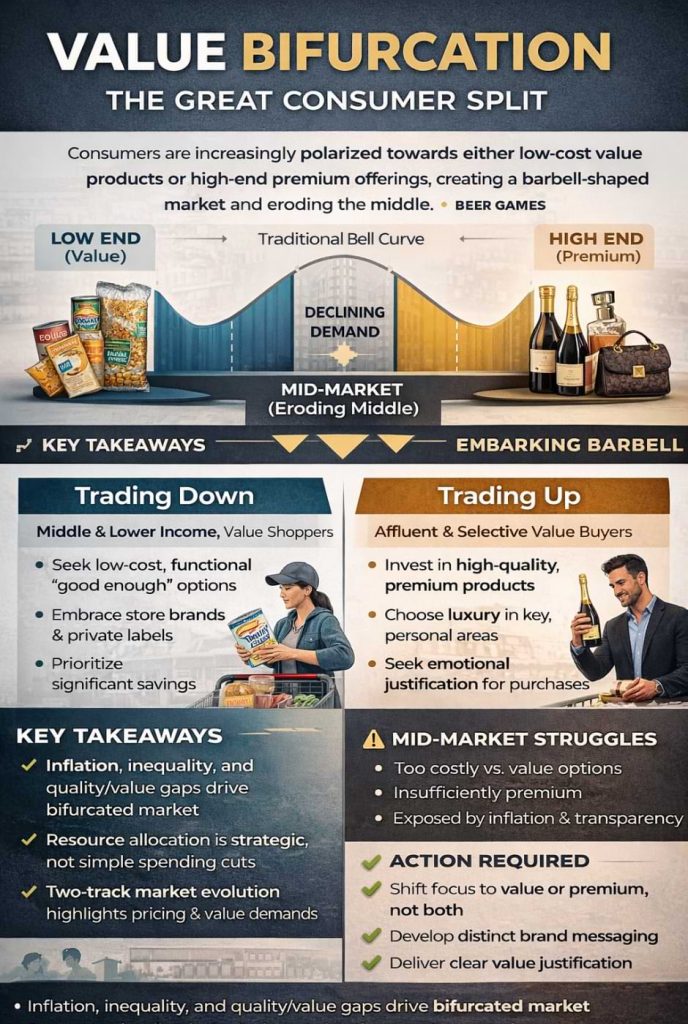
Value bifurcation is a market trend where consumer spending splits between low-cost value options and high-end premium products, while demand for mid-priced offerings declines. This creates a barbell-shaped demand curve rather than the traditional bell curve centered around mid-market products.
Why Is Value Bifurcation Happening?
- Inflation-driven price sensitivity: Rising costs force consumers to scrutinize every purchase, eliminating mid-tier options that fail to justify their premium over budget alternatives.
- Income and wealth divergence: Growing economic inequality creates distinct consumer segments with fundamentally different purchasing constraints and priorities.
- Stronger emotional justification for premium purchases: When budgets tighten, consumers concentrate discretionary spending on items they can rationalize as investments in quality, experience, or personal identity.
- Functional trade-offs in budget buying: Improved quality in value brands reduces the performance gap, making “good enough” genuinely acceptable for many product categories.
The Consumer Market Is Splitting
The concept of an “average buyer” increasingly fails to describe real consumer behavior. Market demand has fragmented into distinct purchasing philosophies that respond to completely different value propositions.
A household might buy store-brand paper towels while splurging on organic coffee, or choose a budget smartphone while investing in premium headphones. This isn’t inconsistent behavior, it reflects strategic resource allocation based on category-specific priorities.
Retail data consistently shows this pattern. Discount retailers and dollar stores report strong traffic alongside luxury brands posting record quarters, while mid-tier department stores struggle with declining foot traffic and margin pressure. E-commerce platforms see similar dynamics: private label basics sell in high volumes while premium specialty products command loyalty and higher average order values. The middle ground, products positioned as “better than basic but not quite premium,” faces intensifying pressure to justify their existence.
This split creates two fundamentally different customer expectations. Value-seeking buyers prioritize price efficiency and functional adequacy, viewing brand names as unnecessary overhead. Premium buyers seek perceived value through quality, experience, status, or emotional satisfaction, willing to pay significantly more when they believe the difference is meaningful. Mid-market brands caught between these expectations often deliver neither the lowest price nor the strongest emotional appeal, leaving them vulnerable from both directions.
Trading Down: Value-Seeking Behavior
Who Is Trading Down and Why?
Trading down concentrates among middle-income households facing sustained cost-of-living pressures, younger consumers prioritizing experiences over possessions, and families reallocating budgets toward non-negotiable expenses like housing, childcare, and healthcare. These consumers haven’t necessarily lost purchasing power entirely, but they’ve become more deliberate about where they accept quality trade-offs.
The motivations reflect practical economics rather than brand rejection. When a private label product performs adequately at 40% less cost, the branded alternative must demonstrate tangible benefits to justify the premium. As store brands improve quality and shed their stigma, functional sufficiency increasingly trumps brand heritage.
- Functional sufficiency over brand loyalty: Consumers evaluate whether branded products deliver measurably better performance, often concluding they don’t for commodity categories.
- Private labels and generics gaining trust: Retailers invest in quality improvements and packaging design, narrowing the perceived gap with national brands.
- Willingness to sacrifice aesthetics or features: Value buyers accept simpler packaging, fewer product variants, and basic functionality in exchange for significant savings.
- Strategic category decisions: Same households trade down in low-involvement categories while protecting spending in areas they care about personally.
| Promotions, necessity, and convenience | What Consumers Prioritize |
|---|---|
| Price | Lowest acceptable cost for functional performance |
| Brand | Secondary to function; reputation matters only if it affects performance |
| Quality | “Good enough” threshold; diminishing returns beyond basic adequacy |
| Loyalty | Easily switchable based on price and availability |
| Purchase Trigger | Promotions, necessity, convenience |
Trading Up: Premiumization
Why Some Consumers Are Spending More, Not Less
Paradoxically, the same economic pressures driving trading down simultaneously fuel premiumization. Higher-income consumers with insulated finances continue trading up by choice, but critically, even budget-constrained shoppers selectively upgrade in categories they prioritize emotionally. This isn’t about wealth alone; it’s about perceived value and psychological justification.
The premium segment thrives on differentiation. While value brands compete primarily on price, premium brands compete on perceived worth: superior materials, craftsmanship, brand story, sustainability credentials, or experiential value. Consumers rationalize higher spending as investment rather than expense, particularly when making fewer, more considered purchases.
The “buy less, buy better” mentality reflects both environmental consciousness and economic pragmatism. A premium product that lasts three times longer than a budget alternative might cost twice as much but deliver better long-term value. This calculation extends beyond durability to emotional satisfaction; the daily pleasure of using something well-made can justify its premium to consumers who frame purchases as enhancing quality of life rather than mere consumption.
Premium Buyer Mindset
- “Buy once, buy better” philosophy: Initial cost matters less than lifetime value, reducing the appeal of frequent replacement cycles.
- Willingness to pay for trust and longevity: Brand reputation serves as risk reduction, with established names commanding premiums for perceived reliability.
- Preference for differentiated, story-driven brands: Products tied to clear values, heritage, or craftsmanship narratives create emotional connections that transcend functional benefits.
- Status and identity signaling: Certain categories serve social and self-expression functions where premium positioning aligns with personal identity.
- Selective indulgence strategy: Even budget-conscious consumers allocate resources toward premium purchases in personally meaningful categories while economizing elsewhere.
Why the Middle Is Disappearing?
Mid-Market Erosion Under Pressure
Mid-priced brands face an uncomfortable reality: they’re too expensive to compete with value alternatives on price, yet insufficiently differentiated to compete with premium brands on perceived worth. This positioning worked when consumers made linear price-quality trade-offs, but bifurcation exposes the middle ground as a no-man’s-land between two dominant strategies.
The problem intensifies with pricing transparency. When consumers can easily compare original prices across retailers, mid-tier brands can’t hide behind opaque pricing or artificial discounting. Tools like reverse discount calculators reveal the actual cost structures behind promotional pricing, making it harder to maintain the illusion of superior value through perpetual sales.
Inflation particularly damages mid-market positioning. When a brand priced 30% above value alternatives raises prices to maintain margins, the gap widens to 40% or 50%, making the premium harder to justify. Meanwhile, premium brands maintain pricing power because their customers are less price-sensitive and more emotionally invested. Mid-tier brands can’t win a race to the bottom against value competitors, nor can they command premium pricing without substantial differentiation.
The positioning ambiguity proves fatal. Mid-market brands often lack a clear answer to “Why should I pay more than the budget option?” and “Why shouldn’t I just buy the premium version?” When brands can’t articulate their value proposition beyond “decent quality at a reasonable price,” they struggle to maintain relevance as consumers polarize toward clear, unambiguous value statements.
| Segment | Competitive Advantage | Risk Level |
|---|---|---|
| Value | Price efficiency, functional adequacy, broad accessibility | Low clear positioning, stable demand |
| Premium | Emotional and perceived value, differentiation, brand loyalty | Low loyal customer base, pricing power |
| Middle | Blurred positioning between price and quality | High compressed from both sides |
Industry Impact: Retail and E-commerce
Retail assortment strategies increasingly reflect bifurcation realities. Smart retailers expand both value-oriented private labels and curated premium selections while reducing mid-tier branded inventory. This “barbell” merchandising approach acknowledges that shelf space dedicated to mid-market products generates lower turns and weaker margins than either extreme.
Private label evolution drives much of this shift. Retailers once positioned store brands as cheap alternatives, but now develop tiered private label portfolios: economy lines competing on price, premium private brands rivaling national names on quality, and specialty lines targeting specific values like sustainability or local sourcing. This strategy captures value-seeking shoppers while building loyalty through exclusive products unavailable elsewhere.
Direct-to-consumer brands exploit bifurcation by positioning themselves as premium alternatives at mid-tier prices, claiming to eliminate “retail markup” while emphasizing quality and brand story. This messaging appeals to consumers seeking premium attributes without premium price tags, though success depends on actually delivering differentiated value rather than merely positioning.
E-commerce platforms amplify bifurcation through algorithmic merchandising that surfaces both budget and premium options prominently while burying middle-tier alternatives. Price-sorting favors value options, while recommendation engines promote highly rated premium products. The middle struggles for visibility in both contexts.
Industry Impact: Consumer Goods (CPG)
Consumer packaged goods manufacturers face particularly acute bifurcation pressure. Private labels capture value-seeking shoppers across categories from groceries to personal care, growing share especially during inflationary periods. National brands respond through innovation and premiumization, launching premium line extensions with functional benefits, sustainability credentials, or experiential differentiation.
Shrinkflation backlash illustrates the risk of trying to maintain mid-market positioning through hidden price increases. When brands reduce package sizes while maintaining prices, consumers notice and feel deceived, driving them toward either honest value brands or premium alternatives perceived as transparent. This dynamic undermines the trust mid-tier brands need to maintain their positioning.
Functional premium products, enhanced formulations, cleaner ingredients, and sustainability attributes allow CPG brands to trade up within categories. An organic, non-GMO version of a conventional product commands significant premiums from consumers who prioritize those attributes, effectively creating premium and value tiers within a single brand portfolio. The conventional mid-tier version increasingly becomes the squeezed middle.
Industry Impact: Automotive and Durable Goods
Automotive markets demonstrate bifurcation clearly. Economy brands and models serve price-conscious buyers prioritizing transportation utility, while luxury brands thrive selling aspirational products with strong emotional appeal and status signaling. Mid-market sedans and family vehicles face declining demand as consumers gravitate toward either affordable compacts and entry SUVs or premium vehicles justified as long-term investments.
Electric vehicles accelerate this pattern. New EV brands position themselves as premium products competing on technology and environmental values, commanding prices that reflect this positioning. Meanwhile, value-oriented manufacturers develop affordable EVs targeting price-sensitive early adopters. The missing piece is a robust mid-market EV segment; most offerings clearly fall into economy or premium tiers.
Durable goods generally follow similar patterns. In appliances, basic functionality from value brands satisfies most needs, while premium brands differentiate through design, smart features, or professional-grade performance. Furniture, electronics, and home goods show the same bifurcation: Ikea and premium boutiques thrive while mid-tier furniture stores struggle; budget electronics and high-end devices dominate while mid-range models languish.
How Brands Win in a Bifurcated Market
Strategic Positioning for Value or Premium
Surviving bifurcation requires brands to make deliberate choices about which segment to serve, then commit fully to that positioning. Attempting to serve both extremes with the same product line typically fails; the strategies, messaging, and operational models differ fundamentally between value and premium approaches.
For value positioning: Success demands operational excellence in cost management, supply chain efficiency, and price competitiveness. Messaging emphasizes functional performance, reliability, and smart spending. Brands must resist feature creep and premium aspirations that increase costs without delivering commensurate value to price-sensitive customers.
For premium positioning: Differentiation becomes paramount. Superior materials, craftsmanship, design, sustainability, brand heritage, or experiential value must be tangible and communicable. Premium brands need strong narratives explaining why their products warrant higher prices, stories about sourcing, production methods, longevity, or values that resonate emotionally with target buyers.
Implementation Strategies
- Clear value communication: Articulate precisely why your product deserves its price point, whether through lowest-cost efficiency or premium differentiation attributes.
- Strong “good, better, best” frameworks: If maintaining multiple tiers, ensure each has distinct positioning and target customer rather than creating confusing overlap.
- Separate messaging for value and premium audiences: Don’t try to appeal to both segments with the same campaign; their decision criteria and emotional triggers differ fundamentally.
- Avoid serving both extremes with the same product: Portfolio strategy might include both value and premium brands, but they should be marketed separately with distinct identities.
- Embrace category-specific positioning: Accept that your brand might be premium in one category and value in another based on competitive dynamics and core competencies.
Consumer Psychology: Decision-Making Under Bifurcation
Understanding bifurcation requires examining the psychological mechanisms driving polarized purchasing. Economic stress doesn’t simply reduce spending uniformly; it fundamentally changes how consumers evaluate trade-offs and justify decisions.
Loss aversion intensifies: Behavioral economics shows people feel losses more acutely than equivalent gains. When budgets tighten, avoiding “wasted” money on mid-tier products that don’t deliver clear value becomes paramount. Consumers prefer the safety of proven value brands or the satisfaction of premium purchases over the ambiguous middle.
Justification logic shifts: Premium purchases require emotional justification (“I deserve this,” “This will last,” “This aligns with my values”), while value purchases need only functional justification (“This does what I need”). Mid-tier products often fail at being neither cheap enough to be obviously smart nor special enough to feel justified.
Category involvement matters: Consumers apply different decision frameworks across categories based on personal interest and expertise. High-involvement categories trigger emotional, premium-oriented decisions, while low-involvement categories default to functional, value-oriented choices. The same person shops completely differently for coffee versus paper towels.
Perceived value exceeds objective value: What matters isn’t actual quality differences but perceived gaps. Premium brands succeed by creating belief in meaningful superiority, even when blind tests might show smaller differences. Value brands succeed by demonstrating adequacy, even if their products outperform expectations.
Is Value Bifurcation Temporary or Structural?
Long-Term Market Evolution
Evidence suggests bifurcation represents structural change rather than a temporary economic response. Even if inflation moderates, several underlying drivers appear durable: persistent income inequality, increased price transparency through technology, and evolving consumer sophistication in distinguishing meaningful differentiation from marketing claims.
Income inequality trajectories in developed economies show little sign of reversal. As wealth concentrates at the top while median incomes stagnate, consumer markets naturally split between segments with different purchasing power and priorities. This creates sustained demand for both value and luxury tiers while squeezing the middle that once served a larger middle class.
Digital tools increase pricing transparency, making it harder for mid-tier brands to maintain ambiguous positioning. Consumers easily compare prices, read reviews, and access information that reveals whether premium pricing reflects genuine differentiation or marketing overhead. This transparency favors honest value positioning and substantiated premium claims while exposing hollow mid-market promises.
Brand trust erosion affects the middle disproportionately. Premium brands build loyalty through consistent quality and emotional connection. Value brands earn trust through reliable functionality at low prices. Mid-tier brands often built equity on marketing rather than product superiority, and that equity degrades as consumers become more skeptical and information-empowered.
Environmental and sustainability concerns potentially reinforce bifurcation. Conscious consumers increasingly favor either premium sustainable options or frugal minimalism over mid-tier consumption. The future might feature even starker choices between buying less but better or choosing maximally efficient value options.
Key Takeaways
- Value bifurcation describes the consumer trend of polarization toward either low-cost value products or high-end premium offerings, with declining demand for mid-priced alternatives. This creates a barbell-shaped market rather than a traditional bell curve.
- Bifurcation accelerates due to inflation, income inequality, improved value brand quality, and stronger emotional justification requirements for premium spending. Economic pressure forces strategic resource allocation rather than uniform spending cuts.
- Trading down concentrates among middle-income households and value-conscious buyers who prioritize functional sufficiency, embrace private labels, and accept quality trade-offs for significant savings. Trading up persists among both affluent consumers and budget-conscious shoppers who selectively invest in premium products within personally meaningful categories.
- Mid-market brands struggle because they’re too expensive to compete with value options on price, yet insufficiently differentiated to justify premiums versus truly premium alternatives. Inflation and price transparency particularly expose weak mid-tier positioning.
- Brands must choose value or premium positioning and commit fully attempting to serve both segments with the same products, typically fails. Success requires clear value communication, distinct messaging for different audiences, and authentic differentiation in chosen positioning.
Navigating Bifurcated Markets
Value bifurcation represents a fundamental restructuring of consumer markets rather than temporary economic turbulence. Brands built on mid-market positioning face existential challenges requiring strategic reinvention: moving decisively toward value or premium, or developing separate brands serving distinct segments.
For consumers, bifurcation creates both challenges and opportunities. Budgets require more deliberate allocation, but clearer market segmentation makes choices more transparent. The key lies in recognizing personal priorities, identifying categories where value suffices, and others where premium investment delivers meaningful returns.
Understanding these dynamics helps both brands and consumers navigate markets increasingly defined by extremes. The middle isn’t merely shrinking, it’s being redefined as the space between two dominant strategies, each with compelling logic but fundamentally different value propositions. Success requires choosing which game to play rather than trying to compete in both simultaneously.