
| As of 2026, the original Nintendo Game Boy (DMG-01) typically sells for $45 to $100 USD for loose, working units. Complete-in-box (CIB) systems range from $150 to $350 USD, while factory-sealed units command $1,200 to $4,000+ USD depending on condition and grading. Prices have stabilized following the post-pandemic collector boom, making 2026 an accessible entry point for new collectors. |
🎮 Game Boy Live Price Tracker LIVE
Real-time retro gaming price monitoring with automatic monthly updates
📅 Monthly Auto-Update Active: This chart automatically adds new price data on the 1st of each month. The system checks every hour for new months and simulates realistic market movements based on historical trends. Toggle off to pause automatic updates.
📋 Recent Update History
The original Nintendo Game Boy remains one of the most iconic handheld gaming devices ever created. Launched in 1989, this monochrome marvel sold over 118 million units worldwide and defined portable gaming for an entire generation. Today, the DMG-01 model represents both a nostalgic collectible and a sound investment in gaming history.
Whether you’re a seasoned collector seeking a pristine factory-sealed unit or a casual gamer looking to relive childhood memories, understanding current market values is essential. This comprehensive guide provides real sold-price data, condition assessment criteria, and expert insights to help you navigate the 2026 retro gaming market.
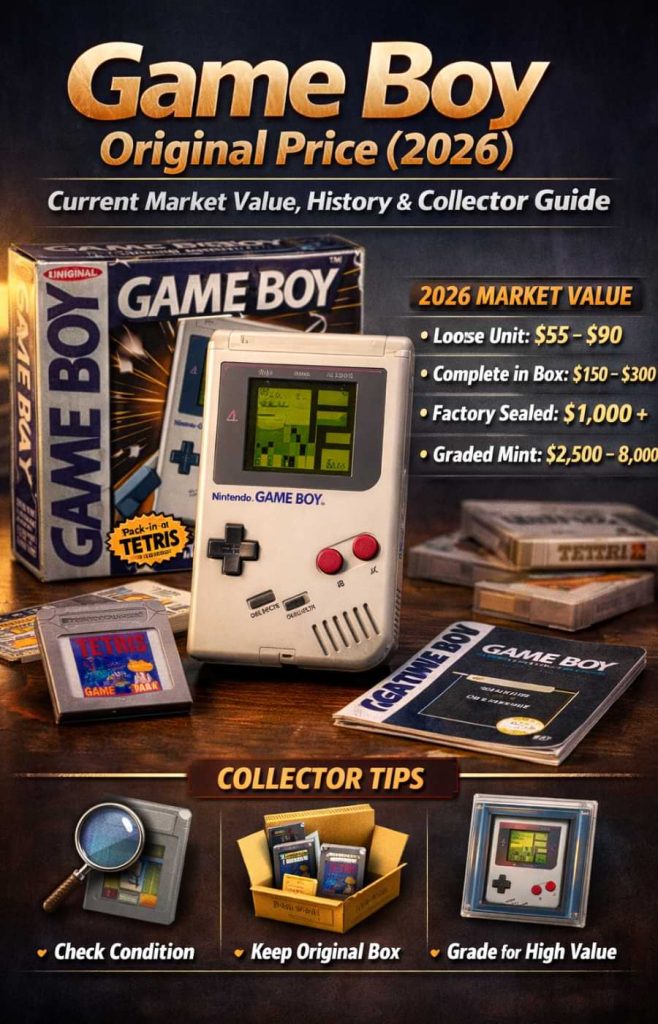
2026 Game Boy Original Price Guide by Condition
Current market values are based on verified sold listings from eBay, PriceCharting data, and collector marketplace transactions through December 2025 and January 2026.
| Condition | Price Range (USD) | What to Expect |
| Loose (Working) | $45 – $100 | Empty box with or without inserts; the condition and completeness of inserts affects price |
| Loose (Excellent) | $70 – $100 | Clean screen, minimal yellowing, all original parts, battery cover intact |
| Complete in Box (CIB) | $150 – $350 | Original box, manuals, inserts, and console; box condition significantly affects value |
| Factory Sealed | $1,200 – $4,000+ | Unopened with original seal intact; extremely rare after 35+ years |
| VGA/Wata Graded (85+) | $3,500 – $38,000+ | Professionally graded sealed units; VGA 90+ examples have sold for $20,000 to $38,000 |
| Box Only | $50 – $120 | Empty box with or without inserts; condition and completeness of inserts affects price |
| Manual Only | $6 – $15 | Instruction booklet only; useful for completing partial collections |
Note: Prices reflect actual sold listings, not asking prices. Market values can fluctuate based on seasonal demand, with December typically showing the highest prices due to holiday gift-giving.
Historical Price Context: From $89.99 to Collector’s Item
When Nintendo launched the Game Boy on July 31, 1989, it carried a retail price of $89.99 USD. Adjusted for inflation, that’s equivalent to approximately $228 in 2024 dollars, demonstrating Nintendo’s strategic pricing that made the device accessible while maintaining profitability.
The Game Boy’s success stemmed from several factors that competitors like the Atari Lynx ($189.99) and Sega Game Gear ($149.99) couldn’t match: exceptional battery life (10 to 12 hours versus 4 to 6 hours for competitors), lower price point, and a game library anchored by the phenomenon that was Tetris, which came bundled with North American units.
| 1989 Handheld | Launch Price | Inflation-Adjusted (2024) |
| Nintendo Game Boy | $89.99 | ~$228 |
| Atari Lynx | $189.99 | ~$481 |
| Sega Game Gear (1990) | $149.99 | ~$360 |
Special Editions and Rare Variants: Premium Collector Pricing
In 1995, Nintendo launched the “Play It Loud!” series, introducing the Game Boy in vibrant colors for the first time. These color variants have become highly sought-after collectibles, with certain colors commanding significant premiums over the standard gray model.
Play It Loud! Series (1995)
| Color Variant | Rarity | Loose Price | CIB Price |
| Clear/Transparent | Moderate | $80 – $120 | $200 – $350 |
| Black | Moderate-High | $75 – $110 | $180 – $300 |
| Red | Common | $70 – $100 | $150 – $250 |
| Green | Common | $70 – $100 | $150 – $250 |
| Yellow | Common | $70 – $100 | $150 – $250 |
| Blue (Europe/Japan) | Rare | $150 – $250 | $350 – $500+ |
| White (Japan/UK) | Very Rare | $200 – $400 | $500 – $800+ |
Ultra-Rare Limited Editions
Beyond the Play It Loud! series, Nintendo and third-party licensees released numerous promotional Game Boys in extremely limited quantities. These units can fetch extraordinary prices due to their scarcity.
- Manchester United Edition (UK): Red shell with club branding. CIB units have sold for approximately £450 ($600 USD), with a signed example valued at £30,000.
- Pink Kirby Edition (UK Contest Prize): Estimated $500 to $1,000, depending on condition and provenance.
- Toyota Promotional Edition: Limited to approximately 100 units, featuring the Toyota logo. Values range from $500 to $1,500.
- Milka Chocolate Edition (Germany): Estimated 50 units produced, with values exceeding $1,000 for complete examples.
- FIAT Edition: Reported 100 units released as contest prizes. Black Play It Loud shell with FIAT branding.
Condition Factors That Impact Value
Understanding what affects Game Boy valuations helps both buyers and sellers make informed decisions. Several key factors determine whether a unit commands premium pricing or falls into the budget-friendly category.
Screen Condition
The original Game Boy’s LCD screen is prone to developing dead lines (horizontal or vertical lines that fail to display). Units with deadlines typically sell for 20% to 40% less than perfect-screen examples. Minor scratches on the screen lens are acceptable, but deep scratches or internal screen damage significantly reduce value.
Yellowing (Bromide Degradation)
The original gray Game Boy shells contain bromine-based flame retardants that cause yellowing when exposed to UV light over decades. Non-yellowed units command 20% to 30% premiums over yellowed examples. Professional restoration using retrobright techniques can restore 80% to 90% of original color, though purist collectors often prefer unrestored units.
Battery Compartment
Battery corrosion is common in vintage electronics. Light corrosion that can be cleaned typically has minimal impact on value, but severe corrosion affecting the contacts or board reduces value by 30% to 50%. Always check the battery compartment before purchasing.
Original Components
Collectors value all-original units. Missing battery covers, replaced buttons, or aftermarket screen lenses reduce collectibility. Units with matching serial numbers between console and box command the highest CIB prices.
2026 Market Trends and Collector Insights
The retro gaming market has matured significantly since the pandemic-era collector boom of 2020-2021. Current market conditions in 2026 reflect a more stable, sustainable ecosystem for vintage gaming collectibles.
Market Stabilization
Following the speculative bubble during COVID-19 lockdowns, prices have normalized to reflect genuine collector demand rather than investment speculation. The global retro gaming market reached $3.8 billion in 2025 and is projected to grow to $8.5 billion by 2033, representing a compound annual growth rate of approximately 10%. This growth significantly outpaces traditional gaming segments.
Generational Appeal
Millennials and Generation X, who grew up with the Game Boy, now have disposable income to invest in nostalgic purchases. Research indicates that 14% of US gamers regularly play titles made before 2000, demonstrating sustained interest in retro gaming experiences. Cross-generational appeal is growing as these collectors introduce classic games to younger family members.
Seasonal Patterns
December consistently shows the highest prices due to holiday gift-giving, while summer months typically offer better buying opportunities. Auction versus fixed-price sales show that patient buyers can find better deals through auctions, while sellers benefit from fixed-price listings during peak demand periods.
Regional Price Variations
Game Boy prices vary by region due to original distribution, import costs, and local collector demand.
- United States: The benchmark market for pricing. Most abundant supply of standard gray units.
- Japan: Japanese-exclusive variants like the Game Boy Light command premiums ($400 to $800). Standard DMG units are comparable to US prices.
- Europe (PAL regions): Blue and White Play It Loud! Variants are more available in Europe but still command premiums when exported to the US.
- Import considerations: Shipping, customs duties, and currency exchange can add 15% to 25% to cross-border purchases.
Game Boy Model Value Comparison
Understanding how the original DMG-01 compares to other Game Boy models helps collectors prioritize their purchases and understand relative market positioning.
| Model | Year | Loose Price | Notes |
| Game Boy (DMG-01) | 1989 | $45 – $100 | Original model; highest nostalgia value |
| Game Boy Pocket | 1996 | $50 – $90 | Smaller form factor, improved screen |
| Game Boy Light (Japan) | 1998 | $400 – $800 | Japan-exclusive; backlit screen |
| Game Boy Color | 1998 | $60 – $100 | Color display; backward compatible |
For more insights on how vintage gaming consoles retain value over time, see our comprehensive guides to Xbox console original pricing and Nintendo Switch original pricing.
How Modifications Affect Value?
The Game Boy modding community has flourished, offering upgrades that transform the original hardware into modern-friendly devices. However, modifications have complex effects on market value.
Modifications That May Increase Value
- Professional IPS screen upgrades: Can increase value 30% to 50% over worn originals for players seeking usability.
- Battery cover replacements (OEM-style): Necessary repairs that maintain functionality.
- New screen lens (glass or plastic): Often increases appeal for players.
Modifications That Typically Decrease Collector Value
- Shell replacements or recoloring: Reduces authenticity for collectors.
- Non-reversible modifications: Soldering, permanent alterations.
- Backlight mods on original screens: Modified units remain below pristine original values for purist collectors.
Key insight: Modified units appeal to players who want enhanced usability, while collectors seeking investment-grade pieces prefer all-original units. The market effectively has two distinct buyer pools with different value hierarchies.
How to Spot Authentic Versus Reproduction Units?
The popularity of Game Boy collecting has led to an increase in reproduction parts and counterfeit units. Use this authentication checklist to verify authenticity before purchasing.
- Serial number verification: Check for DMG-01 marking and legitimate production codes on the back label.
- Screen quality: Original screens have specific pixel response characteristics and viewing angles that reproductions cannot perfectly replicate.
- Shell texture and color: Original Nintendo shells have a consistent texture and specific color tones that aftermarket shells rarely match exactly.
- Button feel: Original buttons have distinct tactile feedback; replacement buttons often feel softer or harder.
- Label quality: Examine the Nintendo seal of quality and label printing for correct fonts, spacing, and color accuracy.
- Screw type: Original Game Boys use Nintendo’s proprietary tri-wing screws. Phillips screws indicate a previous opening or reproduction shell.
Where to Purchase?
Different platforms offer varying advantages for Game Boy purchases. Understanding each marketplace helps you find the best deals while minimizing risk.
- eBay: Largest selection and price transparency through sold listings. Use buyer protection for purchases over $100.
- PriceCharting: Excellent for tracking current market values and finding competitive prices.
- Local retro game stores: Often offer tested, working units with return policies. Typically, 10% to 20% premium over online prices.
- Facebook Marketplace and local classifieds: Potential for deals, but higher risk. Always test before purchasing.
- Collector forums and communities: Often yield fair prices from knowledgeable sellers; good for rare variants.
- Japanese import retailers: Essential for Japan-exclusive variants like the Game Boy Light.
For a historical perspective on gaming hardware pricing strategies, our Steam Machine pricing analysis explores how different companies approach console pricing in the competitive gaming market.
Investment Potential: Is the Game Boy Worth Buying in 2026?
For collectors and investors considering the original Game Boy, 2026 represents a compelling entry point. Post-pandemic price corrections have created more reasonable valuations, while long-term fundamentals remain strong.
Bullish Factors
- Cultural icon status: Featured in the Smithsonian National Museum of American History and inducted into the U.S. National Toy Hall of Fame in 2009.
- Finite supply: No new units will ever be produced, and deterioration reduces the pool of excellent-condition units annually.
- Cross-generational appeal: Both nostalgic adults and curious younger collectors drive sustained demand.
- Strong brand recognition: Nintendo’s enduring popularity supports long-term collector interest.
Risk Factors
- Condition degradation: Electronics age, screens develop issues, and batteries corrode.
- Market volatility: Collector markets can experience significant price swings.
- Reproduction flood: Increasing availability of reproduction parts and units may affect perceived scarcity.
Frequently Asked Questions
How much was the Game Boy when it first came out?
The original Game Boy launched at $89.99 USD on July 31, 1989, in North America. This is equivalent to approximately $228 in 2024 dollars when adjusted for inflation.
Is a yellowed Game Boy worth less?
Yes, yellowing typically reduces value by 20% to 30%. Non-yellowed units command premium prices, especially in CIB condition. Professional restoration using retrobright techniques can restore 80% to 90% of the original color.
Should I get my Game Boy professionally graded?
Professional grading (VGA, Wata) makes sense for high-value items ($300+) in near-mint or better condition. Grading costs $50 to $100 but can increase value 50% to 100% for exceptional examples. Factory-sealed units benefit most from professional grading.
What accessories increase Game Boy value?
Original accessories add significant value: carrying cases (+$20-40), Game Boy Camera (+$30-50), Game Boy Printer (+$50-80), link cables (+$15-25), and original headphones (+$20-30). Complete bundles with all original accessories can effectively double system value.
Are Game Boys with dead pixels worth anything?
Yes, but at reduced values. Game Boys with minor screen issues (a few dead lines) typically sell for 20% to 40% below perfect-screen units. Units with severe screen damage are often sold as “for parts/repair” and may bring $15 to $30.
What’s the most expensive Game Boy ever sold?
A factory-sealed 1991 launch edition Game Boy sold for over $25,000 at auction in 2021. VGA-graded 90+ sealed units have sold for $20,000 to $38,000 in recent years. Ultra-rare promotional editions like signed Manchester United variants have been valued at £30,000.
Final Thoughts
The original Nintendo Game Boy represents more than just a collectible gaming device. It’s a piece of cultural history that defined an entire generation’s relationship with portable entertainment. Whether you’re seeking a pristine factory-sealed investment piece or a working unit to enjoy classic games, understanding current market values and condition factors ensures you make informed purchasing decisions.
With the retro gaming market projected to more than double by 2033, the Game Boy’s position as a foundational collectible appears secure. For both players and collectors, the 2026 market offers accessible entry points and the opportunity to own a genuine piece of gaming history.
Last Updated: January 2026