
| The original Air Jordan 1 retailed for $65 USD when it launched in 1985. As of 2026, authentic 1985 Air Jordan 1 “Chicago” originals typically resell for $8,000 to $25,000 USD, depending on condition, size, and provenance. Game-worn pairs signed by Michael Jordan have sold at auction for $200,000 to $672,000, while museum-grade deadstock examples with original boxes command the highest premiums in the collector market. |
🏀 Air Jordan Live Price Tracker LIVE
Real-time sneaker market monitoring with automatic monthly updates • 1985-2026
👟 Monthly Auto-Update Active: This chart automatically adds new price data on the 1st of each month. The system tracks retail releases and average resale values across iconic Air Jordan models. Prices simulate realistic market movements based on hype cycles, limited releases, and collector demand.
📋 Recent Update History
No sneaker has shaped athletic footwear culture quite like the Air Jordan 1. When Nike released Michael Jordan’s signature shoe on April 1, 1985, they unknowingly launched what would become the most influential sneaker line in history. That original $65 price tag has since transformed into valuations reaching six figures for pristine examples, making the Air Jordan 1 not just a piece of sports memorabilia but a legitimate alternative asset class.
This comprehensive guide traces the Air Jordan’s journey from controversial NBA debut to coveted collector’s item, providing verified pricing data, authentication guidance, and market insights for anyone looking to understand or invest in these cultural artifacts.
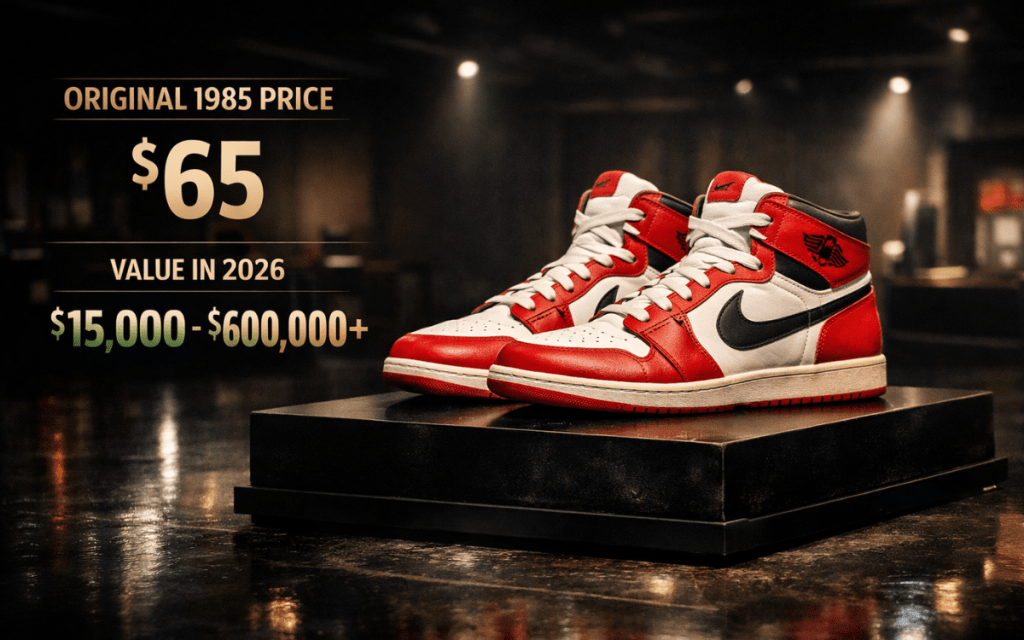
The $65 Shoe That Changed Everything: 1985 Launch
When Peter Moore, Nike’s creative director, designed the first Air Jordan, he created something the sneaker world had never seen. The high-top leather basketball shoe retailed at $65, a premium price point that positioned it squarely in the luxury athletic footwear segment for its era. Adjusted for inflation, that 1985 price equates to approximately $185 in 2026 dollars.
Nike initially projected just $3 million in Air Jordan sales. By the end of 1985, the brand had generated over $126 million in revenue from the line. The shoe’s success stemmed from multiple factors: Jordan’s explosive rookie performance, the infamous NBA “ban” controversy surrounding the black and red colorway, and Nike’s $20 million marketing campaign that was unprecedented for a rookie athlete at the time.
1985 Sneaker Market Context
| 1985 Sneaker | Retail Price | 2026 Equivalent |
| Air Jordan 1 (Nike) | $65 | ~$185 |
| Converse Weapon | $55-60 | ~$160 |
| Average Basketball Shoe | $30-45 | ~$85-130 |
2026 Market Value: What Original Air Jordans Are Worth Today?
The value of authentic 1985 Air Jordan 1s varies dramatically based on condition, colorway, provenance, and whether the shoes were player-worn. Understanding these distinctions is essential for collectors and investors navigating this market.
| Category | Price Range (USD) | Visible wear, cracking, and and sole separation are common |
| 1985 Original (Worn) | $3,000 – $8,000 | Photo-matched provenance critical; signed examples command the highest prices |
| 1985 Original (Good Condition) | $8,000 – $15,000 | Light wear, intact soles, minimal cracking |
| 1985 Deadstock (No Box) | $15,000 – $25,000 | Never worn, age-related oxidation expected |
| 1985 Deadstock (With OG Box) | $25,000 – $50,000+ | Complete set, museum-grade; extremely rare |
| MJ Game-Worn (Authenticated) | $150,000 – $700,000+ | Photo-matched provenance critical; signed examples command highest prices |
| MJ Signed Player Sample | $80,000 – $200,000+ | Unworn samples in Jordan’s size; Sotheby’s estimates |
Note: Prices reflect verified auction results and authenticated marketplace sales through late 2025. The “Chicago” colorway (white, black, varsity red) consistently commands the highest premiums among original colorways.
Record-Breaking Sales: The Most Expensive Air Jordans Ever Sold
The auction market for game-worn Air Jordans has produced staggering results, particularly following ESPN’s “The Last Dance” documentary in 2020, which renewed global interest in Michael Jordan memorabilia.
- $672,000 (2020, Sotheby’s): Game-worn Air Jordan 1 “Chicago” from Jordan’s rookie season, autographed. Set the world auction record for footwear at the time.
- $560,000 (2020): Game-worn and signed Air Jordan 1 pair that helped establish sneakers as legitimate collectibles.
- $486,000 (2020): Originally given to Milwaukee Bucks trainer Mark Pfeil, later resold after documentary hype.
- $422,100 (2022, Lelands): Air Jordan 1 “Chicago” worn on November 5, 1985, believed to be the last standard AJ1 Jordan wore in an NBA game before his injury.
- $205,188 (2025, Grey Flannel): Game-worn pair from October 26, 1985 Bulls vs. Pistons rivalry game, featuring rare “double-lacing” configuration, signed by Jordan.
Understanding 1985 Originals Versus Retro Releases
One of the most critical distinctions for collectors is separating authentic 1985 originals from the numerous retro releases that followed. While retro versions can be valuable, they represent a fundamentally different category with different pricing dynamics.
Key Differences
| Feature | 1985 Original | Retro Releases |
| Tongue Tag | “Nike Air” branding | “Jumpman” logo (most releases) |
| Cut/Height | Higher ankle, OG cut | Slightly lower modern cut (varies) |
| Leather Quality | Premium, thicker leather | Varies by release year |
| Box Style | “Air Jordan” only (no numeral) | Various Jordan Brand boxes |
| 2026 Value Range | $3,000 – $50,000+ | $200 – $2,000 (most releases) |
The 2025 “Chicago” retro release marked Jordan Brand’s 40th anniversary celebration, featuring painstaking attention to recreating the original 1985 details. These modern retros retail around $180 and represent an accessible entry point for collectors who cannot justify five-figure investments in originals.
Condition Factors That Impact Value
For 40-year-old sneakers, condition assessment requires understanding how materials naturally degrade over time. What constitutes “excellent condition” for an 1985 pair differs significantly from modern sneaker standards.
Sole Oxidation and Yellowing
Original Air Jordan 1 midsoles were made with polyurethane that naturally oxidizes and yellows over decades. Some yellowing is expected and does not drastically affect value, but severe discoloration or “sole separation” (where the midsole detaches from the upper) significantly reduces prices. Deadstock pairs that were stored improperly often show worse degradation than lightly worn examples.
Leather Cracking
The premium leather used in 1985 production will show age-related cracking, particularly around flex points like the toe box and ankle collar. Minor surface cracking is acceptable for the era, while deep structural cracks that compromise wearability reduce value by 30% to 50%.
Original Components
Collectors pay premiums for complete original components: original laces (red and black were both used), intact tongue tags with “Nike Air” branding, and original insoles. Replacement parts, even period-correct ones, diminish collector value.
How to Authenticate 1985 Air Jordans?
With original Air Jordan 1s commanding five-figure prices, counterfeiting has become sophisticated. Professional authentication is essential for high-value purchases, but understanding key verification points helps collectors make informed decisions.
- Wings Logo: The embossed “Air Jordan” wings logo should be deeply pressed into the leather, not painted or screen-printed. Letters should be crisp with consistent spacing.
- Swoosh Shape: Authentic Swooshes have precise, sharp tips and smooth curves. Replicas often show fuzzy edges or incorrect proportions.
- Hourglass Silhouette: Genuine Air Jordan 1s display a distinctive hourglass shape when viewed from behind. Counterfeits typically appear too straight or bulky.
- Stitching Quality: Original stitching is uniform and precise. Look for consistent stitch length, proper thread color contrast, and double-stitch patterns on heel tabs.
- Tongue Tag: The interior tongue should have a sewn (not welded) Nike label with specific font characteristics and proper sizing information.
- “K” in Nike: On the outsole, the “K” in Nike should touch the Swoosh tail. Separation indicates a replica.
For purchases exceeding $10,000, professional authentication services like PSA, Beckett, or specialized sneaker authenticators provide documentation that protects both buyer and seller. Major auction houses, including Sotheby’s and Christie’s, employ expert authenticators for high-value sneaker sales.
Air Jordans as Alternative Investments
The transformation of Air Jordans from athletic footwear to an alternative asset class represents one of the most dramatic value appreciations in collectibles history. A $65 investment in 1985 has yielded returns that outpace traditional markets over the same period.
Return on Investment Analysis
An original 1985 “Chicago” Air Jordan 1 purchased at retail for $65 and preserved in deadstock condition would be worth approximately $20,000 to $30,000 in 2026, representing a return exceeding 30,000% over 41 years. Even accounting for inflation, this dramatically outperforms stock market indices, real estate, and most traditional investments over the same period.
Market Considerations
- Liquidity: Unlike stocks, sneakers require finding specific buyers. High-value pairs may take months to sell at optimal prices.
- Storage Costs: Proper climate-controlled storage is essential but adds ongoing expense.
- Authentication Risk: Sophisticated counterfeits mean authentication costs are necessary for buying and selling.
- Market Volatility: Documentary releases, Jordan Brand anniversary events, and cultural moments can cause dramatic price swings.
- Condition Degradation: Unlike gold or bonds, sneakers physically deteriorate over time, potentially diminishing value.
Cultural Legacy and Continued Influence
The Air Jordan 1’s impact extends far beyond basketball courts. It fundamentally changed how athletes approach endorsement deals, how sneaker companies market products, and how consumers relate to athletic footwear as cultural artifacts.
The shoe’s adoption by skateboarding culture in the late 1980s, when unsold pairs were marked down to $20, established a template for sneaker crossover appeal that continues today. Hip-hop artists from the Notorious B.I.G. to modern performers have referenced Air Jordans in lyrics and worn them in music videos, cementing the sneaker’s place in popular culture.
The 2023 film “Air,” directed by Ben Affleck, brought renewed attention to the Nike-Jordan partnership’s origins, while Jordan Brand’s 40th anniversary celebrations in 2025 introduced the silhouette to new generations of collectors. Similar to how vintage gaming consoles have found renewed collector interest, the Air Jordan 1 represents both nostalgia for original owners and discovery for younger enthusiasts. For comparison of how other iconic products have appreciated, see our analysis of Nintendo Switch original pricing and Xbox console pricing history.
Where to Buy Authentic Air Jordans?
Purchasing original 1985 Air Jordans requires navigating a market with significant authentication risks. Different platforms offer varying levels of protection and pricing.
- Major Auction Houses (Sotheby’s, Christie’s, Grey Flannel): Highest authentication standards and provenance documentation. Best for game-worn and museum-quality pieces. Expect 15% to 25% buyer’s premiums.
- StockX and GOAT: Verified resale platforms with authentication processes. Better for retro releases than 1985 originals. Prices often reflect a premium for guaranteed authenticity.
- eBay (with Authenticity Guarantee): Large selection with varying quality. Use only listings covered by eBay’s sneaker authentication program for purchases over $100.
- Specialty Sneaker Consignment: Stores like Flight Club and Stadium Goods offer curated selections with authentication. Physical inspection is possible at retail locations.
- Private Collectors: Potential for better prices, but the highest authentication risk. Always require professional verification before payment.
Frequently Asked Questions
How much did Air Jordans cost in 1985?
The original Air Jordan 1 retailed for $65 USD when it launched in April 1985. This was considered a premium price point for basketball shoes at the time, positioning the Air Jordan as a luxury athletic product.
Why were the original Air Jordans banned?
The black and red “Bred” colorway violated the NBA’s uniform policy requiring shoes to be predominantly white. The league threatened Jordan with $5,000 fines per game. Nike famously paid the fines and leveraged the controversy for marketing, creating the “banned sneaker” narrative.
Are 1985 Air Jordans still wearable?
Most 1985 originals are no longer safely wearable due to polyurethane sole degradation. After 40 years, midsoles typically crumble or separate during wear. Collectors generally preserve originals as display pieces rather than functional footwear.
What’s the difference between Air Jordan 1 High, Mid, and Low?
The 1985 originals were only produced in the High cut. The Mid and Low variations were introduced in later retro releases. For collectors seeking authentic vintage pieces, only High-cut versions from 1985 carry the original premium values.