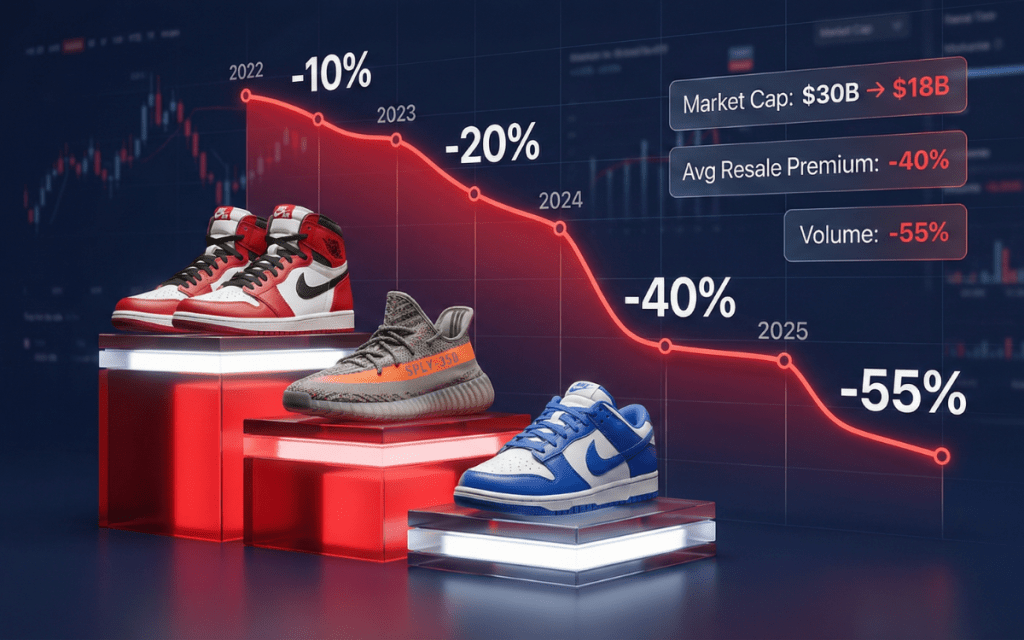
The sneaker resale market is undergoing its most significant correction in over a decade. After years of triple-digit markups and speculative buying, prices across major platforms have declined substantially, creating opportunities for informed consumers to find genuine deals. This analysis examines the data behind the correction and what it reveals about true sneaker value.
| Grade / Item | Low | High | Unit |
|---|---|---|---|
| Typical reseller margin (2020 → 2024) | 10 | 25 | % now, vs 80-100% at peak |
| Travis Scott x Jordan, avg resale (StockX, 2024) | 451 | 451 | USD |
| Nike / Jordan secondary prices, YoY June 2025 | -6.8 | -5.6 | % |
| US resale market size (Resell Calendar, 2025 proj.) | 6 | 6 | billion USD |
| StockX seller fees (Level 5 to Level 1), plus 3% processing | 7 | 9 | % |
The Market Correction by the Numbers
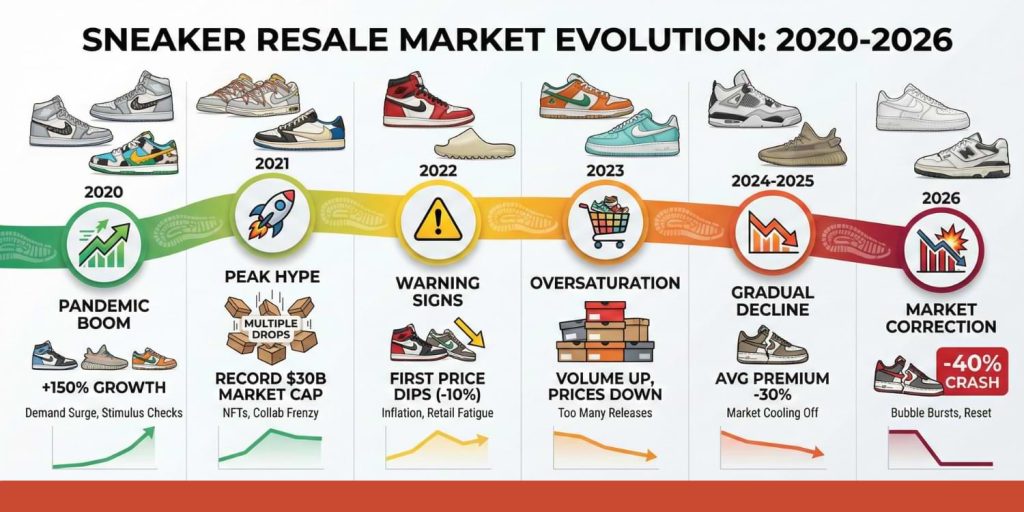
The shift from hype-driven speculation to value-conscious buying is visible across every major metric. According to Resell Calendar and StockX data, in 2020, 58 percent of sneakers were trading above retail on secondary platforms. As of 2024, that number dropped to 47 percent.
This 11-percentage-point decline represents a fundamental market reset. Profit margins that once hit 100% are now closer to 10-25% per pair for most releases. For context, a reseller who previously cleared $150 on a single flip now struggles to net $30 after platform fees.
| Metric | 2020 Peak | 2024 Current | Change |
|---|---|---|---|
| Releases trading above retail | 58% | 47% | -11 points |
| Typical profit margins | 80-100% | 10-25% | -70% average |
| Average premium on general releases | 40-60% | 5-15% | Significant decline |
Despite compressed margins, the U.S. sneaker resale market is projected to hit $6 billion by the end of 2025, according to Resell Calendar, while a report from Future Market Insights values the global sneaker market at approximately $87 billion as of 2025.
What Caused the Correction?
Brand Oversupply
Nike increased production of popular styles like the Nike Dunk and the Air Jordan 1, resulting in oversaturation of the marketplace. When consumers can walk into any Foot Locker and find multiple Dunk colorways on shelves, secondary market premiums evaporate.
Starting in late 2023 and throughout 2024, the imbalance between supply and demand on the primary market flipped. Fewer sellouts and easier access to key releases at retail naturally drove down premiums on the secondary market.
Economic Pressures
"Consumers want to see their dollar go further. More than that, they need their dollar to go further," Sen Sugano, chief brand officer at GOAT Group, told WWD in March 2026, as reported by Hypebeast, when GOAT launched Sneakers.com, a lower-priced site with an average order of about $70.
Shifting Consumer Sentiment
Industry observers noted that for a couple of years, the sneakers market behaved like a speculative asset, not dissimilar to NFTs. But sneakers are made to be worn, they are not speculative assets, and this tension eventually corrected itself.
Platform Fees: The Hidden Cost Eroding Value
Understanding platform fees is essential for calculating true value. These costs significantly impact both buyers and sellers, often turning apparent deals into break-even transactions.
| Platform | Seller Fees | Buyer Fees | Authentication |
|---|---|---|---|
| StockX | 7-9% + 3% processing ($5 minimum) | 3% processing + $13.95 shipping | Yes |
| GOAT | 9.5-25% by rating + $0-$5 fee + 2.9% cash-out | Varies by item | Yes |
| eBay | 8% at $150 or more; 13.6% below $150 | Sales tax applies | Authentication guarantee |
| Poshmark | 20% flat | Included in price | Limited |
| Stadium Goods | 20% commission | Premium pricing | Yes |
With eBay taking 13.6% on athletic shoes under $150 (8% at $150 or more), StockX 7% to 9% plus a 3% payment processing fee, and GOAT 9.5% or more plus a 2.9% cash-out fee, and with shipping, packaging and possible returns on top, a seller's profit on a typical flip can be a small part of the sale price.
For buyers, this means a sneaker listed at $200 actually costs $220-250 after all fees and shipping. Always calculate the complete out-the-door cost when comparing prices to retail alternatives.
Brand Performance: Winners and Losers
The correction has not affected all brands equally. While legacy players struggle with oversaturation, emerging brands are capturing market share.
Declining Performers
Nike and Jordan footwear prices on the secondary sneaker market continued to decline year on year in June 2025, by 6.8 percent and 5.6 percent, respectively, according to a UBS analyst note reported by Dow Jones Newswires in July 2025.
Premiums on some Adidas collaborations, such as Wales Bonner, have also been reported to narrow, though we could not trace the figures to StockX or GOAT data. Even the highly sought-after Samba has seen demand soften as the market reaches saturation.
Rising Performers
| Brand and Model | Growth Rate | Note |
|---|---|---|
| Anta | +1,901% | Kyrie Irving partnership driving sales (StockX, 2024) |
| Asics (all models, GOAT sales) | +645% | Retro styles resonating with consumers |
| Nike Sabrina | +707% | Women’s basketball driving category growth |
| Mizuno | +124% | Casual designs gaining traction |
| Saucony | +59% | Performance and lifestyle crossover |
| Salomon | +58% | Trail-to-street aesthetic trending |
When Kyrie Irving signed with Anta after his Nike split, most U.S. resellers ignored it. The Kai 1 retailed for $120, and people questioned if there was even a market. Those who paid attention found steady flips at $180-220 with minimal competition.
The Women’s Market Opportunity
The women’s sneaker segment grew from 1.6% of the market in 2014 to 42.7% in 2022. This represents one of the most significant demographic shifts in sneaker history.
StockX saw more than 16,000 trades across 43 unique Nike Sabrina sneakers in 2024, a 707 percent increase from 2023. At GOAT Group, the Sabrina 1 and Sabrina 2 grew 401 percent in 2024.
For buyers, this means more inventory and better selection in women’s sizes. Women’s models from athletes like Sabrina Ionescu and Caitlin Clark are among the few categories still commanding consistent premiums.
High-Heat Exceptions That Still Command Premiums
While the broader market has cooled, certain categories continue performing:
| Release Type | Average Resale | Premium | Notes |
|---|---|---|---|
| Travis Scott x Jordan | $451 | 197% | Consistent performer |
| Mocha Jordan 1s (2023) | $1,000+ | 300%+ | Legacy hype model |
| Caitlin Clark Kobe 5 | Varies | 91% | Women’s sports driving demand |
| Limited artist collabs | Varies | 50-150% | Quality dependent |
Travis Scott’s collaborations with Jordan Brand continue to sell for massive premiums on the secondary market. This page has said his shoes averaged $451 on StockX in 2024 with a 197 percent premium; we could not re-find those figures in StockX's published reports in November 2026, so treat them as unconfirmed.
However, these releases are rare. They prove that hype-driven scarcity still works, but the key is that you cannot build a buying strategy around hoping to hit one per year.
How to Identify True Value in the Current Market
Step 1: Establish the Retail Baseline
Before evaluating any resale price, know the original retail cost. A pair listed at $180 that retailed for $170 offers minimal value after platform fees consume the apparent savings.
Step 2: Research Production Numbers
Resell Calendar reported in October 2025 that Nike cut production on limited Jordan releases by 35% to restore exclusivity; we did not find that figure in Nike's own statements. Shoes from genuinely limited runs maintain value better than those marketed as exclusive but produced in large quantities.
Step 3: Calculate Total Acquisition Cost
For a $200 resale sneaker on StockX:
- Listed price: $200
- Processing fee (3%): $6
- Shipping: $13.95
- State tax (varies): $15-20
- Total cost: $235-240
Compare this to retail alternatives before committing.
Step 4: Assess Condition and Authenticity
In the 12 months to 31 May 2024, StockX said in its verification report that it stopped more than 400,000 suspected fakes from trading on the platform, worth almost $85 million.
Where these figures come from
We re-read the sources behind this page on 24 November 2026. Each figure is marked confirmed, changed, not found or not re-read.
| Figure on this page | Status on 24 November 2026 | Source |
|---|---|---|
| 58% of releases above retail in 2020, 47% in 2024; margins 10-25%; US resale $6 billion by end-2025 | Confirmed | Resell Calendar, 11 Oct 2025 |
| Nike production cut of 35% on limited Jordans; women's share 1.6% (2014) to 42.7% (2022); Anta Kai 1 at $120 flipping for $180-220 | Confirmed as Resell Calendar's reporting; now attributed in the text | Resell Calendar, 11 Oct 2025 |
| Nike and Jordan resale prices down 6.8% and 5.6% in June 2025 | Confirmed; the figures come from a UBS analyst note | Dow Jones via Tiger Brokers, 9 Jul 2025 |
| Anta +1,901% on StockX in 2024 | Confirmed | StockX release, 15 Jan 2025, Fashion Dive, 17 Jan 2025 |
| Asics +645%, Sabrina line +401% on GOAT | Changed: the 645% is Asics overall on GOAT, not the Gel-Kayano 14 | House of Heat on the GOAT report, 19 Jan 2025 |
| Saucony +59%, Mizuno +124%, Salomon +58% | Not found; StockX reported Saucony trades up 120% in 2024 | StockX release, 15 Jan 2025 |
| 400,000 products stopped, almost $85 million | Changed: the period is the 12 months to 31 May 2024, not calendar 2024 | SGI Europe on StockX's verification report |
| StockX seller fee 9.5-13% + 2.9% | Changed: now 7% to 9% plus a 3% payment processing fee, $5 minimum | StockX seller fees |
| GOAT 9.5-15% + 5% cash-out | Changed: 9.5% to 25% by seller rating, plus a $0 or $5 seller fee and a 2.9% cash-out fee | GOAT fee policy |
| eBay 0% on sneakers over $100 | Changed: athletic shoes pay 8% at $150 or more and 13.6% below $150 | eBay selling fees |
| Sen Sugano quote on inflationary pressure | Not found; replaced with his March 2026 quote | Hypebeast, 31 Mar 2026 |
| Travis Scott $451 and 197%; Sabrina 16,000 trades and 707%; Mocha Jordan 1 $1,000+; Caitlin Clark Kobe 91% | Not found on re-read; treat as unconfirmed | StockX, GOAT and trade press searched |
| Wales Bonner premiums 74% (2024) to 27% (2025) | Not found; removed from the text | StockX, GOAT and trade press searched |
| Global sneaker market $87 billion; Poshmark and Stadium Goods fees; StockX buyer fees | Not re-read | Future Market Insights; platform pages |
Our analysis: what the 2026 data says about the correction
Re-read on 24 November 2026: we found no source for a market-wide 40% fall. The share of releases trading above retail went from 58% in 2020 to 47% in 2024, a drop of 11 points, or about 19% in relative terms. Glossy cited the same 58% and 47% figures from Measure Protocol in July 2026 and put the resale market at about $6.5 billion in merchandise value at the start of 2026, above the $6 billion Resell Calendar had projected for the end of 2025. The closest figure to 40% we found is narrower: StockX's mid-2024 State of Resale report showed Nike Dunk trades down 41% year on year in the first seven months of 2024. What fell was the premium on most pairs and the trading in a few over-supplied models, not the size of the market.
2026 shows a partial recovery. In StockX's first-half 2026 report, Jordan sneaker sales rose 6% and average Jordan resale prices 5%, driven by retro models; Saucony sales rose 239% and Vans 238%, with the average Vans resale price up from $102 to $180. Citi's tracking put Nike's share of athletic footwear resale volume at 72.3% in September 2026, below its 77.0% peak in October 2023 but rising. At the cheap end, GOAT Group launched Sneakers.com in March 2026 with an average order of about $70, according to Hypebeast.
Fees have changed since this page was written. Here is what a seller keeps from a $200 sale on each platform's current US fee page, before their own shipping and packaging costs:
| Platform | Fees on a $200 sale | Seller keeps | Basis |
|---|---|---|---|
| StockX (Level 1 seller) | $24.00 | $176.00 | 9% transaction fee plus 3% payment processing |
| StockX (Level 5 seller) | $20.00 | $180.00 | 7% plus 3% |
| GOAT (rating 90+, prepaid shipping) | $29.10 | $170.90 | 9.5% commission, $5 seller fee, then 2.9% cash-out on $176 |
| eBay (athletic shoes, $150 or more) | $16.00 | $184.00 | 8% of the total, no per-order fee |
These are our calculations from the fee pages; GOAT's seller fee is $0 for drop-off, and sellers with lower GOAT ratings pay 15% to 25%. For buyers, the gap between platforms is a reason to compare the full checkout price, not the listed price.
Two questions on the 2026 market
Has the sneaker resale market crashed 40%? Not by any measure we could source. The share of releases selling above retail fell from 58% to 47% between 2020 and 2024, and Nike Dunk trades on StockX fell 41% in early 2024, but the US resale market was still worth about $6.5 billion at the start of 2026.
How much does StockX charge sellers in 2026? A transaction fee of 7% to 9% depending on seller level, plus a 3% payment processing fee, with a $5 minimum in the US, according to StockX's help page. A $200 sale leaves $176 to $180 before shipping.
Market Outlook: Where Prices Are Heading
Industry experts suggest the correction may be approaching a healthier equilibrium. In our reading, premiums are unlikely to return to the levels seen in 2020 and 2021, and that is not necessarily bad for buyers. A healthier balance is emerging where products will sell out at retail, the hype model will work, and customers will find products on the secondary market at reasonable premiums.
The Business of Fashion’s sneaker market analysis notes that while the market has cooled, innovative releases and limited collaborations still command attention. Brands that master scarcity and storytelling will continue driving secondary demand.
Making Informed Purchasing Decisions
The sneaker resale correction reveals a fundamental truth: prices driven by speculation rather than genuine demand eventually find their natural level. For consumers willing to research rather than react, this creates opportunities to acquire desired pairs at rational prices.
Understanding how dynamic pricing affects perceived value helps decode why certain releases appear valuable while others languish. The same psychological mechanisms that inflate sneaker premiums operate across consumer markets, from electronics pricing patterns to luxury goods valuations.
For those tracking sneaker prices over time, platforms like Resell Calendar provide historical data that reveals whether current prices represent genuine deals or temporary dips before further declines.
The informed buyer’s advantage lies in distinguishing between manufactured scarcity and authentic value, a skill applicable far beyond footwear.
At OriginalPricing.com, we analyze pricing patterns across consumer markets to help buyers identify genuine value. Learn how shrinkflation affects everyday purchases, explore our methodology for pricing research, or discover how brands use perceived scarcity to inflate prices.
First published January 2026; reviewed November 2026. Statistics as attributed inline to StockX data, GOAT Group statements, Resell Calendar reporting and Future Market Insights estimates, largely covering 2024-2025. Platform fees change; check each platform’s current fee schedule before selling.