
The 2026 Yamaha CrossWave is expected to carry a base MSRP in the $30,000 to $35,000 range in the United States, though Yamaha has not released official pricing as of January 2026. Final out-the-door costs typically increase by $3,000 to $8,000 once taxes, dealer preparation fees, destination charges, trailer purchases, and optional accessories are factored into the transaction.
Key Takeaways
The CrossWave costs more because it offers more:
- 43% more fuel capacity than closest competitor (26.4 vs 18.5 gal)
- 107% more storage than Sea-Doo FishPro Trophy (82 vs 39.6 gal)
- 33% more passenger capacity (4 vs 3 passengers)
- Only PWC with full walk-around deck platform
- Only fishing PWC pre-wired for trolling motor with deep-cycle battery
- Shallowest draft for skinny water access (~6″ vs ~16″)
The CrossWave costs less than buying two watercraft:
- Buyers who would otherwise need both a fishing PWC and a family recreation PWC may find the CrossWave eliminates the need for multiple vessels
- Combined trailer, storage, insurance, and maintenance costs for two watercraft typically exceed $5,000-$8,000 annually
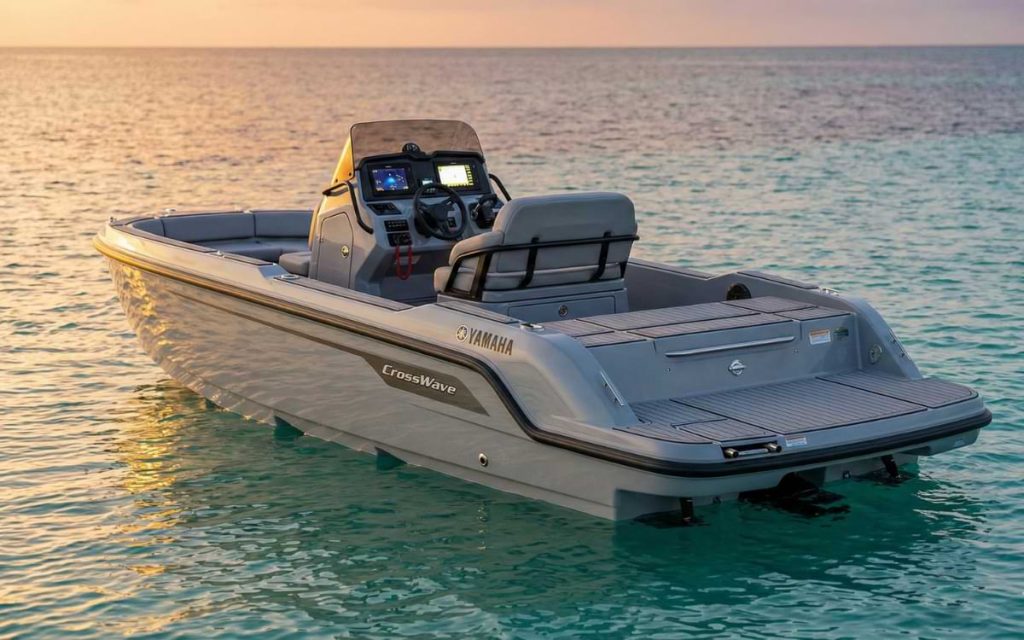
CrossWave
2026 Model Year | Personal Watercraft
Estimated MSRP Range
$30,000 – $35,000
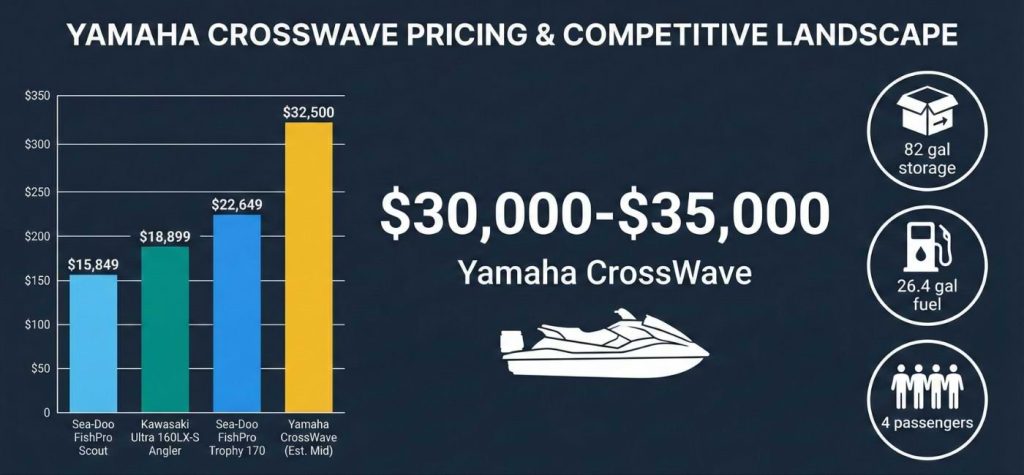
Competitor Pricing
What Is the Yamaha CrossWave?
The Yamaha CrossWave represents a departure from conventional personal watercraft design. Rather than competing directly with traditional sit-down PWCs or stand-up models, Yamaha engineered the CrossWave as a platform that bridges the gap between a jet ski and a small utility boat.
At nearly 13 feet in length and over 5.5 feet in width, the CrossWave provides a 360-degree walk-around deck with marine matting, seating capacity for up to four passengers, and over 82 gallons of onboard storage. The vessel is powered by Yamaha’s 1.9-liter four-cylinder engine, the largest displacement motor currently available in a PWC, paired with a 26.4-gallon fuel tank that enables extended range beyond 100 miles under typical conditions.
This design philosophy creates a pricing structure distinct from both traditional WaveRunners and entry-level pontoon boats. Buyers evaluating the CrossWave should understand that they are not simply purchasing a larger jet ski. They are investing in a multi-purpose platform designed for fishing, family recreation, cruising, and day-long water outings that conventional PWCs cannot accommodate.
How CrossWave Pricing Is Structured?
Base Configuration
Yamaha offers the CrossWave in a single, fully-equipped configuration rather than tiered trim levels. This approach simplifies the purchasing decision but means the entry price reflects a comprehensive feature set that includes dual 7-inch displays (Yamaha Connext system and Simrad marine electronics), integrated Bluetooth audio with two 8-inch EcoXGear speakers, T-track accessory mounting rails, a dedicated anchor locker, and a 55-quart cooler.
Optional Upgrades and Accessories
While the base configuration is well-equipped, Yamaha’s T-track mounting system enables significant customization. Common additions include trolling motor brackets, rod holders, additional cooler mounts, and graphics packages. Buyers should expect accessory packages to add $500 to $2,500, depending on intended use.
The CrossWave is also pre-wired for a Group 24 deep-cycle marine battery, which is not included in the standard configuration. Buyers planning to use trolling motors or additional electronics should budget for battery and installation costs.
Dealer-Installed Additions
Dealer preparation fees, freight and destination charges, and assembly costs vary significantly by location and dealership. These fees typically range from $500 to $1,500. Some dealers may bundle preparation costs into promotional pricing, while others itemize each charge separately.
Trailer purchases represent another variable. A PWC trailer suitable for the CrossWave’s size and weight typically costs $1,200 to $2,500, depending on construction quality and features like braking systems or aluminum versus galvanized steel frames.
Why Prices Vary Between Dealers?
Geographic location, local market demand, dealer volume, and seasonal timing all influence final transaction prices. Dealers in regions with year-round boating seasons may maintain higher prices due to consistent demand, while dealers in seasonal markets sometimes offer more aggressive pricing during off-peak months.
Yamaha CrossWave Competitor Price and Specifications Comparison
Quick Price Comparison Table
| Model | 2026 MSRP | Price vs. CrossWave |
| Yamaha CrossWave | $30,000 – $35,000 (est.) | — |
| Sea-Doo FishPro Trophy 170 | $22,649 | $7,350 – $12,350 less |
| Yamaha FX Limited SVHO | $22,199 | $7,800 – $12,800 less |
| Kawasaki Ultra 160LX-S Angler | $18,899 | $11,100 – $16,100 less |
| Sea-Doo FishPro Sport 170 | $18,149 | $11,850 – $16,850 less |
| Sea-Doo FishPro Scout | $15,849 | $14,150 – $19,150 less |
Complete Specifications Comparison
| Specification | Yamaha CrossWave | Sea-Doo FishPro Trophy 170 | Kawasaki Ultra 160LX-S Angler | Yamaha FX Limited SVHO |
|---|---|---|---|---|
| 2026 MSRP | $30,000-$35,000 (est.) | $22,649 | $18,899 | $22,199 |
| Length | 12’11” (155″) | 12’3″ (147″) | 13’2″ (158″) | 11’9″ (141″) |
| Width | 5’7″ (67″) | 4’1″ (49″) | 4’3″ (51″) | 4’2″ (50″) |
| Dry Weight | TBD | 981 lbs | ~1,000 lbs | 877 lbs |
| Engine | 1.9L (1812cc) 4-cyl | 1630cc Rotax 3-cyl | 1,498cc 4-cyl | 1812cc SVHO 4-cyl |
| Horsepower | High Output (NA) | 170 HP (NA) | 160 HP (NA) | ~250 HP (Supercharged) |
| Fuel Capacity | 26.4 gal | 18.5 gal | 21.1 gal | 18.5 gal |
| Storage Capacity | 82 gal (310L) | 39.6 gal (150L) | 44.5 gal (168L) | 44.5 gal (168L) |
| Passenger Capacity | 4 | 3 | 3 | 3 |
| Top Speed | ~55 mph | ~55 mph | ~60 mph | ~67 mph |
| Display | Dual 7″ (Connext and Simrad) | 10.25″ Touchscreen | 7″ TFT | 7″ Connext Touchscreen |
| Fish Finder | Simrad NSX (Included) | Garmin (Included) | Garmin (Included) | Not Included |
| Audio System | Dual 8″ EcoXGear Bluetooth | Available | Not Included | Factory Installed |
| Walk-Around Deck | Yes (13 ft) | No | No | No |
| Trolling Motor Ready | Pre-wired | Optional | No | No |
Feature-by-Feature Comparison
| Feature | Yamaha CrossWave | Sea-Doo FishPro Trophy 170 | Kawasaki Ultra 160LX-S Angler | Yamaha FX Limited SVHO |
| Primary Use | Multi-purpose (fishing, family, cruising) | Dedicated fishing | Dedicated fishing | Performance cruising |
| Rod Holders | T-track system (customizable) | 5 integrated | 5 integrated | Not included |
| Cooler Included | 55 qt (T-track mount) | 51L LinQ Fishing Cooler | 58 qt ORCA | Molded bow storage |
| Livewell | Optional | Quick-connect included | Not included | Not included |
| Stability at Rest | Squared hull design (high) | ST3 hull (moderate-high) | Deep-V hull (moderate) | Performance hull (moderate) |
| Draft | ~6″ (Shallow) | ~16″ | ~16″ | ~16″ |
| Debris Cleanout | Patented inboard port | iDF system | Standard | Standard |
| Cruise Control | Yes | Yes (iTC) | Yes (electronic) | Yes |
| Reverse System | Yamaha RiDE | iBR | KSRD | Yamaha RiDE |
Fishing-Specific Comparison
| Fishing Feature | Yamaha CrossWave | Sea-Doo FishPro Trophy 170 | Kawasaki Ultra 160LX-S Angler |
| MSRP | $30,000 – $35,000 (est.) | $22,649 | $18,899 |
| Deck Space | 13 ft walk-around | Extended rear platform | Extended rear platform (ULTRA deck) |
| Standing Platform | Full 360° deck | Rear platform only | Rear platform only |
| Fish Finder | Simrad NSX 7″ | Garmin (size varies) | Garmin 7″ integrated |
| Rod Storage | T-track customizable | 5 dedicated holders | 5 dedicated holders |
| Trolling Capability | Pre-wired for motor | Trolling mode only | No trolling motor support |
| Battery Capacity | Pre-wired for Group 24 deep-cycle | Standard PWC battery | Standard PWC battery |
| Anchor System | Dedicated anchor locker | Optional | Not included |
| Shallow Water Access | Excellent (~6″ draft) | Good | Good |
| Stability (Fishing) | Excellent (squared hull) | Very Good (ST3) | Good (Deep-V) |
Range and Efficiency Comparison
| Model | Fuel Capacity | Est. Range | Fuel Type | Cost per Tank* |
| Yamaha CrossWave | 26.4 gal | 100+ miles | Premium Unleaded | $105 – $130 |
| Sea-Doo FishPro Trophy 170 | 18.5 gal | 70-80 miles | Premium Unleaded | $75 – $95 |
| Kawasaki Ultra 160LX-S Angler | 21.1 gal | 75-85 miles | Premium Unleaded | $85 – $105 |
| Yamaha FX Limited SVHO | 18.5 gal | 60-70 miles | Premium Unleaded | $75 – $95 |
Value Analysis: Cost Per Feature
| Value Metric | Yamaha CrossWave | Sea-Doo FishPro Trophy 170 | Kawasaki Ultra 160LX-S Angler |
| Base MSRP | ~$32,500 (midpoint) | $22,649 | $18,899 |
| Cost per Passenger | ~$8,125 | ~$7,550 | ~$6,300 |
| Cost per Gal Storage | ~$396 | ~$572 | ~$425 |
| Cost per Gal Fuel | ~$1,231 | ~$1,224 | ~$896 |
| Electronics Included | Dual displays, fish finder, audio | Single display, fish finder | Single display, fish finder |
| Trailer Required | Yes (larger capacity) | Yes (standard PWC) | Yes (standard PWC) |
Out-the-Door Cost Estimates
| Cost Component | Yamaha CrossWave | Sea-Doo FishPro Trophy 170 | Kawasaki Ultra 160LX-S Angler |
| Base MSRP | $30,000 – $35,000 | $22,649 | $18,899 |
| Destination/Freight | $500 – $800 | $550 | $500 – $600 |
| Dealer Prep | $500 – $1,000 | $300 – $600 | $300 – $500 |
| Trailer (est.) | $2,000 – $3,000 | $1,200 – $1,800 | $1,200 – $1,800 |
| Registration & Tax (8%) | $2,400 – $2,800 | $1,800 – $2,000 | $1,500 – $1,700 |
| Est. Out-the-Door Total | $35,400 – $42,600 | $26,500 – $27,600 | **$22,400 – $23,500** |
Who Should Choose What?
| Buyer Profile | Best Choice | Why |
| Dedicated angler on a budget | Kawasaki Ultra 160LX-S Angler | Lowest price with complete fishing package |
| Serious tournament angler | Sea-Doo FishPro Trophy 170 | Livewell, swivel seat, proven platform |
| Family plus fishing | Yamaha CrossWave | 4-passenger capacity, walk-around deck, all-day range |
| Performance cruiser | Yamaha FX Limited SVHO | Top speed, supercharged power, luxury features |
| All-day water explorer | Yamaha CrossWave | Largest fuel capacity, most storage, multi-purpose utility |
| Shallow water specialist | Yamaha CrossWave | 6-inch draft enables skinny water access |
Factors That Influence CrossWave Pricing
| Cost Factor | Why It Impacts Price | Buyer Consideration |
|---|---|---|
| Hull design and size | The squared-off, stability-focused hull requires more material and engineering than traditional PWC designs, increasing manufacturing costs | Larger footprint means higher shipping costs and potential storage challenges |
| Power system | The 1.9L high-output engine is Yamaha’s largest PWC powerplant, commanding premium pricing compared to smaller displacement motors | Greater fuel capacity (26.4 gallons) partially offsets fuel costs through fewer fill-ups during extended outings |
| Seating layout | Four-passenger capacity with removable seats adds complexity and material costs versus two-up or three-up configurations | Reduces the need for aftermarket electronics but increases base price |
| Standard electronics | Dual 7-inch displays with navigation and fish-finding capabilities are included rather than offered as upgrades | Reduces the need for aftermarket electronics but increases the base price |
| T-track accessory system | Factory-integrated mounting rails enable extensive customization but add manufacturing cost | Standardized mounting reduces long-term accessory costs versus proprietary systems |
| Regional dealer fees | Destination charges, dealer preparation, and local taxes vary by location | Requesting itemized quotes from multiple dealers reveals true cost differences |
Evaluating Value Beyond Sticker Price
Intended Usage Patterns
Buyers who plan to use the CrossWave primarily for short recreational sessions may find the investment difficult to justify compared to less expensive traditional PWCs. However, buyers seeking an all-day platform for fishing, family outings, or extended cruising will find the CrossWave’s feature set eliminates the need for multiple watercraft or frequent compromises on capability.
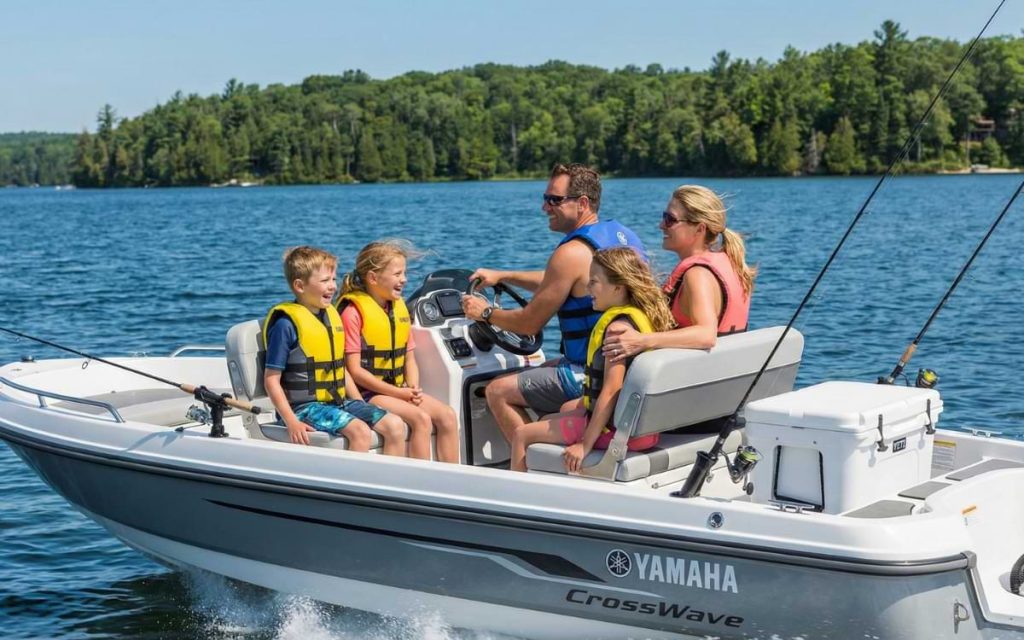
The stability-at-rest characteristic, in particular, serves anglers and families with children who require a platform that does not rock excessively when passengers move about or stand.
Long-Term Ownership Expectations
The CrossWave’s premium construction and Yamaha’s established reliability record suggest lower long-term maintenance costs compared to less expensive alternatives that may require earlier engine rebuilds or component replacements. PWC engines from major manufacturers typically provide 300 to 500 hours of operation before requiring significant service, and the CrossWave’s 1.9L engine shares architecture with proven Yamaha platforms.
Depreciation should also factor into value calculations. Higher-end watercraft with unique market positions tend to depreciate more slowly than entry-level models, though as a new product category, CrossWave resale values remain unestablished.
Storage and Maintenance Realities
The CrossWave’s dimensions (approximately 13 feet by 5.5 feet) exceed standard PWC proportions. Buyers must verify that existing storage facilities, garage spaces, or dock arrangements can accommodate the larger footprint. Indoor storage typically costs more for oversized watercraft.
Transport requirements also differ. The CrossWave’s width may approach or exceed standard trailer lighting widths in some jurisdictions, potentially requiring oversized load permits for highway transport in certain states.
What Is Typically Included in the Standard Configuration?
The 2026 Yamaha CrossWave standard configuration includes:
- 1.9-liter high-output Yamaha marine engine with jet pump propulsion
- 26.4-gallon fuel tank with integrated fuel gauge
- Dual 7-inch touchscreen displays (Connext system and Simrad NSX chartplotter with fish finder)
- Two 8-inch waterproof Bluetooth speakers with EcoCast multi-speaker linking capability
- Walk-around deck with marine-grade matting covering 13 feet of usable space
- Seating for up to four passengers with removable third and fourth seats
- 82 gallons of total storage across multiple compartments including dedicated anchor locker
- 55-quart cooler with T-track mounting capability
- T-track accessory rails running the length of the deck
- Patented inboard jet-pump cleanout port for debris removal without entering the water
- Pre-wiring for Group 24 deep-cycle marine battery installation
- Two 12-volt power outlets for device charging
- Three-position adjustable handlepole
- Deck reboarding holder
- Maintenance-free starting battery
How the CrossWave Compares to Alternative Watercraft?
Versus Traditional Personal Watercraft
Standard PWCs prioritize speed, agility, and rider engagement over utility and passenger comfort. The CrossWave sacrifices some top-end performance (reaching approximately 55 mph versus 65+ mph for performance-oriented models) in exchange for stability, deck space, and extended-range capability.
Buyers seeking an adrenaline-focused riding experience may find traditional high-performance PWCs better suited to their preferences. Those prioritizing practical utility and multi-passenger functionality will find the CrossWave addresses limitations inherent in conventional designs.
Versus Modular Pontoon Boats
Entry-level pontoon boats in the 16 to 18-foot range often overlap with CrossWave pricing but require dedicated dock space, deeper water clearance, and more complex trailer arrangements. The CrossWave’s approximately 6-inch draft allows access to shallow water areas inaccessible to most pontoon hulls.
Pontoons generally offer greater passenger capacity and shade options but lack the CrossWave’s maneuverability, trailering convenience, and ability to launch from standard boat ramps without assistance.
For buyers evaluating both categories, the choice often depends on typical water conditions, storage availability, and whether nimble positioning (advantageous for fishing and exploration) outweighs larger deck space (advantageous for entertaining groups). A detailed comparison of watercraft types for different use cases can help clarify which platform best matches specific requirements.
Expected Ownership Costs Over Time
Routine Maintenance
Annual maintenance for the CrossWave should closely mirror costs for other premium Yamaha WaveRunner models. Typical annual service includes oil and filter changes, spark plug replacement, impeller inspection, and general systems checks. Dealer service rates for comprehensive annual maintenance typically range from $300 to $600 depending on location and service scope.
Winterization is essential in regions with freezing temperatures. Professional winterization services range from $150 to $300 and include fuel stabilization, cooling system preparation, and battery maintenance procedures.
Fuel Efficiency Considerations
The CrossWave’s 26.4-gallon fuel tank provides significant range, with testing suggesting over 100 miles of operation under typical cruising conditions. Fuel consumption varies substantially based on speed, passenger load, and water conditions.
At average regional fuel prices for marine gasoline, budget approximately $75 to $125 per tank. Annual fuel costs depend entirely on usage patterns; recreational users averaging 30 hours annually might spend $400 to $800 on fuel, while heavy users could exceed $1,500.
Insurance Requirements
PWC insurance costs vary based on operator age and experience, geographic location, coverage levels, and the watercraft’s value. For a vessel in the CrossWave’s expected price range, annual comprehensive insurance premiums typically fall between $400 and $1,200.
Many marinas and homeowner associations require proof of liability coverage regardless of state requirements. Financing arrangements almost universally mandate comprehensive and collision coverage until the loan is satisfied.
Storage Expenses
Home garage storage eliminates recurring fees but requires adequate space and a suitable trailer. Marina or dry-stack storage fees vary dramatically by region, ranging from $100 to $400 monthly depending on facility type and location.
Covered or indoor storage commands premium pricing but protects the vessel from UV damage and weather exposure, potentially extending the lifespan of seats, deck materials, and electronics.
Common Buyer Questions
Is the Yamaha CrossWave worth its price?
The CrossWave delivers value for buyers seeking a single platform that combines fishing capability, family recreation, and extended-range cruising. Its worth depends on whether the buyer’s usage patterns require the specific combination of stability, storage, and multi-passenger capacity that traditional PWCs cannot provide.
Who is this boat best suited for?
The CrossWave fits buyers who want PWC maneuverability and trailering convenience combined with small-boat utility. Anglers, families with children, and buyers who spend full days on the water rather than short recreational sessions represent the primary audience.
Why is pricing higher than some pontoon boats?
The CrossWave’s pricing reflects its specialized engineering, premium electronics package, and Yamaha’s largest available PWC powerplant. Unlike basic pontoons, the CrossWave includes navigation electronics, fish-finding equipment, and an integrated audio system as standard equipment.
What should buyers budget beyond the purchase price?
Plan for $4,000 to $8,000 in first-year additional costs including trailer purchase ($1,500 to $2,500), registration and taxes (varies by state), insurance ($400 to $1,200), accessories ($500 to $2,000), and initial maintenance supplies. Ongoing annual costs typically range from $1,500 to $3,500 depending on usage intensity and storage arrangements.