
SaaS pricing is undergoing its most significant transformation in over a decade. While flat subscription fees dominated the 2010s, modern software companies are increasingly adopting hybrid models that combine predictable subscriptions with variable usage charges.
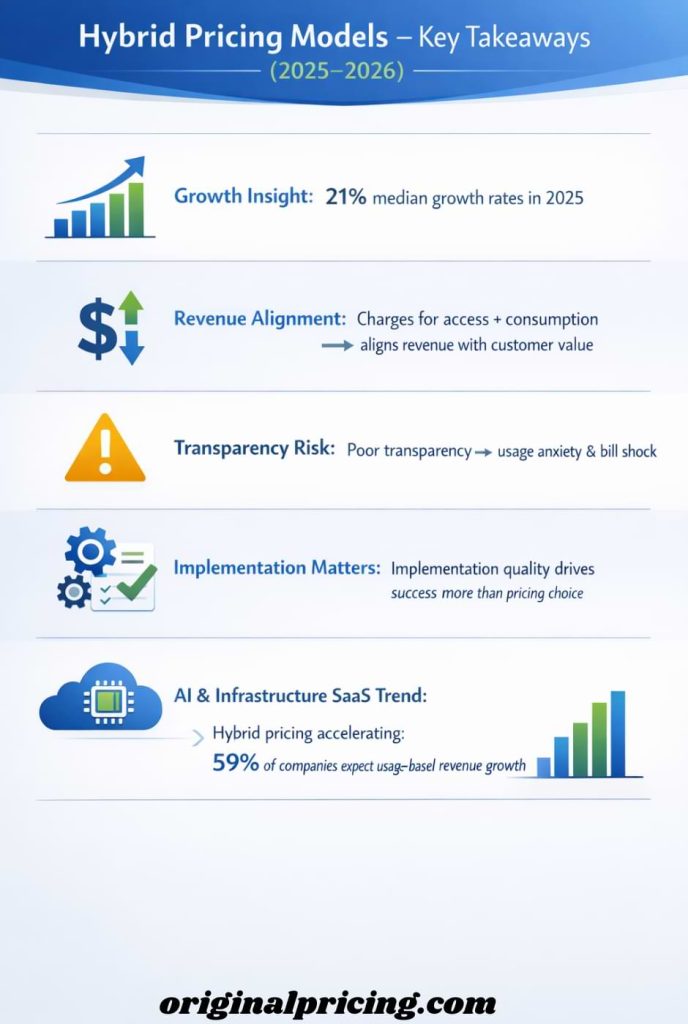
This shift is particularly pronounced in AI platforms, API services, and infrastructure tools, where compute costs scale unpredictably with customer activity. Rising infrastructure expenses, customer demand for pricing fairness, and the need for sustainable revenue expansion are driving this evolution. According to Maxio’s 2025 SaaS Pricing Trends Report, companies using hybrid models report a median growth rate of 21 percent, outperforming both pure subscription and pure usage-based approaches. As software value becomes more closely tied to actual consumption rather than access alone, hybrid pricing is emerging as the industry standard rather than the exception.

What Is a Hybrid Pricing Model?
A hybrid pricing model combines a fixed subscription fee with variable usage-based charges, allowing SaaS companies to balance predictable revenue with pay-for-what-you-use billing.
Why Are SaaS Companies Using Hybrid Pricing?
- Software usage varies significantly between customers, making one-size-fits-all pricing unfair
- Infrastructure and compute costs scale directly with consumption, especially for AI-powered features
- Customers increasingly expect pricing transparency and fairness aligned with the value they receive
- SaaS companies need expansion revenue mechanisms beyond forced seat growth or plan upgrades
How Hybrid Pricing Works in Practice?
Hybrid pricing operates on a dual-component structure where customers pay a base subscription fee for access to core functionality, then incur additional charges based on their actual usage of specific features or resources. The subscription component provides baseline value and ensures predictable revenue for the vendor, while the usage component scales proportionally with the customer’s consumption of compute-intensive features, API calls, data storage, or other metered resources.
This structure creates natural alignment between cost and value. Light users pay primarily for access through their subscription, while power users who extract more value from the platform pay proportionally more through usage charges. Most implementations bill the subscription portion monthly or annually, while usage charges appear either in real-time or as monthly overages. This approach addresses the fundamental limitation of flat pricing, where heavy users receive disproportionate value while light users subsidize platform costs they don’t incur.
The billing mechanics typically involve setting usage thresholds within subscription tiers, with customers paying additional fees once they exceed those limits. Some vendors apply real-time pricing algorithms to adjust charges dynamically based on consumption patterns, though this remains less common than straightforward overage billing.
Common Hybrid Pricing Structures
SaaS companies implement hybrid pricing through several distinct formats, each optimized for different use cases and customer expectations. The most prevalent structures balance simplicity with flexibility.
Subscription with usage overages establishes a monthly base fee that includes a specific usage allowance, with customers paying additional charges when they exceed those limits. This format works particularly well for AI platforms and API services where usage can spike unpredictably.
Seat-based pricing with consumption limits charges per user while imposing caps on actions, data processing, or storage per seat. When teams exhaust these limits, they either upgrade tiers or pay overage fees. B2B SaaS platforms commonly use this structure to maintain familiar per-user economics while accommodating variable usage patterns.
Tiered plans with metered add-ons offer distinct subscription levels (starter, professional, enterprise) with the option to purchase additional capacity for specific features. This approach allows customers to start small and scale specific capabilities without upgrading their entire plan.
Commit-based contracts with usage flex require customers to commit to annual spending minimums while allowing burst usage beyond those commitments at agreed-upon rates. Enterprise customers favor this structure because it provides budget predictability while accommodating seasonal or project-based demand spikes.
Hybrid Pricing Model Examples
| Structure | Fixed Component | Variable Component | Best For |
|---|---|---|---|
| Subscription and Overage | Monthly base fee | API calls, tokens, compute | AI platforms, APIs |
| Seat and Usage | Per-user fee | Data processing, actions | B2B SaaS |
| Tier and Metering | Plan level | Excess usage charges | Mid-market SaaS |
| Commit and Flex | Annual minimum commit | Burst usage beyond commit | Enterprise contracts |
Benefits of Hybrid Pricing
Hybrid pricing delivers economic advantages for both vendors and customers when implemented thoughtfully. From the vendor perspective, the subscription component creates predictable baseline revenue that supports financial planning and runway extension. This stability matters for SaaS businesses that need to forecast growth and allocate resources efficiently.
Meanwhile, the usage component enables natural expansion of revenue from power users who derive more value from the platform, creating a growth mechanism that doesn’t depend solely on acquiring new customers or forcing seat additions.
Customers perceive hybrid models as fairer than flat pricing because charges align more closely with actual value received. This perception matters for adoption and retention. Lower entry barriers benefit customers who want to start small without committing to expensive enterprise plans before proving value. A startup can access enterprise-grade infrastructure by paying a modest base fee plus usage charges that scale with its growth, rather than being priced out by prohibitive upfront commitments.
The model also creates better alignment between vendor costs and customer value delivery. Infrastructure and compute expenses scale with usage in AI and cloud platforms, so charging based on consumption ensures margins remain intact as customers scale. This alignment extends beyond economics to product strategy, encouraging vendors to optimize efficiency and deliver genuine value rather than maximizing seats. Research from the 2025 Monetization Monitor indicates that 59 percent of software companies expect usage-based models to grow as a share of revenue, an 18-point increase versus 2023, reflecting widespread recognition of these benefits.
Downsides and Risks of Hybrid Pricing
Hybrid pricing introduces complexity that can undermine its benefits when poorly implemented. The primary risk is billing confusion, where customers struggle to understand how charges accumulate or what drives their invoices higher each month. This confusion erodes trust and increases support overhead as teams field questions about unexpected costs.
Usage anxiety represents another significant challenge. When customers fear unpredictable bills, they artificially limit their engagement with the platform, reducing the value they extract and paradoxically making them more likely to churn. Metronome’s 2025 field research found that usage stopped not because of price but because administrators didn’t trust they would stay within budget. One director noted that customers actively avoided using AI features even when free credits were included because they feared getting locked into something unpredictable.
Unexpected invoices damage customer relationships and increase dispute volume. Without proper guardrails and communication, customers can exceed usage limits without realizing it until they receive bills that blow past their budgets. This scenario creates friction that subscription models avoid entirely. The operational burden also increases for vendors who must invest in accurate usage tracking, real-time dashboards, and proactive alerting systems to prevent these problems.
Risk Mitigation Strategies
| Risk | What Goes Wrong | Mitigation Strategy |
|---|---|---|
| Surprise bills | Customers exceed limits unknowingly | Real-time usage alerts at 50%, 80%, 100% thresholds |
| Confusion | Complex pricing structures | Plain language explanations and visual calculators |
| Churn from fear | Usage anxiety limits engagement | Hard spending caps and predictable billing periods |
| Trust erosion | Opaque billing practices | Real-time dashboards showing current usage and projected costs |
How to Implement Hybrid Pricing Correctly?
Successful hybrid pricing implementation requires deliberate planning across product, finance, and go-to-market teams. The foundation starts with defining what core values belong in the subscription versus what should be metered. Generally, baseline access, essential features, and standard support should be included in the fixed fee, while compute-intensive capabilities, premium features, or resource-heavy operations become metered components.
The usage metrics you choose to meter must be intuitive and closely aligned with perceived value. Customers need to understand what drives their costs without consulting documentation or support teams. API calls, tokens processed, data stored, and actions completed all represent clear, measurable units that customers can directly connect to their platform usage. Avoid abstract or opaque metrics that confuse rather than clarify.
Transparent usage tracking becomes non-negotiable once you implement consumption-based components. Customers need real-time visibility into their usage, projected costs for the billing period, and alerts before they hit spending thresholds. Without these tools, even fair pricing feels predatory when unexpected bills arrive. The infrastructure required for this transparency represents a significant investment but determines whether customers trust and embrace the model.
Pilot pricing with existing customers before launching broadly. Select customers who represent different usage patterns and segments, explain the new model thoroughly, and monitor both their actual costs compared to the old model and their perception of fairness. This testing phase reveals implementation problems and allows you to adjust thresholds, adjust communication, or refine the structure before it affects your entire customer base.
Cross-functional alignment matters because hybrid pricing touches every team. Sales needs to explain and defend the model during negotiations. The product must build the usage tracking and customer-facing dashboards. Finance requires new forecasting models that account for usage variability. Support will field questions and disputes about billing. Customer success needs to help customers optimize their usage to avoid bill shock. Without coordination across these functions, implementation fails regardless of how sound the model itself may be. This relates closely to concepts explored in value bifurcation, where different customer segments derive value through different mechanisms.
Preventing Usage Anxiety
Usage anxiety kills adoption faster than actual price increases. When customers worry about unpredictable costs, they limit their engagement, extract less value, and become more likely to churn despite lower absolute spending. Preventing this anxiety requires proactive design choices that give customers control and visibility.
Real-time usage dashboards must show current consumption, historical trends, and projected end-of-period costs based on current usage rates. These dashboards need to be accessible, accurate, and updated frequently enough that customers trust the information. Many platforms update hourly or even more frequently for high-velocity usage patterns.
Spending forecasts help customers budget by projecting their likely monthly costs based on recent usage patterns and seasonal trends. When customers can see that their current trajectory will result in a specific invoice amount, they can make informed decisions about whether to optimize usage, adjust their plan, or accept the higher cost because the value justifies it.
Hard and soft usage caps give customers direct control over their maximum exposure. Soft caps trigger alerts and notifications at predetermined thresholds (typically 50 percent, 80 percent, and 100 percent of a limit), while hard caps prevent any usage beyond a specified amount. Hard caps can frustrate power users if set too conservatively, so many platforms offer them as optional safeguards that customers can enable based on their risk tolerance. OpenAI and similar platforms have demonstrated that these controls significantly reduce anxiety while actually increasing average usage because customers feel protected.
Proactive communication matters throughout the customer lifecycle. When usage patterns change significantly, reaching out before the invoice arrives prevents surprise and demonstrates that you’re monitoring their success rather than extracting maximum revenue. If a customer’s usage spikes 3x compared to their historical average, a quick email or in-app notification explaining the change and confirming it’s intentional builds trust rather than eroding it.
Industry-Specific Applications
AI and API Platforms
AI platforms face uniquely unpredictable cost structures because inference costs vary dramatically based on model complexity, input length, and output requirements. A simple classification task might cost fractions of a cent, while generating long-form content or processing complex images can cost orders of magnitude more. This variability makes flat pricing economically unfeasible for vendors and confusing for customers who can’t predict their bills.
Hybrid pricing solves this by charging a base platform fee that covers access, documentation, and baseline support, while metering actual API calls, tokens processed, or compute time consumed. This structure aligns vendor costs (which scale with usage) with customer charges, ensuring sustainable margins regardless of usage patterns. Companies like OpenAI, Anthropic, and Cohere all rely on consumption-based pricing, with various enterprise customers negotiating committed-use deals for predictability.
The 2025 SaaStr analysis noted that 44 percent of SaaS companies now charge for AI-powered features, reflecting how essential metering has become for managing these costs. The principles here connect to broader dynamic pricing strategies that adjust based on real-time factors.
Developer Tools and Infrastructure
Developer tools and infrastructure services deal with highly variable workloads that correlate with customer success rather than team size. A development team might run minimal infrastructure during planning phases, then spike to significant resource consumption during load testing, deployment, or traffic surges. Seat-based pricing fails to capture this reality and either overcharges during quiet periods or undercharges during peak usage.
Consumption-based pricing for infrastructure aligns costs with actual workload. AWS pioneered this approach by charging for compute hours, storage capacity, and data transfer rather than fixed monthly fees. This model became the standard for cloud infrastructure precisely because it scales elastically with customer needs. Development tools like GitHub, Datadog, and Vercel have adopted similar approaches, charging based on repositories, monitored hosts, or build minutes rather than just user seats.
B2B SaaS
Traditional B2B SaaS platforms built on seat-based pricing face growing limitations as software value delivery becomes decoupled from headcount. Automation, AI assistants, and integration-heavy workflows mean that teams can accomplish more with fewer people, reducing the correlation between seats and value. A five-person team using automation and AI features might generate as much output as a twenty-person team using basic features, yet they pay 75 percent less under pure seat-based models.
Hybrid pricing addresses this by combining per-user fees with usage-based charges for high-value actions, data processing, or automation runs. Intercom, for example, introduced Fin AI as a hybrid offering that charges per seat for human agents while metering AI-powered resolution attempts. This structure ensures revenue scales with actual value delivery rather than just team size, creating more sustainable economics as customers adopt efficiency-enhancing features rather than expanding headcount.
Metrics That Matter for Hybrid Pricing
Hybrid pricing changes how SaaS companies measure success and health. Traditional metrics remain relevant but require new interpretation, while several consumption-specific metrics become critical for understanding business performance.
Net Revenue Retention (NRR): becomes more sensitive to usage patterns under hybrid models. Companies can now achieve NRR growth through increased usage from existing accounts rather than solely through upsells and seat expansion. This makes NRR a more accurate measure of product value delivery. High-growth companies using hybrid models report NRR rates above 120 percent, indicating strong usage expansion beyond baseline subscriptions.
Expansion versus contraction revenue: requires separate tracking because usage-based components introduce variability in both directions. Customers naturally increase usage as they derive more value, creating expansion revenue, but usage can also contract during slow periods or as customers optimize efficiency. Understanding what percentage of accounts expand versus contract each period reveals whether the product consistently delivers growing value or whether usage volatility creates retention risk.
Usage elasticity: measures how sensitive customers are to price changes in the metered component. High elasticity means usage drops significantly when you raise rates, while low elasticity indicates customers value the features enough to maintain usage despite higher costs. This metric informs pricing optimization and helps predict revenue impact from rate adjustments.
Cost-to-serve alignment: tracks whether usage-based charges accurately cover the infrastructure and support costs associated with customer consumption. If high-usage customers generate negative contribution margins despite paying usage fees, your metered rates are set too low. Conversely, if low-usage customers subsidize platform costs disproportionately, your subscription fees may be too high relative to the value delivered.
Revenue predictability ranges: become important for financial planning. Pure subscription models offer tight revenue predictability, while consumption models introduce variance. Hybrid approaches land somewhere between, and companies need to understand their typical revenue variance ranges to forecast accurately and set appropriate growth targets.
Is Hybrid Pricing the New Default for SaaS?
Evidence increasingly suggests that hybrid pricing is transitioning from an emerging trend to the industry standard, particularly for companies launching AI-powered features or operating infrastructure-heavy platforms. Data from the PricingSaaS 500 Index shows that 79 companies now offer credit-based pricing models, up 126 percent year-over-year, while 67 percent of SaaS companies leverage some form of usage-based pricing, according to Maxio’s research.
This shift reflects fundamental changes in how software creates value and incurs costs. AI features have high variable costs that scale with usage, making flat pricing economically unsustainable. Customers increasingly expect pricing fairness and transparency, demanding that charges align with actual consumption rather than arbitrary seat counts. The success of early adopters like Snowflake, Databricks, and Twilio demonstrated that consumption-based models can drive faster growth and higher retention when implemented well.
However, predicting whether hybrid pricing becomes truly universal requires acknowledging countervailing forces. Customers experience subscription fatigue and billing complexity when every platform introduces consumption components. Enterprise procurement teams push back on unpredictable costs that complicate budget planning. Some industry observers predict a pendulum swing back toward simpler models as markets mature and cost structures stabilize.
The most likely outcome for 2026 and beyond involves selective adoption based on product characteristics. Infrastructure, APIs, AI platforms, and data services will continue moving toward hybrid models because their cost structures demand it. Traditional B2B SaaS platforms may maintain primarily subscription-based pricing with limited usage-based components for specific premium features. The key differentiator will be whether a platform’s costs scale proportionally with customer usage, as those with high variable costs have no economically viable alternative to consumption-based components.
Key Takeaways
- Hybrid pricing blends subscription stability with usage flexibility, reporting 21 percent median growth rates in 2025 data
- The model aligns revenue with real customer value by charging for both access and consumption
- Poor transparency creates risk through usage anxiety and bill shock, not the model itself
- Implementation quality determines success more than the pricing structure choice
- Hybrid pricing is accelerating rapidly in AI and infrastructure SaaS, with 59 percent of companies expecting usage-based models to grow as a revenue share
Implementation Quality Over Model Selection
The evidence from 2025 and early 2026 demonstrates that hybrid pricing delivers superior growth and retention when implemented with customer experience as the primary design constraint. Companies that invest in transparent usage tracking, proactive communication, and control mechanisms consistently outperform those that treat consumption billing as merely a finance decision. The model itself is neutral; what matters is whether customers understand their charges, trust the billing process, and feel the pricing reflects fair value exchange.
This principle applies across pricing strategy more broadly. Whether exploring private label pricing strategies or implementing advanced hybrid models, the core requirement remains the same: customers must perceive the pricing as fair, transparent, and aligned with the value they receive. Companies that prioritize this perception over short-term revenue optimization will build more sustainable businesses regardless of which specific model they adopt.