
Understanding Kelley Blue Book
Kelley Blue Book has served as the automotive industry’s trusted pricing resource since 1926. Originally published as a printed guidebook for car dealers, KBB now operates as a digital platform that processes over 100 million vehicle valuations annually.
The company collects pricing data from three primary sources: wholesale auction results, dealership transaction records, and private party sales data reported through state DMV filings. KBB analysts review approximately 500,000 vehicle transactions monthly to maintain current market valuations.
Values update weekly for most vehicles, with daily adjustments during periods of significant market volatility. The 2023-2024 period demonstrated this flexibility when used car values fluctuated by 15-20% due to supply chain disruptions and interest rate changes.
🚗 KBB Pricing Calculator
Get instant estimated values for your vehicle – Trade-In, Private Party & Retail
Estimated KBB Values
The Five KBB Price Types
| Price Type | Purpose | Typical Range | Best Used When |
| Trade-In Value | Trading vehicle atthe dealer | $2,000-4,000 below retail | Selling directly to the buyer |
| Private Party Value | Individual seller pricing | $1,500-2,500 below retail | Buying from a dealer |
| Retail Value | Dealer lot pricing | Highest valuation | Buying from dealer |
| Fair Purchase Price | Realistic transaction target | Mid-range estimate | Negotiating any purchase |
| Instant Cash Offer | Guaranteed dealer buyout | $500-1,500 below trade-in | Quick sale needed |
Trade-In Value Explained
Trade-in value represents the amount a dealership will credit toward a new vehicle purchase. This figure sits below private party value because dealers must account for reconditioning costs, holding expenses, and profit margins.
A 2022 Honda Civic with 35,000 miles might show:
- Trade-in value: $21,500
- Private party value: $23,800
- Retail value: $26,200
Dealers typically offer 85-92% of the KBB trade-in value during initial negotiations. The final amount depends on inventory needs, current market demand, and the dealer's assessment of reconditioning requirements.
Private Party Value Reality
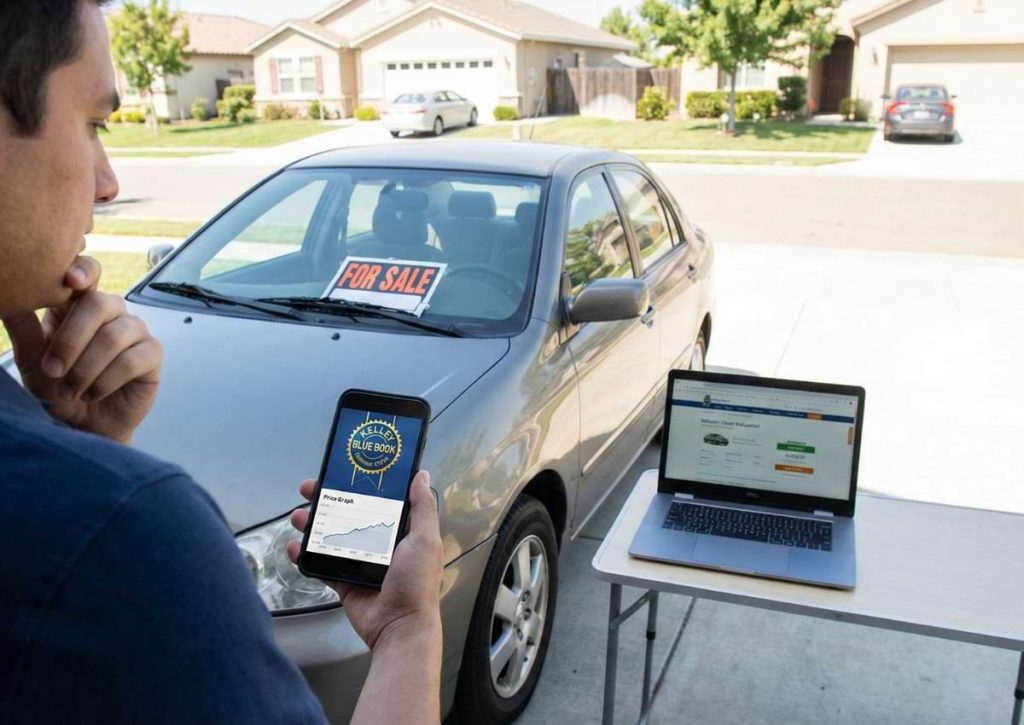
Private party value assumes a direct transaction between individuals, eliminating dealer overhead. However, achieving this price requires substantial effort and time investment.
Sellers must handle advertising, screening potential buyers, managing test drives, and completing paperwork independently. The process typically requires 30-45 days and involves safety considerations when meeting strangers.
Most private sellers receive 90-95% of the KBB private party value after negotiations. Vehicles with documented maintenance history and clean Carfax reports perform better.
Fair Purchase Price
Fair purchase price represents KBB's assessment of realistic transaction amounts based on recent regional sales. This metric adjusts for local market conditions, seasonal demand, and current inventory levels.
During January 2025, fair purchase prices for SUVs in northern states showed premiums of 3-7% compared to southern markets, reflecting winter demand patterns. These regional variations update continuously as transaction data flows into KBB's systems.
How KBB Determines Used Car Prices
Data Collection Methodology
KBB analyzes vehicle transactions through partnerships with:
- Wholesale auction houses (Manheim, ADESA)
- Franchise dealership networks
- Independent dealer associations
- State DMV sale records
- Online marketplace completed sales
Each data source undergoes verification to eliminate outliers and ensure representative pricing. A single make and model may include 1,000-5,000 transactions monthly in major markets.
Price Adjustment Factors
Mileage Impact:
- 12,000 miles annually: baseline valuation
- Each 1,000 miles over average: $50-150 reduction
- Low mileage bonus: $30-100 per 1,000 miles under
- Luxury vehicles show greater mileage sensitivity
Condition Assessment:
| Condition Rating | Description | Value Impact |
| Excellent | No visible defects, complete records | +5% to +8% |
| Very Good | Minor blemishes, regular maintenance | 0% to +3% |
| Good | Normal wear, functioning systems | Baseline |
| Fair | Visible wear, minor mechanical issues | -10% to -15% |
| Poor | Significant damage or mechanical problems | -20% to -30% |
Optional Equipment: Premium packages, navigation systems, and advanced safety features add $1,500-4,500 to base valuations. Technology features depreciate faster than mechanical upgrades.
Vehicle Depreciation Patterns
First Five Years Depreciation
| Year | Average Depreciation | Cumulative Loss |
| Year 1 | 20-25% | 20-25% |
| Year 2 | 15-18% | 35-40% |
| Year 3 | 10-15% | 45-50% |
| Year 4 | 8-12% | 53-58% |
| Year 5 | 7-10% | 60-65% |
Full-size pickup trucks and popular SUVs demonstrate slower depreciation, retaining 50-55% of original pricing value after five years. Luxury sedans typically hold only 35-40% of MSRP during the same period.
Electric vehicles showed unusual patterns during 2023-2024, with some models depreciating 30% in year one due to federal tax credit changes and increased competition.
New Car Pricing Components
Understanding MSRP vs Invoice vs Fair Price
Manufacturer's Suggested Retail Price (MSRP) represents the starting point for negotiations. Invoice price shows what dealers pay manufacturers, though holdback bonuses and volume incentives create additional profit margins.
Fair purchase price for new vehicles typically falls between invoice and MSRP, adjusted for:
- Current manufacturer incentives
- Regional market competition
- Model availability and demand
- Time of year (model year clearance periods)
During December 2024, outgoing model year vehicles showed fair purchase prices averaging 5-9% below MSRP, while newly redesigned models maintained pricing at 1-2% below MSRP.
KBB Pricing Accuracy Analysis
Where KBB Performs Well
Kelley Blue Book provides reliable valuations for:
- Mainstream vehicles with high transaction volumes
- Recent model years (1-5 years old)
- Standard trim levels and configurations
- Stable market conditions
Consumer Reports analysis of 2024 data showed KBB values averaging within 3-5% of actual dealer selling prices for common sedans and SUVs.
Accuracy Limitations
KBB struggles with:
- Rare vehicles or limited production models
- Extensive aftermarket modifications
- Rapid market shifts during supply disruptions
- Rural markets with limited transaction data
- Classic or collector vehicles
A 2024 study examining exotic vehicle sales found KBB valuations varied by 10-18% from actual transaction prices, reflecting data scarcity for these segments.
Why Dealer Prices Differ from KBB?
The Reality of Dealership Operations
Dealers face overhead costs not reflected in KBB valuations:
- Reconditioning and detailing: $800-2,500 per vehicle
- 60-90 day inventory holding costs
- Sales staff compensation
- Facility expenses and advertising
- Warranty obligations on used vehicles
A vehicle purchased at auction for $18,000 incurs total costs of $2,500-$ 4,000 before reaching the sales lot. Dealers must price accordingly to maintain viable operations.
Market Timing Differences
KBB values lag real-time market changes by 7-14 days. During periods of rapid price movement, dealer pricing adjusts more quickly than KBB can update its valuations. This creates temporary discrepancies that resolve as KBB incorporates new transaction data.
Comparing Pricing Tools
KBB vs Edmunds vs NADA
Data Collection Methods:
- KBB emphasizes dealer transaction data and auction results
- Edmunds focuses on actual consumer purchase reports
- NADA serves dealers with wholesale-oriented valuations
Update Frequency:
- KBB: Weekly for most vehicles, daily for volatile segments
- Edmunds: Bi-weekly adjustments with monthly comprehensive updates
- NADA: Monthly updates focused on wholesale channels
Best Use Cases:
- KBB: General consumer research and negotiation baseline
- Edmunds: Cross-verification of retail pricing
- NADA: Understanding dealer cost perspective
No single source provides definitive pricing. Responsible consumers check multiple tools and examine local market listings to establish realistic expectations.
Using KBB When Buying
Step-by-Step Research Process
Establish Baseline Value: Begin with the KBB fair purchase price for the target make, model, and trim level. Document the figure with the current date, as values change weekly.
Adjust for Actual Condition: Inspect vehicle thoroughly and honestly assess condition rating. Most used vehicles fall into the "good" category despite seller claims of "excellent" condition.
Factor Regional Variations: Compare KBB values with 10-15 similar vehicles listed locally. Market pricing reflects supply and demand realities that national averages may miss.
Calculate Total Transaction Cost: Add sales tax, registration fees, and any dealer documentation charges to the purchase price. A $25,000 vehicle costs $27,000-28,000 after these additions in most states.
Negotiation Framework
Present KBB data as one reference point among several, not as the absolute truth. Effective negotiation acknowledges dealer costs while seeking fair pricing for both parties.
Avoid stating "KBB says the price should be X." Instead, reference market research showing comparable vehicles and requesting justification for pricing differences.
Selling Using KBB Values
Setting Realistic Expectations
Sellers consistently overestimate vehicle condition, leading to disappointment when offers come below expected KBB values. Professional inspection provides an objective condition assessment.
Price 5-8% above the desired selling price when listing privately, allowing negotiation room while achieving the target amount. Most buyers expect to negotiate regardless of listing price.
KBB Instant Cash Offer Evaluation
Instant Cash Offer provides a guaranteed dealership purchase within seven days. Offers typically fall $500-1,500 below KBB trade-in value, reflecting dealer certainty and immediate payment.
This option suits sellers prioritizing convenience over maximum value. The time saved and eliminated buyer screening often justify lower proceeds.
Major Price Influencing Factors
Geographic Location Impact
Regional price variations reach 8-15% for identical vehicles:
- Coastal markets: Premium pricing on imports and EVs
- Mountain states: Trucks and AWD vehicles command higher values
- Southern states: Convertibles and sports cars show increased demand
- Northern states: Winter-capable vehicles maintain value better
Seasonal Pricing Patterns
| Season | Strong Segments | Weak Segments |
| Winter | SUVs, AWD vehicles, trucks | Convertibles, sports cars |
| Spring | All segments (peak buying season) | Previous model year inventory |
| Summer | Convertibles, sports cars, family vehicles | Heavy-duty trucks |
| Fall | Fuel-efficient sedans, upcoming model year | Outgoing model year |
Trim Level Significance
Base trim vehicles with popular options often match mid-level trim values. Buyers seeking specific features pay premiums, while unwanted luxury packages add minimal value.
A base trim with leather seats, sunroof, and advanced safety features may be valued higher than a mid-trim lacking these popular options.
Current Market Trends 2025-2026
Used Vehicle Market Stabilization
After 2021-2023 volatility, used vehicle pricing returned to historical depreciation patterns during late 2024. Values stabilized with:
- Increased new vehicle production
- Rising interest rates are reducing demand
- Normalized inventory levels at dealerships
KBB data from January 2025 showed year-over-year used vehicle price declines of 3-7% across most segments, marking a return to pre-pandemic market dynamics.
Electric Vehicle Pricing Shifts
EV used values show unique patterns:
- Rapid depreciation on older models (2019-2021)
- Improved retention on 2023+ vehicles with better range
- Battery warranty remaining significantly impacts value
- Home charging capability affects desirability by region
Supply Chain Recovery Impact
Semiconductor shortage resolution during 2024 normalized new vehicle availability, reducing pressure on used vehicle prices. Previously inflated segments saw the largest corrections:
- Compact SUVs: 8-12% value decline
- Mid-size trucks: 6-10% value decline
- Entry-level sedans: 5-8% value decline
Research Topics for Informed Buyers
Essential Pre-Purchase Investigation
Vehicle History Verification: Obtain Carfax or AutoCheck reports showing accident history, title status, and service records. KBB values assume a clean history.
Mechanical Inspection: Independent pre-purchase inspection costs $150-300 and identifies issues affecting value beyond cosmetic condition.
Market Comparison Analysis: Search current listings for identical make, model, year, and trim within 100 miles. This reveals actual asking prices versus KBB estimates.
Total Ownership Cost Research: Examine insurance rates, fuel economy, maintenance schedules, and reliability ratings. A lower purchase price means nothing if ownership costs exceed alternatives.
Understanding Financing Impact
Interest rates directly affect the affordable vehicle price. A $30,000 vehicle at 6% APR over 60 months costs $580 monthly, while 9% APR raises payments to $623 monthly.
KBB values reflect cash prices. Financed purchases must account for interest costs, potentially totaling $4,000-8,000 over the loan term.
Responsible KBB Usage Guidelines
What KBB Does Well
Kelley Blue Book excels as a starting point for pricing research. The platform provides accessible, regularly updated valuations that prevent completely unrealistic expectations during negotiations.
Use KBB to establish general price ranges and understand market positioning. The data represents thousands of transactions, offering meaningful market insight.
What KBB Cannot Do
KBB cannot replace personal inspection, market research, or professional appraisal. Valuations reflect averages, not specific vehicle condition or unique circumstances.
Never rely exclusively on KBB when making significant financial decisions. Cross-reference multiple sources and examine local market realities.
Official KBB Methodology and Data Sources
https://www.kbb.com/car-values/
Recent KBB Market Data Report
https://mediaroom.kbb.com/2025-01-15-Kelley-Blue-Book-Report-Average-New-Vehicle-Prices-Climb-Higher