
Saffron commands prices that rival precious metals; authentic strands can cost $500 to $5,000 per pound, making it one of the world’s most expensive spices by weight. Yet markets flood with “saffron” selling for $5 per ounce, raising an unavoidable question: how much should real saffron actually cost?
This research examines the true economics behind saffron pricing, from harvest labor to market manipulation, helping buyers distinguish authentic premium spice from artificially dyed impostors.
Saffron Price Tracker
Real-time market data from global sources
Last updated: —
Iranian Super Negin
Premium$12.50
/gramWholesale (FOB Iran)
Kashmiri Mongra
Ultra Premium$18.75
/gramDirect from Kashmir
Spanish Coupe DOP
EU Certified$14.20
/gramLa Mancha Region
Global Average
All Grades$10.25
/gramWeighted by volume
30-Day Price Trend
Price by Grade
Premium export grade
Standard premium
All-red stigmas
Stigma + style
Complete threads
Regional Price Comparison
| Region | Wholesale | Retail | Change |
|---|---|---|---|
| 🇮🇷 Iran | $10.50/g | $13.65/g | +1.5% |
| 🇮🇳 Kashmir | $16.00/g | $20.80/g | -0.8% |
| 🇪🇸 Spain | $11.25/g | $14.63/g | 0.0% |
| 🇦🇫 Afghanistan | $8.75/g | $11.38/g | +2.3% |
| 🇬🇷 Greece | $10.00/g | $13.00/g | +0.5% |
| 🇺🇸 USA Retail | — | $15.50/g | +1.2% |
* Retail prices include 30% average markup + import duties
Authenticity Price Thresholds
Use these benchmarks to assess if pricing aligns with authentic saffron economics
Under $4/gram
99% likelihood of counterfeit. Production costs alone exceed this threshold.
$4-8/gram
Verify carefully. Possible adulteration or old stock. Demand ISO certification.
$8-15/gram
Standard authentic range. Most Iranian Sargol/Negin grades fall here.
$15-25/gram
Premium verified grades. Kashmir Mongra, Spanish DOP, Super Negin with lab certs.
Current Market Check: Today’s average wholesale price is $10.25/gram, which falls within authentic thresholds for Sargol/Negin grades.
Market Insights & Factors
Harvest Season Impact
October-November harvest completed. Fresh 2024 crop entering market, creating price stability in Iranian grades.
Seasonal FactorKashmir Supply Constraints
Limited 2024 harvest (4.2 metric tons) maintaining Kashmir Mongra premium. Domestic Indian demand absorbing 60% of production.
Supply FactorCurrency Exchange Effects
Iranian Rial depreciation (15% YoY) making exports more competitive. USD-based pricing relatively stable despite local currency movement.
Currency FactorPrice Alerts
Mongra dropped below $19/g for first time in 3 months
2 hours agoAfghanistan prices up 8% week-over-week on export demand
5 hours agoQ1 2026 futures contracts trading at $11.20/g average
1 day agoData Sources & Methodology
Primary Sources
- • Iranian Saffron Exporters Union
- • Kashmir Saffron Growers Association
- • Spanish DOP La Mancha Council
- • USDA Foreign Agricultural Service
- • Direct importer reports
Update Frequency
- • Wholesale prices: Daily
- • Regional data: Every 6 hours
- • Retail averages: Weekly
- • Market insights: As events occur
- • Historical data: Real-time archive
Price Calculation
- • Volume-weighted averages
- • Grade-adjusted comparisons
- • Currency normalized to USD
- • FOB pricing for wholesale
- • 30% markup for retail estimates
Disclaimer: This tracker provides educational market research from publicly available sources. Prices represent market averages and may vary significantly by seller, quality verification, and transaction volume. Not intended as pricing advice for commercial purchases. For bulk procurement, consult certified traders directly.
Why Original Saffron Commands Premium Prices?
The Labor Economics Behind Saffron Cultivation
Real saffron’s cost stems from extreme production constraints:
Harvest Requirements:
- Each Crocus sativus flower produces only 3 red stigmas (saffron threads)
- Flowers bloom for 2-3 weeks annually in October-November
- 150,000-170,000 flowers needed for 1 kg of dried saffron
- Hand-harvesting must occur within hours of blooming (before midday sun)
- Manual separation of stigmas from styles requires precision work
Production Reality:
- 40 hours of manual labor per kilogram
- 0.2-0.4 hectares of land produce 1-2 kg annually
- 3 years from corn planting to the first significant harvest
- Climate-sensitive cultivation is limited to specific altitudes
According to agricultural studies from Kashmir and Iran’s Khorasan region, labor represents 60-70% of saffron’s final cost, a figure that remains consistent regardless of production location.
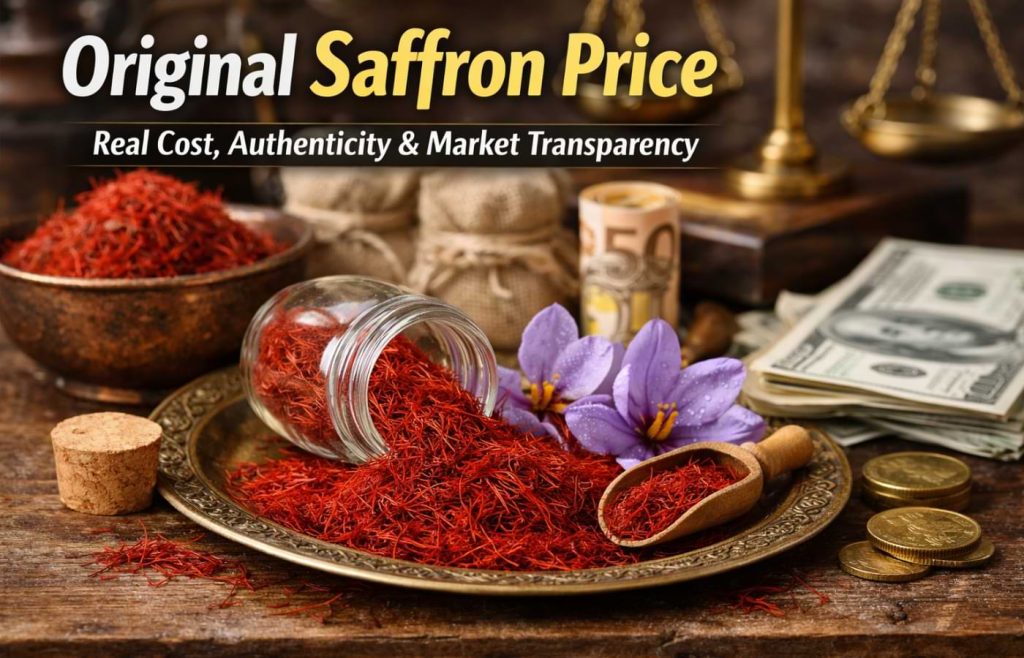
Real Saffron Price Breakdown: What You’re Actually Paying For
Price Per Gram vs Kilogram Analysis
| Quality Grade | Price Per Gram | Price Per Kg | Market Context |
| Super Negin (Iran) | $8-15 | $8,000-15,000 | Export-grade premium |
| Sargol (Coupe) | $6-12 | $6,000-12,000 | All-red stigmas, standard premium |
| Pushal | $4-8 | $4,000-8,000 | Stigma + partial style |
| Bunch (Daste) | $3-6 | $3,000-6,000 | Whole threads with style |
| Kashmiri Mongra | $10-20 | $10,000-20,000 | Limited production, highest crocin |
Note: Prices reflect wholesale/direct import rates. Retail markup adds 30-100%, depending on packaging and certification.
Micro-Pricing: Understanding Cost Per Thread
For home buyers purchasing 1-5 grams:
- Super Negin: Approximately 400-450 threads per gram
- Cost per thread: $0.018-0.033 (less than 4 cents)
- Typical recipe use: 10-20 threads
- Cost per dish: $0.18-0.66
This micro-analysis reveals why authentic saffron remains viable for home cooking despite seeming expensive. A 2-gram container provides 30-40 uses.
Price Indicators of Authenticity: The Red Flags
When Cheap Saffron Is Never Real
| Price Range | Likelihood Assessment | Common Reality |
| Under $500/kg ($0.50/g) | 99% counterfeit | Dyed corn silk, safflower, turmeric-soaked fibers |
| $500-1,500/kg | 90% adulterated | Real saffron mixed with dyed fillers, old stock |
| $1,500-3,000/kg | Potentially authentic | Lower grades (Pushal/Bunch) require verification |
| $3,000-8,000/kg | Standard premium | Sargol/Negin from established regions |
| $8,000-20,000/kg | Verified premium | Lab-tested Super Negin, Kashmiri Mongra, ISO certified |
Critical Price Logic: If harvest labor alone costs $15-25 per hour × 40 hours = $600-1,000 per kilogram before processing, packaging, or profit margins, anything priced below production cost cannot be authentic.
Fake vs Original Saffron: Visual and Price Comparison
Market Deception Tactics
Common Counterfeits and Their Pricing:
- Dyed Corn Silk
- Market price: $50-200/kg
- Appearance: Uniform color, no trumpet-shaped stigma tip
- Sold as: “Kashmiri saffron,” “Spanish saffron.”
- Safflower (Carthamus)
- Market price: $100-400/kg
- Appearance: Orange-red, broader than saffron
- Sold as: “Mexican saffron,” “American saffron.”
- Turmeric-Dyed Paper Threads
- Market price: $150-500/kg
- Appearance: Brittle, breaks easily, no elasticity
- Sold as: Generic “premium saffron.”
- Diluted Real Saffron (60-80% filler)
- Market price: $1,200-2,000/kg
- Appearance: Mixed quality, yellow styles, cut threads
- Sold as: “Pure saffron” (technically contains real saffron)
Authentic Verification Indicators
Visual Characteristics of Real Saffron:
- Deep crimson-red color with lighter orange-red tips
- Trumpet-shaped (flared) stigma end
- 2.5-4 cm thread length
- Slight moisture flexibility (not brittle)
- Distinct sweet hay-like aroma with metallic notes
Chemical Verification (Lab Standards): According to ISO 3632 standards, authentic saffron must meet:
- Crocin content: 180-250 (coloring strength)
- Picrocrocin: 70-110 (flavor compound)
- Safranal: 20-50 (aroma compound)
Water Test Results
- Real saffron: Threads retain shape, release color gradually over 10-15 minutes, water turns golden-yellow
- Fake saffron: Immediate color release (1-2 minutes), threads disintegrate, water becomes orange-red
Regional Pricing Realities: Origin Matters
Iran (90% of Global Production)
Khorasan Province Context:
- Torbat-e Heydarieh and Qaen are primary cultivation zones
- Export-grade Negin: $6,000-12,000/kg (FOB Iran)
- Domestic consumption grade: $4,000-7,000/kg
- Direct farmer price: $3,500-5,500/kg
Supply Chain Impact: U.S. sanctions on Iran (2018-present) created price volatility; authentic Iranian saffron entering through the UAE and Turkey carries a 20%-40% markup for sanction circumvention.
Kashmir, India (2% of Global Production)
Mongra Quality Premium:
- Limited production: 4-6 metric tons annually (entire Kashmir)
- Farm gate price: $8,000-12,000/kg
- Retail in India: $12,000-20,000/kg
- International export: $15,000-25,000/kg
Price Driver: Highest crocin levels (250+) and monofloral cultivation (single-origin purity) justify a premium over Iranian equivalents.
Spain (Mancha Saffron)
European Context:
- Production: 1-1.5 metric tons annually
- Coupe quality: €7,000-12,000/kg (approximately $7,500-13,000/kg)
- DOP certification adds €1,500-2,500/kg
Market Positioning: Protected designation of origin (DOP) and organic certification create a European premium market with traceability emphasis.
United States Retail Pricing
Consumer Market Breakdown (2024-2025- 2026)
| Source/Grade | 1g Retail | 5g Retail | Per-Gram Effective Cost |
| Supermarket brand (questionable) | $6-12 | $20-40 | $4-8/g |
| Specialty store (verified origin) | $12-18 | $50-75 | $10-15/g |
| Direct import (online, ISO certified) | $10-15 | $45-65 | $9-13/g |
| Gourmet shop (Kashmir/Spain DOP) | $18-25 | $80-110 | $16-22/g |
Buying Strategy: Direct importers with ISO 3632 lab certificates offer the best value-to-authenticity ratio, and avoid supermarket brands under $8/gram retail.
Quality Grading System: Understanding Premium Tiers
Iranian Classification (Most Common Globally)
- Super Negin (نگین سوپر)
- Only thick, long stigmas (>3cm)
- Zero yellow style content
- Highest crocin (220-250)
- Price: $10-15/g wholesale
- Negin (نگین)
- Uniform red stigmas, 2.5-3.5 cm
- Minimal style traces
- Crocin: 200-230
- Price: $8-12/g wholesale
- Sargol (سرگل) “Top of the Flower”
- Pure stigma, cut at style separation
- Industry standard premium
- Crocin: 190-210
- Price: $6-10/g wholesale
- Pushal (پوشال)
- Stigma + 1-3mm style attached
- Budget premium option
- Crocin: 170-190
- Price: $4-7/g wholesale
- Bunch/Daste (دسته)
- Complete threads with style
- Traditional household grade
- Crocin: 150-170
- Price: $3-5/g wholesale
Spanish Classification
- Coupe: Equivalent to Sargol (stigma only)
- La Mancha: Style-inclusive grade (similar to Pushal)
- Sierra: Lower-grade regional harvest
Key Difference: Spanish saffron legally requires a minimum of 190 crocin for the “Coupe” designation, slightly higher than the Iranian Sargol baseline.
Market Transparency Issues: What Sellers Don’t Disclose
Age and Storage Impact on Pricing
Saffron Degradation Reality:
| Storage Duration | Crocin Loss | Legitimate Price Adjustment | Market Practice |
| Fresh (0-6 months) | 0-5% | Full price | Often sold at peak |
| 6-12 months | 5-12% | 10-15% discount warranted | Rarely disclosed |
| 12-24 months | 12-25% | 20-30% discount warranted | Sold as “vintage” premium |
| 24+ months | 25-40% | 40%+ discount warranted | Mixed with fresh stock |
Consumer Insight: Unless stored in airtight, dark, cool conditions, saffron loses coloring strength 0.8-1.2% monthly; “bargain” bulk purchases of 50-100g may be old stock.
Country-of-Origin Mislabeling
Common Repackaging Schemes:
- Iranian saffron → Repackaged in Spain → Sold as “Spanish saffron”
- Afghan saffron → Repackaged in Kashmir → Sold as “Kashmiri Mongra”
- Low-grade Iranian → Relabeled as Kashmir/Spain premium
Price Impact: Repackaged product carries a 50$-200% markup over origin pricing despite identical quality.
Verification Solution: ISO 3632-2 testing + origin DNA analysis (available from specialty labs like Arotz Biotechnology) confirms authenticity; legitimate premium sellers provide test certificates.
How to Verify Authentic Saffron Before Purchase
Pre-Purchase Verification Checklist
Documentation Requirements:
✅ ISO 3632 Laboratory Certificate
- Crocin value (coloring strength)
- Picrocrocin (bitterness index)
- Safranal (aroma profile)
- Moisture content (<12%)
- Test date within 6 months
✅ Origin Certification
- Farm location (specific region, not just “Iran/Kashmir”)
- Harvest year
- Import documentation (for international products)
✅ Grade Declaration
- Specific grade (Super Negin, Sargol, Mongra, etc.)
- Thread length specification
- Style content percentage
Physical Inspection Points:
| Characteristic | Authentic | Suspicious |
| Color uniformity | Natural variation, darker center | Perfect uniformity (dyed) |
| Thread tip | Flared trumpet shape | Pointed or frayed |
| Texture | Slightly greasy feel | Completely dry/brittle |
| Breakage | Minimal when bent | Shatters easily |
| Aroma | Complex: honey, hay, slight metallic | Single-note or absent |
At-Home Authentication Tests
Water Dissolution Test (15-Minute Method):
- Place 3-5 threads in 2 tablespoons of warm water (not hot)
- Observe color release pattern:
- Authentic: Gradual golden-yellow tint over 10-15 minutes, threads remain intact
- Fake: Immediate red/orange burst within 2 minutes, threads dissolve or lose color
Baking Soda Reaction Test:
- Soak threads in 1 tablespoon of warm water for 10 minutes
- Add 1/4 teaspoon baking soda
- Authentic saffron: Color shifts to deep yellow (crocin reacts)
- Fake saffron: Color remains orange-red (synthetic dye)
Taste Test (Last Resort):
- Real saffron: Bitter initial taste, followed by floral sweetness, slight metallic note
- Fake: Tasteless, harsh bitterness only, or excessively sweet
Smart Buying Strategies: Balancing Price and Authenticity
Price-to-Quality Sweet Spots
For Home Cooking (5-10g purchases):
- Target price: $9-13/gram retail
- Recommended grade: Sargol/Negin from certified importers
- Purchase frequency: Small quantities (2-5g) every 6 months
For Frequent Users (Restaurants/Enthusiasts):
- Target price: $6-9/gram (25-50g bulk)
- Recommended grade: Pushal (best value for frequent use)
- Direct importer relationships: Reduce markup 30%-40%
For Special Occasions/Gifting:
- Target price: $15-22/gram
- Recommended grade: Super Negin, Kashmir Mongra, Spanish DOP
- Verify premium through lab certificates, not packaging claims
Red Flags That Indicate Overpricing or Fraud
Avoid These Scenarios:
❌ “Rare Kashmiri saffron, limited supply” + price under $10/gram
- Kashmir produces 4-6 tons annually, not rare, but limited
- Authentic Mongra rarely retails below $15/gram internationally
❌ “Organic saffron” with 200%+ premium over conventional
- Saffron cultivation naturally uses minimal inputs
- “Organic” certification is legitimate, but shouldn’t triple prices
❌ “Grade A+++ Super Premium” with no ISO certification
- Grade terminology outside Iranian/Spanish systems is marketing
- Absence of lab testing suggests quality claims are unverifiable
❌ Vacuum-sealed jars with visible moisture condensation
- Indicates improper storage or packaging of high-moisture content
- Will degrade rapidly regardless of initial quality
FAQ
How much should I pay for 1 gram of real saffron?
Authentic saffron ranges $6-15 per gram wholesale, with retail prices of $9-20/gram depending on grade and origin. Iranian Sargol ($9-13/g retail) offers the best value-to-quality ratio for most buyers. Kashmir Mongra ($15-22/g retail) justifies a premium through higher crocin content and limited production.
Why is saffron more expensive than gold by weight?
Labor intensity drives saffron’s cost; 150,000 hand-picked flowers yield 1 kilogram, requiring 40+ hours of manual work. Unlike gold mining’s economies of scale, saffron production remains artisanal. Current saffron prices ($6,000-15,000/kg) occasionally exceed gold ($60,000/kg) on a per-ounce comparison due to harvest constraints.
Can real saffron ever be cheap?
No. Production cost floors exist: labor ($600-1,000/kg), processing, packaging, and supply chain margins mean authentic saffron cannot retail below $4-5/gram wholesale ($8-10/g retail) without operating at a loss. Anything cheaper is adulterated or counterfeit.
How can I tell if saffron is fake by looking at the price?
Apply the “production cost test”: If the retail price is under $8/gram ($8,000/kg), it fails basic economics. Wholesale prices below $4/gram cannot cover harvest labor costs. Iranian Super Negin under $10/gram wholesale or Kashmir Mongra under $12/gram wholesale are statistically impossible without subsidy or fraud.
Does expensive saffron mean it’s automatically authentic?
No. High price ≠ guarantees authenticity; some sellers exploit premium positioning by overcharging for mediocre grades. Always demand ISO 3632 lab certificates with crocin/picrocrocin/safranal values regardless of price. Legitimate premium saffron (>$15/g retail) should include test documentation and origin traceability.
What’s the difference between cheap saffron and expensive saffron?
Cheap saffron ($0.50-5/g) is typically dyed corn silk, safflower substitutes, or heavily adulterated real saffron with 50-80% filler content. Expensive saffron ($10-20/g) should be: pure stigmas from verified origins, ISO-tested quality, and proper storage. The price gap reflects authenticity, not just quality grades.
Is Spanish saffron better than Iranian saffron?
Not inherently, both regions produce exceptional quality when properly graded. Iranian saffron offers better value (higher production volume = lower costs), while Spanish DOP saffron commands premiums through EU certification and limited supply. Chemical analysis shows comparable crocin levels in top grades from both origins.
How much saffron do I need for cooking, and how much will it cost?
Most recipes use 10-20 threads (approximately 0.02-0.04 grams). At $12/gram retail (Sargol grade), this equals $0.24-0.48 per dish. A 2-gram container ($24) provides 50-100 uses, making authentic saffron cost-effective despite high per-gram pricing.
Why do Kashmir and Iranian saffron have different prices?
Supply economics: Iran produces 300+ tons annually (90% global supply), while Kashmir produces 4-6 tons. Kashmir Mongra’s scarcity and highest-in-world crocin content (250+) justify $15-20/gram versus Iranian Super Negin at $10-15/gram. Both are authentic; price difference reflects production scale and chemical potency.
Can I trust saffron sold on Amazon or eBay?
Caution required. Legitimate sellers exist but platforms host significant counterfeit inventory. Verification strategy: (1) Seller provides ISO 3632 certificates, (2) Reviews mention lab testing or water tests, (3) Price aligns with $9-15/gram retail range, (4) Brand has verifiable import documentation. Avoid “too good to be true” deals under $7/gram.
Conclusion: Price as Authenticity Gateway
Real saffron’s cost is non-negotiable; the plant’s biology, harvest limitations, and labor requirements create a production cost floor that cannot be circumvented. While price alone doesn’t guarantee authenticity, it serves as the first and most reliable filter: genuine saffron cannot exist below $4-5 per gram wholesale.
For buyers, the framework is straightforward: invest in certified grades from transparent sources, verify through ISO testing when purchasing premium products, and recognize that saffron’s true value lies in its micro-usage; 20 threads per dish makes even $15/gram saffron cost less than specialty salt.
The market’s abundance of counterfeit products will persist as long as information gaps exist. By understanding production economics and verification methods, consumers transform from vulnerable targets to informed buyers who can access authentic saffron at fair market original prices.