
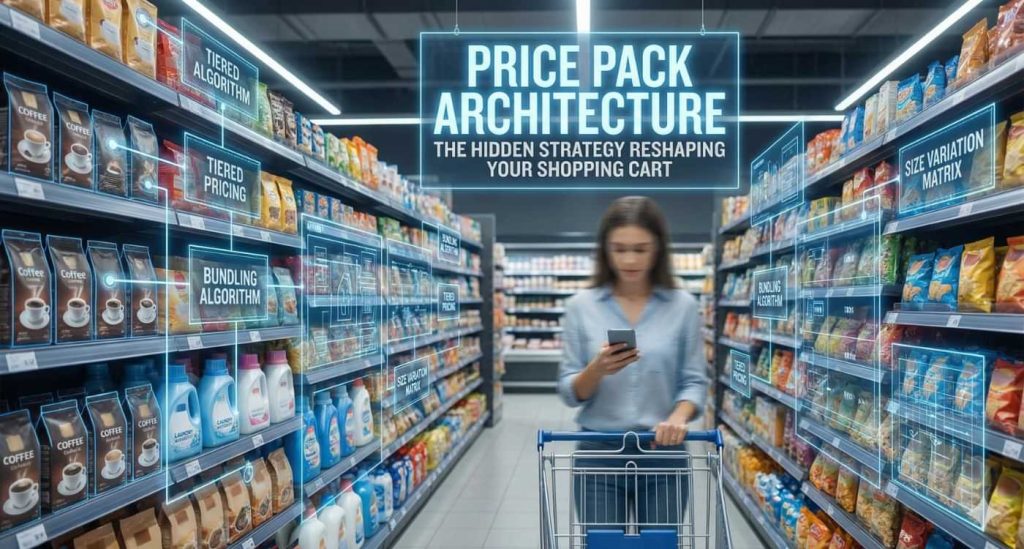
You’ve probably noticed it at the grocery store: your favorite snack seems smaller, or the bottles on the shelf look different. Welcome to the world of Price Pack Architecture (PPA), a pricing strategy that’s quietly transforming how companies manage costs without alarming customers with dramatic price hikes.
What Is Price Pack Architecture?
Price Pack Architecture is a strategic approach to product packaging and pricing that involves adjusting package sizes, formats, or quantities while managing the price point. Instead of raising the price on your 16-ounce bag of chips, a company might introduce a 13-ounce bag at the same price or slightly lower.
The core components of PPA include:
- Package size optimization
- Multi-pack bundling strategies
- Price point anchoring
- Format variations (bottles vs. cans, bags vs. boxes)
Unlike simple price increases, PPA gives brands flexibility to respond to rising costs while maintaining psychological price points that consumers expect.
Price Pack Architecture vs. Shrinkflation: Understanding the Difference
The New York Times recently called PPA a “euphemism for shrinkflation,” but the two concepts aren’t quite identical.
The Key Distinctions
| Aspect | Price Pack Architecture | Shrinkflation |
|---|---|---|
| Strategy | Comprehensive portfolio planning | Single tactic: reduce package size |
| Transparency | May include multiple pack sizes at different price points | Often subtle, hoping consumers won’t notice |
| Scope | Entire product line optimization | Individual product reduction |
| Communication | Sometimes announced as “new sizing options.” | Rarely communicated directly |
Shrinkflation is when your ice cream container quietly shrinks from 64 ounces to 48 ounces at the same price. It’s a subset of PPA, but PPA encompasses much more.
PPA might mean offering three sizes: a small format for budget shoppers, a medium “value” size, and a large bulk option. This gives consumers a choice while protecting profit margins.
🛒 Price Pack Architecture Calculator
Compare package sizes and detect shrinkflation instantly
Your Comparison Results
Shrinkflation Detected!
💡 Shopping Smart Tips
Why Revenue Managers Are Embracing PPA?
According to industry surveys, 80% of revenue managers say PPA is becoming more relevant to their business. Here’s why:
Rising input costs are relentless. Commodity prices, transportation, and packaging materials all fluctuate. When costs spike, brands face a choice: absorb losses or pass them to consumers.
Direct price increases hurt sales. Consumers notice when their $4.99 cereal jumps to $5.99. Purchase frequency drops, and customers may switch to competitors or store brands.
Psychological pricing matters. There’s a real difference between $4.99 and $5.00 in consumer psychology. PPA lets brands hold that critical price point while adjusting the value equation.
Competitive pressure is intense. If your competitor holds their price steady with a smaller package, you might lose shelf space or market share by raising prices outright.
Understanding these dynamics is crucial for anyone trying to avoid common pricing mistakes that cost money.
How Brands Use Pack Size Changes to Manage Costs?
The execution of PPA involves several sophisticated techniques:
1. Graduated Size Ladders
Brands create a range of sizes at strategic price points:
- Single-serve: $1.99 (high unit price, convenience premium)
- Standard: $4.99 (the old “normal” size)
- Family size: $7.99 (better value per ounce, but higher total spend)
This isn’t just about smaller packages; it’s about giving consumers a reason to choose each size.
2. The “New and Improved” Pivot
When reformulating a product, brands introduce a “new” version in a different size. The old 24-count box might become a 20-count “better tasting” version.
3. Multi-Pack Strategies
Instead of selling a 12-ounce bag, sell three 4-ounce bags as a “variety pack” or “portion control” option. The total price might be higher, but it feels different.
4. Format Switching
Move from bags to resealable pouches, from boxes to canisters. The new format distracts from size changes and can command a premium for added “convenience.”
These strategies increasingly rely on machine learning to predict customer willingness to pay at different price-size combinations.
The Consumer Impact: What You Need to Know
PPA affects your wallet, but being informed helps you fight back:
Price Per Ounce Is Your Best Friend
Always check the unit price on shelf tags. A 10-ounce bottle at $3.99 might seem cheaper than a 16-ounce bottle at $5.99, but you’re paying $0.40 per ounce versus $0.37 per ounce.
Quick comparison:
| Product | Total Price | Size | Price Per Ounce | Better Value? |
|---|---|---|---|---|
| Small bottle | $3.99 | 10 oz | $0.40/oz | ❌ |
| Large bottle | $5.99 | 16 oz | $0.37/oz | ✅ |
Many shoppers skip this calculation, which is why using a price calculator can beat mental math and save you money.
Watch for “Value Size” Traps
Sometimes the “family size” or “value pack” isn’t actually a better deal. Companies know consumers assume bigger = better value, but that’s not always true.
Historical Package Sizes
Keep mental notes of package sizes you regularly buy. When your 16-ounce container becomes 14 ounces, you’ll notice and can make informed decisions.
Tools to Combat Price Pack Architecture
Smart consumers are fighting back with technology and strategy:
Store apps and unit price displays: Most major retailers now show unit pricing on shelf tags. Use them religiously.
Reverse discount calculations: If you know the old package was 16 oz at $4.99, you can figure out what the new 14 oz package should cost to maintain value. Our reverse discount calculator helps you do this math instantly while shopping.
Bulk buying strategies: When you find a product before it transitions to PPA, stock up. Non-perishables can be bought in quantity.
Store brand alternatives: Generic brands often lag behind name brands in implementing PPA, offering better value temporarily.
The Industry Perspective
Companies defend PPA as necessary for survival. Here’s their argument:
Input costs have risen 20-40% for many packaged goods since 2020. Raising prices proportionally would have pushed that $4.99 cereal to $7.00+, destroying sales volume.
PPA lets brands maintain the “price point architecture” on shelves. The $1, $2, $5, and $10 price points are psychological anchors. Consumers shop by these landmarks, so brands design their entire portfolio around them.
From a business standpoint, it’s not about deception; it’s about staying competitive while managing margins.
Is Price Pack Architecture Here to Stay?
The short answer: yes.
As long as input costs remain volatile and consumer price sensitivity stays high, PPA will be a core tool in the pricing toolkit. Revenue managers increasingly see it as more sustainable than the old pattern of holding prices for years, then shocking consumers with large increases.
The trend is accelerating because:
- E-commerce makes it easier to test different pack sizes and prices
- Data analytics help brands optimize size-price combinations
- Inflation has made consumers more accepting of change
- Private label competition forces innovation
What consumers can do is stay informed, calculate value per unit, and vote with their wallets.
Making Smarter Shopping Decisions
You can’t stop PPA, but you can outsmart it:
Create a price book. Note the unit prices of items you buy regularly. Track changes over time.
Compare across brands. PPA affects brands differently. When one brand shrinks, competitors might not follow immediately.
Reconsider brand loyalty. If your favorite brand is using aggressive PPA while the store brand isn’t, maybe it’s time to switch.
Buy based on unit cost. Train yourself to ignore the package size and total price. Focus only on cost per ounce, per pound, or per unit.
Many shoppers who implement these strategies report savings of 10-15% on grocery bills, simply by being more aware of pricing structures.
The Future of Pricing Transparency
Some encouraging trends are emerging:
Regulatory attention: Consumer protection agencies in several states are looking at requiring clearer unit pricing displays.
Retailer transparency: Some chains are experimenting with shelf tags that show size changes from previous versions.
App solutions: Third-party apps are emerging that track package size changes and alert shoppers.
The more consumers demand transparency, the more pressure brands face to be honest about changes.
Final Thoughts
Price Pack Architecture isn’t inherently good or evil; it’s a business tool. Understanding it empowers you to make better decisions and avoid the pricing mistakes that cost money over time.
The key is awareness. Every time you shop, you’re navigating a carefully designed pricing landscape. Brands spend millions optimizing these decisions. You can spend a few seconds checking unit prices to protect your budget.
In an era where every dollar counts, that’s time well spent.