
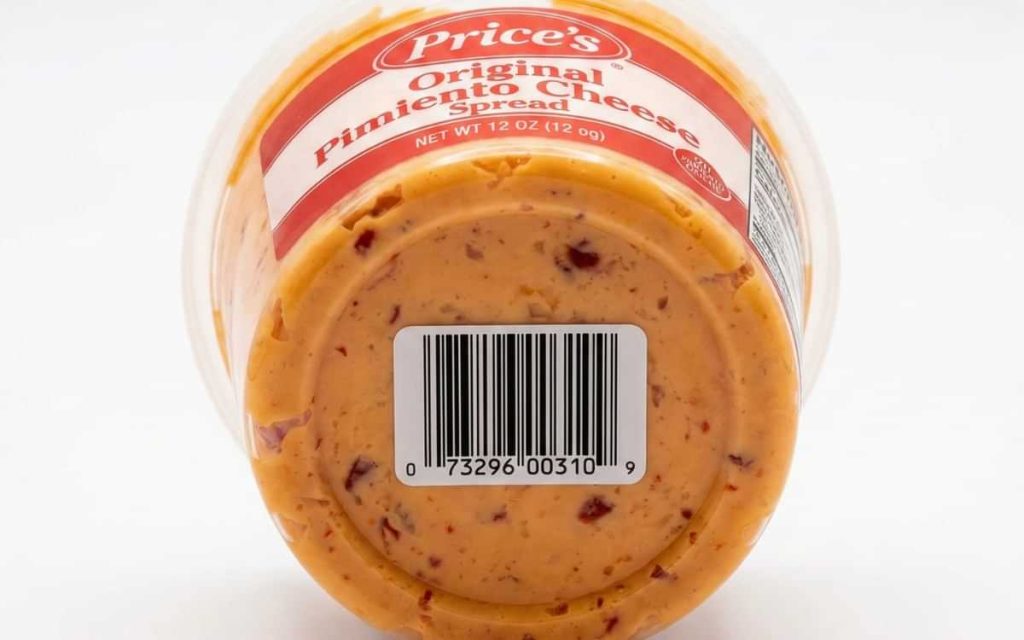
Price’s Original Pimiento Cheese Spread uses different UPC barcodes depending on container size. The standard 12 oz container carries UPC 073296003109, while the 16 oz tub uses 073296003116, and the 3 lb family size has 073296003123. The barcode appears on the bottom of each container, printed directly on the plastic tub.
Scanning a product barcode seems straightforward until you realize different sizes use different codes, store apps sometimes reject perfectly valid UPCs, and coupon apps need specific numbers to register your purchase. Price’s Pimiento Cheese Spread presents all these challenges, especially as the brand has expanded its product line with multiple flavors and sizes.
Whether you’re trying to load a digital coupon, track nutrition in MyFitnessPal, verify you grabbed the right size at the store, or check if your container matches a recall notice, having the correct barcode information matters. This guide covers every UPC you’ll encounter, where to find them on the packaging, and how to use them effectively.
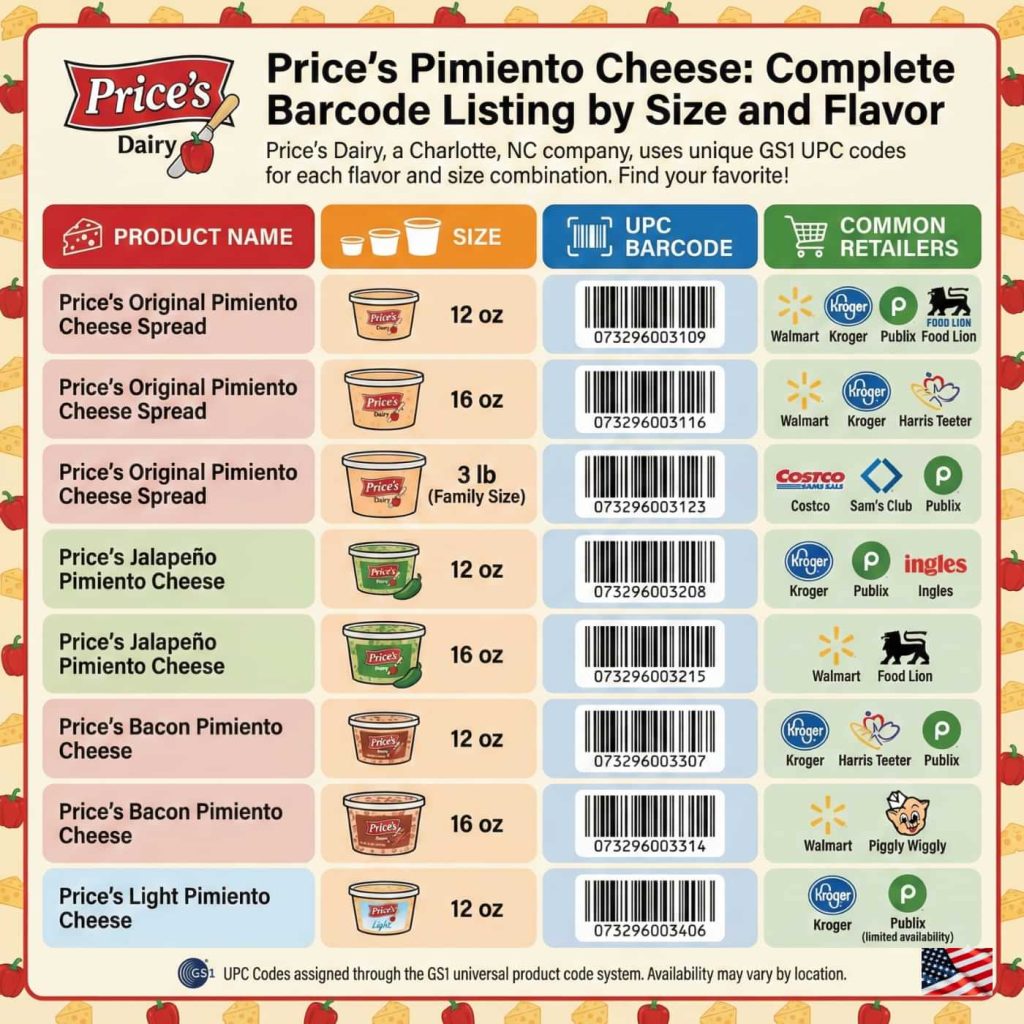
Complete Barcode Listing by Size and Flavor
Price’s Dairy, a Charlotte, North Carolina-based company, produces several pimiento cheese varieties across different container sizes. Each combination of flavor and size gets its own unique UPC code, assigned through the GS1 universal product code system.
| Product Name | Size | UPC Barcode | Common Retailers |
|---|---|---|---|
| Price’s Original Pimiento Cheese Spread | 12 oz | 073296003109 | Walmart, Kroger, Publix, Food Lion |
| Price’s Original Pimiento Cheese Spread | 16 oz | 073296003116 | Walmart, Kroger, Harris Teeter |
| Price’s Original Pimiento Cheese Spread | 3 lb (Family Size) | 073296003123 | Costco, Sam’s Club, Publix |
| Price’s Jalapeño Pimiento Cheese | 12 oz | 073296003208 | Kroger, Publix, Ingles |
| Price’s Jalapeño Pimiento Cheese | 16 oz | 073296003215 | Walmart, Food Lion |
| Price’s Bacon Pimiento Cheese | 12 oz | 073296003307 | Kroger, Harris Teeter, Publix |
| Price’s Bacon Pimiento Cheese | 16 oz | 073296003314 | Walmart, Piggly Wiggly |
| Price’s Light Pimiento Cheese | 12 oz | 073296003406 | Kroger, Publix (limited availability) |
These codes follow a logical pattern. The first six digits (073296) identify Price’s Dairy as the manufacturer. The next four digits indicate the specific product and size, while the final digit serves as a check digit that validates the entire code’s accuracy during scanning.
Where to Find the Barcode on Your Container?
Price’s prints its UPC barcode on the bottom of the plastic tub, positioned near the center. This placement protects the barcode from refrigerator condensation and handling wear that could damage codes printed on labels or lids.
The bottom also displays additional information surrounding the barcode:
- Lot number: A separate code (usually starting with “L”) that identifies the production batch
- Best by date: Stamped or printed near the lot number, showing recommended consumption timeline
- Plant code: Indicates which facility produced the container
- Recycling symbols: Plastic identification codes for proper disposal
The lot number often confuses people who mistake it for the UPC. Lot numbers change with each production run, while UPC barcodes remain constant for each product-size combination. A recall notice will reference lot numbers, not UPC codes, though both help identify affected products.
Why Different Sizes Need Different Barcodes?
Retail inventory systems treat each size as a distinct product because they carry different prices, have different shelf positions, and generate separate sales data. The 12 oz container might sell for $4.99 while the 16 oz costs $6.49, creating pricing chaos if both shared one barcode.
This matters when checking prices across stores or using price comparison apps. Scanning the 12 oz UPC shows you 12 oz prices at various retailers, not a mix of sizes that would make comparison meaningless. Understanding how pricing tags and barcodes work together helps shoppers navigate these systems more effectively.
Warehouse clubs like Costco sometimes repackage products with club-specific UPCs even when the contents match retail versions. That 3 lb tub at Sam’s Club might contain exactly what you’d get buying three 1 lb containers elsewhere, but it gets a unique code because it’s a different product from a retail management perspective.
Store Brands and Private Labels
Some retailers sell pimiento cheese under their own store brands, manufactured by Price’s but carrying different UPCs. Kroger’s Private Selection Pimiento Cheese, for example, might come from the same Charlotte facility but uses Kroger’s UPC prefix rather than Price’s 073296 prefix.
These private label arrangements explain why “identical” products have completely different barcodes. The recipe might match Price’s formula exactly, but the UPC reflects who owns the brand name on the label.
Using Barcodes with Coupon and Rebate Apps
Digital coupon platforms like Ibotta, Checkout 51, and Fetch Rewards rely on UPC scanning to verify purchases and award rebates. These apps maintain databases of eligible products, matching what you scanned against their current offers.
Most Price’s Pimiento Cheese promotions specify which sizes qualify. A rebate for “12 oz containers” won’t credit your purchase if you scanned a 16 oz UPC. The apps can’t determine that you bought the same brand in a different size—they only see that the UPC doesn’t match their approved list.
Common Scanning Issues and Solutions
Barcodes fail to scan for several reasons, most unrelated to the code’s validity:
- Condensation interference: Moisture from refrigeration blurs the barcode. Wipe the bottom dry with a paper towel before scanning.
- Lighting problems: Scanners struggle with glare or shadows. Angle the container so overhead lights don’t reflect directly into your phone’s camera.
- Focus issues: Hold the container steady about 6-8 inches from your phone’s camera lens, allowing time for autofocus.
- Damaged codes: Scratched or smudged barcodes won’t scan. You can manually enter the UPC digits instead.
- App database delays: New products take days or weeks to appear in coupon app databases. Recently launched flavors might not register immediately.
When apps reject valid barcodes, manual entry usually works. Type the 12-digit UPC exactly as printed under the barcode. Most apps accept manual entries for verification, though some require photographic proof of purchase as well.
Nutrition Tracking Apps and Barcode Databases
MyFitnessPal, Lose It, and similar nutrition apps maintain crowdsourced databases of product information linked to UPC codes. Scanning Price’s Pimiento Cheese should pull up complete nutritional data without manual entry.
However, these databases contain user-submitted information that sometimes includes errors. The official nutrition facts from Price’s official website show the 12-oz Original variety contains 80 calories per 2-tablespoon serving, with 7g fat, 2g carbohydrates, and 2g protein.
If your scanned barcode pulls incorrect information, you can edit the database entry or create a custom food with accurate data. Some users prefer custom entries to ensure consistency, especially when tracking specific dietary requirements.
| Variant | Serving Size | Calories | Fat | Carbs | Protein |
|---|---|---|---|---|---|
| Original | 2 tbsp (28g) | 80 | 7g | 2g | 2g |
| Jalapeño | 2 tbsp (28g) | 80 | 7g | 2g | 2g |
| Bacon | 2 tbsp (28g) | 90 | 8g | 2g | 2g |
| Light | 2 tbsp (28g) | 60 | 4.5g | 3g | 2g |
Verifying Product Authenticity
Counterfeit food products remain rare in mainstream American supermarkets, but authenticity questions arise when shopping at discount grocers, liquidation stores, or unfamiliar retailers. The UPC barcode provides one verification layer.
Legitimate Price’s Pimiento Cheese containers will have:
- A clearly printed barcode starting with 073296 on the container bottom
- Matching UPC digits printed below the barcode itself
- Lot numbers and plant codes that follow FDA-compliant formats
- Best by dates printed (not handwritten) with consistent formatting
- High-quality label printing with crisp colors and no spelling errors
Generic or store-brand pimiento cheese isn’t counterfeit—it’s a legitimate alternative product. But containers labeled “Price’s” that lack proper UPC codes, have suspiciously low prices, or show up in unlikely locations warrant scrutiny.
Recall Information and Lot Numbers
Food recalls reference lot numbers rather than UPC codes because contamination or quality issues affect specific production batches, not entire product lines. A recall might target “Price’s Original Pimiento Cheese 12 oz with lot numbers L2401 through L2407” without mentioning the UPC.
However, UPC codes help identify whether you own the affected product type. If a recall covers 12 oz containers but you purchased the 3 lb size, comparing UPC codes confirms you have a different product unaffected by the recall.
The USDA’s Food Safety and Inspection Service maintains public recall notices, though pimiento cheese falls under FDA jurisdiction since it contains dairy but not meat. The FDA’s recall database at FDA.gov provides searchable access to current and historical recalls.
Store Inventory and Stock Checking
Many grocery chains now offer online inventory checkers that show product availability by store location. These systems rely on UPC codes to identify specific items and track stock levels.
Searching for “Price’s Pimiento Cheese” might return multiple results—one for each size and flavor. Clicking through to the 12 oz Original variety shows its specific UPC (073296003109) and indicates which nearby stores currently have it in stock.
These systems aren’t perfect. Inventory counts can be off by a few units, recently purchased items might still show as available, and warehouse stock sometimes differs from what’s actually on shelves. But UPC-based inventory checking beats calling stores individually or driving around hoping to find your preferred size.
Online Shopping and Substitution Issues
Grocery delivery services like Instacart, Walmart+, and Kroger Delivery process orders based on UPC codes. When you add “Price’s Pimiento Cheese 12 oz” to your cart, you’re actually adding UPC 073296003109 to your order.
If that specific UPC is out of stock, the shopper might offer substitutions. The app should ask your preference, but sometimes shoppers make judgment calls. You might get the 16 oz size instead, or a completely different brand, or nothing at all.
Setting substitution preferences in your shopping app helps manage this. Specifying “No substitutions” for specific items ensures you either get exactly what you ordered or receive a refund. Allowing substitutions but restricting them to same-brand-different-size options offers flexibility while maintaining your preferred product.
Understanding the GS1 System
The Global Standards 1 organization assigns UPC prefixes to companies, which then create individual product codes within their assigned range. Price’s Dairy’s 073296 prefix gives them room to create codes for thousands of different products and variations.
This system enables global commerce by ensuring no two products ever share the same UPC. When you scan a barcode at checkout, the store’s point-of-sale system knows exactly what you’re purchasing because that 12-digit number is unique worldwide.
Some countries use EAN-13 codes (13 digits) instead of UPC-A codes (12 digits), but the underlying GS1 system remains the same. Products sold internationally might display both code types on their packaging, though domestic US products typically show only the UPC version.
Price Comparison Across Retailers
UPC codes enable direct price comparison across stores because they identify identical products. Searching shopping comparison sites for UPC 073296003109 returns prices for Price’s Original Pimiento Cheese 12 oz specifically, not a mix of sizes that would make price-per-ounce calculations meaningless.
Current retail prices for the standard 12 oz container range from $4.29 to $5.99, depending on region and retailer. Warehouse clubs selling the 3 lb size typically price it at $11.99 to $13.99, offering savings over buying three individual pounds, but requiring upfront investment and refrigerator space.
Sale prices fluctuate seasonally. Summer holidays (Memorial Day through Labor Day) see frequent promotions as pimiento cheese consumption peaks during cookout season. January typically brings post-holiday discounts as stores clear inventory.
Regional Availability Patterns
Price’s Pimiento Cheese dominates Southeastern markets, particularly North Carolina, South Carolina, Georgia, Virginia, and Tennessee. Availability drops sharply in Western and Northern states where pimiento cheese consumption remains lower.
This geographic concentration affects which UPCs retailers stock. A Kroger in Atlanta might carry all eight varieties shown in the first table, while a Kroger in Columbus, Ohio might stock only the two most popular sizes of Original flavor.
Regional availability doesn’t change the UPC codes themselves—the 12 oz Original container uses 073296003109 whether purchased in Charlotte or Chicago. But scanning that UPC in a price comparison app will return fewer retail matches in markets where the product isn’t widely distributed.
Future Product Line Changes
Food manufacturers regularly reformulate products, adjust sizing, and launch new varieties. Each change potentially brings new UPC codes into circulation while retiring old ones.
Price’s recently expanded beyond traditional pimiento cheese with products like pimiento cheese dips in different container styles and seasonal flavors with limited production runs. Each gets its own UPC, expanding the total number of codes in active use.
Discontinued products create UPC orphans—codes that once identified real products but no longer correspond to anything in production. These codes remain in retail databases for years, occasionally causing confusion when old inventory resurfaces or database entries persist after products disappear.
Practical Barcode Tips
Getting the most from UPC barcodes requires understanding both their capabilities and limitations:
- Save frequently used UPCs: If you buy the same size regularly, keep the code in your phone’s notes app for quick manual entry when scanning fails.
- Check before shopping: Verify sale prices match your intended size by confirming the UPC in store ads or apps before visiting.
- Photograph receipts: Rebate apps often require proof of purchase beyond just the barcode. Keep receipt photos until rebates process.
- Compare per-unit pricing: Larger sizes don’t always offer better value. Calculate cost per ounce across different UPCs to find actual savings.
- Monitor expiration dates: Stores rotate stock based on dates, not UPCs. Newer inventory might sit behind older containers even though both carry identical barcodes.
Beyond the Barcode
UPC codes solve specific retail and consumer problems, but they represent just one data point about a product. Understanding what Price’s Pimiento Cheese actually contains, where it comes from, and whether it fits your dietary needs requires looking beyond the barcode.
The ingredient list, nutrition facts panel, allergen warnings, and preparation suggestions all provide crucial information that no barcode can communicate. A UPC tells you what you’re buying; the rest of the packaging explains what you’re actually getting.
Price’s Original variety contains sharp cheddar cheese, mayonnaise, pimientos, cream cheese, salt, and various seasonings. The specific proportions and preparation methods remain proprietary, contributing to the brand’s distinctive flavor profile that’s made it a Southern staple since 1924.
The Bottom Line
Price’s Pimiento Cheese Spread uses a straightforward UPC system where each size-flavor combination gets its own unique code. The standard 12 oz Original container’s 073296003109 barcode appears on the container bottom, ready for scanning at checkout, in coupon apps, or for nutrition tracking.
Different sizes require different codes because retail systems treat them as separate products with distinct prices and inventory counts. The 16 oz container’s 073296003116 and 3 lb tub’s 073296003123 serve the same verification and tracking functions as the 12 oz code, but identify different product configurations.