
The global private label market was valued at $271 billion in 2024 and is projected to reach $1.6 trillion by 2034, representing a compound annual growth rate (CAGR) of 19.4%. This explosive growth is driven by consumer price sensitivity, improved product quality, and retailer margin expansion strategies.
The rise of store brands represents one of the most significant shifts in retail history. What began as generic, low-quality alternatives has evolved into a sophisticated market segment that challenges national brands across every category. Understanding this transformation reveals fundamental changes in consumer behavior, retail economics, and pricing strategies.
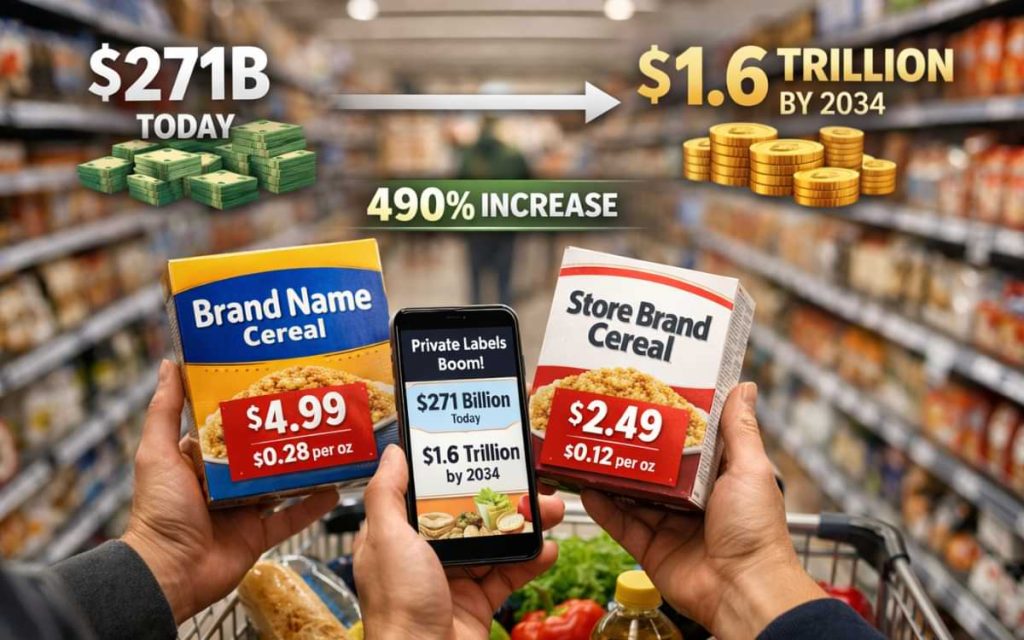
Private Label Market Growth Projection
Market value trajectory from 2024 to 2034
490% Growth
From $271 Billion (2024) to $1.6 Trillion (2034)
Understanding the Private Label Market
Private label products are goods manufactured by one company but sold under another company’s brand name. These include store brands (Kroger Brand, Great Value), premium retailer brands (Trader Joe’s, Whole Foods 365), and white-label products sold across multiple retailers.
The market encompasses virtually every retail category:
- Grocery and food products
- Health and beauty items
- Household cleaning supplies
- Over-the-counter medications
- Apparel and accessories
- Electronics and home goods
- Pet supplies
Unlike national brands that invest heavily in marketing and advertising, private labels leverage the retailer’s existing customer base and shelf space, allowing for lower prices while maintaining healthy profit margins.
Market Size and Growth Trajectory
| Year | Market Value | Key Drivers |
|---|---|---|
| 2024 | $271 billion | Post-pandemic inflation, value consciousness |
| 2027 (projected) | $520 billion | Quality improvements, premium tier expansion |
| 2030 (projected) | $890 billion | Digital integration, sustainability focus |
| 2034 (projected) | $1.6 trillion | Market maturity, global penetration |
This growth outpaces the broader retail market by a substantial margin. According to the Private Label Manufacturers Association, store brands now account for one in every five products sold in supermarkets, with penetration rates exceeding 50% in some European markets.
The trajectory isn’t merely about volume increases. Private labels are capturing market share from established national brands through strategic positioning, quality enhancements, and sophisticated pricing strategies that appeal to increasingly budget-conscious consumers.
Regional Market Performance
Europe: The Private Label Powerhouse
European markets lead global private label penetration, with Switzerland reaching 53% market share and the United Kingdom at 47%. German discount retailers Aldi and Lidl have built entire business models around high-quality private labels, fundamentally reshaping consumer expectations.
North America: Rapid Acceleration
The United States saw private label market share jump from 17.4% to 21.2% between 2020 and the present, driven by inflation concerns and improved quality perceptions. Costco’s Kirkland Signature brand alone generates over $60 billion in annual sales, rivaling many national CPG companies.
Asia-Pacific: Emerging Growth
While starting from lower penetration rates, Asian markets represent the fastest-growing segment. Rising middle classes, e-commerce expansion, and localized product development fuel double-digit growth rates across the region.
Latin America and the Middle East
These markets show increasing private label adoption, particularly in staple categories where price sensitivity remains high and modern retail formats expand.
Private Label Category Performance Analysis
Market share, growth rates, and consumer acceptance across major product categories
🏆 Top Performing Categories by Market Share
Market Share by Category
Detailed Category Analysis
What’s Driving the Explosive Growth?
Consumer Economic Pressures
Persistent inflation has fundamentally altered shopping behavior. When consumers face rising costs for housing, transportation, and healthcare, grocery spending becomes a primary area for budget management. Store brands offer immediate savings averaging 20-40% compared to national brand equivalents.
This isn’t temporary substitution during economic hardship. Research from Nielsen IQ shows that 70% of consumers who switch to private labels continue purchasing them even after their financial situations improve, indicating permanent behavioral shifts.
Quality Perception Revolution
The “generic” stigma has largely disappeared. Modern private labels often match or exceed national brand quality, with many manufactured in the same facilities using similar ingredients and processes. Blind taste tests frequently show consumers cannot distinguish between store brands and premium national brands.
Premium private label tiers, like Trader Joe’s specialty items or Whole Foods’ organic line, compete directly with premium national brands on quality while maintaining price advantages. This quality improvement stems from:
- Advanced manufacturing partnerships
- Investment in product development
- Sophisticated supply chain management
- Quality control matching national brand standards
- Packaging and presentation improvements
Retailer Margin Incentives
Private labels deliver substantially higher profit margins than national brands. While national brands might offer retailers 10-15% margins, private labels can provide 25-40% margins depending on the category.
This profitability incentivizes retailers to dedicate prime shelf space to store brands, create exclusive product lines, and actively promote private labels over national alternatives. The relationship between dynamic pricing strategies and private label positioning allows retailers to maximize profitability while maintaining competitive pricing perceptions.
Digital Commerce Integration
E-commerce platforms amplify private label advantages. Online shopping eliminates the visual shelf presence that traditionally favored national brands. Search results and recommendation algorithms can prioritize store brands, while subscription models lock in recurring private label purchases.
Amazon’s suite of private labels (Amazon Basics, Solimo, Happy Belly) demonstrates how platform control translates to private label promotion. The company can test products, gather data, and optimize offerings faster than traditional retailers.
Category Performance Analysis
| Product Category | Private Label Market Share | Growth Rate | Consumer Acceptance |
|---|---|---|---|
| Milk and Dairy | 38% | Medium | Very High |
| Fresh Produce | 12% | High | Growing |
| Frozen Foods | 29% | High | High |
| Canned Goods | 34% | Medium | Very High |
| Cleaning Supplies | 31% | Very High | High |
| Over-the-Counter Medicine | 42% | Medium | Very High |
| Paper Products | 28% | High | High |
| Snacks | 18% | Very High | Moderate |
| Pet Food | 14% | Very High | Growing |
Commodity-like products with clear equivalence (sugar, flour, milk) show highest penetration. Categories with strong brand loyalty or perceived quality differences (soft drinks, premium snacks) show lower but rapidly growing penetration as quality perceptions shift.
Impact on National Brands
The private label surge creates significant pressure on consumer packaged goods (CPG) companies. Traditional brand strategies built on marketing investment and distribution power face challenges when retailers control shelf space and actively promote competing products.
National brands respond through:
Innovation acceleration: Introducing new products and variations faster to differentiate from store brand copies
Premium positioning: Emphasizing unique benefits, ingredients, or experiences that private labels cannot easily replicate
Value size offerings: Creating budget-friendly package sizes to compete on price without full reformulation
Retailer partnerships: Developing exclusive flavors or sizes for specific chains to maintain shelf presence
Direct-to-consumer channels: Bypassing traditional retail to control pricing and customer relationships
According to McKinsey and Company, CPG companies losing ground to private labels face pressure to reduce prices, which compresses margins and limits innovation investment, creating a difficult strategic bind.
Consumer Savings and Value Proposition
The cumulative savings from private label adoption create meaningful household budget impact. A family spending $800 monthly on groceries could save $160-$240 by strategically choosing store brands for appropriate categories, totaling $1,920-$2,880 annually.
However, smart shopping requires understanding where private labels deliver genuine value versus where quality differences justify brand premiums. Using tools like a reverse discount calculator helps quantify actual savings and identify pricing mistakes that cost money when assumptions about store brand value don’t match reality.
Best Categories for Private Label Substitution:
- Basic staples (flour, sugar, salt, rice)
- Over-the-counter medications with identical active ingredients
- Paper products and cleaning supplies
- Dairy products (milk, butter, yogurt)
- Canned and frozen vegetables
- Baking ingredients
Categories Where Brand Loyalty May Be Justified:
- Products with unique formulations you strongly prefer
- Specialty items where quality variation impacts results
- Products with significant performance differences you’ve personally tested
- Items where brand-specific features provide genuine value
The Premium Private Label Phenomenon
An unexpected dimension of private label growth comes from premium store brands that compete with national premium brands rather than offering budget alternatives. These lines target quality-conscious consumers willing to pay more for superior products but skeptical of national brand pricing.
Trader Joe’s built its entire concept around this model, offering unique, high-quality private-label products at moderate prices. Whole Foods’ 365 brand, Costco’s Kirkland Signature premium tiers, and Target’s Good and Gather elevated offerings all pursue similar strategies.
This premium segment drives margin expansion while attracting affluent customers who might otherwise shop exclusively at specialty stores. The approach proves that private labels can compete across the entire value spectrum, not just as budget options.
Sustainability and Ethical Considerations
Modern consumers increasingly factor environmental and social considerations into purchasing decisions. Private labels offer advantages in this arena:
Supply chain control: Retailers implementing sustainability initiatives can directly mandate supplier practices for private label products
Reduced packaging waste: Store brands can adopt minimal packaging without worrying about shelf visibility competition with heavily marketed national brands
Local sourcing: Regional private labels can emphasize local ingredients and production, reducing transportation emissions
Transparent pricing: Private label pricing structures can more easily reflect true costs of sustainable practices without complex brand marketing layers
However, this also requires retailer accountability. National brands build reputations over decades; retailers launching sustainable private labels must maintain consistent standards to preserve consumer trust.
Future Market Outlook and Projections
Reaching the projected $1.6 trillion valuation by 2034 requires sustained growth across multiple dimensions:
Continued inflation pressure: Economic uncertainty maintains consumer price sensitivity, driving ongoing private label trial and adoption
Generational shifts: Younger consumers show less brand loyalty and more willingness to evaluate products on individual merit rather than historical brand reputation
Technology integration: AI-driven personalization, smart packaging, and supply chain optimization reduce private label development costs while improving quality
Global market expansion: Developing markets adopting modern retail formats create new private label opportunities with less entrenched brand loyalty
Category expansion: Private labels entering historically brand-dominated categories like premium beverages, specialty foods, and personal care
The growth won’t be uniform. Economic recoveries might slow adoption temporarily. National brand innovation could recapture market share in specific categories. Regulatory changes affecting labeling or manufacturing could impact private label economics.
However, the fundamental drivers, retailer profitability incentives, consumer value consciousness, and quality improvements,create structural support for continued expansion. Private labels have moved from market segment to market force, permanently altering the competitive landscape.
Strategic Implications for Consumers
Understanding this market transformation empowers better shopping decisions. The expansion of high-quality private labels creates unprecedented opportunities for value-conscious consumers to reduce spending without sacrificing quality.
The key is informed evaluation rather than blanket assumptions. Some store brands offer exceptional value. Others charge nearly brand-equivalent prices for inferior products. Successful shopping strategies involve:
- Testing private labels in low-risk categories to build confidence
- Comparing actual ingredients and specifications, not just prices
- Tracking personal preferences and satisfaction over time
- Understanding which product attributes matter most for your household
- Remaining flexible as quality and pricing evolve
The projected growth to $1.6 trillion reflects millions of individual consumers making these evaluations and increasingly choosing store brands. That collective shift represents not just market statistics but fundamental changes in how people think about brands, value, and purchasing decisions.