
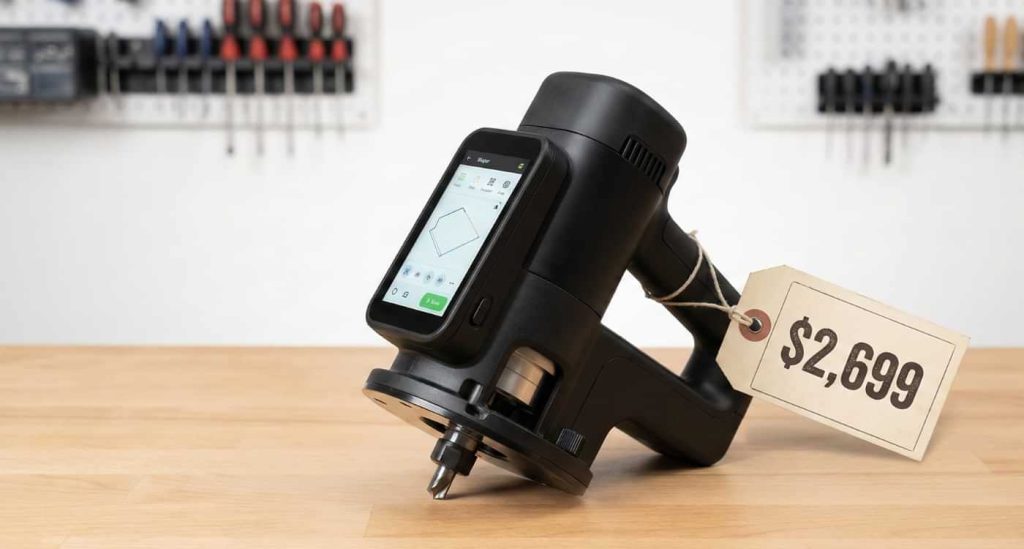
The Shaper Origin handheld CNC router costs $2,699 for the base unit as of January 2026. Complete packages, including the workstation, range from $3,499 to $4,299. Total cost of ownership adds Shaper Tape ($35 per roll lasting 50-75 linear feet), router bits ($15-$80 each), and optional accessories like dust collection systems.
A handheld CNC router sounds like science fiction until you see the Shaper Origin in action. It combines computer precision with human flexibility, letting woodworkers cut complex joinery and inlays without the footprint or complexity of traditional CNC machines. But that innovation comes at a price that makes many potential buyers pause before clicking the purchase button.
Understanding what Shaper Tools charges for the Origin requires looking beyond the base unit sticker price. The system depends on consumable tape, works best with specific accessories, and delivers different value propositions depending on whether you run a professional shop or weekend woodworking projects in your garage.
Shaper Origin Gen 2
Handheld CNC Router| Date | Price | Event |
|---|---|---|
| Today | $2,699 | Stable |
| Oct 2023 | $2,699 | Launch Price |
Base Unit Pricing Breakdown
The Shaper Origin sells as a standalone unit without requiring you to buy packages or bundles you might not need. The base price gets you the handheld CNC unit itself, along with everything needed to start cutting immediately.
| Item | What's Included | Price | Essential? |
|---|---|---|---|
| Shaper Origin Base Unit | Handheld CNC router, power supply, USB cable, calibration card, quick start guide, 1/4" collet | $2,699 | Required |
| Shaper Tape Starter Roll | One 15-foot roll (included with base unit) | Included | Required |
| Basic Router Bits | Starter set (3 bits included) | Included | Required |
| Shaper Hub Software Access | Cloud design library, file storage | Included | Optional |
The $2,699 price point represents a strategic positioning choice. Shaper Tools prices the Origin above prosumer routers but below entry-level traditional CNC machines. A quality handheld router costs $200-$400, while a comparable-capability floor-standing CNC starts around $4,000 before adding computer, software, and workspace requirements.
This pricing reflects the unique technology inside. The Origin uses a camera system to read specialized tape applied to your work surface, constantly adjusting its position to maintain accuracy within 1/64th inch. That computer vision system, combined with responsive motors and proprietary software, creates manufacturing costs that exceed traditional power tools.
Complete Package Options
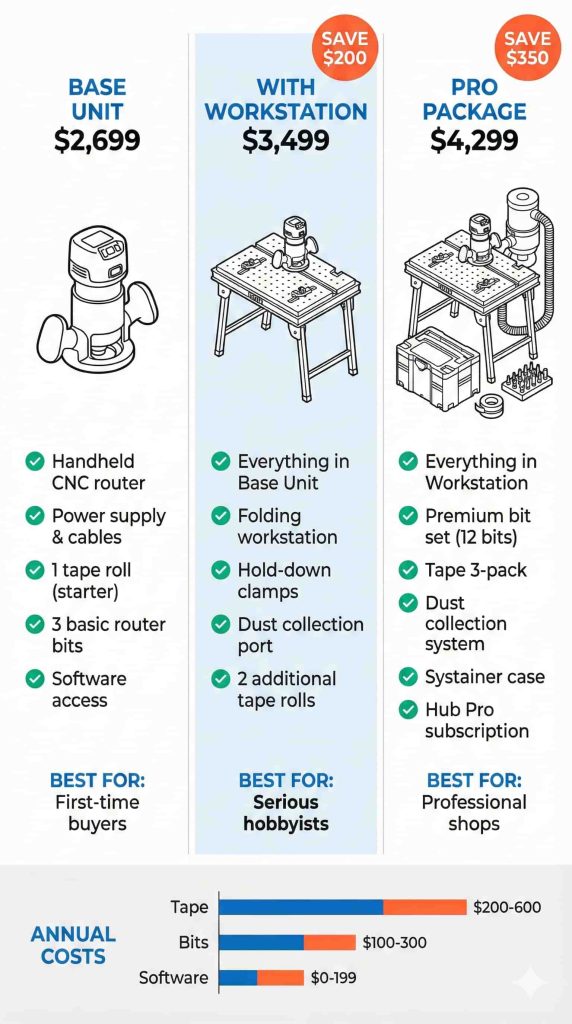
Shaper Tools offers bundled packages that include the Origin plus workspace solutions and additional accessories. These packages address the reality that most buyers need more than just the handheld unit to work efficiently.
| Package Name | Contents | Price | Savings vs Individual |
|---|---|---|---|
| Origin Only | Base unit with starter tape and bits | $2,699 | N/A |
| Origin + Workstation | Origin unit, folding workstation with clamps, dust collection port, and additional tape roll | $3,499 | $200 |
| Origin Pro Package | Origin unit, workstation, premium bit set (12 bits), tape 3-pack, dust collection system, systainer case | $4,299 | $350 |
| Origin Plus ShaperHub Pro | Origin unit, workstation, Hub Pro annual subscription ($199 value) | $3,649 | $49 |
The workstation deserves special attention because the Origin's effectiveness depends heavily on proper work surface setup. The dedicated workstation provides a rigid, flat reference surface with integrated hold-downs and tape application guides. You can build your own workstation or use the Origin on any flat surface covered with Shaper Tape, but the official workstation eliminates setup variables that affect accuracy.
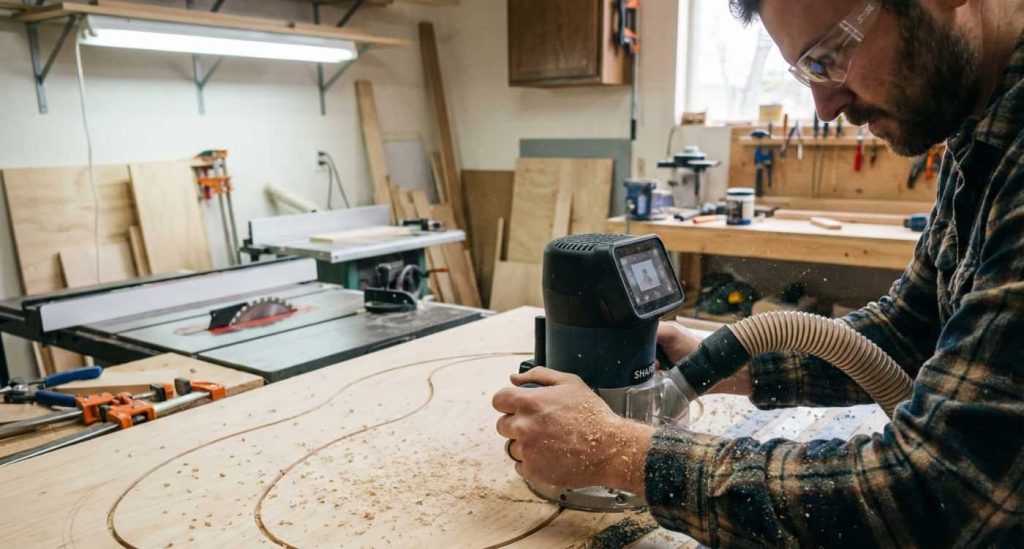
Ongoing Ownership Costs
The purchase price tells only part of the story. Operating the Origin generates recurring expenses that vary based on usage intensity and project types.
Shaper Tape Consumption
Every cut requires Shaper Tape on your work surface. The Origin's camera reads this specialized fiducial tape to maintain position accuracy. You cannot substitute other materials or reuse tape once applied and removed.
A standard 15-foot roll costs $35 and covers approximately 50-75 linear feet of cutting path, depending on design complexity and how efficiently you plan your tape layout. A professional cabinet shop running the Origin daily might consume 2-3 rolls monthly ($70-$105). A hobbyist building occasional projects might use one roll every 2-3 months ($12-18 monthly average).
This consumption model mirrors other workshop consumables. Table saw blades need replacement. Sandpaper gets used up. Finishing supplies run out. Shaper Tape simply represents another line item in workshop budgeting, though its proprietary nature means you cannot shop for cheaper alternatives.
Router Bit Requirements
The Origin accepts standard 1/4" shank router bits, giving you access to thousands of existing bit options rather than requiring proprietary cutting tools. However, certain projects benefit from specific bit geometries:
- Upcut spiral bits ($25-$40): Best for through-cuts and pockets, excellent chip evacuation
- Downcut spiral bits ($25-$40): Clean top surface, minimal tearout on veneered materials
- Compression bits ($40-$80): Clean cuts on both faces, ideal for cabinet work
- V-bits ($15-$30): Engraving and V-carving, various angles available
- Surfacing bits ($30-$50): Large-area flattening and cleanup operations
A comprehensive bit collection runs $300-$500 initially, with individual replacements needed as bits dull. Bit life depends on material hardness and cutting parameters, ranging from 50-200 hours of cutting time per bit.
Optional Software and Services
The basic Shaper Hub access comes included with your Origin purchase, providing cloud storage and access to community-shared designs. Hub Pro adds advanced features for $199 annually:
- Premium design templates and projects
- Advanced nesting algorithms for material efficiency
- Priority customer support
- Extended file storage (100GB vs 10GB)
- Collaboration tools for team environments
Professional shops find Hub Pro worthwhile for the nesting features alone, which can reduce material waste by 15-20% on sheet goods projects. Hobbyists often skip the subscription unless they need specific premium designs.
Regional Pricing Variations
Shaper Tools sells internationally, but prices vary by region due to import duties, VAT, and distribution costs. Converting currencies at current exchange rates doesn't accurately predict what you'll pay outside the United States.
| Region | Base Unit Price | Currency | Notes |
|---|---|---|---|
| United States | $2,699 | USD | Free shipping to 48 states |
| Canada | $3,599 | CAD | Includes duty and GST/HST |
| United Kingdom | £2,399 | GBP | Includes VAT (20%) |
| European Union | €2,799 | EUR | VAT varies by country (19-27%) |
| Australia | $4,199 | AUD | Includes GST and shipping |
These international prices reflect not just currency conversion but also Shaper Tools' cost structure for serving each market. European buyers pay VAT that doesn't apply to US purchasers. Australian customers face higher shipping costs and smaller order volumes that increase per-unit distribution expenses.
Financing and Payment Options
Recognizing that a $2,699 purchase represents a significant investment for individual woodworkers and small shops, Shaper Tools partners with financing providers to offer payment plans.
Current financing options through Affirm allow qualified buyers to spread payments across 12, 24, or 36 months. A typical 24-month plan at current rates might look like:
- Purchase price: $2,699
- Down payment: $0 (depending on approval)
- APR: 10-30% (varies by credit profile)
- Monthly payment: $125-$145
- Total cost: $3,000-$3,480
These payment plans make the Origin more accessible but add 10-35% to the total cost. Professional shops might negotiate different terms through business equipment financing, sometimes securing better rates by including the Origin in larger equipment purchases.
Used Market and Depreciation
The secondary market for used Origins remains relatively thin because the tool launched in 2018, making even the oldest units less than eight years old. Current used prices range from $1,800 to $2,200 for units in good working condition, representing 30-35% depreciation from new pricing.
Several factors influence used Origin values:
- Generation: Early units (2018-2020) lack some software features added to newer models, though most updates apply retroactively
- Condition: The handheld form factor means Origins see direct handling and potential drops or impacts
- Included accessories: Used sales with workstations, extra tape, and bit collections command premium prices
- Registration transfer: Warranty and software licensing transferability affects buyer confidence
Depreciation has stabilized after the initial 30% drop in the first year. Owners who purchased at launch in 2018 for $2,499 now see their units valued around $1,700-$1,900, suggesting annual depreciation of roughly 5% after the first year.
Comparing Value Against Alternatives
The Origin competes against both traditional CNCs and conventional routing approaches. Understanding how different tool categories price themselves helps evaluate whether Shaper's positioning makes sense for your needs.
Traditional CNC Routers
Desktop CNC routers from companies like Inventables (X-Carve), Carbide 3D (Shapeoko), and Onefinity start around $1,500-$2,500 for comparable cutting areas. However, true comparisons require adding:
- Computer to run CAM software ($500-$1,500)
- Floor space or dedicated bench (6-10 square feet minimum)
- Dust collection system sized for enclosed cutting ($200-$500)
- Learning curve for CAM software (20-50 hours)
- Material handling for large sheets (setup time and helpers)
Total cost of ownership for traditional CNC approaches $3,000-$5,000 before cutting the first project. The Origin's $2,699 entry point looks more competitive when accounting for these additional requirements.
Festool Domino and Traditional Joinery
The Festool Domino DF 500, often mentioned in Origin discussions because both tools modernize woodworking processes, costs $1,050-$1,150 for the base unit. Adding the Domino to a traditional routing setup still costs less than an Origin.
However, the Domino excels at one specific task (loose tenon joinery) while the Origin handles hundreds of operations: joinery, inlay, templates, complex profiles, and precise dimensioning. Comparing prices alone misses the capability difference.
ROI Analysis by User Type
Whether the Origin justifies its price depends entirely on how you plan to use it and what it replaces or enables in your workflow.
Professional Cabinet Shops
Cabinet makers running the Origins report time savings of 40-60% on complex face frame joinery compared to traditional layout and routing methods. A shop charging $75/hour for labor recoups the $2,699 investment after saving roughly 36 billable hours.
For operations already using template routing, the Origin reduces template creation time from hours to minutes and eliminates template storage. One shop we spoke with calculated their break-even at three months after adding an Origin to their five-person operation.
Furniture Makers and Custom Woodworkers
Small studios building custom furniture find value in the Origin's ability to execute intricate inlay work without outsourcing to CNC services. A single complex inlay job that previously required $200-$400 in CNC service fees can be done in-house, with the time savings and creative control adding qualitative benefits.
The break-even timeline extends to 12-18 months for custom woodworkers, but the capability expansion, rather than pure time savings, drives the purchase decision.
Serious Hobbyists
Home woodworkers face the hardest value justification. Without billable hours or client projects, ROI calculations become subjective. The Origin enables projects previously impossible without CNC access, but quantifying that capability in dollars proves difficult.
Some hobbyists justify the expense by comparing it to other premium tools in their shops. A $2,699 Origin sits between a quality table saw ($1,500-$2,500) and a premium planer-jointer combo ($3,000-$4,000). The question becomes whether the unique capabilities match or exceed the value those other tools provide.
Hidden Costs and Considerations
Beyond the obvious tape and bit expenses, Origin ownership brings some less apparent costs:
Dust Collection Requirements
The Origin generates significant dust during operation. While you can technically run it without dust collection, practical use requires either a shop vacuum ($150-$300) or integration with an existing dust collection system. The official Shaper dust collection adapter costs $49, and quality flexible hoses add another $30-$50.
Design Software
The Origin accepts standard SVG files, meaning you can use free software like Inkscape for simple designs. However, complex projects benefit from CAD software: Fusion 360 ($495/year), Vectric VCarve ($349-$699 one-time), or Adobe Illustrator ($20.99/month).
Many users already own design software for other purposes, but those new to digital design face additional costs or significant learning curves with free alternatives.
Workshop Infrastructure
The Origin requires a stable, flat work surface. If you lack a dedicated workspace, building a proper Origin work table adds $200-$500 in materials and time. The official workstation solves this problem but adds $800-$1,600, depending on the package.
Price History and Market Evolution
Shaper Tools launched the Origin through Kickstarter in 2016 with early bird pricing at around $1,499 and standard backing at $1,999. Production units shipped in 2018 at $2,499, and the current $2,699 price represents a modest 8% increase over six years.
This pricing stability contrasts with many technology products that drop in price as manufacturing scales. The Origin's complex camera and positioning systems, combined with relatively low production volumes compared to mass-market power tools, maintain higher manufacturing costs that prevent dramatic price reductions.
Shaper Tools occasionally runs promotions during major woodworking shows or holidays, typically offering $200-$300 discounts or free accessory packages rather than direct price cuts. These sales occur 2-3 times annually and represent the best opportunities for price-conscious buyers.
Educational and Institutional Pricing
Schools, makerspaces, and universities can access educational pricing through Shaper's education program. Discounts range from 10-20% depending on order volume and institution type.
Educational pricing reflects Shaper's long-term strategy of introducing students to the platform before they enter professional careers. These programs mirror strategies used throughout the tool industry, where educational exposure drives future professional purchases.
International Shipping and Import Duties
Customers outside primary markets (US, Canada, EU, UK, Australia) face additional complexity. Shaper ships to many countries but doesn't always handle customs clearance. Buyers may face:
- Import duties (0-30% depending on country)
- VAT or sales tax (5-27% depending on jurisdiction)
- Customs broker fees ($50-$200)
- Extended shipping times (2-6 weeks)
- Warranty service complexity (international returns)
These factors can add 20-50% to the base price for buyers in markets without direct Shaper presence. Some international woodworkers coordinate group buys to split shipping costs, though this complicates warranty registration.
Strategic Pricing in Context
Shaper's pricing strategy reflects broader trends in modern tool markets. Premium manufacturers like Festool, Mafell, and Woodpeckers have demonstrated that professional woodworkers will pay significant premiums for tools that save time, improve accuracy, or enable new capabilities.
This outcome-based pricing approach values tools not by their manufacturing cost but by the results they enable. A $2,699 Origin competes less with $200 routers and more with $4,000+ CNC systems, even though its capabilities fall between these categories.
The strategy appears successful. Shaper Tools reportedly sold several thousand units in their first year of production, and the company continues developing the platform with software updates and accessory releases. The market has validated their price point, at least for the professional and serious hobbyist segments they target.
Making the Purchase Decision
Deciding whether the Origin justifies its price requires an honest assessment of several factors:
- Project types: Do you regularly need precision cuts, complex joinery, or intricate inlay work?
- Space constraints: Does a traditional CNC fit your workshop, or does the Origin's portability solve a real problem?
- Skill level: Are you comfortable with digital design, or will the learning curve delay ROI?
- Volume: Will you use the Origin weekly or monthly, versus occasionally?
- Alternative costs: What would outsourcing comparable CNC work cost annually?
For professional shops doing production work with complex joinery or custom inlay, the Origin typically pays for itself within 3-6 months. Custom furniture makers and sign shops see longer timelines (12-18 months) but gain creative capabilities that drive business growth.
Hobbyists face the toughest decision. The Origin enables projects impossible with conventional tools, but without billable hours or client work, justifying $2,699 plus ongoing tape costs requires genuine enthusiasm for the technology and projects it enables.
The Bottom Line
The Shaper Origin costs $2,699 for the base unit, with a realistic total investment reaching $3,500-$4,500 when including essential accessories, initial consumables, and proper workspace setup. Ongoing costs add $200-$600 annually, depending on usage intensity.
That pricing positions the Origin as a premium tool for professionals and committed hobbyists rather than an entry-level option for curious beginners. The technology delivers genuine value through time savings and expanded capabilities, but only for users whose projects regularly benefit from computer-guided precision.
For shops already outsourcing CNC work or spending significant time on complex joinery and template routing, the Origin's price represents a clear value proposition with measurable ROI. For woodworkers doing primarily straight cuts, simple joinery, and conventional projects, the investment may outpace the benefits.
The secondary market offers some relief for budget-conscious buyers, with used units available for $1,800-$2,200. This 30% discount reduces the risk for buyers uncertain about the Origin's fit in their workflow, though it still represents a significant investment.