
Your favorite cereal box looks the same. The price hasn’t changed. But something feels off when you pour your morning bowl; it runs out faster than it used to.
Welcome to shrinkflation, a pricing strategy that’s reshaping grocery aisles and household budgets across the country. Understanding this phenomenon helps consumers make smarter purchasing decisions and protects their wallets from hidden price increases.
This guide explains what shrinkflation is, how to spot it, and what it means for your shopping habits.
What Is Shrinkflation?
Shrinkflation occurs when companies reduce the size, weight, or quantity of a product while maintaining the same price point. The term combines “shrink” and “inflation” to describe this subtle form of price increase.
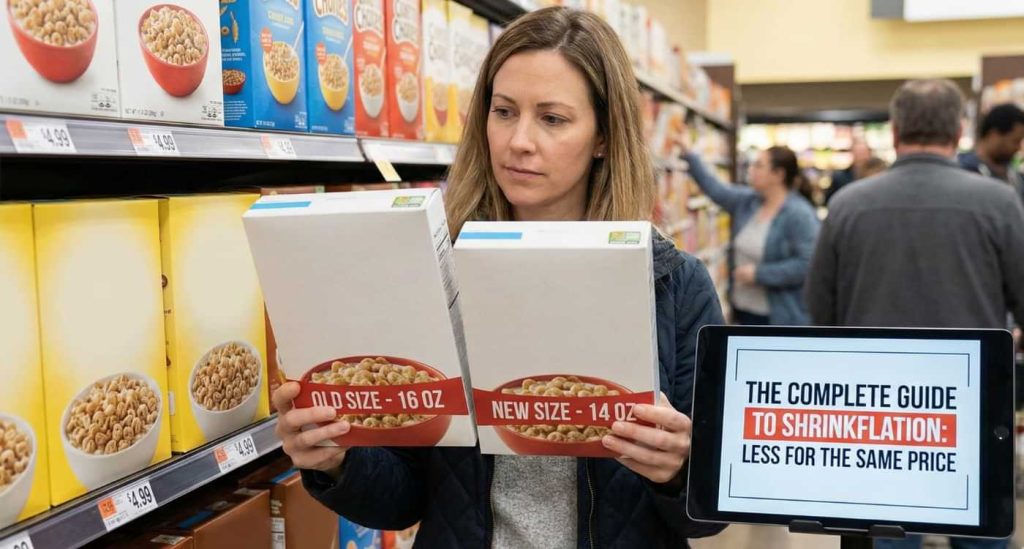
Instead of raising the sticker price from $4.99 to $5.99, a brand might reduce a 16-ounce package to 14 ounces at the same $4.99. The price appears stable, but consumers receive less product for their money.
This practice became widespread during periods of high inflation when input costs rose dramatically. Rather than risk customer backlash from visible price increases, companies quietly adjusted package sizes instead.
The strategy relies on consumer inattention. Most shoppers remember prices but rarely track exact package weights or counts. A chocolate bar that shrinks from 2.1 ounces to 1.86 ounces at the same price often goes unnoticed until someone mentions it online.
Historical Context
Shrinkflation isn’t new. Companies have adjusted package sizes for decades as manufacturing costs fluctuated. What changed in recent years is the scale and frequency.
Between 2020 and 2024, supply chain disruptions and commodity price spikes forced many brands to choose between raising prices or reducing quantities. Data from the Bureau of Labor Statistics showed package size reductions accelerated significantly during this period, affecting everything from snack foods to paper products.
The practice gained mainstream attention when social media users began documenting size changes and major news outlets picked up the story. Suddenly, shrinkflation had a name, and consumers started paying closer attention.
Shrinkflation vs Inflation: Understanding the Difference
While related, shrinkflation and inflation represent different economic concepts.
Inflation measures the general increase in prices across the economy. When inflation rises, a dollar buys less than it did before. It’s tracked through indices like the Consumer Price Index (CPI) and affects wages, savings, and purchasing power broadly.
Shrinkflation is a specific pricing tactic individual companies use. It represents a hidden price increase; consumers pay the same amount but receive less product.
Key Distinctions
| Aspect | Inflation | Shrinkflation |
|---|---|---|
| Scope | Economy-wide phenomenon | Company-specific strategy |
| Visibility | Highly visible through price tags | Hidden in package sizes |
| Measurement | Tracked by government statistics | Difficult to measure systematically |
| Consumer Response | Immediate awareness | Often goes unnoticed |
| Reversibility | Rare for prices to decrease | Sizes rarely return to original |
Why Companies Choose Shrinkflation Over Price Increases
Psychological pricing research shows consumers react strongly to price changes but often overlook quantity adjustments. A product jumping from $4.99 to $5.99 triggers immediate resistance. The same product shrinking 15% at $4.99 may go completely unnoticed.
This is why brands often prefer shrinkflation during cost-pressure periods. It preserves the psychological anchor of familiar price points while maintaining profit margins.
The strategy also works because consumers often make pricing mistakes when evaluating value. Without checking unit prices, shoppers assume consistent package sizes and miss the reduction entirely.
Common Shrinkflation Examples
Shrinkflation appears across virtually every consumer goods category. Here are the most frequent examples:
Food and Beverage Products
Snack foods, represent prime shrinkflation territory. Potato chip bags, cookie packages, and candy bars frequently adjust sizes while maintaining prices.
A major chip brand reduced bags from 16 ounces to 13 ounces over several years. Each adjustment was small enough to avoid immediate backlash, but the cumulative effect meant consumers received nearly 20% less product.
Ice cream containers, shifted from half-gallons (64 ounces) to 48 ounces, then to 46 ounces in some cases. The tubs look similar on shelves, but families get fewer servings per container.
Coffee products, also experienced significant shrinkflation. Standard cans that once held 16 ounces dropped to 12 ounces or even 10.5 ounces, while retail prices stayed flat or increased slightly.
Household and Personal Care Items
Paper products, like toilet paper and paper towels, often reduce sheet counts per roll. A package might contain the same number of rolls, but each roll has fewer sheets, resulting in less total product.
Cleaning products: sometimes reduce fluid ounces while emphasizing “concentrated” formulas. While legitimate concentration increases do exist, not all reductions correlate with proportional strength improvements.
Personal care items, including shampoo, soap, and deodorant, regularly shrink container sizes. A bottle that held 16 ounces might become 14 ounces or 12.5 ounces over time.
Digital Products and Subscriptions
Shrinkflation extends beyond physical goods. Streaming services and subscription boxes occasionally reduce offerings while maintaining membership prices.
A meal kit service might reduce from four recipes per week to three. A streaming platform might restrict simultaneous streams or add commercials to previously ad-free tiers.
These represent the digital equivalent of shrinkflation, less value for the same subscription cost.
Packaging Changes That Hide Reductions
Companies employ clever packaging modifications to disguise size reductions. Adding dimples to jar bottoms, creating indented product bases, or using taller, thinner bottles all make smaller quantities less obvious.
Some brands introduce “new packaging” or “improved formulas” that coincidentally contain less product. The marketing focuses on the upgrade rather than the size change, deflecting attention from the reduction.
Why Companies Use Shrinkflation?
Understanding the business rationale behind shrinkflation provides important context. Companies face genuine cost pressures that force difficult decisions.
Rising Input and Logistics Costs
Commodity prices fluctuate significantly. Wheat, cocoa, coffee, oils, and other raw materials can spike 30-50% or more during supply disruptions. Transportation costs also vary dramatically based on fuel prices and shipping availability.
When a chocolate manufacturer’s cocoa costs increase 40%, they face stark choices. Absorbing the cost eliminates profit margins. Raising prices risks losing customers to competitors or store brands. Reducing the bar size from 2 ounces to 1.7 ounces maintains margins with less customer friction.
This logic explains why shrinkflation accelerated during recent inflation. Companies weren’t necessarily being deceptive, they were trying to survive unprecedented cost pressures without destroying demand.
Psychological Pricing and Price-Point Resistance
Certain price points carry psychological weight. $0.99, $4.99, $9.99, these prices feel significantly cheaper than $1.00, $5.00, or $10.00, even though the difference is minimal.
Retailers and brands build entire pricing strategies around maintaining these anchor points. Breaking them can reduce sales velocity considerably.
When faced with cost increases that would push products past these thresholds, shrinkflation offers an alternative. A brand can hold the $4.99 price point by reducing quantity rather than crossing into $5.49 or $5.99 territory.
Shelf Competition and Pack Architecture
Grocery shelves operate as competitive battlegrounds. Products compete for attention, and price tags factor heavily in consumer decisions.
Price pack architecture strategies emphasize creating size ladders at strategic price points. Shrinkflation helps maintain these architectures when costs rise.
If a competitor’s similar product stays at $4.99, raising your price to $5.99 could cost significant market share. Matching their price with a slightly smaller package keeps you competitive while protecting margins.
How to Spot Shrinkflation?
Detecting shrinkflation requires vigilance, but several strategies make identification easier.
Check Unit Pricing on Shelf Tags
Most retailers display unit prices, cost per ounce, per pound, or per count on shelf tags below products. This metric reveals true value better than the total price.
When comparing products or tracking purchases over time, unit prices expose shrinkflation immediately. If a product you regularly buy shows an increasing unit price despite a stable retail price, shrinkflation likely occurred.
Make unit price comparison a shopping habit. It takes seconds and protects against hidden price increases across all categories.
Compare Historical Package Sizes
Keep mental notes of package sizes for regularly purchased items. When your usual cereal box looks different or feels lighter, check the net weight printed on the package.
Photo documentation helps. Some consumers photograph product labels during shopping trips. Comparing these photos over months or years creates a visual record of size changes.
Online shopping histories also reveal changes. Check past orders for the exact product specifications, if the current version shows different ounces or counts, shrinkflation happened.
Look for Packaging Redesigns
“New look” and “improved packaging” often accompany size reductions. Brands use redesigns to distract from quantity changes.
When you notice packaging updates, immediately check the net weight or count against what you remember. The new design may be masking a significant reduction.
Be especially suspicious of packages that look similar in dimensions but list lower net weights. This indicates material reduction without obvious visual changes.
Monitor Price Per Unit Over Time
Using a price comparison calculator helps track unit costs systematically. Record unit prices for frequently purchased items and review them monthly.
Spreadsheets or shopping apps can automate this tracking. When unit costs rise without corresponding price increases, you’ve identified shrinkflation.
This method works particularly well for staple products you buy repeatedly, like coffee, cereal, or cleaning supplies.
Is Shrinkflation Legal and Ethical?
Shrinkflation occupies a gray area legally and ethically.
Legal Considerations
In the United States, shrinkflation is generally legal. The Federal Trade Commission requires accurate labeling of net weights and quantities, but companies can change these amounts as long as labels reflect the actual contents.
No law prevents reducing package sizes. As long as the new net weight or count appears clearly on packaging, companies comply with regulations.
However, deceptive practices that mislead consumers about quantity could violate FTC guidelines. “Slack fill”, excess empty space in packages faces scrutiny if it misrepresents the amount of product inside.
The Consumer Product Safety Commission and FDA also regulate specific categories, but their focus remains on safety and accurate labeling rather than preventing size reductions.
Ethical Transparency Questions
Legal doesn’t always mean ethical. Many consumer advocates argue that shrinkflation lacks transparency.
When companies reduce sizes without clear communication, they exploit consumer inattention. While the information appears on labels, it requires active vigilance to notice, something most shoppers don’t maintain.
More ethical approaches might include temporary labels highlighting size changes, clearer size comparisons on packaging, or explicit communication about cost pressures requiring adjustments.
Impact on Brand Trust
Research from consumer behavior experts at institutions like Harvard Business School shows shrinkflation can damage brand loyalty when discovered. Consumers who feel deceived often switch to competitors or less expensive alternatives.
Brands risk short-term margin protection for long-term customer relationships. Once trust erodes, rebuilding takes significant time and investment.
Some companies have found that transparency works better. Communicating honestly about cost pressures and explaining necessary changes maintains customer goodwill more effectively than silent reductions.
Impact of Shrinkflation on Consumers
The effects of widespread shrinkflation extend beyond individual purchases.
Household Budget Pressure
When package sizes shrink across many products simultaneously, families need to buy more frequently to maintain consumption. A household that previously bought toilet paper monthly might now need it every three weeks.
These cumulative effects add up. If 20-30 regularly purchased items each provide 10-15% less product, annual household spending must increase proportionally to maintain the same consumption level.
Budget-conscious families feel this pressure acutely. Fixed incomes don’t stretch as far when every package delivers less value.
Changed Buying Behaviors
Shrinkflation drives several consumer responses:
Bulk buying increases: when possible, as consumers try to stock up before further reductions occur. This works for non-perishables but isn’t feasible for all product categories.
Store brand switching: It becomes more attractive. Private label products often lag name brands in implementing shrinkflation, offering better temporary value.
Cross-category substitution: happens when consumers replace expensive items that have shrunk significantly with cheaper alternatives or different product types entirely.
Brand loyalty decreases as price sensitivity increases. Consumers who might have stuck with familiar brands become more willing to try alternatives.
Long-Term Trust Implications
Beyond immediate budget impacts, shrinkflation affects how consumers view brands and retailers. Survey data indicate declining trust in food and consumer goods companies among demographics that feel exploited by these practices.
This trust erosion has broader implications. When consumers believe companies prioritize profits over fair dealing, they become more cynical about marketing claims, quality assertions, and corporate communications generally.
Rebuilding this trust requires transparency and consumer-friendly practices that some companies have been slow to adopt.
Tools to Detect Shrinkflation
Technology and systematic approaches help consumers identify and respond to shrinkflation.
Price-Per-Unit Comparison
The most effective shrinkflation defense is consistent unit price monitoring. Comparing cost per ounce, per count, or per pound reveals true value regardless of packaging or marketing changes.
Many smartphone apps now include unit price calculators. Scanning barcodes or entering product details shows comparative value across brands, sizes, and retailers.
Some apps specifically track shrinkflation by maintaining historical size and price databases, alerting users when products they regularly buy undergo reductions.
Shrinkflation Calculator Concepts
A dedicated shrinkflation calculator helps consumers compare old versus new package sizes. By entering the original size and price alongside the new specifications, shoppers can see the effective price increase percentage.
For example, if a 16-ounce product at $4.99 becomes 13 ounces at $4.99, the calculator reveals this represents an effective 23% price increase per ounce.
These tools make invisible price increases visible, empowering informed purchasing decisions.
How Calculators Improve Pricing Transparency
Transparency tools level the information asymmetry between companies and consumers. While brands have sophisticated data on consumer price sensitivity and optimal size-price combinations, individual shoppers historically lacked comparable resources.
Price comparison and shrinkflation calculators democratize this information. Consumers can quickly evaluate whether apparent deals represent real value or marketing manipulation.
As these tools gain adoption, they may pressure companies toward more honest pricing practices. When consumers can easily detect shrinkflation, the strategy becomes less effective.
According to research from consumer advocacy organizations, increased price transparency correlates with more competitive pricing and fewer deceptive practices across retail sectors.
Alternatives to Shrinkflation for Brands
Companies facing cost pressures have options beyond quietly reducing package sizes.
Transparent Price Pack Architecture
Price pack architecture done openly involves creating multiple size options at different price points while clearly communicating the value proposition of each.
Instead of shrinking the standard package, brands can introduce a smaller “budget” option and a larger “value” option alongside the original. This gives consumers choice while maintaining margins across the portfolio.
The key difference is transparency. Customers select sizes based on their needs and budgets rather than unknowingly receiving less product at familiar prices.
Tiered Pricing and Value Packs
Creating good-better-best pricing tiers lets brands serve different customer segments explicitly. A basic version at a lower price point, a standard option, and a premium variant with added features or quantity provide options.
Value packs, multipacks at discounted unit prices, reward customers who buy larger quantities while protecting single-unit margins for convenience purchasers.
These approaches make price-value relationships explicit rather than hiding changes in package specifications.
Clear Price Communication Strategies
Some brands have successfully maintained customer trust by communicating openly about cost pressures.
Temporary shelf labels explaining “Our costs for [ingredient] have increased significantly. We’re working to maintain quality while keeping prices accessible” acknowledge reality without concealing it.
Social media posts explaining supply chain challenges and the difficult decisions they necessitate can build empathy. Customers generally understand businesses must remain profitable, but appreciate honesty about the tradeoffs involved.
Several studies from marketing research firms show consumers respond more positively to transparent price increases than to discovered shrinkflation. The short-term price resistance companies fear may be less damaging than the long-term trust erosion from perceived deception.
Navigating the Shrinkflation Landscape
Shrinkflation represents a real phenomenon affecting household budgets across income levels. Companies face legitimate cost pressures, but the strategy’s lack of transparency creates tension between businesses and consumers.
Understanding shrinkflation empowers better shopping decisions. By checking unit prices, monitoring package sizes, and using comparison tools, consumers can identify hidden price increases and adjust their purchases accordingly.
For businesses, the long-term costs of eroded trust may outweigh short-term margin preservation. Alternative strategies that maintain transparency while managing costs often serve companies better over time.
The most effective response combines awareness, tools, and changed habits. Stay vigilant about unit prices, track the products you buy regularly, and don’t assume familiar packaging contains familiar quantities.
Smart shopping means looking beyond price tags to understand true value. In an era of shrinkflation, this skill matters more than ever.
Informed consumers make better choices. Armed with knowledge and the right tools, you can protect your budget while navigating the evolving landscape of consumer goods pricing.
Want to spot shrinkflation before it hits your wallet? Use our Price Pack Architecture Calculator to compare package sizes and detect hidden price increases. Learn more about pricing strategies and avoid common pricing mistakes that cost you money.