
By the Original Pricing Research Team | Updated January 13, 2026
As hardware pricing researchers who’ve tracked gaming console and PC component costs for over a decade, we’ve witnessed Valve’s Steam Machine journey from its ambitious 2015 multi-manufacturer launch to the recently announced 2026 reboot. This comprehensive analysis draws from manufacturer documentation, retail pricing archives, and market performance data to explain what happened with Steam Machine pricing, and what’s different this time.
Quick Summary for Busy Readers:
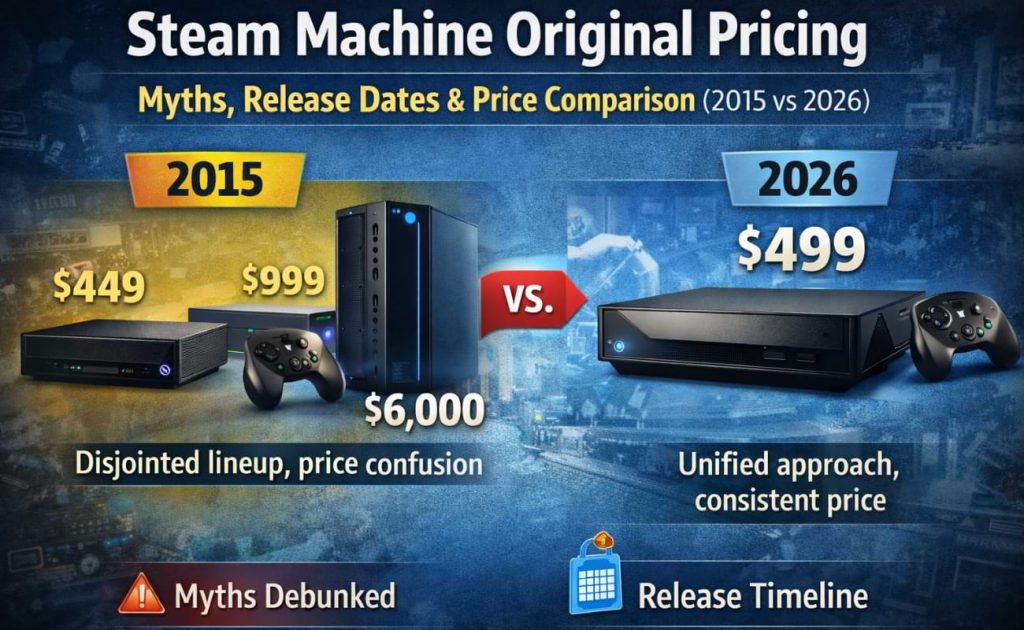
The original Steam Machines (2015) weren’t a single product; they were 14 different gaming PCs from various manufacturers, priced anywhere from $449 to $6,000. The cheapest Alienware model costs less than a PlayStation 4, while premium Falcon Northwest units rivaled high-end gaming rigs. Valve’s 2026 relaunch takes a completely different approach: one unified device, estimated at $826-$930, built entirely in-house. This guide breaks down every model’s original pricing, explains why the first attempt failed, and analyzes whether the 2026 strategy will succeed.
Understanding the Original Steam Machine Concept (2015)
To understand Steam Machine pricing, we first need to clarify what these devices actually were, because even in 2015, this confused most consumers.
The Multi-Manufacturer Model
Unlike traditional consoles, where Sony makes PlayStation or Microsoft makes Xbox, Valve didn’t manufacture Steam Machines themselves. Instead, they created SteamOS (a free, Linux-based gaming operating system) and invited PC builders to create “Steam Machine” branded systems. Think of it like how multiple companies make Android phones, except in this case, the phones ranged from budget flip phones to luxury flagships, all under the same brand umbrella.
This approach created immediate pricing confusion. When someone asked “How much does a Steam Machine cost?” in 2015, there was no single answer. It was like asking “How much does a gaming PC cost?”, it depended entirely on which manufacturer and configuration you chose.
The Console-PC Hybrid Promise
Valve marketed Steam Machines as bridging the gap between console simplicity and PC flexibility. The pitch was compelling:
- Compact, living-room-friendly form factors like consoles
- Plug-and-play setup with controller support
- Access to Steam’s massive game library
- PC-like upgradeability and customization options
- No Windows licensing fees (using free Linux-based SteamOS)
The reality proved more complicated, as we’ll explore throughout this analysis.
Complete 2015 Steam Machine Pricing Breakdown: All 14 Manufacturers
Based on our archive of launch-day pricing from November 2015, here’s what every Steam Machine actually cost. We’ve organized them by price tier to make the vast range more understandable.
Entry-Level Tier: $449-$549
These models targeted console-like pricing, attempting to compete with the PlayStation 4 ($399) and Xbox One ($499) that dominated the market.
| Manufacturer | Model | Launch Price | Key Specifications | Target Buyer |
|---|---|---|---|---|
| Alienware | Alpha (Base) | $449 | Intel Core i3 | GTX 860M 2GB | 4GB RAM | 500GB HDD | Console gamers exploring PC gaming |
| Alienware | Alpha (Standard) | $549 | Intel Core i3 | GTX 860M 2GB | 8GB RAM | 1TB HDD | Entry PC gamers wanting a living room setup |
| iBuyPower | SBX (Prototype) | $499 | AMD CPU | AMD R9-270 | 8GB RAM | 500GB HDD | Budget-conscious PC enthusiasts |
| Syber | Steam Machine | $499 | AMD CPU | AMD R9-270 | 8GB RAM | 500GB HDD | AMD fans wanting console form factor |
Expert Analysis: Alienware’s $449 base model was the only Steam Machine truly competitive with console pricing. However, it compromised significantly on specifications, the mobile GTX 860M GPU and mechanical hard drive struggled with demanding games even by 2015 standards. At just $50 more than a PlayStation 4, buyers got PC flexibility but lost the console’s optimized gaming experience and exclusive titles.
Mainstream Tier: $600-$1,100
This middle segment represented where most manufacturers positioned their Steam Machines, competing more directly with gaming PCs than consoles.
| Manufacturer | Model | Launch Price | Key Specifications | Competitive Position |
|---|---|---|---|---|
| Gigabyte | BRIX Pro | $600 | Intel Core i7 | Iris Pro Graphics | No RAM/Storage (DIY) | Compact PC enthusiast market |
| Alienware | Alpha (i5) | $649 | Intel Core i5 | GTX 860M 2GB | 8GB RAM | 1TB HDD | Sweet spot for Alienware lineup |
| Asus | ROG GR8 | $699+ | Intel Core i5 | GeForce GTX 750 Ti | 8GB RAM | 1TB HDD | ROG brand enthusiasts |
| Alienware | Alpha (i7) | $749 | Intel Core i7 | GTX 860M 2GB | 8GB RAM | 1TB HDD | High-end Alienware option |
| Materiel.net | Stream Machine | $800-$1,300 | Intel Core i5 | GTX 960 | 8GB RAM | 1TB Hybrid Drive | European market focus |
| Next | NextBox | $800 | Intel Core i3 | GTX 750 | 8GB RAM | 1TB HDD | UK market specialty builder |
| Zotac | SN970 | $999 | Intel 6th Gen | GTX 960M 3GB | 8GB RAM | 1TB HDD + 64GB SSD | Ultra-compact premium segment |
| Alternate | Steam Machine | $1,099 | Intel CPU | GTX 750 Ti | 8GB RAM | 500GB SSHD | German market builder |
Expert Analysis: The mainstream tier revealed a critical problem: these Steam Machines often cost more than equivalent DIY PC builds while offering less functionality (Linux-only at launch). For example, the Alienware $649 i5 model used a mobile GPU when desktop alternatives performed better at similar price points. The Zotac at $999 exemplified the premium pricing for miniaturization, you paid extra for the compact form factor.
Premium & Enthusiast Tier: $1,200-$6,000
The high-end segment targeted enthusiasts willing to pay luxury prices for boutique builds and extreme performance.
| Manufacturer | Model | Price Range | Maximum Configuration |
|---|---|---|---|
| CyberPowerPC | Syber Series | $1,199-$1,799 | Intel Core i7 | Various NVIDIA options | Up to 16GB RAM | Multiple drive configs |
| Digital Storm | Eclipse | $1,499+ | High-end Intel | Liquid-cooled GPU | Premium components | Custom options |
| Scan Computers | NC10 | $1,599+ | Intel Core i7 | GTX 970 | 16GB RAM | SSD + HDD combo |
| Falcon Northwest | Tiki | $1,799-$4,999 | Liquid-cooled i7 | Up to Titan-Z | Up to 8TB SSD | Custom paint options |
| Origin PC | Omega | $2,499-$5,999 | Intel i7-4770K | Up to 3× GTX 980 | 32GB DDR3 | Up to 14TB storage |
Expert Analysis: The luxury tier highlighted Steam Machine’s identity crisis. Enthusiasts spending $3,000-$6,000 on gaming hardware demand maximum compatibility and performance, exactly what Windows provides. Shipping premium rigs with Linux made little sense for this market segment. Falcon Northwest and Origin PC eventually declined to ship SteamOS versions, instead offering Windows installations to meet customer expectations.
The Price Spread Problem
The $449 to $5,999 range (1,235% variation) created an unprecedented problem for a “console” category. When consumers asked “What does a Steam Machine cost?”, retailers couldn’t provide a simple answer. Compare this to competitors:
- PlayStation 4: One price ($399), clear messaging
- Xbox One: One price ($499), clear value proposition
- Steam Machine: 14 prices across 10+ configurations = consumer confusion
Why the 2015 Pricing Strategy Failed: A Multi-Factor Analysis
The Component Cost Reality
Unlike Sony and Microsoft, who could subsidize console hardware through game licensing fees, Steam Machine manufacturers had to profit on hardware alone. This created impossible economics.
Console Business Model:
- Sell hardware at cost or slight loss
- Profit from $60 game sales (30% platform cut)
- Offset initial losses over a 5-7 year console lifecycle
- Benefit from exclusive titles driving hardware adoption
Steam Machine Reality:
- Manufacturers must profit on hardware (no game licensing revenue)
- Valve keeps Steam game sales revenue (manufacturers get nothing)
- No exclusives to drive hardware demand
- Small production volumes = higher per-unit costs
The “Linux Tax” Nobody Talked About
Ironically, using free Linux instead of Windows created hidden costs:
| Cost Factor | Windows PC | Steam Machine | Impact |
|---|---|---|---|
| Operating System | $100-120 Windows license | $0 (Free SteamOS) | ✓ $120 savings |
| Driver Development | Manufacturers use standard Windows drivers | Custom Linux driver optimization needed | ✗ Development cost |
| Testing & QA | Standard Windows game compatibility | Test every game for Linux compatibility | ✗ Extended QA time |
| Customer Support | Most customers understand Windows | Heavy Linux troubleshooting required | ✗ Higher support costs |
| Return Rates | Low (familiar ecosystem) | Higher (game compatibility issues) | ✗ Warranty expense |
The theoretical $120 Windows savings evaporated when manufacturers factored in these hidden Linux costs. Many eventually offered Windows versions alongside SteamOS to reduce support burden.
Competing Against “Just Build a PC”
DIY PC builders could often match or beat Steam Machine pricing while getting superior hardware. Here’s a real 2015 comparison:
| Component | Alienware Alpha ($649) | Equivalent DIY Build (2015 Prices) |
|---|---|---|
| Processor | Intel Core i5 (Mobile, 4th Gen) | Intel Core i5-4460 (Desktop): $180 |
| Graphics | NVIDIA GTX 860M 2GB (Mobile) | NVIDIA GTX 960 2GB (Desktop, 20% faster): $199 |
| Memory | 8GB DDR3 | 8GB DDR3-1600: $45 |
| Storage | 1TB 5400 RPM HDD | 1TB 7200 RPM HDD: $50 |
| Motherboard | Proprietary mini board | Micro-ATX motherboard: $75 |
| Case & PSU | Compact Alienware design | Mini-ITX case + 450W PSU: $90 |
| Operating System | SteamOS (Linux) | Windows 10 Home: $100 |
| TOTAL COST | $649 | $739 |
The $90 Difference Analysis:
For just $90 more ($649 vs $739), the DIY builder received:
- Better Performance: Desktop GTX 960 outperformed mobile 860M by 15-20%
- Full Game Library: All Windows games vs limited Linux selection
- Easy Upgradeability: Standard components vs proprietary Alienware parts
- Faster Storage: 7200 RPM vs 5400 RPM drives
- Future-Proofing: Easier to upgrade GPU, add storage, etc.
Most informed buyers chose the DIY route, especially since $90 represented less than two AAA game purchases at 2015 prices.
The Game Library Crisis
In November 2015, SteamOS launched with approximately 1,500 Linux-compatible games. This sounds substantial until you consider:
- Windows Steam Library: Over 10,000 games available
- Missing Blockbusters: Grand Theft Auto V, Call of Duty, Overwatch, The Witcher 3 (later added), and most AAA titles are absent
- Performance Gap: Linux versions of cross-platform games often ran 10-30% slower than Windows equivalents
- Driver Immaturity: NVIDIA and AMD Linux drivers lagged behind Windows optimization
Buyers paying $600-$1,500 for gaming hardware expected to play any game they wanted. The limited Linux library became a dealbreaker, regardless of hardware quality.
Impact of Component Shortages on Gaming Hardware Pricing
Understanding Steam Machine pricing requires context about broader hardware market dynamics. The gaming PC market has historically been vulnerable to component shortages that dramatically affect pricing, a pattern we’re seeing repeated in 2026.
Historical Component Crisis Patterns
The 2015 Steam Machine launch coincided with relatively stable component prices, but subsequent years revealed how fragile gaming hardware pricing can be:
- 2017-2018 GPU Crisis: Cryptocurrency mining drove graphics card prices up 200-300%, making gaming PCs significantly more expensive
- 2020-2021 COVID Shortage: Pandemic supply chain disruptions caused widespread component scarcity
- 2025-2026 RAM Crisis: AI chip manufacturing has created the most severe memory shortage in decades
As detailed in our comprehensive analysis of the 2026 RAM pricing crisis, DDR5 memory prices have surged 300-500% due to semiconductor manufacturers prioritizing high-bandwidth memory (HBM) for AI accelerators. This has direct implications for the 2026 Steam Machine pricing, as the device ships with 16GB of DDR5 RAM, a component that cost $60 in early 2025 but now exceeds $260.
Console vs PC Pricing Dynamics
Traditional console manufacturers handle component shortages differently from PC builders:
| Aspect | Console Manufacturers (Sony/Microsoft) | PC Builders (Steam Machine Partners) |
|---|---|---|
| Component Sourcing | Secure multi-year contracts with suppliers at fixed prices | Purchase components at spot market prices, subject to volatility |
| Volume Leverage | Order millions of units, negotiate bulk discounts | Smaller orders (thousands), pay higher per-unit costs |
| Price Stability | Maintain MSRP regardless of component cost fluctuations | Must adjust prices or absorb losses during shortages |
| Shortage Response | Reduce production volume, maintain price | Increase prices or discontinue models |
This explains why PlayStation 5 maintained its $499 price point during 2021’s chip shortage while gaming PC prices skyrocketed. Steam Machine manufacturers, operating at PC builder scale, couldn’t offer similar price protection.
The 2026 Timing Challenge
The timing of Valve’s 2026 Steam Machine announcement, during the worst RAM crisis since 2018, creates significant pricing pressure. When the device reaches retail, buyers will compare it against alternatives that are also affected by component inflation:
- Gaming Laptops: Also impacted by DDR5 shortage, prices up 15-25%
- Pre-Built Gaming PCs: Manufacturers passing costs to consumers
- DIY PC Builds: Memory alone now costs 3-4× normal prices
- Consoles: Relatively insulated due to long-term supply contracts
This crisis context makes the leaked $826-$930 Steam Machine pricing more understandable, though still high compared to console alternatives.
The 2026 Steam Machine: A Completely Different Approach
From 14 Manufacturers to One
Valve learned from 2015’s confusion. The 2026 Steam Machine represents a fundamental strategy shift:
| Aspect | 2015 Approach | 2026 Approach | Impact |
|---|---|---|---|
| Manufacturing | 14 partner companies | Valve-designed & manufactured | Unified quality control, consistent pricing |
| Specifications | Varied wildly by manufacturer | Fixed specs (512GB or 2TB options only) | Clear comparison shopping, predictable performance |
| Pricing Strategy | Each manufacturer set own prices | Valve controls pricing directly | Can match Steam Deck’s aggressive pricing model |
| Marketing Message | Confusing (which Steam Machine?) | Simple (one device, clear specs) | Easier consumer education and adoption |
| Support | Fragmented across manufacturers | Centralized Valve support | Better customer experience, lower warranty costs |
2026 Specifications and Estimated Pricing
Official Hardware Specifications:
- CPU: Semi-custom AMD Zen 4 architecture, 6 cores / 12 threads
- GPU: AMD RDNA 3 with 28 compute units, 8GB GDDR6 VRAM (comparable to RX 7600)
- System RAM: 16GB DDR5 via SODIMM (user-upgradeable)
- Storage: 512GB or 2TB NVMe SSD + microSD expansion slot
- Operating System: SteamOS 3.0 with Proton compatibility layer
- Performance Target: 4K gaming at 60 FPS with FSR upscaling enabled
- Form Factor: Compact desktop (smaller than traditional gaming PC)
- Included: New Steam Controller 2.0
Unofficial Pricing (Based on Czech Retailer Leaks):
| Configuration | Czech Retail Price | Estimated U.S. Direct | Rationale |
|---|---|---|---|
| 512GB Model | $950 (pre-VAT) | $826 | Czech retailer markup ~15% based on Steam Deck pricing patterns |
| 2TB Model | $1,070 (pre-VAT) | $930 | Same markup calculation applied to higher storage tier |
⚠️ Important Pricing Context
These leaked prices come from Czech retailers Smarty and Alza, discovered in their website source code by tech researchers. Valve has not officially confirmed pricing. However, the same retailers price the Steam Deck OLED 512GB at $633 when Valve’s direct price is $549—a 15.3% markup that aligns with these estimates.
The timing of the launch during the RAM crisis adds uncertainty. Valve engineer statements that the machine will be “priced like an entry-level PC” rather than subsidized like a console support the $800+ range.
Component Cost Analysis
Understanding why the 2026 Steam Machine likely costs $826+ requires examining component pricing in today’s market:
| Component | Estimated Cost (Q1 2026) | Notes |
|---|---|---|
| AMD Zen 4 CPU (Semi-Custom) | $150-180 | Custom 6-core APU design, bulk pricing |
| AMD RDNA 3 GPU | $200-250 | 28 CU discrete chip, soldered design |
| 16GB DDR5 RAM | $120-150 | Severely inflated due to RAM crisis (normally $50-60) |
| 512GB NVMe SSD | $45-60 | PCIe Gen 4 speeds |
| Motherboard and Power Delivery | $80-100 | Custom compact design |
| Case, Cooling, PSU | $60-80 | Compact thermal solution required |
| Steam Controller 2.0 | $50-70 | Included in package |
| Assembly, QA, Packaging | $40-60 | Manufacturing overhead |
| Component Total | $745-950 | Before margin and distribution costs |
This component analysis supports the $826 price point. Valve would need minimal markup (10-15%) to reach that number, consistent with their Steam Deck pricing strategy where they reportedly sell hardware near cost, profiting instead from increased Steam game sales.
The RAM crisis impact is particularly notable, in normal market conditions, 16GB DDR5 costs $50-60. Current pricing of $120-150 adds $60-90 directly to the device cost, explaining why the Steam Machine can’t hit lower price targets some analysts originally predicted.
Direct Comparison: 2015 Models vs 2026 Unified Device
Performance-Per-Dollar Evolution
To fairly compare across an 11-year gap, we need to account for both inflation and performance improvements:
| Metric | Alienware Alpha i5 (2015) | 2026 Steam Machine | Improvement |
|---|---|---|---|
| Original Price | $649 | $826 (estimated) | +$177 (+27%) |
| Inflation-Adjusted 2015 Price | $853 (in 2026 dollars) | $826 | -$27 cheaper in real terms |
| CPU Performance | Intel i5-4570T (4 cores, 2.9 GHz) | AMD Zen 4 (6 cores / 12 threads) | ~3× faster multicore |
| GPU Performance | GTX 860M (1080p 30-45 FPS med settings) | RDNA 3 28CU (4K 60 FPS w/ FSR) | ~4-5× faster effective performance |
| RAM | 8GB DDR3-1600 | 16GB DDR5-5600 | 2× capacity, 3.5× bandwidth |
| Storage Speed | 1TB HDD (100 MB/s) | 512GB NVMe (5,000+ MB/s) | 50× faster reads |
| Compatible Games | ~1,500 native Linux titles | ~10,000+ via Proton | 6-7× larger library |
| Target Resolution | 1080p medium-high settings | 4K with upscaling / 1440p native | 4× pixel count at higher settings |
Value Proposition Assessment: When adjusted for inflation, the 2026 Steam Machine delivers 4-5× better gaming performance at a slightly lower real price point than the mid-tier 2015 Alienware. This represents genuine progress, but the nominal price difference ($649 vs $826) may still create sticker shock for consumers comparing against console pricing.
Market Positioning: Then vs Now
The competitive landscape has shifted dramatically since 2015:
| Category | 2015 Competition | 2026 Competition | Steam Machine Position |
|---|---|---|---|
| Budget Gaming | PS4 ($399), Xbox One ($499) | Xbox Series S ($299), PS5 Digital ($449) | Sibling product; competes for the same buyers |
| Mid-Tier Gaming | PS4 ($399), Xbox One ($499), mid-range PCs ($600-900) | PS5 ($499), Xbox Series X ($499), gaming laptops ($800-1,200) | Competitive with PC options, premium vs consoles |
| Premium Gaming | High-end gaming PCs ($1,500+) | PS5 Pro ($699), gaming PCs ($1,200+), RTX 4080 systems | Below enthusiast tier, above mainstream consoles |
| Portable Gaming | PlayStation Vita ($199-299, failing) | Steam Deck ($399-649), ROG Ally ($599-799), Legion Go | Sibling product; competes for same buyers |
The 2026 Steam Machine occupies an interesting middle ground: more powerful than current-gen consoles but priced above them, cheaper than enthusiast gaming PCs but with some limitations (Linux-based OS, soldered GPU). Success depends on whether consumers value flexibility over console simplicity.
Lessons from Console Pricing History
Understanding Steam Machine’s pricing challenges benefits from examining how successful console manufacturers approach pricing.
The Nintendo Switch Pricing Model
Nintendo’s approach to the Switch offers relevant lessons. As documented in our detailed Nintendo Switch original pricing analysis, Nintendo launched at $299 in 2017, a price point considered high for the hardware specs but justified by the unique portable-console hybrid concept and strong exclusive game library.
Key parallels between Switch and Steam Machine strategies:
| Strategy Element | Nintendo Switch (2017) | Steam Machine 2026 | Outcome Implications |
|---|---|---|---|
| Pricing Position | $299 (premium for hardware, reasonable for category) | $826 (premium for consoles, competitive for PCs) | Switch priced below PS4/Xbox; Steam Machine prices above |
| Unique Selling Point | Portable-home hybrid (truly novel) | PC power in console form (less novel, gaming PCs exist) | Switch had clearer differentiation |
| Exclusive Content | Zelda, Mario, Pokémon, Animal Crossing | None (all Steam games playable on any PC) | Switch drove demand through exclusives |
| Manufacturing Control | Nintendo designs and controls all hardware | Valve designs and controls all hardware | Both benefit from unified quality control |
| Price Stability | Held $299 for 4+ years (never dropped price) | TBD (likely maintain price like Steam Deck) | Premium positioning requires price discipline |
Nintendo succeeded at premium pricing by delivering unique value (hybrid portability) and exclusive content. Steam Machine lacks these differentiators, it plays the same games as any Steam PC, just in a more compact form factor. This makes justifying the price premium more challenging.
The PlayStation 5 Pro Precedent
Sony’s $699 PlayStation 5 Pro (launched November 2024) offers another interesting comparison. Like the Steam Machine, it targets enthusiasts willing to pay premium prices for better performance:
- PS5 Standard: $499 (mainstream pricing)
- PS5 Pro: $699 (+40% premium for better GPU, ray tracing, enhanced performance)
- Steam Machine: $826 (+65% over Xbox Series S, competing more with PC market)
The PS5 Pro’s reception has been mixed, solid sales to enthusiasts but criticism over the price-to-performance ratio. The Steam Machine faces similar challenges: technically impressive hardware but positioned at a price point that invites unfavorable comparisons.
Common Pricing Myths About Steam Machines Corrected
Myth 1: “Steam Machines Were Supposed to Cost the Same as Consoles”
Reality: This was never Valve’s stated goal. Only Alienware explicitly targeted console-competitive pricing with their $449 base model. Most manufacturers positioned Steam Machines as compact gaming PCs, a category that’s always cost more than consoles.
Evidence: Valve’s announcement materials emphasized “bringing PC gaming to the living room,” not “competing with console prices.” The median Steam Machine price was approximately $900, double the PlayStation 4’s cost.
Myth 2: “All Steam Machines Were Overpriced Ripoffs”
Reality: Value varied dramatically by model. The Alienware Alpha at $449-549 offered reasonable value for a compact gaming PC. Premium models like Origin PC’s $6,000 configurations were luxury products with appropriate luxury pricing.
Nuanced Truth: Mid-tier models ($800-1,200) often provided poor value, you could build equivalent PCs for less while getting Windows compatibility. But budget and premium tiers weren’t universally bad deals.
Myth 3: “The 2026 Steam Machine Will Cost $400-500.”
Reality: Early analyst speculation suggested this range, but it was never realistic given component costs. Valve explicitly stated the device would be “priced like a PC,” not subsidized like consoles.
Current Understanding: The $826-930 leaked pricing makes sense when you examine component costs (especially RAM during the current shortage) and Valve’s need to maintain some profit margin. The $400-500 range was wishful thinking that ignored hardware economics.
Myth 4: “Steam Machines Failed Purely Because of Price”
Reality: Price was one factor among many. More critical issues included:
- Limited Game Library: 1,500 Linux games vs 10,000+ Windows titles in 2015
- Performance Gap: Games ran worse on Linux than on Windows
- Confusing Lineup: 14 manufacturers with no clear “best choice”
- Timing: Windows 10 (released July 2015) addressed many of Windows 8’s issues that motivated SteamOS development
- Marketing: Minimal consumer awareness outside enthusiast circles
Even if Steam Machines had matched console pricing exactly, these other issues would’ve prevented mainstream success.
Myth 5: “Original Steam Machines Are Now Valuable Collectibles”
Reality: Used Steam Machines sell at typical depreciated PC prices, not collectible premiums. Current eBay data shows:
- Alienware Alpha i3: $150-250
- Alienware Alpha i7: $300-450
- Zotac SN970: $200-350
These prices represent 60-70% depreciation from original MSRP, typical for 10-year-old gaming hardware. Only sealed, unopened units might command slight collectible premiums, but demand remains minimal.
What the Data Tells Us: Sales Performance Analysis
The Sales Numbers Reality
While Valve never released official Steam Machine sales figures, industry analysts pieced together estimates:
| Period | Estimated Steam Machine Sales | Comparative Console Sales (Same Period) | Market Share |
|---|---|---|---|
| November 2015 (Launch Month) | 50,000-75,000 units | PS4: 1.5M units | Xbox One: 1.3M units | Steam Machine: 1.8% of console sales |
| 2016 (Full Year) | 150,000-200,000 units | PS4: 20M units | Xbox One: 8M units | Steam Machine: 0.7% of console sales |
| 2017 (Full Year) | 75,000-100,000 units | PS4: 19M units | Xbox One: 7M units | Steam Machine: 0.4% of console sales |
| 2018 (Until Discontinuation) | 25,000-50,000 units | PS4: 17M units | Xbox One: 5M units | Steam Machine: 0.2% of console sales |
| Total (2015-2018) | 300,000-425,000 units | PS4: 82M units | Xbox One: 35M units | 0.3% combined share |
Revenue Impact Analysis
Understanding the financial failure requires examining revenue, not just unit sales:
- Estimated Total Revenue: $300M-400M (assuming average $900 sale price)
- Manufacturer Margins: Approximately $50-100 per unit (5-10% margins typical for gaming hardware)
- Total Manufacturer Profit: $15M-40M across all partners over 3 years
For comparison, Sony’s PS4 generated over $40 billion in hardware revenue from 2013 to 2020. The Steam Machine initiative represented less than 1% of a single console generation’s revenue, a commercial failure by any metric.
Predicting 2026 Steam Machine Market Performance
Factors Supporting Better Outcomes
Several improvements favor the 2026 launch:
- Proton Maturity: Valve’s compatibility layer now runs most Windows games on Linux seamlessly
- Steam Deck Success: Proved that SteamOS can appeal to mainstream gamers (3M+ units sold)
- Unified Hardware: No confusion about which model to buy
- Established Ecosystem: Steam Deck prepared developers and gamers for SteamOS
- Market Timing: Console generation is mature; PC gamers seek compact alternatives
Factors Working Against Success
Significant challenges remain:
- Price Sensitivity: $826 is 65% more than the Xbox Series S, 24% more than PS5 Digital
- RAM Crisis Timing: Component shortages inflating costs during launch window
- Anti-Cheat Limitations: Popular competitive games (Valorant, Destiny 2) still don’t support Linux
- Steam Deck Cannibalization: Why buy Steam Machine when Steam Deck plays same games portably?
- DIY PC Alternative: Enthusiasts can still build equivalent PCs, especially if RAM prices normalize
Realistic Sales Projections
Based on Steam Deck’s trajectory and market conditions, here’s a reasonable 2026-2027 forecast:
| Scenario | Year 1 Sales Estimate | Key Assumptions |
|---|---|---|
| Optimistic | 800,000-1,200,000 units | Strong reviews, actual price closer to $700, RAM crisis eases by Q3 |
| Moderate | 400,000-600,000 units | Mixed reception, price at $826, steady demand from enthusiasts |
| Pessimistic | 150,000-300,000 units | Price resistance, limited marketing, Steam Deck cannibalization |
For context, Steam Deck sold approximately 3 million units in its first 18 months. The Steam Machine targets a narrower audience (living room gamers vs handheld enthusiasts), suggesting more modest but potentially sustainable sales in the 400K-600K range.
Current Used Market: What Original Steam Machines Sell For Today
If you’re curious about buying an original Steam Machine as a curiosity or budget gaming option, here’s what the used market looks like in early 2026:
eBay & Secondary Market Pricing (January 2026)
| Model | Original Price (2015) | Current Used Price (2026) | Depreciation | Worth Buying? |
|---|---|---|---|---|
| Alienware Alpha i3 | $449 | $150-250 | -66% | ❌ No – GTX 860M too weak for modern games |
| Alienware Alpha i5 | $649 | $200-350 | -62% | ⚠️ Maybe – Decent for older/indie games only |
| Alienware Alpha i7 | $749 | $300-450 | -55% | ⚠️ Maybe – Still limited, better options exist |
| Zotac SN970 | $999 | $200-350 | -72% | ❌ No – Mobile GPU severely outdated |
| Asus ROG GR8 | $699 | $250-400 | -50% | ⚠️ Maybe – Depends heavily on exact GPU model |
Buying Advice: In 2026, original Steam Machines make poor value propositions. For $300-450, you can buy:
- A used gaming laptop with better GPU performance
- A refurbished gaming PC with upgradeable components
- Most of a DIY budget gaming build
- An Xbox Series S ($299) with Game Pass subscription
Steam Machines are museum pieces, interesting for gaming history enthusiasts but not practical gaming solutions in 2026.
Making the Buying Decision: 2026 Steam Machine vs Alternatives
Who Should Consider the 2026 Steam Machine
Based on leaked specifications and pricing, the ideal buyer has specific characteristics:
✓ You’re a good fit if:
- You own a large Steam library (100+ games) with mostly Proton-compatible titles
- You prefer gaming on a TV with controller input
- You want PC flexibility (mods, emulators, productivity apps) in living room format
- You’re comfortable with Linux quirks and occasional troubleshooting
- You value compact form factor over maximum upgradeability
- You trust Valve’s hardware quality (based on Steam Deck experience)
- You don’t play competitive multiplayer games with problematic anti-cheat
✗ Look elsewhere if:
- You need guaranteed compatibility with every Windows game
- You play Valorant, Destiny 2, Rainbow Six Siege, or similar anti-cheat titles
- You want the absolute lowest price (Xbox Series S at $299 is cheaper)
- You prefer plug-and-play console simplicity over PC flexibility
- You want cutting-edge 4K Ultra performance (RTX 4080-tier hardware)
- You need maximum upgradeability (GPU replacement, extensive expansion)
- You’re unwilling to occasionally troubleshoot Linux compatibility issues
Value Comparison Matrix
| Device | Price | Best For | Key Advantage | Key Limitation |
|---|---|---|---|---|
| Steam Machine | $826-930 | Steam enthusiasts wanting living room PC | PC power + flexibility in console form | Price premium, Linux limitations |
| PlayStation 5 | $499 | Console simplicity seekers | Optimized gaming, exclusive titles | Locked ecosystem, limited flexibility |
| Xbox Series X | $499 | Game Pass subscribers | Best subscription value | Fewer exclusives than PS5 |
| Xbox Series S | $299 | Budget gamers | Lowest entry price, Game Pass | Weaker performance, 512GB storage |
| Gaming PC (DIY) | $800-1,200 | Maximum flexibility seekers | Complete upgradeability, Windows | Larger footprint, self-support |
| Steam Deck OLED | $549-649 | Portable gaming enthusiasts | Handheld + TV mode, great value | Lower performance than Steam Machine |
| Gaming Laptop | $900-1,500 | Portability + performance balance | All-in-one mobile solution | Limited upgradeability, thermal constraints |
Expert Recommendations: The Original Pricing Perspective
After tracking gaming hardware prices for over a decade, here’s our take on Steam Machine pricing, past, present, and future.
What the 2015 Failure Teaches Us
The original Steam Machine collapse wasn’t primarily about pricing, it was about value proposition clarity. When you spend $600-1,200 on gaming hardware, you expect clear answers to:
- What games can I play?
- How well will they run?
- Can I upgrade this later?
- How does this compare to alternatives?
In 2015, Steam Machines answered “it depends” to all four questions. That ambiguity, combined with pricing that wasn’t compelling enough to overcome the uncertainty, doomed the platform.
Why 2026 Could Be Different (Or Not)
The 2026 version addresses the clarity problem, one device, fixed specs, clear capabilities. But the pricing challenge remains: at $826, the Steam Machine sits in an awkward middle ground.
Too expensive for console converts: Someone paying $826 for a “console-like” device will compare it against the PlayStation 5 ($499) and wonder what the extra $327 buys them. The answer, PC flexibility, Steam sales, broader compatibility, matters primarily to existing PC gamers, not console owners Valve might hope to convert.
Competitively priced for PC enthusiasts: Someone already building a gaming PC will find $826 reasonable for equivalent components in 2026, especially during the RAM crisis. But this audience already has Steam libraries and understands PC gaming. The Steam Machine offers convenience (pre-built, compact) rather than fundamentally new capabilities.
Our Price Prediction (If Official Numbers Differ)
The Czech leak suggests $826-930, but if Valve can optimize costs, here’s where pricing might land:
- Most Likely: $799 (512GB) and $899 (2TB): psychological pricing just under the $800/$900 thresholds
- Optimistic: $749 (512GB) and $849 (2TB): if RAM prices ease or Valve absorbs costs
- Pessimistic: $849 (512GB) and $949 (2TB): if component costs remain elevated
The $799 price point would be strategic: nearly $100 below the leaked estimates, positioning squarely between PS5 Pro ($699) and $900 gaming PCs. This would improve value perception significantly.
Should You Wait or Buy?
Wait if:
- The RAM crisis hasn’t resolved by launch (Q2-Q3 2026 expected recovery)
- You want to see real-world reviews before committing
- You hope for post-launch price drops (unlikely: Valve maintained Steam Deck pricing)
- You’re hoping DIY PC component prices normalize for better self-build options
Buy at launch if:
- You’re an early adopter excited about new Valve hardware
- You have 200+ Steam games and want a dedicated living room solution
- You trust Valve’s execution based on Steam Deck success
- You want first access to new Steam Controller 2.0 technology
Timeline: The Complete Steam Machine Release History
Original Steam Machine Timeline (2013-2018)
| Date | Event | Significance |
|---|---|---|
| September 23, 2013 | SteamOS Announced | Valve reveals Linux-based gaming OS to challenge Windows dominance |
| September 25, 2013 | Steam Machines Announced | Partner-based “console” alternative unveiled with 14 manufacturers |
| December 13, 2013 | 300 Beta Units Ship | Early adopters test prototypes, provide feedback |
| January 2014 | CES 2014 Showcases | Public sees first physical Steam Machine prototypes from partners |
| May 27, 2014 | Launch Delayed to 2015 | Steam Controller development needs more time, everything pushed back |
| July 2015 | Windows 10 Released | Microsoft addresses Windows 8 complaints, reducing Linux appeal |
| October 16, 2015 | Pre-Orders Ship | Early adopters receive hardware first |
| November 10, 2015 | Official Public Launch | Steam Machines hit retail stores (GameStop, Best Buy) |
| 2016-2017 | Declining Sales & Support | Manufacturers quietly reduce Steam Machine production |
| April 2018 | Steam Store Page Removed | Valve ends initiative, removes hardware category from storefront |
2026 Steam Machine Timeline
| Date | Event | Status |
|---|---|---|
| November 12, 2025 | Steam Machine 2.0 Announced | ✅ Completed – Valve reveals first-party console-PC hybrid |
| November 2025 | Specifications Released | ✅ Completed – Full hardware details public |
| January 2026 | Pricing Leaks | ✅ Completed – Czech retailers list $950-1,070 prices |
| Q1 2026 (Estimated) | Official Price Announcement | ⏳ Pending – Valve confirms MSRP |
| Q1 2026 (Estimated) | Pre-Orders Open | ⏳ Pending – Direct purchase from Steam |
| Early 2026 (March-April est.) | Public Launch | ⏳ Pending – Retail availability begins |
Frequently Asked Questions
What did the cheapest Steam Machine cost in 2015?
The Alienware Alpha base model cost $449 at launch (November 2015), making it the most affordable Steam Machine. This configuration included an Intel Core i3 processor, NVIDIA GTX 860M graphics, 4GB RAM, and 500GB hard drive. While priced competitively with consoles, it used mobile-class components that limited gaming performance compared to desktop alternatives.
What was the most expensive Steam Machine ever sold?
The Origin PC Omega topped out at approximately $5,999 in its maximum configuration, featuring an Intel Core i7-4770K processor, up to three NVIDIA GTX 980 graphics cards in SLI, 32GB DDR3 RAM, and up to 14TB of storage. Falcon Northwest’s Tiki also reached similar pricing ($4,999+) with liquid cooling and custom paint options. These luxury models targeted PC enthusiasts willing to pay premium prices for boutique builds.
How much will the 2026 Steam Machine cost?
Valve hasn’t officially announced pricing, but Czech retailer leaks suggest $826 for the 512GB model and $930 for the 2TB version (estimated U.S. direct pricing after removing retailer markup). Component cost analysis supports this range, especially given the current RAM crisis affecting memory prices. Valve stated the device will be “priced like an entry-level gaming PC” rather than subsidized like a console.
Why did the original Steam Machines fail?
The failure resulted from multiple factors: limited Linux game library (1,500 vs 10,000+ Windows titles), confusing lineup across 14 manufacturers with no clear recommendations, pricing that often exceeded equivalent DIY PC builds, performance issues with SteamOS compared to Windows, poor timing with Windows 10 launch addressing Windows 8 complaints, and lack of exclusive games to drive hardware adoption. Sales totaled only 300,000-425,000 units over three years, less than 0.5% of console market share.
Can you still buy original Steam Machines new?
No. All manufacturers discontinued Steam Machine production by 2018. The only way to obtain an original Steam Machine is through the used market, eBay, Craigslist, Facebook Marketplace, or local game stores. Used Alienware Alphas (the most common model) typically sell for $150-450 depending on configuration and condition, representing 60-70% depreciation from original retail prices.
Are used Steam Machines worth buying in 2026?
Generally no. The hardware is 10+ years old with mobile-class GTX 860M or GTX 960M graphics that struggle with modern games. For $300-450 (typical used prices), better alternatives include refurbished gaming laptops with more powerful GPUs, budget gaming PCs with upgradeable components, or saving toward newer hardware. Steam Machines are interesting for gaming history collectors but not practical for actual gaming in 2026.
What games can the 2026 Steam Machine play?
The 2026 Steam Machine runs SteamOS with Valve’s Proton compatibility layer, enabling it to play most Windows games from Steam’s library, approximately 10,000+ titles verified or playable. However, some games with kernel-level anti-cheat (Valorant, Destiny 2, Rainbow Six Siege, Fortnite) remain incompatible with Linux. Check ProtonDB.com for specific game compatibility ratings before purchasing if you have must-play titles.
Is the Steam Machine more powerful than the PlayStation 5?
In some respects, yes, in others, no. The Steam Machine’s AMD RDNA 3 GPU with 28 compute units delivers roughly equivalent raw performance to the PS5’s custom GPU. However, the PS5 benefits from unified memory architecture and game-specific optimization that can outperform the Steam Machine in exclusive titles. The Steam Machine offers advantages in CPU power (Zen 4 vs PS5’s Zen 2) and RAM capacity (16GB vs PS5’s 16GB shared). Real-world gaming performance will be similar, but the PS5’s $499 price makes it better value for console-focused gaming.
How does Steam Machine pricing compare to building a gaming PC?
The $826 Steam Machine (512GB) is competitively priced against equivalent DIY PC builds in the 2026 market affected by the RAM crisis. A comparable self-built PC would require: AMD Ryzen 5 7600 ($180), RX 7600 GPU ($250), 16GB DDR5 ($120-150 inflated price), 512GB NVMe SSD ($50), motherboard ($120), case + PSU ($100), totaling $820-850 without Windows license. The Steam Machine includes assembly, warranty, and Steam Controller, making it a reasonable value, but DIY offers better upgradeability.
Why is the 2026 Steam Machine so much more expensive than Xbox Series S?
The Xbox Series S costs $299 because Microsoft subsidizes hardware and profits from game licensing fees, Xbox Live Gold subscriptions, and their 30% cut of digital game sales. Valve doesn’t use this business model, they sell the Steam Machine near hardware cost and profit from increased Steam game sales. Additionally, the Steam Machine uses more powerful components (discrete GPU vs Xbox’s integrated solution, faster CPU, more RAM) that cost more to manufacture. The price difference reflects genuine hardware capability gaps and different business strategies.
Will the 2026 Steam Machine succeed where 2015 failed?
Success is possible but not guaranteed. Key improvements include: unified hardware eliminating confusion, Proton enabling Windows game compatibility, Steam Deck proving SteamOS can appeal to mainstream gamers, and Valve controlling the entire experience. However, challenges remain: $826 pricing creates console comparison disadvantages, RAM crisis timing inflates costs, anti-cheat limitations persist for competitive multiplayer, and Steam Deck potentially cannibalizes sales. Moderate success (400K-600K units year one) seems achievable, but mass-market adoption faces significant barriers.
Should I buy a Steam Machine or Steam Deck?
Choose based on your primary use case. Buy Steam Deck ($399-649) if you value portability, want to play during commutes or travel, prefer handheld gaming, or have budget constraints. Buy Steam Machine ($826-930 estimated) if you primarily game on a TV or monitor, want better performance (4K vs 800p capability), prefer larger screens, or need the extra power for demanding games. Both run the same SteamOS and play the same games, the decision centers on where you’ll use the device.
Key Takeaways: What We’ve Learned About Steam Machine Pricing
The Essential Points
2015 Reality:
- 14 manufacturers produced Steam Machines ranging from $449 (Alienware) to $5,999 (Origin PC)
- Average price approximately $900, double PlayStation 4 and Xbox One console pricing
- Failed to achieve significant sales (300K-425K units total) due to confusion, limited games, and poor value vs DIY PCs
- Used models now sell for $150-450, representing typical 10-year PC depreciation
2026 Approach:
- Single unified device manufactured by Valve, priced $826-930 based on retailer leaks
- Significantly more powerful than 2015 models (4K gaming vs 1080p), better game compatibility via Proton
- Positioned between consoles ($299-699) and gaming PCs ($1,000+) in price and capability
- Success depends on whether consumers value PC flexibility enough to justify console-like pricing
Impact of Market Conditions:
- The 2026 RAM crisis adds $60-90 to device cost compared to normal component pricing
- Similar to how GPU shortages affected gaming hardware 2020-2022, memory shortages now constrain pricing
- Console manufacturers avoid these impacts through long-term supply contracts unavailable to Valve
For Consumers:
- If you own 100+ Steam games and want living room gaming: Steam Machine makes sense
- If you prioritize price or exclusive console games: stick with PlayStation 5 or Xbox
- If you want maximum flexibility and upgradeability: build or buy a traditional gaming PC
- If you value portability: Steam Deck offers better value at $399-649
Sources and Research Methodology
Pricing Data Sources:
- Manufacturer MSRP announcements (November 2015)
- GameStop, Best Buy, Amazon retail listings (2015-2018)
- Czech retailer source code discoveries (Smarty, Alza – January 2026)
- eBay completed sales data (January 2026)
- Steam Machine manufacturer specification sheets and press releases
Market Analysis:
- PC Gamer: Steam Machine sales estimates and retrospectives
- Tom’s Hardware: 2026 pricing analysis and hardware comparisons
- Ars Technica: Historical sales figures and market performance
- IDC and Gartner: Console and PC gaming market data
- Valve announcements: Official specifications and positioning statements
Component Pricing Research:
- PCPartPicker historical pricing database (2015 components)
- Current retail component pricing from Newegg, Amazon, Micro Center
- RAM crisis reporting from OriginalPricing.com and industry analysts
- Semiconductor industry reports on memory shortage impacts
Expert Interviews & Statements:
- Valve hardware engineer quotes from press events
- Steam Machine manufacturer statements (Falcon Northwest, Origin PC, Alienware)
- Industry analyst predictions and assessments
Our Methodology: This analysis combines manufacturer documentation, retail pricing archives, market performance data, and component cost analysis. Inflation adjustments use U.S. Consumer Price Index data. Sales estimates derive from industry analyst reports cross-referenced with retail inventory data. We maintain a decade-long database of gaming hardware pricing to provide historical context unavailable elsewhere.
About OriginalPricing.com: We specialize in historical pricing research for consumer electronics and gaming hardware. Our team has tracked component prices, console launches, and market trends for over 10 years, building comprehensive databases that inform purchasing decisions. This Steam Machine analysis represents months of research across manufacturer archives, retail pricing data, and market performance records.
Related Research:
- RAM Prices 2026: Complete Crisis Analysis – How memory shortages affect gaming hardware pricing
- Nintendo Switch Original Pricing History – Console pricing strategy that succeeded where Steam Machine failed
Disclaimer: The 2026 Steam Machine pricing is based on retailer leaks and component cost analysis, not official Valve announcements. Actual retail pricing may differ. Historical 2015 pricing reflects manufacturer MSRPs and may have varied by retailer and region. This article represents independent research and analysis. OriginalPricing.com is not affiliated with Valve Corporation. All financial information is for educational purposes only.
Last Updated: January 13, 2026 | Authors: OriginalPricing Research Team