
The consumer robotics market isn’t creeping into our homes anymore. It’s rushing in. Close to 20.1 million consumer service robots were sold globally in 2024, according to the International Federation of Robotics (IFR), marking an 11% jump from the previous year. Industrial robot installations hit 542,000 units that same year, and the global market value of those installations reached an all-time high of $16.7 billion. Forecasts now project 575,000 annual installations for 2025 and over 700,000 by 2028.
Key Statistics at a Glance
For quick reference, here are the numbers that define this market right now:
- 20.1 million consumer service robots sold globally in 2024 (IFR)
- 542,000 industrial robots installed worldwide in 2024
- 4.66 million industrial robots currently operational worldwide
- $16.7 billion all-time high market value for industrial robot installations
- $14.30-19.15 billion consumer robotics market value in 2025
- $29.4-55 billion projected consumer robotics market by 2030
- 575,000 projected industrial robot installations for 2025
- 57% of China’s industrial robots now supplied by domestic manufacturers
- 610 robotics investment deals in China in the first nine months of 2025 ($7B total)
- 97% of consumer robot unit sales are domestic task robots
- 16,000 humanoid robots sold commercially in 2025
- $5,500 lowest price for a full humanoid robot (Unitree R1)
- 31% growth in Robot-as-a-Service fleet in 2024
- 39.2% projected CAGR for the humanoid robot market through 2030
But the real story isn’t just about factories. It’s about the kitchen counter, the living room floor, and the backyard lawn.
So what’s driving this explosion? And why are robots flying off shelves faster than retailers can stock them? Let’s break it all down with the latest numbers.
How Big Is the Consumer Robotics Market Right Now?
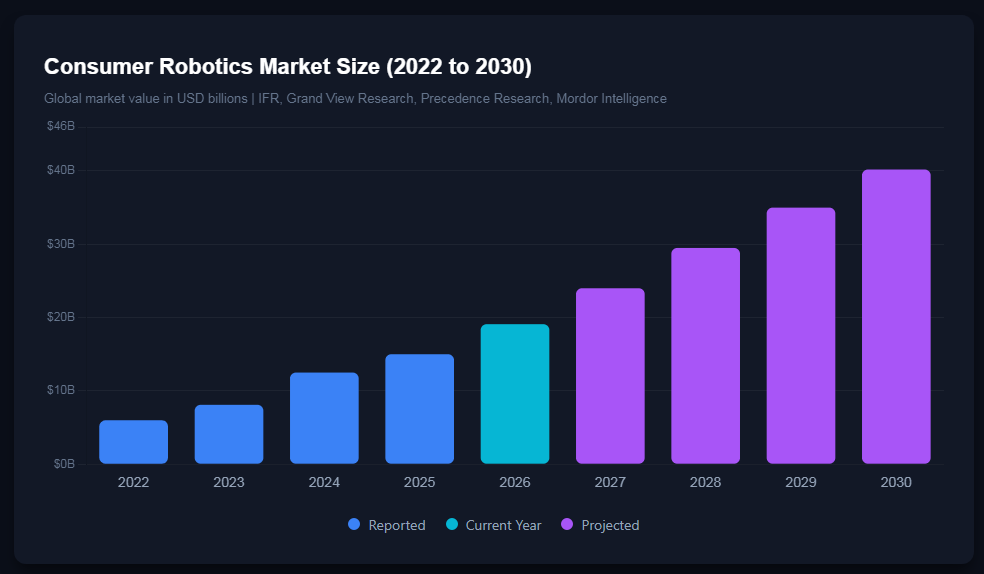
The global consumer robotics market was valued between $10.92 billion and $15.01 billion in 2024, depending on the research methodology. By 2025, the market is expected to reach approximately $13.69 billion to $19.15 billion across major forecasts. Moving into this year, estimates place the market at roughly $17.12 billion to $24.42 billion, with growth accelerating as AI integration and smart home adoption continue expanding.
Here’s how the major forecasts stack up:
| Source | 2025 Value | 2026 Estimate | 2030 Projection | CAGR |
| Mordor Intelligence | $14.30B | ~ $16.5B | $29.39B | 15.50% |
| Grand View Research | $13.7B | ~ $17.1B | $40.15B | 25.0% |
| Precedence Research | $13.69B | $17.12B | ~ $40B | 25.04% |
| Global Growth Insights | $19.15B | $24.42B | ~ $55B | 27.54% |
| Business Research Co. | ~ $15B | ~ $19B | $53.42B (2029) | 30.5% |
The household robots sub-segment alone hit $14.7 billion in 2025 and is projected to reach $17.5 billion this year, growing to $41.9 billion by 2031, according to Global Market Insights. The companion robot segment within this is expected to hit $8.9 billion by 2035, making it the fastest-growing subcategory.
When you zoom out to the broader robotics industry (including industrial and service robots), the total market sits at approximately $88.27 billion, with projections pushing past $218 billion by 2031.
These aren’t abstract numbers. They reflect a real shift in how people spend money on home technology. If you’ve been tracking how product pricing trends shift across consumer electronics, the pattern here is strikingly similar: rapid adoption followed by aggressive price competition.
What Types of Consumer Robots Are People Actually Buying?
Not all consumer robots are created equal, and the market breakdown tells us a lot about where the money’s flowing.
Market Share by Product Type
| Robot Category | Market Share (2024-2025) | Growth Outlook (to 2030) |
| Cleaning robots (vacuum/mop) | ~38% of all consumer units | Steady, mature segment |
| Robotic lawn mowers | ~12% | Growing fast in suburban markets |
| Social/companion robots | ~8% | Fastest CAGR (16.31% through 2031) |
| Educational robots | ~6% | Expanding through STEM programs |
| Personal assistants | ~5% | Tied to smart home adoption |
| Security/surveillance robots | ~4% | AI-driven growth of 50%+ in North America |
Domestic task robots (primarily vacuums and mops) account for about 97% of all consumer robot sales by unit volume. That’s a staggering concentration. Brands like iRobot, Ecovacs, and Roborock have turned the robotic vacuum cleaner into a mainstream household appliance rather than a novelty gadget. iRobot launched eight new Roomba models in 2025 with lidar room mapping, priced from $299 to $999. Roborock announced plans for a Hong Kong Stock Exchange listing, with 2024 overseas revenue of approximately $883 million, surpassing its domestic sales.
But the fastest-growing segment? That’s companion and social robots. These AI-powered devices, designed for emotional engagement, elder care, and education, are projected to reach $8.9 billion by 2035. Over 20% of new social robots launched in 2024 featured facial recognition and mood detection capabilities, something that wasn’t even commercially viable three years ago.
The social robots segment is expected to witness the highest CAGR through 2030 across all consumer robotics categories, according to Grand View Research.
Who’s Leading the Charge? Top Countries in Consumer Robotics
Regional Market Share and Forecast (2024-2030)
| Region | Market Share (2024) | CAGR (2025-2030) | Key Driver |
| North America | ~35-36% | ~15-18% | Smart home adoption, aging population |
| Asia-Pacific | ~30% | 18.3-27.04% (fastest) | Manufacturing power, government subsidies |
| Europe | ~24-25% | ~14% | Energy efficiency regulations, AI innovation |
| Middle East | Emerging | 16.06% (fastest regional growth) | Smart city investments, luxury home automation |
North America currently holds the largest revenue share. In the United States alone, 69% of homeowners owned at least one home automation device in 2023, with robotic vacuum cleaners being the most popular category. The U.S. consumer robotics market is valued at $3.45 billion in 2025 and could exceed $26 billion by 2034. Household robotic adoption in American homes surged by 32% recently, and smart cleaning robots now represent about 40% of all consumer robotics sales in the region.
But Asia-Pacific is where the volume story lives. Japan produces over 45% of the world’s home robotics units and expanded its long-term care subsidy to cover 50% of eligible robot costs for private residences. China installed 295,000 industrial robots in 2024, the highest annual total on record, and its domestic manufacturers now supply 57% of its own market, up from just 28% a decade ago. China’s industrial robot output grew by 28% year-over-year in 2025, and the country’s robotics sector attracted 610 investment deals totaling $7 billion in the first nine months of 2025 alone, a 250% increase from the previous year.
Chinese firms like Unitree, Ecovacs, and Keenon Robotics now deploy products across more than 80 countries. Understanding China’s growing export dominance gives important context for why consumer robot prices continue to drop even as features improve.
The 620,000 Unit Question: Why Robots Sell Out So Fast?
The IFR confirmed in September 2025 that global industrial robot installations totaled 542,000 units in 2024, more than double the number from a decade ago. Installations are projected to grow 6% to 575,000 units in 2025, with the 700,000-unit milestone expected by 2028. The total operational stock of industrial robots worldwide reached 4.66 million units in 2024, up 9% year-over-year.
On the consumer side, the sellout phenomenon is even more dramatic. When Ecovacs launched a Robot-as-a-Service pilot in late 2025 at approximately $28/month, they secured 12,000 subscribers in a single quarter. Amazon unveiled a new home robotics line integrating Alexa with household assistants. A major tech company’s modular robot (capable of cleaning, assisting, and entertaining) racked up over 500,000 preorders within three months of its announcement.
Several factors explain why demand keeps outpacing supply
Cost deflation in key components
LiDAR sensors, brushless motors, and lithium-ion batteries have all gotten significantly cheaper. Entry-level robot vacuums that cost $500 three years ago now start under $200. Lithium-ion battery production in China alone reached 29 billion units in 2024, a 20% year-over-year increase.
AI integration
Google DeepMind released its Gemini Robotics APIs in 2025, enabling natural-language task planning across third-party platforms. Samsung showcased its Ballie prototype at CES 2025, demonstrating predictive AI that triggers lighting, HVAC, and security routines autonomously. The IFR identified AI-driven autonomy and the convergence of IT and operational technology as top robotics trends for this year.
Aging demographic
The U.S. Census Bureau projects 77 million Americans will be aged 65 and older by 2034. Japan and parts of Western Europe face even more acute demographic shifts. Demand for elderly care robots has risen by 45% recently.
Smart home ecosystems. Wi-Fi-connected robots captured 66.73% of shipments in 2025, integrating seamlessly with voice assistants and home security systems. The smart home appliance market is expected to exceed $100 billion.
What’s Coming Next: Trends Reshaping the Market Through 2030?
Humanoid Robots Enter the Consumer Conversation
The humanoid robotics market is projected to grow from $2.92 billion in 2025 to $15.26 billion by 2030, registering a CAGR of 39.2%. An estimated 16,000 humanoid robots were sold commercially in 2025, with Chinese manufacturers producing the majority. China’s Ministry of Industry and Information Technology earmarked approximately $1.4 billion in 2025 specifically for humanoid R&D with a household focus.
Tesla is targeting 5,000 Optimus units in 2025 with plans to scale to 100,000 by 2026. BYD aims for 1,500 humanoids in 2025, ramping to 20,000 by 2026. At CES 2026, Boston Dynamics unveiled its Electric Atlas for industrial tasks, with initial deployments already fully allocated. Unitree’s G1 remains one of the most affordable full-size bipedal robots at $90,000, and its newer R1 model can be purchased for around $5,500. Analysts expect the average bill-of-materials cost per humanoid to drop to $13,000-$17,000 by the early 2030s.
Morgan Stanley forecasts the global humanoid robotics industry could reach $5 trillion by 2050, with China projected to have 302.3 million units in use by then.
Robot-as-a-Service (RaaS) Goes Mainstream
The subscription model is gaining serious traction. The RaaS fleet grew by 31% overall in 2024, with a 42% growth rate specifically in the transportation and logistics segment. For consumers, this means access to premium robots without the $1,000+ upfront cost that has historically limited adoption in middle-income households. E-commerce channels now account for over 50% of consumer robotics sales in North America, further lowering barriers to entry.
AI-Powered Emotional Intelligence
Social robots with facial recognition, mood detection, and conversational AI aren’t just for tech enthusiasts anymore. These devices are finding real use cases in elder care, children’s education, and mental wellness support. The IFR’s top trends report for this year highlights that generative AI is shifting robots from rule-based automation to intelligent, self-evolving systems. Agentic AI, which combines analytical AI for structured decision-making with generative AI for adaptability, is emerging as the next frontier.
Sustainability Becomes a Selling Point
Companies like iRobot and Ecovacs are investing in low-power systems, recyclable components, and longer product lifecycles. Europe’s focus on sustainability has driven a 55% increase in demand for energy-efficient consumer robots. Samsung extended its SmartThings Energy integration to eight new markets in late 2025, lowering cleaning robot electricity costs by up to 35%.
Market Predictions: 2025 to 2030 at a Glance
| Metric | 2025 | 2026 (Est.) | 2028 (Proj.) | 2030 (Proj.) |
| Consumer robotics market value | $13.7-19.2B | $17.1-24.4B | ~$25-35B | $29.4-55B |
| Annual industrial robot installations | 575,000 | ~610,000 | 700,000+ | ~780,000+ |
| Operational industrial robots worldwide | ~4.9M | ~5.2M | ~5.8M | ~6.5M+ |
| Consumer service robots sold (annual) | ~22M | ~24M | ~28M | ~33M+ |
| Humanoid robot market value | $2.92B | ~$4.1B | ~$8B | $15.26B |
| RaaS fleet growth rate | ~30% | ~28% | ~22% | ~18% |
Consumer robots have moved well past the “gimmick” phase. With $14 billion to $19 billion flowing through the market in 2025 and AI capabilities advancing faster than pricing can keep up, we’re watching a genuine transformation in how households operate. The robot vacuum that seemed like a luxury five years ago is now the entry point for a much larger ecosystem of home automation.
Trusted sources
- International Federation of Robotics (IFR) – World Robotics 2025 Service Robots Report https://ifr.org/ifr-press-releases/news/service-robots-see-global-growth-boom (20.1 million consumer units sold, 200,000 professional units, RaaS growth, regional breakdowns)
- International Federation of Robotics (IFR) – World Robotics 2025 Industrial Robots Report https://ifr.org/ifr-press-releases/news/global-robot-demand-in-factories-doubles-over-10-years (542,000 installations, 4.66M operational stock, China 57% domestic share, 575K forecast for 2025, $16.7B market value)
- ChinaPower Project (CSIS) – Is China Leading the Robotics Revolution? https://chinapower.csis.org/china-industrial-robots/ (28% output growth in 2025, 16,000 humanoid units sold, $1.4B government R&D earmark, 57% domestic manufacturing share, Unitree/Ecovacs global expansion)