
Last Updated: January 2026
A professional vehicle wrap costs between $2,500 and $6,000 for a full car wrap in 2026, with prices varying by vehicle size, material quality, and design complexity. Partial wraps range from $500 to $2,000, while commercial fleet wraps average $3,000 to $5,500 per vehicle. DIY wraps cost $500 to $800 in materials but require significant skill and typically 20 to 40 hours of labor.
Vehicle Wrap Pricing Calculator
Real-time cost estimates based on current market data
Configure Your Wrap
| Material | Per Sq Ft | Change |
|---|
Quality Tier Comparison
If you have been researching vehicle wrap pricing, you have probably noticed quotes ranging from $1,500 to over $10,000 for what seems like the same service. This massive spread exists for good reasons, and understanding them will help you avoid overpaying while still getting quality work.
The national average for a full vehicle wrap on a standard sedan falls between $2,500 and $5,000 in 2026. However, your actual cost depends on five primary factors: vehicle size and body complexity, vinyl material grade, design requirements, geographic location, and installer experience level. A wrap quote in Los Angeles will run 35 to 45 percent higher than the same job in rural Ohio, and premium materials like color-shifting vinyl can triple your base cost.
This pricing guide draws from verified installer quotes, manufacturer specifications, and industry surveys conducted through late 2025 and early 2026. The goal is straightforward: give you accurate pricing data so you can evaluate quotes confidently and budget appropriately for your project.
Vehicle Wrap Pricing at a Glance
Before diving into the details, here is what you can expect to pay for different wrap types in 2026. These figures represent national averages from professional installers using mid-range to premium materials.
| Wrap Type | Low | Average | High | Best For |
| Full Wrap – Sedan | $2,500 | $3,500 | $5,000 | Complete color change |
| Full Wrap – SUV | $3,500 | $4,500 | $6,500 | Larger surface area |
| Full Wrap – Truck | $3,200 | $4,200 | $6,000 | Pickup trucks |
| Partial Wrap | $500 | $1,200 | $2,000 | Hood, roof, accents |
| Commercial Van | $2,800 | $4,000 | $5,500 | Business branding |
| Box Truck | $3,000 | $5,000 | $7,000 | Mobile advertising |
| Fleet (per vehicle) | $2,200 | $3,200 | $4,500 | 5+ vehicle discount |
| DIY (materials only) | $500 | $650 | $800 | Experienced DIYers |
These prices assume standard solid-color vinyl from reputable manufacturers like 3M or Avery Dennison. Specialty finishes, including matte, satin, carbon fiber, chrome, and color-shifting materials, will add 20 to 200 percent to these base figure,s depending on the finish type.
What Affects Vehicle Wrap Pricing?
Understanding the factors that drive wrap costs helps you evaluate quotes and identify where you might save money without sacrificing quality.
Vehicle Size and Body Complexity
Surface area is the starting point for every wrap quote. A typical sedan has 200 to 250 square feet of wrappable surface, while a full-size SUV has 250 to 300 square feet. This difference alone accounts for $500 to $1,500 in additional cost.
Body complexity matters just as much as size. Vehicles with aggressive body lines, deep recesses, and complex curves require more time and skill to wrap properly. A Jeep Wrangler, for example, typically costs 20 to 30 percent more than a similarly-sized sedan because of its angular surfaces and removable panels. Sports cars with wide fenders and air intakes present similar challenges.
Door jambs, side mirrors, and trim pieces are often quoted separately. Full door jamb coverage adds $200 to $500 to most quotes, but skipping them creates visible color breaks when doors open. Discuss this with your installer upfront to avoid surprises.
Vinyl Material Quality
Not all vinyl is created equal. The material you choose affects not only the initial cost but also how long your wrap lasts and how it looks over time.
Calendared vinyl is the budget option at $2 to $4 per square foot. It works fine for short-term applications and flat surfaces, but tends to shrink over time and struggles with complex curves. Expect a 3 to 5 year lifespan under normal conditions.
Cast vinyl from manufacturers like 3M, Avery Dennison, and KPMF runs $5 to $12 per square foot. This is the standard for quality wraps. Cast vinyl conforms better to curves, resists shrinking, and typically lasts 5 to 7 years. Most professional installers use cast vinyl exclusively.
Premium and specialty vinyl starts at $10 per square foot and can exceed $30 for exotic finishes. This category includes color-shifting films, chrome and mirror finishes, brushed metal effects, and premium satin formulations. These materials require more installation skill and have shorter lifespans, typically 3 to 5 years for chrome and color-shift options.
Design Complexity
A solid color change is the simplest and most affordable option. The installer works with a single material and focuses entirely on application quality. Custom graphics, multi-color designs, and commercial branding introduce additional costs.
Design fees for custom graphics typically range from $300 to $1,500, depending on complexity. Simple logo placement might cost $300 to $500, while full commercial vehicle branding with custom artwork can reach $1,500 to $2,500 for design alone. These fees are separate from the wrap installation.
Printed wraps require precise panel alignment, especially on vehicles with complex body lines. Each additional color, gradient, or graphic element increases both design time and installation difficulty. If you are considering custom graphics, request printed samples on actual vehicle panels before committing.
Geographic Location
Where you live significantly impacts wrap pricing. Major metropolitan areas command premium rates due to higher shop overhead, labor costs, and competition for skilled installers.
Los Angeles and New York City represent the high end of the market, with prices running 35 to 50 percent above national averages. A $3,500 wrap in the Midwest might cost $5,000 to $5,500 in Manhattan. Miami, San Francisco, and other coastal cities fall somewhere in between.
Rural areas and smaller cities often offer significant savings. Shops in these regions have lower overhead and face less competition, allowing them to price more competitively. However, the installer pool is smaller, so quality can be more variable. Always review portfolios carefully, regardless of location.
Installer Expertise and Certification
Vehicle wrapping is a skilled trade that takes years to master. Certified installers who have completed manufacturer training programs from 3M, Avery Dennison, or FELLERS typically charge 15 to 30 percent more than non-certified competitors.
This premium usually justifies itself through better results and warranty coverage. Certified installers have demonstrated proficiency with specific materials and typically offer longer workmanship warranties. More importantly, they are less likely to damage your vehicle during installation or produce results that fail prematurely.
When evaluating installers, ask to see recent work on vehicles similar to yours. A shop that excels at commercial fleet wraps may not have extensive experience with color-change wraps on exotic sports cars. The best installer for your project is one who has successfully completed similar projects multiple times.
Vinyl Material and Finish Pricing Breakdown
Material choice is where wrap costs can vary most dramatically. Understanding the options helps you balance your budget against your aesthetic goals and longevity expectations.
| Finish | Per Sq Ft | Full Wrap | Lifespan | Notes |
| Gloss | $5-8 | $2,500-4,500 | Best as an accent, not full wrap | Most paint-like appearance |
| Matte | $6-10 | $3,000-5,000 | 5-7 yrs | Requires special care products |
| Satin | $7-11 | $3,200-5,500 | 5-7 yrs | Popular on luxury vehicles |
| Metallic | $8-12 | $3,500-6,000 | 5-7 yrs | Flake patterns vary by brand |
| Carbon Fiber | $10-15 | $4,000-6,500 | 4-6 yrs | Best as an accent, not a full wrap |
| Chrome/Mirror | $15-25 | $6,000-10,000 | 2-4 yrs | Difficult install, shorter life |
| Color-Shift | $18-30 | $7,500-12,000 | 3-5 yrs | Color changes with angle |
Chrome and color-shifting wraps deserve special mention. While visually striking, these materials are significantly more difficult to install, more prone to damage, and have shorter lifespans than standard vinyl. Many installers charge a 30 to 50 percent labor premium for these materials, and some decline chrome work entirely due to the difficulty involved.
For most vehicle owners seeking a color change, gloss or satin vinyl offers the best balance of appearance, durability, and cost. Matte finishes have gained popularity but require specialized cleaning products and show fingerprints and water spots more readily than gloss surfaces.
DIY vs Professional Wrap Costs
The internet is full of DIY wrap tutorials promising professional results for a fraction of the cost. While DIY wrapping is possible, the reality is more nuanced than most videos suggest.
Realistic DIY Costs
Material costs for a DIY sedan wrap run $300 to $600 for quality cast vinyl. However, first-time wrappers need additional supplies and should budget for mistakes.
A complete first-time DIY budget typically includes vinyl material at $300 to $600, a heat gun at $30 to $80, squeegees and felt applicators at $20 to $50, cutting tools and gloves at $25 to $40, surface prep supplies at $30 to $60, and extra vinyl for mistakes at $100 to $200. This brings the realistic total to $505 to $1,030 for materials and tools.
Time Investment
Professional installers complete a full wrap in 2 to 4 days. First-time DIYers should expect 20 to 40 hours of work spread over multiple weekends. Complex vehicles or specialty materials can extend this significantly.
The learning curve is steep. Applying vinyl to flat surfaces is relatively straightforward, but bumpers, mirrors, and complex curves require techniques that take practice to master. Many DIY projects stall or fail in these challenging areas.
Quality Differences
Professional wraps typically last longer and look better than DIY attempts. Experienced installers know how to stretch vinyl properly, eliminate air bubbles, and ensure edges are sealed against moisture and debris. These details affect both appearance and longevity.
DIY wraps also void most material warranties. Manufacturers like 3M and Avery Dennison offer warranties only when their products are installed by certified professionals. If your DIY wrap fails prematurely, you have no recourse with the manufacturer.
When DIY Makes Sense?
DIY wrapping can work well for partial wraps on simpler surfaces like hoods, roofs, or roof inserts. These areas are flatter and more forgiving of technique imperfections. Starting with a partial wrap also lets you develop skills before attempting a full vehicle.
If you enjoy hands-on projects and have patience for a learning curve, DIY can be rewarding. Just go in with realistic expectations about the time commitment and potential for do-overs.
Commercial and Fleet Vehicle Wrap Pricing
Business vehicle wraps serve a different purpose than personal wraps. They are marketing investments that generate impressions and brand awareness. Understanding the return on investment helps justify the expense.
Commercial Vehicle Pricing
| Vehicle Type | Partial Wrap | Full Wrap | Daily Views | CPM |
| Sedan/Compact | $800-1,800 | $2,500-4,500 | 30,000-50,000 | $0.04-0.08 |
| Pickup Truck | $1,000-2,200 | $3,000-5,500 | 40,000-60,000 | $0.04-0.07 |
| Sprinter/Cargo Van | $1,500-3,000 | $3,500-6,500 | 50,000-70,000 | $0.03-0.06 |
| Box Truck (14-16 ft) | $1,800-3,500 | $4,000-7,500 | 60,000-90,000 | $0.02-0.05 |
| Food Truck | $2,000-4,000 | $4,500-8,500 | Varies | Varies |
| Semi Trailer | $3,000-5,500 | $6,000-12,000 | 70,000-100,000+ | $0.02-0.04 |
CPM (Cost Per Thousand Impressions) is calculated based on a 5-year wrap lifespan. Daily view estimates from the Outdoor Advertising Association of America research.
Fleet Discount Structures
Most wrap shops offer volume discounts for fleet orders. Typical structures include 10 to 15 percent off for 5 to 9 vehicles, 15 to 20 percent off for 10 to 24 vehicles, and 20 to 25 percent off for 25 or more vehicles. These discounts reflect efficiencies in design work, material ordering, and scheduling.
Fleet wraps often make sense even at full price when you calculate the advertising value. A wrapped vehicle generates 30,000 to 70,000 impressions daily, depending on driving patterns and vehicle size. Over a 5-year wrap lifespan, that translates to cost per thousand impressions of $0.04 to $0.15, dramatically lower than digital advertising, billboards, or print media.
Design Considerations for Commercial Wraps
Commercial wraps require different design thinking than personal color changes. The goal is visibility and brand recognition, not subtlety. Effective commercial designs use high contrast colors, readable fonts at a distance, and clear calls to action.
Work with a designer who understands vehicle wrap constraints. Phone numbers and websites need to be large enough to read from 50 feet. Complex logos may need simplification. Dark vehicles in particular need careful color choices to ensure graphics are visible.
Regional Pricing Variations
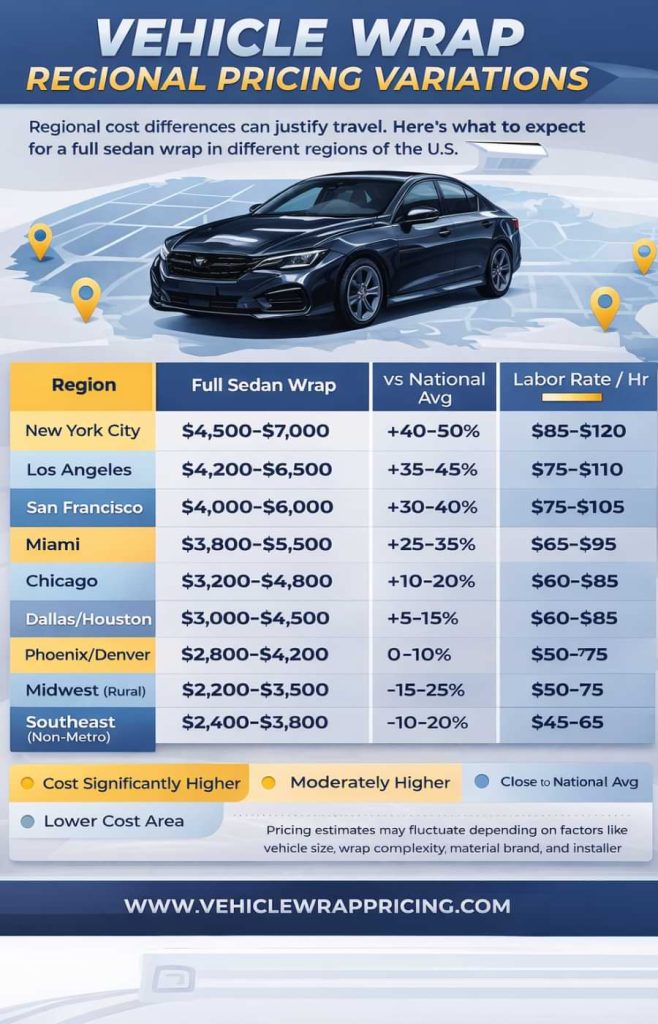
Where you get your vehicle wrapped matters as much as what you are wrapping. Regional cost differences can be substantial enough to justify travel in some cases.
| Region | Full Sedan Wrap | vs National Avg | Labor Rate/Hr |
| New York City | $4,500-7,000 | +40-50% | $85-120 |
| Los Angeles | $4,200-6,500 | +35-45% | $75-110 |
| San Francisco | $4,000-6,000 | +30-40% | $75-105 |
| Miami | $3,800-5,500 | +25-35% | $65-95 |
| Chicago | $3,200-4,800 | +10-20% | $60-85 |
| Dallas/Houston | $3,000-4,500 | +5-15% | $55-80 |
| Phoenix/Denver | $2,800-4,200 | 0-10% | $50-75 |
| Midwest (Rural) | $2,200-3,500 | -15-25% | $40-60 |
| Southeast (Non-Metro) | $2,400-3,800 | -10-20% | $45-65 |
The price differences reflect both labor costs and market dynamics. Coastal cities have higher costs of living, more expensive commercial real estate, and greater demand for wrap services. Competition for skilled installers drives wages up, and those costs pass through to customers.
If you live near a market boundary, getting quotes from shops in both areas can reveal significant savings. A customer in northern New Jersey might save $1,000 or more by working with a shop in central Pennsylvania rather than Manhattan. Just factor in travel time and any return visits for warranty work.
Hidden Costs and Price Considerations
The quote you receive may not include everything you need. Understanding potential add-ons helps you budget accurately and avoid surprises.
Pre-Installation Costs
Your vehicle’s current condition affects wrap pricing. Paint damage, previous wrap removal, and surface preparation can add hundreds or thousands to your final bill.
Paint correction or repair may be needed if your paint has chips, scratches, or oxidation. Wraps conform to the surface beneath them, so imperfections show through. Minor correction runs $200 to $500, while significant repair work can exceed $1,500.
Previous wrap removal typically costs $500 to $1,000, depending on the wrap’s age and condition. Old wraps that have baked in the sun for years can be particularly difficult and time-consuming to remove.
Ceramic coating removal is necessary because vinyl does not adhere properly to coated surfaces. Expect to pay $150 to $400 for this service.
Additional Service Costs
Most quotes cover the basic wrap installation. Related services are usually extra.
Door jamb wrapping adds $200 to $500 but creates a more finished look when doors are open. Chrome delete packages that wrap or paint chrome trim pieces run $300 to $800. Window tinting, often bundled with wraps, costs $200 to $600, depending on film quality and the number of windows.
Ceramic coating over a fresh wrap has become popular for added protection and easier cleaning. This service adds $500 to $1,500, depending on the coating system used.
Long-Term Maintenance Costs
Wraps require ongoing care to maximize their lifespan. Budget for hand washing with wrap-safe products at $15 to $30 per month if you use a detailer, or invest in proper supplies for DIY care.
Edge repairs and sealing touch-ups run $50 to $200 annually if needed. Eventually, the wrap will need professional removal, which costs $500 to $1,500. Attempting removal yourself risks damaging the underlying paint.
Vehicle Wrap vs Paint Comparison
The wrap versus paint debate comes up in every vehicle customization discussion. Both have merits depending on your goals and circumstances.
| Factor | Vehicle Wrap | Professional Paint |
| Cost | $2,500-6,000 | $3,000-15,000+ |
| Lifespan | 5-7 years | 10-15+ years |
| Reversibility | Fully removable | Permanent |
| Install Time | 2-5 days | 1-3 weeks |
| Paint Protection | Protects original paint | Replaces original paint |
| Resale Impact | Neutral to positive | Often negative |
| Repair | Panel replacement | Color matching required |
| Color Options | Hundreds of options | Unlimited custom mixing |
Wraps make particular sense for leased vehicles where returning to original condition is required, for owners who change vehicles frequently, and for anyone who might want to reverse the modification later. A wrap also protects the factory paint, which can improve resale value when removed.
Paint jobs are better for permanent color changes on vehicles you plan to keep long-term. A quality paint job will outlast multiple wrap cycles and often looks slightly better up close to a trained eye. However, non-factory paint colors typically decrease resale value, so factor that into your decision.
Collectors of classic and exotic vehicles often prefer wraps specifically because they preserve originality. Much like understanding how original Shelby Cobra pricing depends heavily on matching numbers and factory finishes, any high-value vehicle benefits from reversible modifications that protect original components.
Frequently Asked Questions
How much did people actually pay for their car wraps?
Real-world examples from verified installations show the full range. A Honda Civic owner in Ohio paid $2,200 for a gloss black wrap with a 3-year warranty from a newer shop. A BMW 3-Series owner in Los Angeles spent $4,800 for a satin gray wrap from a certified 3M installer. A Ford F-150 owner in Texas paid $3,600 for a matte military green wrap, including bed coverage. These examples illustrate how vehicle type, location, and installer choice affect final pricing.
Is a $2,000 car wrap realistic?
Yes, but with significant caveats. At $2,000, you are typically getting calendared vinyl instead of cast, a limited color selection, and installation from a less experienced shop. The wrap may only last 3 to 4 years instead of 5 to 7. This price point works for short-term ownership, vehicles you do not care about perfection on, or as a test before committing to a premium wrap. It does not work well for complex vehicles, exotic finishes, or anyone expecting showroom quality.
Is wrapping your car worth it compared to paint?
For most people seeking a color change, yes. Wraps cost 30 to 50 percent less than comparable quality paint jobs, take less time, and are completely reversible. They also protect your factory paint, which matters for resale. Paint makes more sense only for permanent changes on long-term keeper vehicles where you value the absolute best finish quality above all else.
Why are car wraps so expensive?
Vehicle wrapping is skilled, labor-intensive work. Materials account for only 30 to 40 percent of the cost. The remaining 60 to 70 percent covers skilled labor, which requires years of training to master. A full wrap takes 15 to 25 hours of focused work by trained professionals. Compare the hourly rate to other skilled trades like auto body work or upholstery, wrap pricing is actually competitive. The shops also carry significant overhead, including climate-controlled installation bays, specialized tools, and insurance.
Will a wrap damage my paint?
Quality vinyl properly installed and removed will not damage healthy paint. Problems arise from four scenarios: cheap vinyl that leaves adhesive residue, improper installation that traps contaminants, leaving wraps on too long (beyond 7 to 8 years), or wrapping over existing paint problems. If your paint is in good condition and you use a reputable installer with quality materials, the wrap actually protects your paint from UV rays, minor scratches, and road debris.
What is the cheapest decent wrap option?
Partial wraps offer the best value for budget-conscious buyers. A hood and roof wrap runs $500 to $1,200 and creates visual impact without the full-wrap cost. Racing stripes or accent graphics cost $300 to $800. These options let you work with quality materials and installers while staying under $1,500. If you need a full wrap on a tight budget, look for newer shops building their portfolios who may offer competitive rates, but always verify their work quality first.
Full wrap vs partial wrap – which is a better value?
It depends on your goals. Full wraps make sense for complete color changes and maximum paint protection. Partial wraps work better for styling accents at 30 to 50 percent of the full wrap cost. A $1,200 partial wrap that covers high-visibility areas like the hood, roof, and mirrors can create nearly as much visual impact as a full wrap for someone on a budget. Consider what you actually want to achieve before deciding.
Is vehicle wrap pricing negotiable?
Most shops have 5 to 15 percent flexibility in their pricing. Effective negotiation tactics include bundling multiple services, being flexible on timing to fill slow periods, paying in cash to save credit card fees, and committing to referrals. What you should not negotiate on is material quality. Accepting cheaper vinyl to save $300 often costs more in reduced lifespan and appearance. Focus negotiations on labor costs and service bundles instead.
How long does a vehicle wrap last?
Quality cast vinyl wraps last 5 to 7 years under normal conditions with proper care. Garage-kept vehicles in moderate climates may see wraps last 7 to 8 years. Vehicles parked outside in harsh sun or extreme climates may only get 4 to 5 years. Chrome and color-shifting wraps have shorter lifespans of 2 to 4 years, regardless of care. Proper maintenance, including regular washing and avoiding automatic car washes, extends wrap life significantly.
What should I budget for a vehicle wrap in 2026?
For a sedan or small SUV, budget $3,000 to $4,500 for a quality full wrap with cast vinyl from a reputable installer. Add 20 to 40 percent for larger vehicles like full-size SUVs and trucks. Add another 20 to 100 percent for specialty finishes like matte, satin, or color-shift. Budget an additional $500 to $1,500 for potential extras like door jambs, chrome delete, previous wrap removal, or paint correction. Starting with $4,500 to $5,500 in mind gives most sedan owners comfortable padding for a quality result without surprises.
Making Your Decision
Vehicle wrap pricing varies significantly based on factors within your control. Choosing standard finishes over exotic materials, working with shops in moderately priced markets, and maintaining realistic expectations about DIY all help manage costs without sacrificing quality.
Get quotes from at least three installers before committing. Review their portfolios for work similar to what you want. Ask about warranty coverage, material brands, and what the quote includes versus excludes. The cheapest quote is rarely the best value when it comes to something that will cover your vehicle for the next 5 to 7 years.
Just as understanding Tesla Cybertruck pricing requires looking beyond the sticker price to total ownership costs, evaluating wrap quotes means considering longevity, warranty, and quality alongside the bottom line number. The right wrap at the right price transforms your vehicle while protecting your investment.