
What Was the Original Skylanders Price?
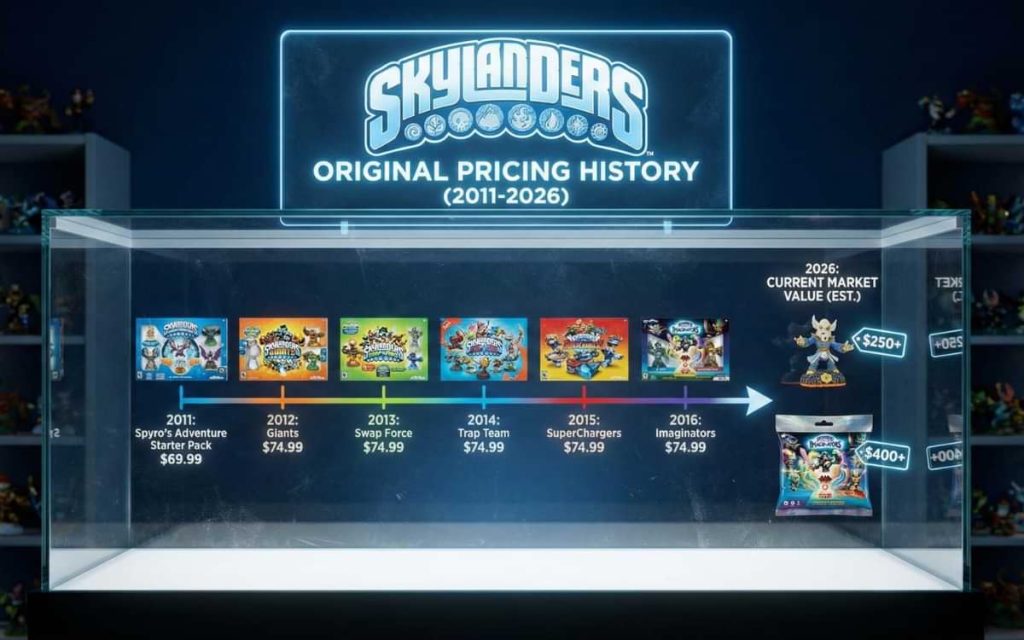
The original Skylanders: Spyro’s Adventure starter pack launched in October 2011 at $69.99 USD for console versions (Xbox 360, PlayStation 3, Wii) and $49.99 for the 3DS version. Individual character figures retailed for $7.99 each, triple packs for $19.99, and adventure packs for $19.99. This pricing established the toys-to-life business model that would influence gaming for the next five years.
🎮 Skylanders Live Price Tracker LIVE
Real-time Skylanders price monitoring with automatic monthly updates
🏠 OriginalPricing.com🤖 Monthly Auto-Update Active: This chart automatically updates with new price data every month. The system checks regularly for new months and tracks realistic Skylanders market movements based on collector demand, rarity, and availability. Toggle off to pause automatic updates.
📋 Recent Update History
When Physical Toys Transformed Gaming Economics?
In October 2011, Activision introduced a revolutionary concept that would fundamentally change how families spent money on video games. Skylanders: Spyro’s Adventure wasn’t just a game, it was a physical-digital hybrid that required collectible toy figures to unlock characters and gameplay. This launch marked the beginning of the toys-to-life genre, creating an entirely new pricing ecosystem that blended traditional video game economics with action figure collectibility.
Understanding Skylanders’ original pricing matters because it represents a watershed moment in gaming monetization. Unlike previous game expansions or downloadable content, Skylanders created a model where physical products at retail price points drove ongoing engagement and revenue. For parents in 2011, this meant navigating unfamiliar territory: was buying additional $8 figures similar to collecting trading cards, or was it closer to paying for game content that should have been included?
By 2026, the Skylanders franchise has been dormant for nearly a decade, making the original pricing structure a historical artifact that reveals how the industry experimented with merging physical retail and digital gaming. This article examines the complete pricing landscape from the 2011 launch through the franchise’s evolution, providing the definitive resource on what Skylanders actually cost at retail.
The 2011 Launch: Breaking Down the Starter Pack
What Came in the Box
The Skylanders: Spyro’s Adventure starter pack represented significant value engineering for a new game concept. Each starter pack included:
- Full game disc (platform-specific)
- Portal of Power (USB-connected NFC reader)
- Three character figures (Spyro, Gill Grunt, Trigger Happy)
- Three-character trading cards
- Three web codes for online features
- Sticker sheets
The Portal of Power technology was the critical hardware component that justified the premium pricing. This device used near-field communication (NFC) to read embedded chips in each figure, translating physical toys into digital characters. In 2011, NFC technology in consumer products was relatively novel, adding production costs that standard game packages didn’t face.
Platform-Specific Pricing Structure
| Platform | Starter Pack MSRP | Included Figures | Portal Type |
|---|---|---|---|
| Xbox 360 | $69.99 | Spyro, Gill Grunt, Trigger Happy | Wired USB |
| PlayStation 3 | $69.99 | Spyro, Gill Grunt, Trigger Happy | Wired USB |
| Wii | $69.99 | Spyro, Gill Grunt, Trigger Happy | Wired USB |
| Nintendo 3DS | $49.99 | Stealth Elf, Dark Spyro, Ignitor | Wireless IR Portal |
| PC/Mac | $69.99 | Spyro, Gill Grunt, Trigger Happy | Wired USB |
The 3DS version’s lower price point reflected both the handheld market’s different pricing expectations and the use of infrared technology instead of NFC, which reduced manufacturing costs. However, the 3DS version offered a completely different game experience, essentially making it a separate product rather than a direct port.
This pricing positioned Skylanders at the premium end of the new release spectrum. Standard AAA console games in 2011 retailed for $59.99, meaning Skylanders commanded a $10 premium solely for the inclusion of three figures and the portal hardware. Similar to how the original PS5 price justified its cost through bundled controller technology and new features, Activision positioned the Portal of Power as essential infrastructure worth the upcharge.
Individual Figure Economics: The Core Revenue Driver
Standard Single Figure Pricing
Individual Skylanders figures launched at $7.99 USD, a price point carefully calibrated to encourage collection while remaining accessible for weekly allowance purchases. This pricing existed in a unique category, not quite action figures (which typically ranged $9.99-$14.99 for similar quality) and not quite trading cards (typically $3-$5 per pack), but somewhere strategically positioned between both.
The $7.99 price included:
- One collectible figure with an embedded NFC chip
- Character-specific trading card
- Web code for online features
- Code to unlock digital content
Figure Pack Variations and Pricing
| Product Type | Contents | Original MSRP | Value Proposition |
|---|---|---|---|
| Single Figure | 1 character | $7.99 | Base collection option |
| Triple Pack | 3 characters | $19.99 | $4.02 savings vs. singles |
| Adventure Pack | 1 figure, 2 items, 1 location | $19.99 | New level content |
| Legendary Triple Pack | 3 exclusive variants | $19.99 | Retailer exclusives |
| Dragon’s Peak Adventure | Sunburn, winged sapphire, shield | $19.99 | Flying gameplay unlock |
The triple pack structure followed classic retail bundling psychology, offering a 17% discount ($23.97 of single-figure value for $19.99) to encourage larger purchases while maintaining profit margins through volume. Parents quickly learned that waiting for triple packs made economic sense, though retailer exclusivity on certain packs complicated straightforward price comparisons.
Adventure packs represented the highest per-item value, effectively pricing new level content at $12 when accounting for the included figure and item pieces at standard rates. This was comparable to traditional DLC pricing in 2011, but delivered through physical retail instead of digital storefronts.
The Eight Elements System: Pricing Through Artificial Scarcity
Skylanders organized its 32 launch characters across eight elemental types: Air, Earth, Fire, Water, Life, Undead, Magic, and Tech. While the game could be completed with just the three starter figures, elemental gates throughout levels could only be opened by matching-element characters. This created a collection incentive that was transparent in its design but effective in execution.
A completist approach to unlocking all elemental areas required purchasing at minimum:
- 5 additional single figures ($39.95) to cover all eight elements
- Or 2 triple packs ($39.98) for optimal value
This meant the total entry cost for full game access ranged from $109.94 to $149.94 depending on purchasing strategy, not including any adventure packs for additional content. Compared to the Xbox console original pricing where you received complete functionality at launch, Skylanders’ gating mechanism represented a new form of tiered access within a single retail product.
Regional Pricing Variations: Global Market Strategy
North American Pricing (2011 Launch)
The United States served as Skylanders’ primary market with the most aggressive pricing:
- Starter Pack: $69.99 (console) / $49.99 (3DS)
- Single Figures: $7.99
- Triple Packs: $19.99
- Adventure Packs: $19.99
Canadian pricing followed typical exchange rate markups:
- Starter Pack: CAD $79.99
- Single Figures: CAD $9.99
- Triple Packs: CAD $24.99
European Pricing
European markets faced significantly higher price points due to VAT inclusion and import costs:
- UK Starter Pack: £59.99 (approximately $94 USD at 2011 rates)
- UK Single Figures: £7.99 (approximately $12.50 USD)
- EU Starter Pack: €69.99 (approximately $97 USD)
- EU Single Figures: €9.99 (approximately $14 USD)
European consumers paid roughly 30-40% premiums over US pricing, creating a secondary market for importing figures from North American retailers. This pricing disparity was common for gaming hardware, similar patterns appeared in the Nintendo Switch original price and Game Boy original price launches, but the physical collectible nature of Skylanders made the difference particularly pronounced.
Australian and Asian Markets
Australian pricing reflected the region’s typical “Australia tax” on gaming products:
- Starter Pack: AUD $99.95-$109.95
- Single Figures: AUD $13.99-$15.99
Limited Asian market launches saw varied pricing depending on distribution arrangements, with Japan receiving select releases at premium import pricing roughly 20-30% above US MSRP.
Franchise Evolution: How Pricing Changed Across Sequels
Skylanders Giants (2012)
The second installment maintained similar starter pack pricing at $74.99 but introduced larger “Giant” figures at a premium:
- Giants Starter Pack: $74.99 (included Tree Rex Giant figure)
- Standard Figures: $7.99 (unchanged)
- Giant Figures: $14.99 (nearly double standard price)
- Triple Packs: $19.99 (unchanged)
The Giant figures’ premium pricing came from legitimately larger physical products with enhanced detail, but also tested consumer willingness to pay more for mechanically superior characters in-game.
Skylanders Swap Force (2013)
Swap Force introduced figures with interchangeable top and bottom halves, again at premium pricing:
- Swap Force Starter Pack: $74.99
- Standard Figures: $9.99 (20% increase from original)
- Swap Force Figures: $14.99
- Triple Packs: $24.99
By 2013, Activision had normalized higher figure prices across the board, pushing standard single figures from $7.99 to $9.99. This represented the first significant base price increase and signaled the franchise’s confidence in sustained demand.
Skylanders Trap Team (2014)
Trap Team’s pricing reflected the most complex product mix yet:
- Trap Team Starter Pack: $74.99 (included trap crystals)
- Standard Figures: $9.99
- Trap Master Figures: $14.99
- Individual Traps: $5.99 (new collectible category)
- Trap Multi-Packs: $17.99 (3 traps)
The addition of separately sold trap crystals created a new revenue stream. While cheaper than figures at $5.99 each, the need for multiple traps across different elements added collection costs. A complete trap collection required approximately $120-$150 beyond the starter pack investment.
Skylanders SuperChargers (2015) and Imaginators (2016)
The franchise’s final years saw continued pricing escalation:
SuperChargers:
- Starter Pack: $74.99
- Vehicle Figures: $14.99
- Character + Vehicle Combo: $24.99
Imaginators:
- Starter Pack: $74.99
- Sensei Figures: $14.99
- Creation Crystals: $9.99
By Imaginators in 2016, the baseline figure price had settled at a permanent $14.99 for premium characters, with the starter pack maintaining the $74.99 standard established in 2012. This pricing likely contributed to market fatigue, as families faced ever-increasing collection costs with diminishing novelty.
Comparison With Competing Toys-to-Life Franchises
Disney Infinity Pricing (2013-2016)
Disney entered the toys-to-life market in 2013 with competitive positioning:
- Starter Pack: $74.99 (matching Skylanders Giants)
- Standard Figures: $12.99-$14.99 (premium over Skylanders)
- Play Sets: $34.99 (new level content)
Disney leveraged brand recognition to justify higher figure prices, betting that character appeal (Marvel, Star Wars, Pixar) would overcome the cost difference. The strategy worked initially, but faced similar market saturation by 2016.
Nintendo amiibo Pricing (2014-Present)
Nintendo took a different approach with amiibo in 2014:
- No Starter Pack Required: Used existing Wii U/3DS NFC readers
- Standard Figures: $12.99
- Multi-Game Compatibility: Single figures worked across multiple titles
The amiibo model reduced barrier to entry (no $75 starter pack investment) but offered less dedicated gameplay integration. This positioned amiibo as complementary rather than essential, potentially extending its market viability. Similar to how Steam Machine pricing attempted to compete with console ecosystems through different value propositions, amiibo succeeded by avoiding direct competition with Skylanders’ model.
Market Outcome (2026 Perspective)
By 2026, all three major toys-to-life franchises have ceased active development:
- Skylanders: Last release 2016 (Imaginators)
- Disney Infinity: Discontinued 2016
- amiibo: Continues limited releases but is no longer central to Nintendo’s strategy
The pricing escalation across all three franchises, from Skylanders’ original $7.99 figures to the industry-wide $14.99 standard by 2015, suggests the market could not sustain the collection costs long-term. Parents who initially saw Skylanders as a $70 game investment discovered it was actually a $200-$500 commitment per installment for engaged children.
The True Cost of Skylanders: Complete Collection Economics
First-Year (2011-2012) Collection Costs
For a family purchasing during Skylanders’ first year, the complete collection costs broke down as follows:
Minimum Playthrough Cost:
- Starter Pack: $69.99
- Additional figures for elemental coverage: $39.98 (2 triple packs)
- Total: $109.97
Complete Character Collection:
- Starter Pack: $69.99
- 29 additional characters: $231.71 (mix of singles and triple packs)
- Total: $301.70
100% Collection (All Variants):
- Including retailer exclusives, legendary variants, and adventure packs: $400-$500
These figures assume retail pricing without sales or discounts. Savvy shoppers could reduce costs through strategic purchases during Black Friday, clearance cycles, or retailer promotions. However, the psychological pressure on children to collect specific characters often worked against patient bargain hunting.
Multi-Game Family Investment (2011-2016)
A family buying each main Skylanders release faced escalating costs:
| Year | Game | Starter Pack | Est. Figure Purchases | Annual Cost |
|---|---|---|---|---|
| 2011 | Spyro’s Adventure | $69.99 | $150-$250 | $220-$320 |
| 2012 | Giants | $74.99 | $100-$200 | $175-$275 |
| 2013 | Swap Force | $74.99 | $100-$200 | $175-$275 |
| 2014 | Trap Team | $74.99 | $150-$250 | $225-$325 |
| 2015 | SuperChargers | $74.99 | $100-$200 | $175-$275 |
| 2016 | Imaginators | $74.99 | $100-$200 | $175-$275 |
Six-Year Franchise Total: $1,145-$1,745 for moderately engaged collectors
This lifetime value far exceeded any traditional gaming franchise. For comparison, a family buying all six years of Call of Duty games at $60 each spent $360 total, less than a quarter of Skylanders’ minimum engagement cost.
Retail Strategy and Artificial Scarcity
Wave-Based Releases
Activision employed a wave release strategy that created perceived scarcity:
- Wave 1: Launch day availability (10-12 characters)
- Wave 2: 4-6 weeks post-launch (8-10 new characters)
- Wave 3: Holiday season (remaining launch wave characters)
- Wave 4+: January-March (final characters and variants)
This approach kept products in news cycles throughout the holiday season and created urgency around specific characters that weren’t yet available. Parents familiar with limited edition collectibles recognized the pattern from other toy lines, but the gameplay integration made missing specific characters more frustrating than purely collectible items.
Retailer Exclusivity
Major retailers secured exclusive variants and figures:
- Target: Red variants (Legendary Bash, etc.)
- Toys “R” Us: Purple variants and exclusive packs
- GameStop: Gold variants and early access
- Walmart: Silver variants
These exclusives didn’t add gameplay value but drove collection completionists to multiple retailers. From a pricing transparency perspective, this practice complicated price comparisons and created regional availability issues. The strategy worked for short-term retail partnerships but contributed to collector fatigue by 2015-2016.
Secondary Market and Collector Values (2026 Perspective)
Original Figures Current Resale Market
By 2026, ten years after the franchise’s conclusion, original Skylanders pricing has largely collapsed in secondary markets:
Common Figures (2011 Release):
- Original Price: $7.99
- 2026 Resale: $1-$3 (loose), $5-$10 (new in package)
- Depreciation: 87-95%
Rare/Exclusive Variants:
- Original Price: $7.99-$19.99 (in exclusive packs)
- 2026 Resale: $15-$50 (depending on variant and condition)
- Some appreciation for truly rare variants
Complete Starter Packs:
- Original Price: $69.99
- 2026 Resale: $20-$40 (complete in box)
- Depreciation: 71-94%
The current market reflects typical electronic toy lifecycle depreciation, similar to how Labubu original price collectibles experience value fluctuations based on ongoing popularity rather than playability.
Investment Perspective
Skylanders represented a poor investment for those hoping collectible value would justify purchase costs. Unlike some gaming hardware that maintains value (limited edition consoles) or appreciates (sealed first-print games), Skylanders’ dependency on now-obsolete technology and discontinued franchise support eliminates functional value for most figures.
The lesson aligns with broader collectible market principles: items produced in massive quantities for collection purposes rarely appreciate. The original production run of popular Skylanders characters numbered in the millions, ensuring supply would always exceed nostalgic demand.
What We Learned: The Toys-to-Life Pricing Experiment
Why the Model Succeeded (2011-2014)
Skylanders’ pricing worked during its peak years because it successfully merged several proven revenue models:
- Collectible Card Game Economics: Similar spending patterns to Pokémon or Magic: The Gathering
- Action Figure Market: Leveraged existing toy aisle retail relationships
- Premium Game Pricing: Maintained AAA game quality and production values
- DLC Model: Offered ongoing content through physical products
The $7.99 entry point per figure proved ideal for impulse purchases and birthday gifts. Parents could say “yes” to a single figure more easily than to a $30-$40 DLC pack, even though the cumulative spending exceeded traditional downloadable content costs.
Why the Market Collapsed (2015-2016)
Several factors converged to end the toys-to-life boom:
Market Saturation: Three major franchises (Skylanders, Disney Infinity, LEGO Dimensions) competed for limited household budgets and shelf space.
Pricing Fatigue: Escalation from $7.99 to $14.99 base figures doubled collection costs while novelty decreased.
Digital Alternative Emergence: Free-to-play mobile games offered similar collection mechanics without physical storage requirements.
Environmental Concerns: Growing awareness of electronic waste made buying hardware-dependent toys less appealing.
Franchise Fatigue: Annual releases with diminishing innovation reduced must-have appeal.
By 2016, the market had fundamentally shifted. The pricing model that seemed revolutionary in 2011 felt exploitative by the franchise’s end, particularly as children’s existing figure collections became incompatible or underutilized in newer releases.
Frequently Asked Questions
How much did the original Skylanders starter pack cost in 2011?
The Skylanders: Spyro’s Adventure starter pack launched at $69.99 for Xbox 360, PlayStation 3, Wii, and PC versions. The Nintendo 3DS starter pack was priced lower at $49.99 due to its different hardware and game design. These prices included the game, Portal of Power, and three character figures.
Were Skylanders figures expensive compared to regular toys?
At $7.99 each, Skylanders figures were priced below comparable action figures ($10-$15) but above trading cards and small collectibles ($3-$5). The pricing positioned them as affordable impulse purchases individually but created high cumulative costs for engaged collectors seeking full game access.
Why did Skylanders cost more than regular video games?
The $69.99 starter pack price exceeded standard $59.99 game pricing due to the included Portal of Power hardware and three NFC-enabled figures. The portal’s near-field communication technology and the embedded chips in each figure added manufacturing costs that traditional disc-only games didn’t face.
How much did a complete Skylanders collection cost?
A complete collection of the original 32 Skylanders characters costs approximately $300-$350 at retail pricing, including the starter pack and strategic triple pack purchases. Including all variants, adventure packs, and exclusive releases pushed costs to $400-$500 for completionists.
Did Skylanders prices increase over the franchise’s lifespan?
Yes, significantly. Standard figures increased from $7.99 (2011) to $9.99 (2013) to $14.99 for premium characters by 2016. Starter packs rose from $69.99 to $74.99, and new product categories (Giants, vehicles, traps) added premium pricing tiers throughout the franchise.
What are original Skylanders figures worth today in 2026?
Most common Skylanders figures from 2011 sell for $1-$3 loose or $5-$10 new in package on secondary markets, representing 87-95% depreciation from original $7.99 retail prices. Rare variants may maintain $15-$50 values, but the overall market has collapsed due to discontinued franchise support.
How did Skylanders pricing compare to Disney Infinity and amiibo?
Disney Infinity matched Skylanders starter pack pricing ($74.99) but charged more for individual figures ($12.99-$14.99). Nintendo amiibo eliminated starter pack costs entirely but priced figures at $12.99, offering better value for casual collectors but less dedicated game integration.