| Grade / Item | Low | High | Unit |
|---|---|---|---|
| Starter pack MSRP (2011): PC / consoles and 3DS | 59.99 | 69.99 | USD |
| Common 2011 figures, loose (Nov 2026) | 7.90 | 8.31 | USD |
| Portals of Power, loose (Giants / Trap Team) | 21.62 | 25.71 | USD |
| Rare figures, loose (five dearest read) | 515 | 1,057 | USD |
What Was the Original Skylanders Price?
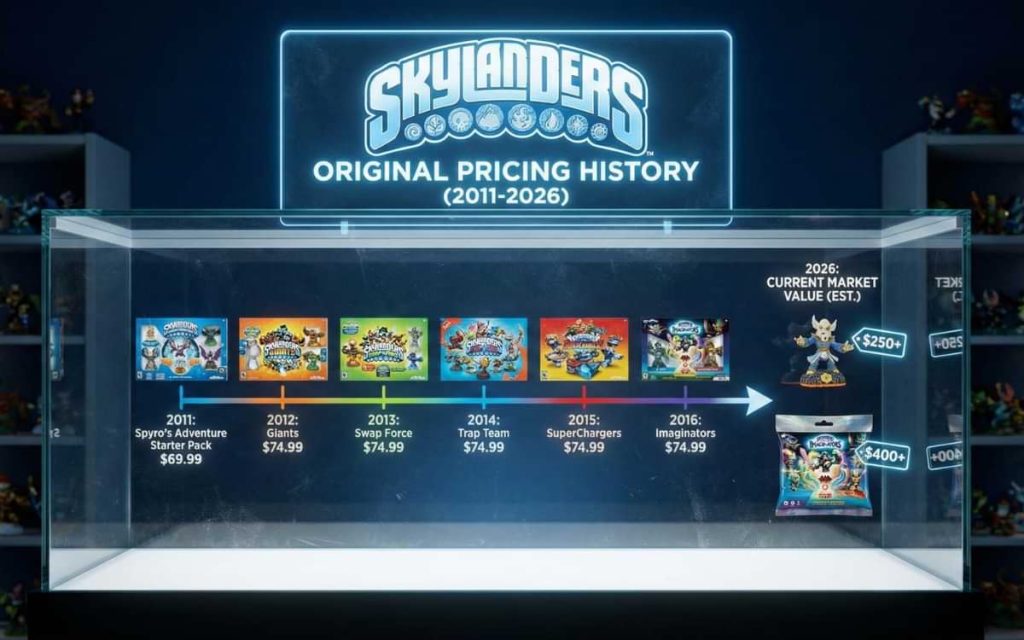
The original Skylanders: Spyro’s Adventure starter pack launched in October 2011 at $69.99 USD for console versions (Xbox 360, PlayStation 3, Wii) and the Nintendo 3DS, and $59.99 for PC, according to a Kotaku report of 14 October 2011 (an earlier version of this page gave $49.99 for the 3DS and $69.99 for PC). Individual character figures retailed for $7.99 each, triple packs for $19.99, and adventure packs for $19.99. This pricing established the toys-to-life business model that would influence gaming for the next five years.
Note, November 2026: an earlier version of this page included an interactive price chart that generated simulated price movements rather than recorded prices. It has been removed. The prices in the article text are the ones we stand behind; see how we research prices.
When Physical Toys Transformed Gaming Economics?
In October 2011, Activision introduced a revolutionary concept that would fundamentally change how families spent money on video games. Skylanders: Spyro’s Adventure wasn’t just a game, it was a physical-digital hybrid that required collectible toy figures to unlock characters and gameplay. This launch marked the beginning of the toys-to-life genre, creating an entirely new pricing ecosystem that blended traditional video game economics with action figure collectibility.
Understanding Skylanders’ original pricing matters because it represents a watershed moment in gaming monetization. Unlike previous game expansions or downloadable content, Skylanders created a model where physical products at retail price points drove ongoing engagement and revenue. For parents in 2011, this meant navigating unfamiliar territory: was buying additional $8 figures similar to collecting trading cards, or was it closer to paying for game content that should have been included?
By 2026, the Skylanders franchise has been dormant for nearly a decade, making the original pricing structure a historical artifact that reveals how the industry experimented with merging physical retail and digital gaming. This article examines the complete pricing landscape from the 2011 launch through the franchise’s evolution, providing the definitive resource on what Skylanders actually cost at retail.
The 2011 Launch: Breaking Down the Starter Pack
What Came in the Box
The Skylanders: Spyro’s Adventure starter pack represented significant value engineering for a new game concept. Each starter pack included:
- Full game disc (platform-specific)
- Portal of Power (USB-connected NFC reader)
- Three character figures (Spyro, Gill Grunt, Trigger Happy)
- Three-character trading cards
- Three web codes for online features
- Sticker sheets
The Portal of Power technology was the critical hardware component that justified the premium pricing. This device used near-field communication (NFC) to read embedded chips in each figure, translating physical toys into digital characters. In 2011, NFC technology in consumer products was relatively novel, adding production costs that standard game packages didn’t face.
Platform-Specific Pricing Structure
| Platform | Starter Pack MSRP | Included Figures | Portal Type |
|---|---|---|---|
| Xbox 360 | $69.99 | Spyro, Gill Grunt, Trigger Happy | Wired USB |
| PlayStation 3 | $69.99 | Spyro, Gill Grunt, Trigger Happy | Wired USB |
| Wii | $69.99 | Spyro, Gill Grunt, Trigger Happy | Wired USB |
| Nintendo 3DS | $69.99 | Stealth Elf, Dark Spyro, Ignitor | Wireless IR Portal |
| PC/Mac | $59.99 (PC) | Spyro, Gill Grunt, Trigger Happy | Wired USB |
Correction, 23 November 2026: an earlier version of this page priced the 3DS starter pack at $49.99 and the PC version at $69.99. Kotaku reported on 14 October 2011 that the starter kits cost $69.99 for consoles and the 3DS and $59.99 for PC. The 3DS version was a different game with its own portal, but it was not cheaper.
This pricing positioned Skylanders at the premium end of the new release spectrum. Standard AAA console games in 2011 retailed for $59.99, meaning Skylanders commanded a $10 premium solely for the inclusion of three figures and the portal hardware. Similar to how the original PS5 price justified its cost through bundled controller technology and new features, Activision positioned the Portal of Power as essential infrastructure worth the upcharge.
Individual Figure Economics: The Core Revenue Driver
Standard Single Figure Pricing
Individual Skylanders figures launched at $7.99 USD, a price point carefully calibrated to encourage collection while remaining accessible for weekly allowance purchases. This pricing existed in a unique category, not quite action figures (which typically ranged $9.99-$14.99 for similar quality) and not quite trading cards (typically $3-$5 per pack), but somewhere strategically positioned between both.
The $7.99 price included:
- One collectible figure with an embedded NFC chip
- Character-specific trading card
- Web code for online features
- Code to unlock digital content
Figure Pack Variations and Pricing
| Product Type | Contents | Original MSRP | Value Proposition |
|---|---|---|---|
| Single Figure | 1 character | $7.99 | Base collection option |
| Triple Pack | 3 characters | $19.99 | $3.98 savings vs. singles |
| Adventure Pack | 1 figure, 2 items, 1 location | $19.99 | New level content |
| Legendary Triple Pack | 3 exclusive variants | $19.99 | Retailer exclusives |
| Dragon’s Peak Adventure | Sunburn, winged sapphire, shield | $19.99 | Flying gameplay unlock |
The triple pack structure followed classic retail bundling psychology, offering a 17% discount ($23.97 of single-figure value for $19.99) to encourage larger purchases while maintaining profit margins through volume. Parents quickly learned that waiting for triple packs made economic sense, though retailer exclusivity on certain packs complicated straightforward price comparisons.
Adventure packs represented the highest per-item value, effectively pricing new level content at $12 when accounting for the included figure and item pieces at standard rates. This was comparable to traditional DLC pricing in 2011, but delivered through physical retail instead of digital storefronts.
The Eight Elements System: Pricing Through Artificial Scarcity
Skylanders organized its 32 launch characters across eight elemental types: Air, Earth, Fire, Water, Life, Undead, Magic, and Tech. While the game could be completed with just the three starter figures, elemental gates throughout levels could only be opened by matching-element characters. This created a collection incentive that was transparent in its design but effective in execution.
A completist approach to unlocking all elemental areas required purchasing at minimum:
- 5 additional single figures ($39.95) to cover all eight elements
- Or 2 triple packs ($39.98) for optimal value
This meant the total entry cost for full game access started at $109.94 with single figures or $109.97 with two triple packs (the $149.94 upper figure this page gave before has no stated basis), not including any adventure packs for additional content. Compared to the Xbox console original pricing where you received complete functionality at launch, Skylanders’ gating mechanism represented a new form of tiered access within a single retail product.
Regional Pricing Variations: Global Market Strategy
North American Pricing (2011 Launch)
The United States served as Skylanders’ primary market with the most aggressive pricing:
- Starter Pack: $69.99 (consoles and 3DS) / $59.99 (PC)
- Single Figures: $7.99
- Triple Packs: $19.99
- Adventure Packs: $19.99
Canadian pricing followed typical exchange rate markups:
- Starter Pack: CAD $79.99
- Single Figures: CAD $9.99
- Triple Packs: CAD $24.99
European Pricing
European markets faced significantly higher price points due to VAT inclusion and import costs:
- UK Starter Pack: £59.99 (approximately $94 USD at 2011 rates)
- UK Single Figures: £7.99 (approximately $12.50 USD)
- EU Starter Pack: €69.99 (approximately $97 USD)
- EU Single Figures: €9.99 (approximately $14 USD)
European consumers paid roughly 30-40% premiums over US pricing on the starter pack, and more on single figures, on the unsourced figures above, creating a secondary market for importing figures from North American retailers. This pricing disparity was common for gaming hardware, similar patterns appeared in the Nintendo Switch original price and Game Boy original price launches, but the physical collectible nature of Skylanders made the difference particularly pronounced.
Australian and Asian Markets
Australian pricing reflected the region’s typical “Australia tax” on gaming products:
- Starter Pack: AUD $99.95-$109.95
- Single Figures: AUD $13.99-$15.99
Limited Asian market launches saw varied pricing depending on distribution arrangements, with Japan receiving select releases at premium import pricing roughly 20-30% above US MSRP.
Franchise Evolution: How Pricing Changed Across Sequels
Skylanders Giants (2012)
The second installment maintained similar starter pack pricing at $74.99 but introduced larger “Giant” figures at a premium:
- Giants Starter Pack: $74.99 (included Tree Rex Giant figure)
- Standard Figures: $7.99 (unchanged)
- Giant Figures: $14.99 (nearly double standard price)
- Triple Packs: $19.99 (unchanged)
The Giant figures’ premium pricing came from legitimately larger physical products with enhanced detail, but also tested consumer willingness to pay more for mechanically superior characters in-game.
Skylanders Swap Force (2013)
Swap Force introduced figures with interchangeable top and bottom halves, again at premium pricing:
- Swap Force Starter Pack: $74.99
- Standard Figures: $9.99 (25% increase from original)
- Swap Force Figures: $14.99
- Triple Packs: $24.99
By 2013, Activision had normalized higher figure prices across the board, pushing standard single figures from $7.99 to $9.99. This represented the first significant base price increase and signaled the franchise’s confidence in sustained demand.
Skylanders Trap Team (2014)
Trap Team’s pricing reflected the most complex product mix yet:
- Trap Team Starter Pack: $74.99 (included trap crystals)
- Standard Figures: $9.99
- Trap Master Figures: $14.99
- Individual Traps: $5.99 (new collectible category)
- Trap Multi-Packs: $17.99 (3 traps)
The addition of separately sold trap crystals created a new revenue stream. While cheaper than figures at $5.99 each, the need for multiple traps across different elements added collection costs. A complete trap collection required approximately $120-$150 beyond the starter pack investment.
Skylanders SuperChargers (2015) and Imaginators (2016)
The franchise’s final years saw continued pricing escalation:
SuperChargers:
- Starter Pack: $74.99
- Vehicle Figures: $14.99
- Character + Vehicle Combo: $24.99
Imaginators:
- Starter Pack: $74.99
- Sensei Figures: $14.99
- Creation Crystals: $9.99
By Imaginators in 2016, the baseline figure price had settled at a permanent $14.99 for premium characters, with the starter pack maintaining the $74.99 standard established in 2012. This pricing likely contributed to market fatigue, as families faced ever-increasing collection costs with diminishing novelty.
Comparison With Competing Toys-to-Life Franchises
Disney Infinity Pricing (2013-2016)
Disney entered the toys-to-life market in 2013 with competitive positioning:
- Starter Pack: $74.99 (matching Skylanders Giants)
- Standard Figures: $12.99-$14.99 (premium over Skylanders)
- Play Sets: $34.99 (new level content)
Disney leveraged brand recognition to justify higher figure prices, betting that character appeal (Marvel, Star Wars, Pixar) would overcome the cost difference. The strategy worked initially, but faced similar market saturation by 2016.
Nintendo amiibo Pricing (2014-Present)
Nintendo took a different approach with amiibo in 2014:
- No Starter Pack Required: Used existing Wii U/3DS NFC readers
- Standard Figures: $12.99
- Multi-Game Compatibility: Single figures worked across multiple titles
The amiibo model reduced barrier to entry (no $75 starter pack investment) but offered less dedicated gameplay integration. This positioned amiibo as complementary rather than essential, potentially extending its market viability. Similar to how Steam Machine pricing attempted to compete with console ecosystems through different value propositions, amiibo succeeded by avoiding direct competition with Skylanders’ model.
Market Outcome (2026 Perspective)
By 2026, all three major toys-to-life franchises have ceased active development:
- Skylanders: Last release 2016 (Imaginators)
- Disney Infinity: Discontinued 2016
- amiibo: Continues limited releases but is no longer central to Nintendo’s strategy
The pricing escalation across all three franchises, from Skylanders’ original $7.99 figures to the industry-wide $14.99 standard by 2015, suggests the market could not sustain the collection costs long-term. Parents who initially saw Skylanders as a $70 game investment discovered it was actually a $200-$500 commitment per installment for engaged children.
The True Cost of Skylanders: Complete Collection Economics
First-Year (2011-2012) Collection Costs
For a family purchasing during Skylanders’ first year, the complete collection costs broke down as follows:
Minimum Playthrough Cost:
- Starter Pack: $69.99
- Additional figures for elemental coverage: $39.98 (2 triple packs)
- Total: $109.97
Complete Character Collection:
- Starter Pack: $69.99
- 29 additional characters: $231.71 (all bought singly at $7.99; about $195.89 with nine triple packs and two singles)
- Total: $301.70
100% Collection (All Variants):
- Including retailer exclusives, legendary variants, and adventure packs: $400-$500
These figures assume retail pricing without sales or discounts. Savvy shoppers could reduce costs through strategic purchases during Black Friday, clearance cycles, or retailer promotions. However, the psychological pressure on children to collect specific characters often worked against patient bargain hunting.
Multi-Game Family Investment (2011-2016)
A family buying each main Skylanders release faced escalating costs:
| Year | Game | Starter Pack | Est. Figure Purchases | Annual Cost |
|---|---|---|---|---|
| 2011 | Spyro’s Adventure | $69.99 | $150-$250 | $220-$320 |
| 2012 | Giants | $74.99 | $100-$200 | $175-$275 |
| 2013 | Swap Force | $74.99 | $100-$200 | $175-$275 |
| 2014 | Trap Team | $74.99 | $150-$250 | $225-$325 |
| 2015 | SuperChargers | $74.99 | $100-$200 | $175-$275 |
| 2016 | Imaginators | $74.99 | $100-$200 | $175-$275 |
Six-Year Franchise Total: $1,145-$1,745 for moderately engaged collectors
This lifetime value far exceeded any traditional gaming franchise. For comparison, a family buying all six years of Call of Duty games at $60 each spent $360 total, less than a third of Skylanders’ minimum engagement cost.
Retail Strategy and Artificial Scarcity
Wave-Based Releases
Activision employed a wave release strategy that created perceived scarcity:
- Wave 1: Launch day availability (10-12 characters)
- Wave 2: 4-6 weeks post-launch (8-10 new characters)
- Wave 3: Holiday season (remaining launch wave characters)
- Wave 4+: January-March (final characters and variants)
This approach kept products in news cycles throughout the holiday season and created urgency around specific characters that weren’t yet available. Parents familiar with limited edition collectibles recognized the pattern from other toy lines, but the gameplay integration made missing specific characters more frustrating than purely collectible items.
Retailer Exclusivity
Major retailers secured exclusive variants and packs; the best-documented program was the Legendary variant line sold through Toys”R”Us, and other chains carried their own exclusive figures and bundles at various points. These exclusives didn’t add gameplay value but drove collection completionists to multiple retailers. From a pricing transparency perspective, this practice complicated price comparisons and created regional availability issues. The strategy worked for short-term retail partnerships but contributed to collector fatigue by 2015-2016.
Secondary Market and Collector Values (November 2026)
| Item | Original price | Loose value, Nov 2026 (PriceCharting) |
|---|---|---|
| Spyro (2011) | $7.99 | $8.31 |
| Gill Grunt / Trigger Happy (2011) | $7.99 | $7.90 |
| Giants Portal of Power | bundled | $21.37 |
| Trap Team Portal of Power | bundled | $26.66 |
| Fire Yawn (rare variant) | – | $1,057 |
| Chompy Mage (Imaginators) | $14.99 | $985 |
| Sensei / Master Ro-Bow (Imaginators) | $14.99 | $500-$535 |
The pattern is the opposite of what casual sellers assume. The common 2011 figures, produced in the millions, still trade at roughly their original $7.99 retail price in nominal dollars, which is a real-terms loss of about 30% to inflation over 15 years (our calculation) but nowhere near worthless. The genuinely valuable pieces are the late-era, low-print-run figures, mostly from Imaginators (2016), when shrinking sales meant small production runs: several now sell for $450 to over $1,000 loose.
Investment Perspective
Mass-produced commons did what mass-produced collectibles always do: held nominal value at best. The appreciation went to figures nobody was speculating on at the time, the final-wave characters printed in small numbers as the franchise died. If you have a bin of Skylanders in the attic, the commons fund a pizza; check any Imaginators-era senseis and variants individually on PriceCharting before selling the lot.
What We Learned: The Toys-to-Life Pricing Experiment
Why the Model Succeeded (2011-2014)
Skylanders’ pricing worked during its peak years because it successfully merged several proven revenue models:
- Collectible Card Game Economics: Similar spending patterns to Pokémon or Magic: The Gathering
- Action Figure Market: Leveraged existing toy aisle retail relationships
- Premium Game Pricing: Maintained AAA game quality and production values
- DLC Model: Offered ongoing content through physical products
The $7.99 entry point per figure proved ideal for impulse purchases and birthday gifts. Parents could say “yes” to a single figure more easily than to a $30-$40 DLC pack, even though the cumulative spending exceeded traditional downloadable content costs.
Why the Market Collapsed (2015-2016)
Several factors converged to end the toys-to-life boom:
Market Saturation: Three major franchises (Skylanders, Disney Infinity, LEGO Dimensions) competed for limited household budgets and shelf space.
Pricing Fatigue: Escalation from $7.99 to $14.99 base figures doubled collection costs while novelty decreased.
Digital Alternative Emergence: Free-to-play mobile games offered similar collection mechanics without physical storage requirements.
Environmental Concerns: Growing awareness of electronic waste made buying hardware-dependent toys less appealing.
Franchise Fatigue: Annual releases with diminishing innovation reduced must-have appeal.
By 2016, the market had fundamentally shifted. The pricing model that seemed revolutionary in 2011 felt exploitative by the franchise’s end, particularly as children’s existing figure collections became incompatible or underutilized in newer releases.
23 November 2026 check: launch prices against a 2011 source, and values today
The prices on this page had no dated source. On 23 November 2026 we checked the 2011 US launch prices against a Kotaku report of 14 October 2011 (Mike Fahey), written the week the game went on sale, and the Disney Infinity prices against a Nintendo Life report on Disney Infinity pricing of January 2013, which cites Eurogamer.
| Item | This page said | The source says | Source |
|---|---|---|---|
| Starter pack, Wii and Xbox 360 | $69.99 | $69.99 for consoles | Kotaku |
| Starter pack, Nintendo 3DS | $49.99 | $69.99 | Kotaku |
| Starter pack, PC | $69.99 | $59.99 | Kotaku |
| Single figure | $7.99 | $7.99 | Kotaku |
| Three-pack of figures | $19.99 | $19.99 | Kotaku |
| Adventure pack | $19.99 | $19.99 | Kotaku |
| Disney Infinity starter pack, US | $74.99 | $75 on Wii U | Nintendo Life |
| Disney Infinity single figure | $12.99-$14.99 | $12.99; three-packs $29.99 | Nintendo Life |
| Disney Infinity play set | $34.99 | $34.99 | Nintendo Life |
Two launch prices were wrong and have been corrected throughout: the 3DS starter pack cost the same $69.99 as the console versions, and the PC version was $10.00 cheaper at $59.99. Four pieces of arithmetic were also corrected. A triple pack saved $3.98 against three singles (16.6%), not $4.02. The move from $7.99 to $9.99 figures was a 25% increase, not 20%. The $231.71 for 29 extra figures is the cost of buying every one singly; with nine triple packs and two singles it is $195.89, which makes the full set of 32 characters $265.88 with the starter pack. And six $60 games total $360, which is 31% of the $1,145 low estimate for six years of Skylanders, so less than a third, not less than a quarter.
The 2011 prices in October 2026 dollars
| Item | October 2011 price | In October 2026 dollars |
|---|---|---|
| Single figure | $7.99 | $11.91 |
| Three-pack or adventure pack | $19.99 | $29.80 |
| Starter pack, PC | $59.99 | $89.42 |
| Starter pack, consoles and 3DS | $69.99 | $104.33 |
| All 32 launch characters, every extra figure bought singly | $301.70 | $449.72 |
Adjusted with the US Consumer Price Index for all urban consumers (FRED series CPIAUCNS): 226.421 in October 2011 and 337.511 in October 2026.
What the 2011 figures sell for on 23 November 2026
| Figure | Loose | Complete in package | Loose as a share of $11.91 |
|---|---|---|---|
| Spyro | $8.31 | $35.20 | 70% |
| Trigger Happy | $7.93 | $29.99 | 67% |
| Gill Grunt | $7.90 | $29.25 | 66% |
| Stealth Elf | $6.14 | $22.50 | 52% |
| Chop Chop | $6.00 | $32.55 | 50% |
Loose commons have lost a third to a half of their real value; packaged ones have beaten inflation. The five loose figures sell for $6.00 to $8.31, which is 50% to 70% of the $11.91 that $7.99 is worth today. The same figures complete in their packaging sell for $22.50 to $35.20, 2.8 to 4.4 times the 2011 price and 1.9 to 3.0 times it after inflation. The three figures from the console starter pack total $24.14 loose.
Portals and rare figures. The Giants Portal of Power was $21.62 loose and the Trap Team portal $25.71, against $21.37 and $26.66 on 20 November. The dearest items visible on the page were Fire Yawn at $1,057.03 loose and $1,634.78 complete, Chompy Mage from Imaginators at $985.00, Life Yawn at $631.78, the Lost Imaginite Mines level pack with Master Ro-Bow at $535.00 and a clear Master Starcast at $515.00. The page is long and we could read only part of it.
Which figures on this page are sourced
| Figure | Status on 23 November 2026 |
|---|---|
| 2011 US launch prices | Kotaku, 14 October 2011; read 23 November 2026 |
| Disney Infinity prices of 2013 | Nintendo Life, January 2013, citing Eurogamer; read 23 November 2026 |
| Prices of the five sequels, 2012 to 2016, including Giants, traps, vehicles and senseis | No source read; treat as unverified |
| Canadian, UK, European, Australian and Japanese prices and their dollar conversions | No source |
| amiibo at $12.99 | No source read |
| Estimated figure purchases per year and the six-year total of $1,145 to $1,745 | Assumptions of the original article, not data |
| Wave schedule and retailer exclusives | General description; no source |
| Current values | PriceCharting, the part of the page we could read on 23 November 2026 |
| Inflation adjustment | Our arithmetic on FRED data read 23 November 2026 |
One inconsistency remains in the older text: it names amiibo as the third toys-to-life line in one section and LEGO Dimensions in another. Both existed; the page does not price LEGO Dimensions.
Where these figures come from
Kotaku report of 14 October 2011, Nintendo Life report on Disney Infinity pricing, PriceCharting Skylanders value guide and FRED series CPIAUCNS, all read 23 November 2026. Savings, totals, shares and inflation-adjusted prices are our arithmetic. PriceCharting figures are averages of sold listings and change daily.
Frequently Asked Questions
Was the 3DS Skylanders starter pack cheaper than the console version?
No. Kotaku reported on 14 October 2011 that the starter kits cost $69.99 for consoles and the 3DS and $59.99 for PC. An earlier version of this page gave $49.99 for the 3DS in error.
What is a $7.99 Skylanders figure in today's money?
About $11.91 in October 2026 dollars. Loose common figures from 2011 sell for $6.00 to $8.31, so they have lost 30% to 50% of their real value, while figures still in their packaging sell for $22.50 to $35.20.
How much did the original Skylanders starter pack cost in 2011?
The Skylanders: Spyro's Adventure starter pack launched at $69.99 for Xbox 360, PlayStation 3, Wii and Nintendo 3DS, and at $59.99 for PC, according to Kotaku on 14 October 2011. These prices included the game, a Portal of Power and three character figures.
Were Skylanders figures expensive compared to regular toys?
At $7.99 each, Skylanders figures were priced below comparable action figures ($10-$15) but above trading cards and small collectibles ($3-$5). The pricing positioned them as affordable impulse purchases individually but created high cumulative costs for engaged collectors seeking full game access.
Why did Skylanders cost more than regular video games?
The $69.99 starter pack price exceeded standard $59.99 game pricing due to the included Portal of Power hardware and three NFC-enabled figures. The portal’s near-field communication technology and the embedded chips in each figure added manufacturing costs that traditional disc-only games didn’t face.
How much did a complete Skylanders collection cost?
A complete collection of the original 32 Skylanders characters costs approximately $266 to $302 at retail pricing including the starter pack ($265.88 using triple packs, $301.70 buying every figure singly). Including all variants, adventure packs, and exclusive releases pushed costs to $400-$500 for completionists.
Did Skylanders prices increase over the franchise’s lifespan?
Yes, significantly. Standard figures increased from $7.99 (2011) to $9.99 (2013) to $14.99 for premium characters by 2016. Starter packs rose from $69.99 to $74.99, and new product categories (Giants, vehicles, traps) added premium pricing tiers throughout the franchise.
What are original Skylanders figures worth today in 2026?
Common 2011 figures sell for roughly their original retail price, about $8 loose, per PriceCharting’s eBay sold-listing data (November 2026). Portals run $21-$27 loose. The real money is in rare late-era figures: several Imaginators-era characters and variants sell for $450 to over $1,000.
How did Skylanders pricing compare to Disney Infinity and amiibo?
Disney Infinity matched Skylanders starter pack pricing ($74.99) but charged more for individual figures ($12.99-$14.99). Nintendo amiibo eliminated starter pack costs entirely but priced figures at $12.99, offering better value for casual collectors but less dedicated game integration.
Updated November 2026; launch prices checked against Kotaku (14 October 2011) and values reread 23 November 2026. Launch and sequel prices are US MSRPs as reported in 2011-2016 coverage and Activision announcements; regional launch prices are as reported at the time. Current values: PriceCharting Skylanders value guide (eBay sold-listing data), 20 November 2026. Collection-cost totals are our own calculations from those MSRPs. Prices change.