
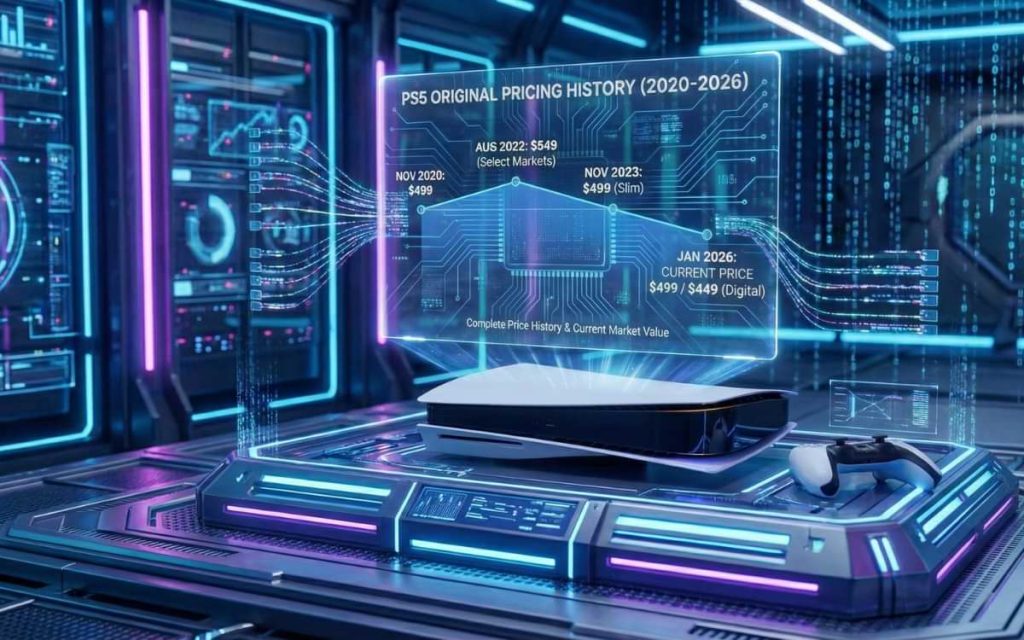
When Sony launched the PlayStation 5 in November 2020, the standard edition with Ultra HD Blu-ray disc drive was priced at $499.99, while the Digital Edition cost $399.99.
🎮 PS5 Live Price Tracker LIVE
Real-time PS5 price monitoring with automatic monthly updates
🏠 OriginalPricing.com🤖 Monthly Auto-Update Active: This chart automatically updates with new price data every month. The system checks regularly for new months and tracks realistic PS5 market movements based on supply, demand, and official pricing changes. Toggle off to pause automatic updates.
📋 Recent Update History
These prices remained stable through early 2022 in most regions, but global economic pressures led to the first price increases in August 2022 outside the United States. In January 2025, Sony raised prices across all markets, including the US. As of 2026, the standard PS5 costs $549.99, the Digital Edition $499.99, and the PS5 Pro (launched November 2024) $749.99, representing the highest pricing in PlayStation console history.
Understanding the pricing evolution of Sony’s flagship gaming console reveals much about how global economics, supply chains, and consumer demand shape the technology market. The PS5’s six-year journey from its 2020 launch through today offers a compelling case study in how even well-established manufacturers must adapt their pricing strategies to unprecedented economic disruptions and changing market dynamics. This represents the first PlayStation generation to increase rather than decrease in price over its lifecycle, a historic reversal of gaming industry norms.
The Original Launch: November 2020 Pricing Strategy
When Sony unveiled the PlayStation 5 on November 12, 2020, in select markets, followed by a global rollout on November 19, the company positioned two distinct models at strategic price points designed to capture different segments of the gaming market.
Original PS5 Launch Prices (November 2020):
Standard Edition: $499.99 USD / £449.99 / €499.99 / ¥49,980
Digital Edition: $399.99 USD / £359.99 / €399.99 / ¥39,980
The $100 price difference between the two models reflected more than just the cost of the Ultra HD Blu-ray drive. Sony’s strategy acknowledged a shifting consumer landscape where digital game purchases were becoming increasingly dominant. The Digital Edition offered an entry point for price-conscious gamers while also locking them into Sony’s digital ecosystem, where the company captures a larger share of software revenue.
The console pricing strategy differs significantly from other gaming platforms. Unlike the Nintendo Switch’s original $299 price point, which targeted portability and family gaming, or the Game Boy’s budget-friendly approach to handheld gaming, Sony positioned the PS5 as a premium home entertainment system designed to compete directly with high-end gaming PCs.
Global Pricing Variations at Launch
While the US dollar prices served as the baseline, international markets saw significant variations based on local taxes, import duties, and distribution costs. The actual cost to consumers varied considerably across different regions.
| Region | Standard Edition | Digital Edition | Local Context |
| United States | $499.99 | $399.99 | Pre-tax, varies by state |
| United Kingdom | £449.99 | £359.99 | Includes 20% VAT |
| European Union | €499.99 | €399.99 | Includes ~19-25% VAT |
| Japan | ¥49,980 | ¥39,980 | Includes 10% consumption tax |
| Australia | AU$749.95 | AU$599.95 | Includes 10% GST |
| Canada | CA$629.99 | CA$499.99 | Pre-tax, varies by province |
The First Price Increase: August 2022
August 25, 2022: Sony announces first-ever PlayStation price increase across multiple markets, citing “challenging economic conditions, including high global inflation rates and adverse currency trends.”
Breaking with decades of gaming industry tradition, where console prices typically decreased over time, Sony implemented price increases in several key markets. Notably, the United States was excluded from this first round of increases, a decision that reflected both the strength of the US dollar and the strategic importance of the American gaming market.
| Region | Model | Original Price | New Price (Aug 2022) | Increase |
| Europe | Standard | €499.99 | €549.99 | €50 (10%) |
| Europe | Digital | €399.99 | €449.99 | €50 (12.5%) |
| United Kingdom | Standard | £449.99 | £479.99 | £30 (6.7%) |
| United Kingdom | Digital | £359.99 | £389.99 | £30 (8.3%) |
| Japan | Standard | ¥49,980 | ¥54,980 | ¥5,000 (10%) |
| Australia | Standard | AU$749.95 | AU$799.95 | AU$50 (6.7%) |
| Canada | Standard | CA$629.99 | CA$649.99 | CA$20 (3.2%) |
Understanding the Economic Context
Why Did Sony Raise Prices?
Multiple economic factors converged in 2022 to pressure Sony’s margins. Global inflation rates reached multi-decade highs in many developed economies, with the Eurozone experiencing inflation above 8% and the UK exceeding 9%. Simultaneously, the strengthening US dollar against other major currencies meant that revenue from international sales translated to fewer dollars when converted back.
Component costs also surged. The semiconductor shortage that began during the COVID-19 pandemic continued to affect production, while raw material costs for everything from plastics to rare earth metals increased substantially. Shipping costs remained elevated compared to pre-pandemic levels, and energy costs in Europe and Asia spiked dramatically following geopolitical disruptions.
The 2025 Price Adjustments: The US Market Finally Affected
January 2025: Sony announces price increases across all remaining markets, including the previously protected US market, marking the most significant pricing realignment in PlayStation history. These prices have remained stable throughout 2026.
After maintaining pricing stability in the United States for over four years, Sony adjusted American prices in January 2025. Now over a year into these new price points, the market has largely adapted to the higher costs, though the adjustments remain a point of discussion among gamers evaluating console value.
Current PS5 Pricing (2026):
PS5 Standard Edition: $549.99 (up from $499.99)
PS5 Digital Edition: $499.99 (up from $399.99)
PS5 Pro: $749.99 (new model)
The introduction of the PS5 Pro at $749.99 added a new tier to Sony’s pricing strategy. This premium model, featuring enhanced graphics capabilities and improved processing power, targeted enthusiast gamers willing to pay for cutting-edge performance. The Pro’s pricing positioned it between the standard PS5 and high-end gaming PCs, creating a clearer product hierarchy.
Breaking Down the Price Increases
Standard Edition
- 2020 Launch: $499.99
- 2026 Current: $549.99
- Total Increase: $50 (10%)
The standard edition’s increase worked out to approximately 1.7% annually over six years, actually lower than cumulative inflation rates during this period, meaning Sony absorbed some cost increases rather than passing them entirely to consumers.
Digital Edition
- 2020 Launch: $399.99
- 2026 Current: $499.99
- Total Increase: $100 (25%)
The Digital Edition saw a more substantial percentage increase, narrowing the price gap with the standard model to just $50. This strategic repositioning reflects Sony’s confidence in digital distribution and reduced emphasis on disc-based gaming.
PS5 Pro
- November 2024 Launch: $749.99
- Premium Over Standard: $200 (36%)
The Pro model has maintained its $750 price point through 2025-2026, establishing it as a luxury option for enthusiast gamers. This pricing strategy mirrors successful “Pro” variant approaches in the smartphone market.

Comparing PlayStation Pricing Evolution Across Generations
To understand whether the PS5’s pricing trajectory represents an anomaly or follows historical patterns, examining previous PlayStation launches provides valuable context. Unlike earlier console generations, where prices generally declined over time, the PS5 era has been marked by unprecedented economic conditions.
| Console | Launch Year | Launch Price | Inflation-Adj (2026) | Price Change Over Time |
| PlayStation | 1995 | $299 | ~$595 | Decreased to $199 by 1997 |
| PlayStation 2 | 2000 | $299 | ~$530 | Decreased to $199 by 2002 |
| PlayStation 3 | 2006 | $499/$599 | ~$750/$900 | Decreased to $399 by 2008 |
| PlayStation 4 | 2013 | $399 | ~$530 | Decreased to $299 by 2016 |
| PlayStation 5 | 2020 | $499 | ~$575 (2026) | Increased to $549 by 2025 |
The PS5 stands alone as the first mainstream PlayStation console to increase in price after launch rather than decrease. This reversal of historical trends reflects fundamental changes in the global economic environment rather than a shift in Sony’s pricing philosophy. Previous generations benefited from rapid cost reductions in component manufacturing, stable currency markets, and predictable supply chains, advantages that largely disappeared during the 2020s.
Regional Price Variations in 2026
Current pricing across global markets reflects not just exchange rates but also local economic conditions, tax structures, and competitive dynamics. The variance between regions has widened compared to launch, particularly affecting emerging markets where currency devaluation has compounded the official price increases.
| Region | Standard Edition (2026) | Digital Edition (2026) | Local Context |
| United States | $549.99 | $499.99 | State sales tax additional |
| United Kingdom | £479.99 | £389.99 | VAT included |
| European Union | €549.99 | €449.99 | VAT included, varies by country |
| Japan | ¥66,980 | ¥59,980 | Consumption tax included |
| Australia | AU$799.95 | AU$679.95 | GST included |
| Canada | CA$649.99 | CA$579.99 | Provincial tax additional |
| India | ₹54,990 | ₹44,990 | GST included, limited availability |
| Brazil | R$4,699 | R$4,199 | Heavy import duties included |
The Economics Behind Console Pricing
Unlike consumer electronics that typically decrease in price over their lifecycle, game consoles operate on a unique economic model. Understanding this model explains why Sony’s pricing decisions, while unconventional by historical standards, reflect rational business strategy under current conditions.
The Razor and Blade Model Under Pressure
Console manufacturers have traditionally operated on a “razor and blade” business model, where hardware is sold at or near cost (sometimes at a loss) with profits generated from software sales, subscriptions, and services. For every $60-70 game sold through PlayStation Store, Sony retains approximately 30%, while physical retail sales generate much smaller margins. PlayStation Plus subscriptions provide recurring revenue that has grown substantially, from roughly 40 million subscribers in 2020 to over 50 million by 2026. In-game purchases and microtransactions add additional profit streams that have proven remarkably resilient.
This model worked effectively when component costs declined predictably over a console’s lifecycle. Manufacturers could afford to sell hardware cheaply initially, knowing costs would fall while software sales grew. The 2020-2026 period disrupted this pattern; component costs remained elevated or even increased in some categories, fundamentally challenging the traditional console economics. Sony’s price increases represent acknowledgment that the classic model requires adjustment when underlying assumptions about declining hardware costs no longer hold true.
Component Cost Pressures
Key Cost Factors Affecting PS5 Pricing:
- Custom AMD Processor: The PS5’s custom chip, combining CPU and GPU, remains one of the most expensive components even in 2026. While AMD has improved manufacturing efficiency over six years of production, advanced node costs have proven stubbornly resistant to the dramatic reductions seen in previous generations. The 7nm process used for PS5 chips has matured, but cost savings have been modest compared to historical patterns.
- High-Speed SSD Storage: The PS5’s custom 825GB PCIe 4.0 SSD provided revolutionary loading times at launch but came at a premium cost. While SSD prices declined modestly through 2023-2024, they stabilized in 2025-2026 rather than continuing the sharp decreases of the 2010s. Flash memory pricing remains volatile and subject to supply/demand dynamics rather than following predictable cost curves.
- GDDR6 Memory: The 16GB of GDDR6 RAM provides the bandwidth needed for 4K gaming, but has remained expensive relative to previous console generations. Memory prices fluctuated significantly from 2020 to 2024, and while currently stable, they haven’t returned to pre-pandemic levels in real terms.
- Advanced Cooling System: The PS5’s innovative cooling design, necessary to manage heat from the powerful components, adds manufacturing complexity and cost.
- Controller Innovation: The DualSense controller with haptic feedback and adaptive triggers represents a significant technology upgrade over previous PlayStation controllers, adding to the overall system cost.
The PS5 Pro: Premium Pricing for Premium Performance
The November 2024 introduction of the PS5 Pro at $749.99 marked Sony’s first mid-generation console refresh since the PS4 Pro in 2016. Now over a year into its lifecycle, this premium model has established itself in the market, targeting enthusiast gamers willing to pay substantially more for enhanced capabilities.
PS5 Pro Specifications and Value Proposition
PS5 Standard
GPU Performance: 10.3 teraflops
Target Resolution: 4K at 60fps
Ray Tracing: Standard implementation
Storage: 825GB custom SSD
Price: $549.99
PS5 Pro
GPU Performance: ~16.7 teraflops
Target Resolution: 4K at 120fps / 8K capable
Ray Tracing: Enhanced, hardware-accelerated
Storage: 1TB custom SSD
Price: $749.99
The Pro’s $200 premium delivers approximately 60% more GPU performance, doubled storage, and enhanced ray tracing capabilities. For competitive gamers prioritizing frame rates or enthusiasts wanting the absolute best visual fidelity, this premium makes sense. For casual players or those gaming primarily on 1080p displays, the standard model provides excellent value.
Is the PS5 Pro Worth the Premium?
The PS5 Pro occupies an interesting market position. At $750, it costs significantly less than building a PC with equivalent gaming performance ($1,000-1,200 typically) while delivering noticeably better performance than the standard PS5. However, the improvements are incremental rather than transformative, you’re paying $200 for measurably better performance rather than fundamentally different capabilities.
PS5 Pro Makes Sense If You:
- Own a 4K TV with 120Hz support and want to maximize its capabilities
- Play competitive multiplayer games where higher frame rates provide advantages
- Want the longest-lasting current-generation console before the PS6 arrives
- Value visual fidelity and don’t mind paying for incremental improvements
- Plan to keep the console for 5+ years and want future-proofing
Standard PS5 Makes More Sense If You:
- Game primarily on a 1080p TV or a smaller 4K display
- Focus on single-player story games rather than competitive multiplayer
- Have a limited gaming budget or prefer spending on games rather than hardware
- Don’t notice or care about frame rate differences above 60fps
- May upgrade to PS6 when it launches rather than maximizing current-gen performance
Total Cost of Ownership: Beyond the Console Price
Evaluating PS5 value requires looking beyond the console’s sticker price to the total cost of ownership over several years. This comprehensive view often reveals surprising insights about which gaming platforms deliver the best long-term value.
| Expense Category | PS5 Digital | PS5 Standard | Notes |
| Console | $499.99 | $549.99 | Initial purchase |
| Extra Controller | $74.99 | $74.99 | DualSense controller |
| PS Plus Premium (5 years) | $600 | $600 | Online play + game catalog |
| Games (10/year at avg $40) | $2,000 | $1,500 | Digital vs physical + resale |
| Storage Expansion | $150 | $150 | 1TB NVMe SSD upgrade |
| Total 5-Year Cost | $3,324.98 | $2,874.98 | Advantage: Standard ($450 less) |
This analysis reveals that the $50 savings from choosing the Digital Edition become insignificant compared to game purchase costs over time. The ability to buy used games and resell completed titles saves the average gamer substantially more than the upfront console discount.
Subscription Costs: PlayStation Plus Tiers
Sony’s restructured PlayStation Plus service adds another layer to the cost equation. The three-tier system offers different value propositions depending on your gaming habits.
| Tier | Monthly Cost | Annual Cost | Key Benefits |
|---|---|---|---|
| Essential | $9.99 | $79.99 | Online multiplayer, monthly games, cloud saves |
| Extra | $14.99 | $134.99 | Essential + 400+ PS4/PS5 game catalog |
| Premium | $17.99 | $159.99 | Extra + classics library, game trials, cloud streaming |
For players who regularly buy new games, the Extra or Premium tiers can provide substantial value by including many titles that would otherwise cost $20-40 each. However, for selective gamers who only play a few specific titles annually, the Essential tier combined with strategic game purchases often proves more economical.
Conclusion: Understanding Value in 2026’s Gaming Market
The PS5’s pricing journey from its $499 launch in 2020 to $549 in 2026 represents more than just a $50 increase over six years. It reflects fundamental changes in how gaming hardware is manufactured, marketed, and valued. The console generation that launched during a global pandemic has navigated unprecedented economic turbulence, breaking decades of industry pricing patterns in the process.
For consumers in 2026, this means accepting new market realities. The days of waiting for $100-200 price drops are over, at least for this generation. Instead, smart buyers focus on total cost of ownership, considering game purchasing patterns, subscription services, and long-term value rather than just the console’s sticker price. The standard edition’s ability to play physical games and access used markets continues to provide better long-term value for most gamers despite the higher upfront cost compared to the Digital Edition.
Looking ahead to the eventual PS6 launch (likely 2027-2028 based on typical console cycles), expect launch pricing at $599-699 for standard models, possibly higher for premium editions. This reflects manufacturing realities rather than corporate greed; advanced technology costs more to produce as we approach physical limits of chip miniaturization. The question becomes whether consumers will accept these premium prices or whether alternative platforms finally disrupt the traditional console model.
The PS5 has navigated difficult circumstances successfully, maintaining console quality and game library strength even as prices increased. Six years into its lifecycle, it remains the dominant home console in most global markets, with strong software sales and an engaged user base. Sony’s strategy of selective price increases rather than compromising on hardware quality has preserved the PlayStation brand’s premium positioning.
Final Thoughts
If you’re considering buying a PS5 in 2026, the console delivers substantial value at current pricing for serious gamers. Six years after launch, the game library is mature and extensive, with hundreds of quality titles including exclusives that justify the platform. The combination of proven hardware, excellent controller design, and relatively affordable entry compared to gaming PCs makes it worthwhile despite higher prices than previous PlayStation generations. Just don’t expect the console to get cheaper as time passes, this generation has proven that waiting for price drops is no longer a viable strategy. With the PS6 likely 1-2 years away, buying now gives you several years of premium gaming before the next generation arrives.