
Dubai property prices have increased approximately 58% over the last 10 years. The average price per square foot rose from around 962 AED in 2015 to roughly 1,524 AED by end of 2025, according to Dubai Land Department and DXB Interact data. The market dipped between 2016 and 2020 due to oversupply and the pandemic, then surged to record highs from 2021 onward.
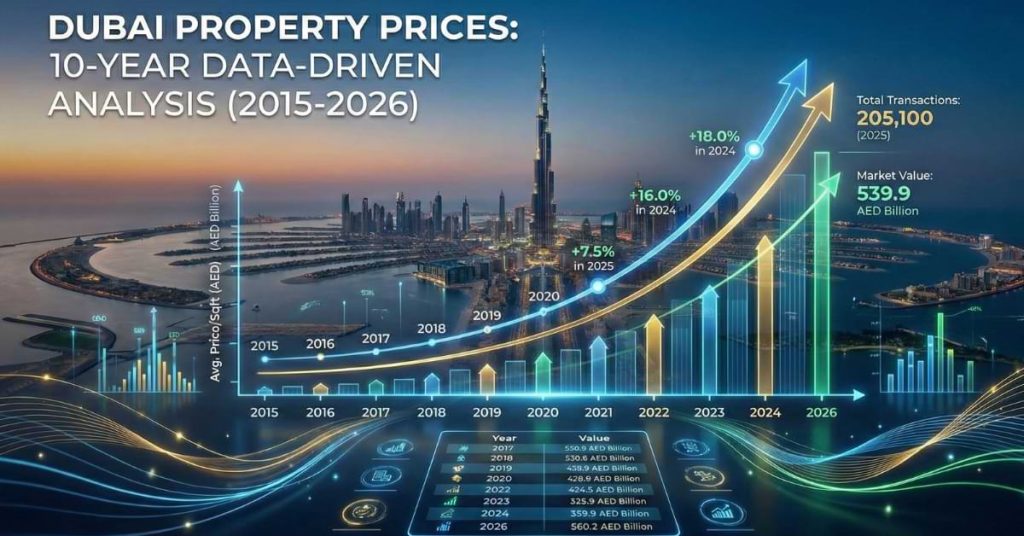
Dubai Property Prices Changed in 10 Years
If you bought a property in Dubai back in 2015, you’re probably sitting on some solid gains right now. The numbers don’t lie. Over the past decade, Dubai’s real estate market has gone through a full cycle of correction, pandemic shock, and explosive recovery. And that recovery hasn’t slowed down.
Let’s break it all down, year by year, so you can see exactly where prices stood, what moved the market, and where things might be heading.
Dubai Property Prices: Year-by-Year Breakdown (2015 to 2025)
Here’s the complete picture. This table shows the average price per square foot, annual change, total transactions, and overall market value for each year.
| Year | Avg. Price/Sqft (AED) | YoY Change | Total Transactions | Market Value (AED Billion) |
|---|---|---|---|---|
| 2015 | ~962 | -4.1% | 63,000+ | 267 |
| 2016 | ~951 | -1.1% | 60,595 | 259 |
| 2017 | ~1,000 | +5.2% | 64,000+ | 285 |
| 2018 | ~940 | -6.0% | 55,000+ | 223 |
| 2019 | ~900 | -4.3% | 42,000+ | 226 |
| 2020 | ~894 | -0.7% | 50,000+ | ~175 |
| 2021 | ~950 | +6.3% | 84,196 | ~300 |
| 2022 | ~1,039 | +9.4% | 97,466 | 265.6 |
| 2023 | ~1,175 | +13.1% | 132,628 | 400+ |
| 2024 | ~1,386 | +18.0% | 169,000+ | 488 |
| 2025 | ~1,524 | +12.9% | 205,100 | 539.9 |
Sources: Dubai Land Department (DLD), DXB Interact, ValuStrat, REIDIN
That’s a pretty dramatic shift if you zoom out. The market basically flatlined for half the decade, then went vertical starting in 2021.
The Decline Phase: 2015 to 2020
Between 2015 and 2020, Dubai’s property market was stuck in a prolonged correction. Prices per square foot dropped from around 962 AED to roughly 894 AED. That might not sound like much, but it represented years of stagnation while other global markets were climbing.
So what happened? A few things all hit at once.
Oversupply was the big one. Developers kept delivering thousands of new units every year. In some periods, supply simply outpaced demand. Areas like Jumeirah Village Circle and Dubai South saw massive buildouts that flooded the mid-range segment.
The oil price crash in 2015 and 2016 added pressure. While Dubai’s economy isn’t directly dependent on oil, the broader Gulf economic slowdown reduced investor confidence and slowed capital flows into real estate.
Then came 2020. COVID-19 caused a brief but real panic. Transaction volumes dropped sharply in Q2 2020. But here’s the interesting part: prices didn’t collapse the way many expected. The dip was relatively shallow (less than 1% year-over-year), and recovery started faster than almost anyone predicted.
The Boom Phase: 2021 to 2025
2021 was the turning point. Transaction volumes jumped to over 84,000 (up 66% from 2020), and the total market value hit nearly AED 300 billion. That was the highest transaction value in Dubai’s recorded real estate history at the time.
From there, it just kept accelerating.
2022 saw nearly 97,500 transactions worth AED 265.6 billion. Square foot prices surged past 1,039 AED, representing a 30%+ jump from the pandemic low. Jumeirah Village Circle remained the go-to for affordable apartments, while Dubai Marina held its position at the luxury end.
2023 shattered records again with over 132,600 transactions. Average prices climbed to around 1,175 AED per square foot. Off-plan sales exploded, with developers launching projects faster than ever to meet demand.
2024 pushed further with 169,000+ transactions valued at AED 488 billion. Price per square foot hit approximately 1,386 AED. The Valley by Emaar and Arabian Ranches led gains in the villa segment, while Business Bay dominated apartment sales.
2025 closed out as the strongest year yet. According to DXB Interact data compiled from the Dubai Land Department, over 205,100 residential transactions were recorded with a combined value of AED 539.9 billion (roughly USD 147 billion). The REIDIN price index showed a 12.88% year-over-year increase, with villas outperforming apartments at +15.16% versus +12.52%.
What’s Actually Driving Dubai Property Prices Up?
It’s not just one thing. Several forces are working together, and they’re unlikely to fade anytime soon.
Population growth is massive. Dubai’s population has been expanding rapidly, driven by favorable visa reforms (Golden Visa, freelancer visas, retirement visas) that are attracting long-term residents rather than just short-term speculators. That shift from speculative to genuine end-user demand is the single biggest change in this cycle.
Foreign investment keeps flowing in. Indian nationals have remained the top foreign buyer group for most of the last decade. Russian, British, and Chinese buyers have also increased their activity significantly since 2022. For those exploring luxury purchases in the UAE market, the pricing landscape extends well beyond real estate into categories like original Hublot prices in UAE and diamond ring pricing in the UAE.
Interest rates are easing. The UAE follows US Federal Reserve policy through its currency peg. As rates moderate, mortgage activity has picked up meaningfully. Cavendish Maxwell reported about 11,500 mortgage transactions in Q3 2025 alone, a 12.7% year-over-year increase.
Infrastructure keeps improving. New metro lines, the expansion of Al Maktoum International Airport, and ongoing development of master-planned communities all support long-term price appreciation.
Top Performing Areas by Price Growth
Not every neighborhood has performed equally. Here’s where the biggest gains have concentrated:
- Palm Jumeirah: Consistently the highest-priced residential area, with luxury villas commanding premiums well above AED 3,000 per square foot.
- Downtown Dubai: Strong appreciation driven by proximity to Burj Khalifa and Dubai Mall.
- Dubai Marina: The top luxury apartment location throughout the decade.
- Business Bay: Massive transaction volumes and steady price growth.
- Jumeirah Village Circle (JVC): The affordable segment leader, popular with first-time buyers and investors seeking rental yields.
- Mohammed Bin Rashid City: One of the fastest-appreciating villa communities.
- The Valley by Emaar: Leading gains in the affordable villa segment more recently.
Apartments vs. Villas: Which Performed Better?
Villas have generally outperformed apartments over the decade, especially from 2021 onward. The pandemic-driven desire for more space accelerated villa demand, and that preference has stuck.
In 2025, villas showed a 15.16% annual price increase compared to 12.52% for apartments. Average villa prices have risen from approximately AED 3.1 million in 2015 to over AED 3.5 million in 2024. Apartments have followed a similar trajectory but with sharper dips during the correction years.
That said, apartments make up 83% of total transaction volume, so they remain the backbone of the market. Investors chasing rental yields still favor apartments, especially in areas like JVC and Business Bay where gross yields sit around 5% to 7%.
What About 2026? Where Are Prices Headed?
The outlook for 2026 is one of continued growth, but at a slower pace. Knight Frank projects around 3% appreciation in the prime segment and roughly 1% in mainstream areas. Cushman & Wakefield Core expects mid-single-digit growth of about 5% to 8% overall.
Supply is a key variable. Approximately 48,000 new units are expected in 2025, with another 72,000 projected for 2026. If demand holds steady, prices should continue climbing. But the sheer volume of incoming supply could cool the pace of gains, particularly in oversaturated segments.
Is Now a Good Time to Buy Property in Dubai?
There’s no single right answer here, because it depends entirely on your goals, timeline, and risk tolerance. But the data tells a clear story: people who bought during the 2018 to 2020 dip are now sitting on 50% to 70% gains in many areas. Those who waited for a “better deal” have watched prices move further away.
The market is transitioning from a high-growth phase to a more balanced one. That’s not a bad thing. It suggests prices are more likely to stabilize than crash, which is actually a healthier environment for long-term buyers.
One thing to always keep in mind when evaluating any purchase, whether it’s real estate or consumer goods: understanding what “original price” really means helps you avoid overpaying based on inflated reference points.
Frequently Asked Questions
How much have Dubai property prices increased in the last 10 years?
Dubai property prices have increased approximately 58% from 2015 to 2025, with the average price per square foot rising from around 962 AED to roughly 1,524 AED.
What was the lowest point for Dubai property prices in the last decade?
The lowest point was around 2019 to 2020, when average prices dipped to approximately 894 AED per square foot due to oversupply and the COVID-19 pandemic.
Which areas in Dubai have seen the highest price growth?
Palm Jumeirah, Downtown Dubai, Dubai Marina, Business Bay, and Mohammed Bin Rashid City have consistently ranked among the top-performing areas for price appreciation.
Are Dubai property prices expected to keep rising in 2026?
Most analysts expect continued growth but at a slower pace. Knight Frank projects 1% to 3% growth depending on the segment, while Cushman & Wakefield Core forecasts 5% to 8% overall appreciation.
Is it better to buy an apartment or villa in Dubai?
Villas have outperformed apartments in price growth (15.16% vs. 12.52% in 2025), but apartments offer higher rental yields and lower entry points. Your choice depends on whether you’re prioritizing capital gains or rental income.