
Last Updated: 2026 | Original Pricing Research Team
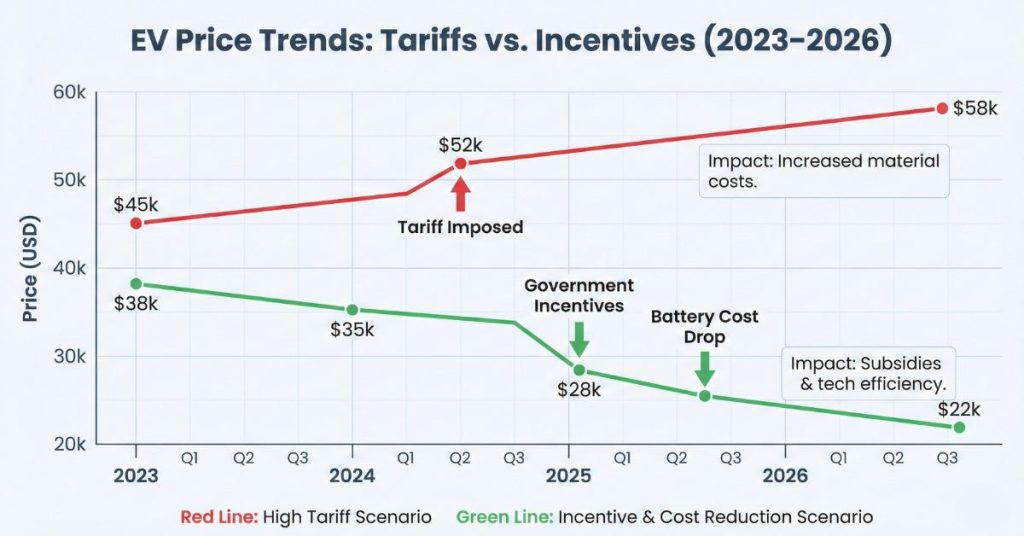
The EV market in 2026 is being pulled in two opposite directions. U.S. tariffs of 100% on Chinese-made EVs are pushing new vehicle prices up by $5,000 to $12,000, while a flood of off-lease vehicles and manufacturer price cuts are driving used EV prices down to record lows. The $7,500 federal EV tax credit expired in late 2025, adding further pressure. Meanwhile, China officially ended its domestic EV price war in February 2026 after the industry absorbed an estimated $68 billion in losses. The result is a fractured market where some buyers will pay more than ever and others will find historic bargains.

What’s Driving the 2026 EV Pricing Shakeup?
If you’ve been watching EV prices over the past few months, you’ve probably noticed something weird. Some electric cars are getting cheaper while others are getting more expensive. That’s not a glitch. It’s the direct result of three major forces colliding at the same time.
- 100% U.S. tariffs on Chinese-made EVs: Any electric vehicle manufactured in China faces a 100% import tariff when entering the U.S. market. This effectively doubles the sticker price and blocks Chinese brands like BYD from selling directly to American consumers.
- Expiration of the $7,500 federal EV tax credit: Congressional Republicans eliminated the federal EV tax credit as part of a broader legislative package in 2025. Without this subsidy, analysts project U.S. EV sales could decline by as much as 25% in the first half of 2026.
- China’s price war officially ends: On February 12, 2026, China’s State Administration for Market Regulation (SAMR) barred automakers from selling vehicles below manufacturing cost. This ends a brutal three-year price war that cost the Chinese auto industry an estimated $68 billion.
- Massive wave of off-lease EVs: Over 1.1 million EVs were leased in the U.S. since 2023. Those 36-month leases are now expiring, flooding the used market with gently used electric vehicles and crashing resale values.
This combination has created what industry analysts are calling a “recalibration” period. It’s similar to what we track across other product categories where dynamic pricing strategies reshape markets in unexpected ways.
2026 EV Price Changes by Brand: Who’s Going Up, Who’s Going Down?
Not every EV is moving in the same direction. Here’s a breakdown of confirmed 2026 pricing shifts based on MSRP changes and tariff exposure:
| Brand/Model | 2025 Starting MSRP | 2026 MSRP | Change | Why |
| Cadillac Optiq | $56,195 | ~$54,000 | -$2,000+ | New RWD trim |
| Chevy Silverado EV WT | $57,095 | $54,895 | -$2,200 | New base trim |
| Toyota bZ (redesigned) | $37,070 | $34,900 | -$2,170 | Redesign savings |
| Hyundai Ioniq 5 | $43,875 | ~$38,000* | -$5,000+ | Dealer incentives |
| Chinese-made EVs (if imported) | $25,000-$35,000 | $50,000-$70,000 | +100% | Tariff wall |
*Reflects dealer discounts to clear 2025 inventory before cheaper 2026 models arrive.
Korean automakers are emerging as clear winners. A U.S.-South Korea trade deal capped auto tariffs at 15%, well below the 25% many analysts expected. This gives Hyundai, Kia, and Genesis a significant cost advantage that’s being passed down to buyers. Understanding these value bifurcation trends helps explain why some segments are dropping while others climb.
The Used EV Market: Where the Real Deals Are?
Here’s where things get really interesting for budget-conscious buyers. The used EV market in 2026 is experiencing what analysts call a “perfect storm” of falling prices.
According to Cox Automotive data, the price gap between used EVs and used gas cars narrowed to just $897 on average in late 2025. That’s the smallest spread ever recorded. With lease returns flooding the market, 56% of used EV inventory is now priced under $30,000, and 30% of those affordable options are 2023 models or newer.
Top Used EV Deals in 2026
| Model | Average Used Price (2026) | Key Advantage |
| Chevrolet Bolt EV/EUV | Under $15,000 | Many have new batteries from recall |
| Nissan Leaf | ~$12,890 | Lowest entry point for EVs |
| Tesla Model 3 | ~$23,278 | Highest resale volume, strong demand |
| Hyundai Ioniq 5 / Kia EV6 | $25,000-$30,000 | 800V fast charging architecture |
EV battery prices have dropped roughly 20% recently, and replacement costs are trending toward parity with major gas engine repairs by 2030. Real-world studies show modern EV battery packs lose only about 1.5% to 1.8% of capacity per year, making used purchases far less risky than many buyers assume. If you’re comparing these values against traditional automotive pricing, tools like our Kelley Blue Book pricing guide can provide additional context.
China Ends Its EV Price War: Global Ripple Effects
This is arguably the biggest pricing story of February 2026. China’s SAMR officially banned automakers from selling vehicles below manufacturing cost, ending a price war that defined the global EV landscape for three years. The numbers tell the story: the Chinese auto industry lost an estimated 471 billion yuan ($68 billion) in output value during this period. January 2026 passenger car sales in China dropped nearly 20% from the previous month, falling to 1.4 million units from December’s 2.2 million.
For U.S. consumers, this matters more than you might think. Even though Chinese EVs can’t reach American showrooms due to the 100% tariff, China’s rock-bottom pricing has been putting indirect pressure on American automakers to bring prices down. With that pressure easing, don’t expect dramatic price cuts from domestic brands anytime soon. S&P forecasts Chinese light vehicle sales could fall up to 3% in 2026, while BYD is pivoting hard toward exports with a target of 1.3 million overseas sales.
This pricing shift mirrors patterns we’ve seen across other industries. When Tesla adjusted Cybertruck pricing multiple times since launch, it reflected similar market recalibration pressures.
PHEVs: The Surprise Winner of the Tariff Shakeup
One category is quietly dominating in 2026: plug-in hybrids. Cox Automotive’s latest forecast projects PHEVs will jump from 8% to 19% of U.S. electrified vehicle sales this year. The reasons are straightforward. Most new PHEVs still qualify for the full $7,500 tax credit through 2032 under existing legislative provisions. Their smaller battery packs (15 to 30 kWh versus 60 to 100+ kWh for pure EVs) mean virtually zero exposure to battery-related tariffs. And the gas backup eliminates range anxiety, which remains the biggest barrier for mainstream buyers.
Models like the Ram 1500 Ramcharger reportedly hit 87,000 reservations within 72 hours of the tariff news breaking. Jeep Wrangler 4xe waitlists stretched to 9 to 12 months, and Toyota simply can’t build Prius Primes fast enough to meet demand.
What This Means for Buyers Right Now?
The 2026 EV market rewards informed buyers and punishes those who don’t do their homework. Here’s the practical takeaway:
- Used EVs are at historic lows. If you’ve been waiting for an affordable entry into electric driving, this is your window. Prices are stabilizing, and experts suggest the steep discounts won’t last past late 2026 as lease return volumes normalize.
- Korean EVs offer the best new-car value. The favorable tariff structure gives Hyundai, Kia, and Genesis a pricing edge that’s being reflected in aggressive dealer discounts right now.
- Consider PHEVs seriously. They still qualify for the full tax credit, carry lower insurance and maintenance costs, and face minimal tariff exposure.
- Avoid counting on Chinese EV imports. Despite rock-bottom prices in global markets, the 100% U.S. tariff wall isn’t going anywhere soon. Canada’s recent tariff cut to 6.1% for a limited quota is the exception, not the trend.
Understanding common pricing mistakes can help you avoid overpaying during volatile market periods like this one.
Frequently Asked Questions
How much did the EV tax credit save buyers?
The federal EV tax credit was worth up to $7,500 for new electric vehicles and up to $4,000 for used EVs. It was eliminated in late 2025, effectively raising the out-of-pocket cost for buyers overnight.
Why are used EV prices falling so fast?
Three main factors: over 1.1 million leased EVs from 2023 are reaching their lease-end dates and flooding the market, EVs have been depreciating at nearly twice the rate of gas cars, and the loss of the federal tax credit reduced new EV demand, further pushing down resale values.
Will Chinese EVs ever be available in the U.S.?
Not at competitive prices under current policy. The U.S. maintains a 100% tariff on Chinese-made EVs, effectively doubling their price. While Canada recently reduced its tariff to 6.1% for a limited quota, there’s no indication the U.S. will follow suit in the near term.
Are PHEVs still eligible for tax credits in 2026?
Yes. Most plug-in hybrid electric vehicles qualify for the full $7,500 federal tax credit through 2032 under existing legislative provisions, making them one of the most cost-effective electrified options available right now.