
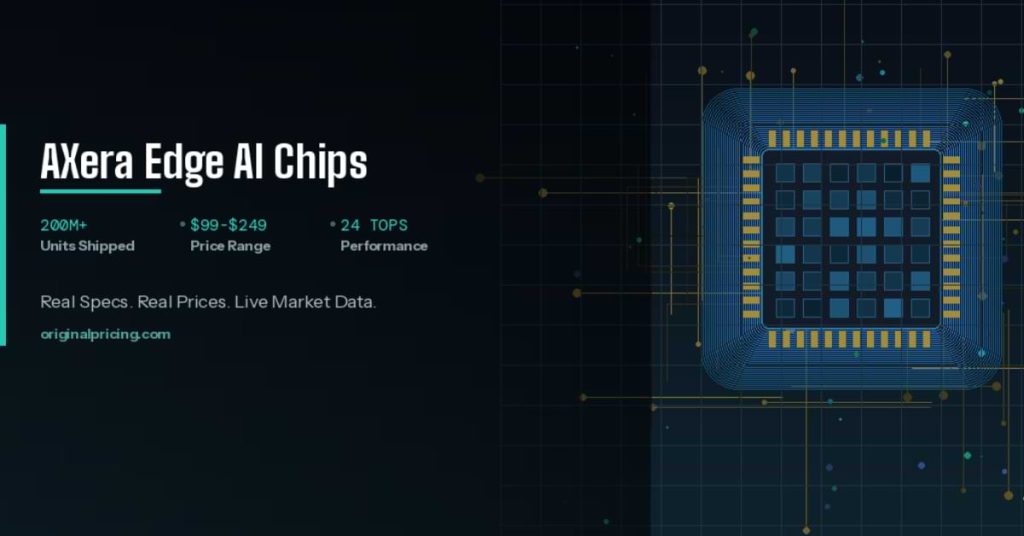
Edge AI chips process artificial intelligence workloads directly on local devices instead of sending data to cloud servers. AXera Semiconductor, a Shanghai-based fabless chipmaker founded in 2019, has shipped over 200 million SoC units and recently went public on the Hong Kong Stock Exchange. The company’s AXNeutron NPU and AXProton AI-ISP technologies power everything from smart city cameras to autonomous vehicles, making it one of the most significant players in the on-device intelligence space.
What Are Edge AI Chips?
Edge AI chips are specialized processors designed to run machine learning models directly on a device rather than relying on a remote data center. Your phone recognizing faces without an internet connection, or a security camera detecting unusual activity in real time, all happens locally on these chips.
This shift matters because cloud-based AI introduces latency, consumes bandwidth, and raises privacy concerns. According to Grand View Research, the global edge AI market reached an estimated $24.91 billion in 2025 and is projected to grow at a compound annual rate of 21.7% through 2033. Hardware components alone accounted for over half of that total revenue, underscoring just how critical these processors have become.
Industries from automotive to healthcare are racing to embed intelligence at the device level, fueling a new generation of chipmakers. AXera Semiconductor leads the charge in mid-to-high-end inference.
Who Is AXera Semiconductor?
AXera Semiconductor (formerly Shanghai Zhiaixin Semiconductor Technology) is a fabless chip company headquartered in Shanghai, China. Founded in 2019, it specializes in AI inference system-on-chip (SoC) solutions built for edge computing and on-device intelligence.
The company’s growth has been remarkably fast. In six years, AXera developed five generations of chips, accumulating over 200 million units in total shipments by late 2025. That volume made it the largest global provider of mid-to-high-end visual on-device AI inference chips by shipment count in 2024, according to China Insights Industry Consultancy.
AXera went public on the Hong Kong Stock Exchange in February 2026, raising approximately HK$2.96 billion (roughly $379 million) through its IPO. The company is backed by prominent investors including Tencent and Qiming Venture Partners, with cornerstone support from OmniVision’s WILL Semiconductor unit.
AXera Semiconductor at a Glance
| Detail | Information |
| Founded | 2019 (Shanghai, China) |
| Headquarters | Shanghai, China |
| IPO | Hong Kong Stock Exchange (600.HK), February 2026 |
| IPO Raised | HK$2.96 billion (~$379 million) |
| Total Shipments | 200+ million SoC units (as of late 2025) |
| Key Investors | Tencent, Qiming Venture Partners, OmniVision/WILL Semiconductor |
| Core Technologies | AXNeutron NPU, AXProton AI-ISP |
| Target Markets | Smart cities, autonomous driving, robotics, edge computing, consumer electronics |
AXera’s Core Technologies: What Powers These Chips?
Two proprietary technologies sit at the heart of every AXera chip.
AXNeutron Mixed-Precision NPU
The AXNeutron is AXera’s neural processing unit, using a multi-threaded heterogeneous multi-core design that supports 4-bit to 32-bit mixed precision computing. It can run different AI models, from lightweight object detection to large language models like DeepSeek, Qwen, and Llama, directly on the device. The architecture supports over 100 AI operators covering image, video, text, and multimodal tasks. AXera claims a 10x energy efficiency improvement over traditional GPGPUs.
AXProton AI-ISP
The AXProton is AXera’s AI-enhanced image signal processor, using pixel-level AI processing to improve image quality in challenging conditions like low light and fast motion. First commercialized in the AX630A chip, it is now standard across AXera’s entire product line. For applications like smart city surveillance or autonomous robots from Unitree, Kepler, and Magic Atom, this visual processing is essential.
AXera’s Product Lineup and Pricing
AXera’s chip portfolio spans three segments: vision terminals (smart cameras), smart vehicles (ADAS and autonomous driving), and edge AI inference (industrial automation, robotics, consumer devices).
| Chip | CPU | NPU Performance | Key Feature | Primary Use Case |
| AX620 Series | Dual-core A53 | Up to 3.6 TOPS | AI-ISP, low power | Smart home cameras, entry-level IPC |
| AX630C | Dual-core A53 | Up to 6 TOPS | 4K night vision | Industrial smart cameras |
| AX650N | Octa-core A55 | 10.8 TOPS (INT8) | 8K encode/decode | Smart cities, edge boxes, video conferencing |
| AX8850 | Octa-core A55 | 24 TOPS (INT8) | Transformer support | Edge AI inference, robotics, LLM deployment |
| M55H/M76H | Automotive-grade | Varies | ADAS certified | L2 to L2+ autonomous driving |
Third-party hardware based on AXera chips reaches consumers at competitive prices. M5Stack’s AI Pyramid box (AX8850) sells for $199, while its M.2 module goes for $99. Radxa’s AICore AX-M1 accelerator also uses the AX8850, targeting developers who want 24 TOPS of inference power. These prices undercut competing M.2 solutions from Hailo that run closer to $200. For context on how memory pricing affects hardware costs, chip-level efficiency directly impacts what you pay for finished products.
The Edge AI Chip Market: Where Things Stand?
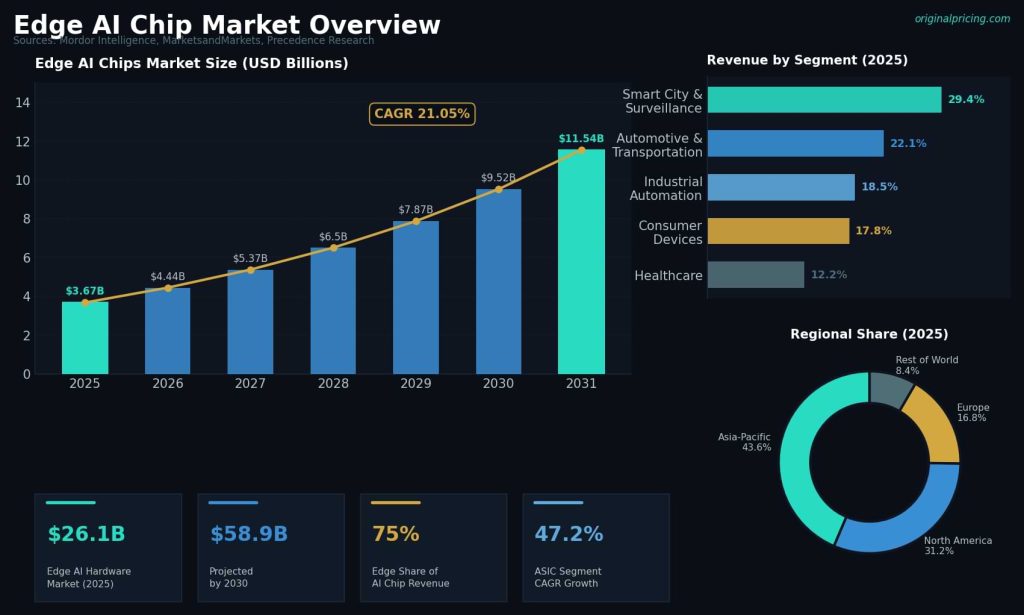
The edge AI chip segment is growing rapidly, and the numbers tell a compelling story. Mordor Intelligence valued the edge AI chips market at $3.67 billion in 2025, projecting it to reach $11.54 billion by 2031 at a compound annual growth rate of about 21%. Asia-Pacific dominates with nearly 44% of global market share, driven heavily by government semiconductor investment programs across China, South Korea, and Japan.
Smart city and surveillance applications accounted for roughly 29% of revenue in 2025, but automotive is where the fastest growth is happening, with a projected 26% annual expansion through 2031. AXera’s automotive-grade SoCs have already shipped over 510,000 units and its driver assistance chips ranked second in domestic smart driving SoC market share. The consumer robotics market is another major growth driver as robots increasingly need powerful on-device AI processing.
Key Market Stats
- Edge AI hardware market: $26.14 billion in 2025, projected $58.90 billion by 2030 (MarketsandMarkets)
- Overall AI chip market: $121.73 billion in 2026, over $1.1 trillion by 2035 (Precedence Research)
- Edge processing accounted for 75% of AI chip revenue by processing type in 2025
- ASIC chipsets growing fastest at 47.2% CAGR, reflecting demand for custom AI silicon
Why AXera Matters for Smart Device Pricing?
Here is the part that connects directly to your wallet. Edge AI chip costs flow downstream into everything from security cameras to advanced driver-assistance packages. AXera’s approach of delivering competitive pricing through energy-efficient design has real consequences for consumers. When a chip consumes less power and costs less to integrate, the finished product becomes more affordable.
AXera’s IPO, despite the company still operating at a net loss (855.7 million yuan for the first nine months of 2025), signals confidence that heavy R&D investment now will translate into profitable scale later. The company generated 2.69 billion yuan in revenue over that same period, showing strong commercial traction even as it invests aggressively in next-generation designs. For anyone following the rise of Chinese tech companies in the global spotlight, AXera’s trajectory is worth watching closely.
How AXera Stacks Up Against the Competition?
NVIDIA dominates high-end autonomous driving with its DRIVE AGX platform, and Qualcomm targets mobile flagships. What differentiates AXera is its focus on the mid-market sweet spot: chips delivering strong inference at price points that work for mass-market smart cameras, industrial sensors, and immersive technology platforms. As MarketsandMarkets notes, this growing demand for real-time on-device processing across IoT ecosystems makes the mid-range segment strategically critical.
What to Watch Next?
- Post-IPO execution: AXera allocated 60% of IPO proceeds to technology upgrades and new products. Watch for next-gen chip announcements.
- Automotive expansion: L2+ to L3 autonomous driving is pushing demand for in-vehicle compute. AXera’s XMOTOR brand could see accelerated adoption.
- LLM on the edge: The AX8850’s native support for transformer models positions it at the forefront of bringing large language models to local devices.
- Geopolitical factors: US-China semiconductor tensions continue shaping the landscape. AXera’s domestic manufacturing provides a hedge against supply chain disruptions.
Frequently Asked Questions
What does AXera Semiconductor make?
AXera designs AI inference system-on-chip (SoC) processors for edge computing. Its chips power smart cameras, autonomous vehicles, and industrial equipment that process AI workloads locally without cloud servers.
How much do AXera-based products cost?
Consumer-accessible products built on AXera chips range from $99 for an M.2 AI accelerator module (M5Stack LLM-8850) to $249 for a complete edge computing box (M5Stack AI Pyramid-Pro). OEM chip pricing varies by volume and configuration.
Is AXera Semiconductor publicly traded?
Yes. AXera listed on the Hong Kong Stock Exchange (ticker: 600.HK) in February 2026, raising approximately $379 million through its initial public offering.
How does AXera compare to NVIDIA for edge AI?
They target different segments. NVIDIA focuses on high-end autonomous driving (1,000+ TOPS) and data center inference. AXera specializes in the mid-range (3.6 to 24 TOPS) where cost efficiency and low power matter most for mass-market IoT devices.
What is the edge AI chip market worth?
The edge AI chips market was valued at approximately $3.67 billion in 2025 and is projected to reach $11.54 billion by 2031. The broader edge AI hardware market, including processors, memory, and complete systems, exceeded $26 billion.