Unitree’s G1 starts at $13,500 and shipped 5,500+ units in 2025. Kepler’s K2 costs about $34,000 with an 8-hour battery. MagicLab’s MagicBot G1 runs around $119,800. China now controls over 85% of global humanoid shipments heading into 2026.
Something wild happened on Chinese New Year’s Eve this year. Viewers of the 2026 Spring Festival Gala watched humanoid robots perform kung fu, backflips, and comedy sketches. Not clunky demonstrations. Actual choreographed routines with swords, nunchucks, and trampoline somersaults.
Within two hours of the broadcast, robot searches on JD.com jumped 300%. Orders spiked 150%. Delivery dates got pushed to April. We covered the full story behind how Unitree became China’s most searched company overnight after the Gala, and the demand surge hasn’t slowed down since.
A year ago, these same robots were wobbling through folk dances. Now they’re doing drunken boxing and wall-run backflips. The progress is real, and three companies are leading the charge at very different price points.
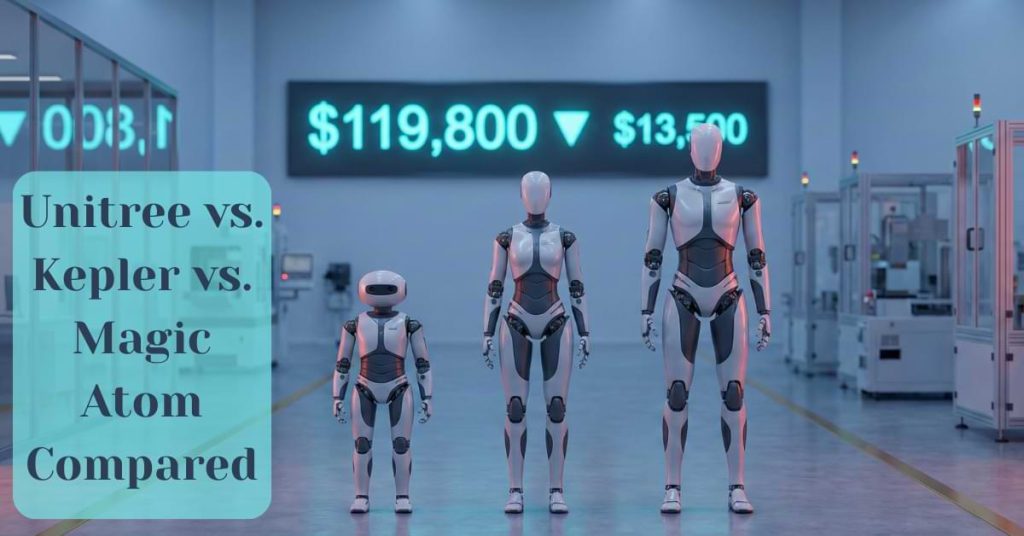
Side-by-Side: What You Actually Get for the Money
| Spec | Unitree G1 | Kepler K2 | MagicBot G1 |
| Price | From $13,500 | ~$34,000 | ~$119,800 |
| Height | 127 cm (4’2″) | 178 cm (5’10″) | 174 cm (5’9″) |
| Weight | ~35 kg | 85 kg | ~67.5 kg |
| Degrees of Freedom | 23 to 43 | Up to 52 | 42 |
| Battery Life | ~2 hours | ~8 hours | 4 to 5 hours |
| Arm Payload | 3 kg/arm | 15 kg/hand | 20 kg/arm |
| Top Speed | 2 m/s | ~1.5 m/s | ~1.5 m/s |
| Best For | Research labs | Factory floors | Multi-use fleets |
| Shipping Since | August 2024 | Q3 2025 | Mid-2025 |
Unitree G1: $13,500 and Already Everywhere
Unitree is the name most people know. The Hangzhou company started making robot dogs back in 2016, launched the H1 humanoid in 2023, and then dropped the G1 in August 2024 at a price that turned heads.
At $13,500 for the base model (84,900 yuan in China), the G1 costs less than a used car. That’s how it ended up at Amazon’s robotics lab, Stanford, MIT, and UT Austin. About 5,500 units shipped in 2025 alone. CEO Wang Xingxing told 36Kr he’s targeting 10,000 to 20,000 shipments this year.
Here’s the catch, though That $13,500 base model doesn’t come with SDK access. You can’t program it. You can’t upgrade it to the EDU variant either because the motor mounts and wiring are completely different. If you need actual development tools with ROS 2 and Python support, you’re looking at $43,500 for the G1 EDU Standard or up to $73,900 for the Ultimate.
Unitree also dropped the R1 in July 2025 at just $5,900. TIME named it one of the Best Inventions of 2025. That kind of rapid price drop is reshaping the entire consumer robots market, which analysts now expect to grow well beyond earlier forecasts.
One concern worth noting: security researchers found in September 2025 that the G1 sends sensor data without telling the operator. A Bluetooth vulnerability also lets nearby attackers take control of multiple Unitree models. The U.S. Congress has requested an investigation into the company’s possible military ties, though no restrictions have been imposed as of February 2026.
Kepler K2: $34,000 and Built for Full Shifts
Shanghai Kepler took the opposite approach from Unitree. Instead of chasing researchers and hobbyists, they went straight to factory managers.
The K2 “Bumblebee” stands at full human height (178 cm), weighs 85 kg, and runs for about 8 hours on a single charge. That last number is the big deal. When your robot can work an entire factory shift without swapping batteries, the ROI math changes fast.
Kepler prices the K2 at RMB 248,000, which works out to roughly $34,000. For that you get 52 degrees of freedom, hands with 12 DOF each, and 96 tactile sensors per fingertip, plus proprietary planetary roller screw actuators pushing 8,000 Newtons of thrust.
The K2 is already doing real work. It’s been running inspection and assembly support at the SAIC-GM plant in Shanghai, where they build Buicks, Chevrolets, and Cadillacs. Kepler says they’ve locked in framework agreements for thousands of units.
The robot’s hybrid architecture hits 81.3% energy efficiency with its straight-knee gait. Kepler’s ability to hit this price while maintaining quality speaks to the same manufacturing advantage that’s driving China’s broader export dominance in 2025. Vertical supply chain control keeps costs down in ways that Western competitors can’t easily replicate.
Three funding rounds since early 2025 brought in investors across the supply chain, from motor manufacturers to sensor makers. Kepler isn’t just building robots. They’re building the ecosystem to keep costs dropping.
MagicLab MagicBot: $119,800 Premium Play
MagicLab (also called Magic Atom Robotics Technology) is the dark horse. Founded in late 2023 in Wuxi, they pulled in RMB 150 million in angel funding and moved fast. Really fast.
Within six months of opening sales, MagicLab reported RMB 500 million in letters of intent and RMB 130 million in firm orders. They’ve partnered with over 100 organizations worldwide on proof-of-concept pilots.
Their flagship MagicBot G1 stands 174 cm tall, packs 42 degrees of freedom, and handles 20 kg per arm (40 kg total). Battery lasts 4 to 5 hours. The standard edition runs about $119,800, which puts it firmly in the enterprise category.
The smaller MagicBot Z1, launched in July 2025, is more accessible at 177,800 yuan (around $24,500). It stands 1.4 meters tall with up to 50 degrees of freedom and was the one that stole the show at the Spring Festival Gala. MagicLab’s Z1 pulled off a Thomas 360-degree rotation on live TV, a first for any humanoid that size.
The Numbers Behind China’s Lead
Let’s put some hard data on this.
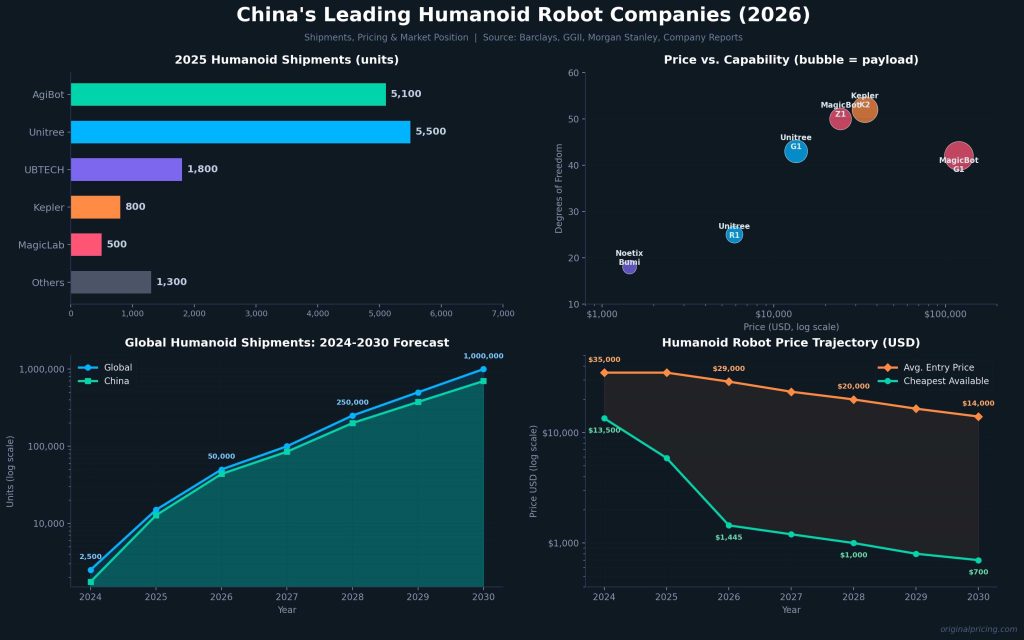
Omdia's General-Purpose Embodied Robotics Market Radar, as reported by TechNode on 9 January 2026, put global humanoid shipments for 2025 at about 13,000 units: AgiBot first with 5,168 (39%), Unitree second with 4,200 and UBTECH third with 1,000. Unitree's own later figure is higher: its humanoid shipments exceeded 5,500 units in 2025, according to the China Daily report on its listing. An earlier version of this page cited Barclays for roughly 15,000 global installations with more than 85% in China; we have not seen that note and cannot confirm it.
China’s Ministry of Industry and Information Technology counts more than 140 domestic humanoid robot manufacturers with 330+ models released. Morgan Stanley doubled its 2026 China sales forecast to 28,000 units. GGII projects 62,500 domestic shipments this year, up from about 18,000 in 2025. That’s a 247% jump.
Bank of America thinks average humanoid prices will drop from $35,000 in 2025 to $17,000 by 2030. Goldman Sachs sees production costs falling from $250,000 to $150,000 per unit in just the first year at scale. Here’s what the full timeline looks like:
Humanoid Robot Market Snapshot: 2024 to 2030
| Year | Global Shipments | China Share | Avg. Entry Price | Cheapest Model | Avg. Production Cost | Key Milestone |
| 2024 | ~2,500 units | ~70% | $16,000 | Unitree G1 ($13,500) | ~$250,000 | G1 mass production begins |
| 2025 | ~15,000 units | 85%+ | $35,000 | Unitree R1 ($5,900) | ~$150,000 | Kepler K2, MagicBot ship |
| 2026 (est.) | 40,000–62,500 | 85–90% | $28,000–$30,000 | Noetix Bumi ($1,445) | ~$100,000 | Unitree IPO, 62.5K China units |
| 2027 (proj.) | 100,000+ | ~85% | $22,000–$25,000 | Sub-$5,000 expected | ~$70,000 | Tesla Optimus scale ramp |
| 2028 (proj.) | 250,000+ | ~80% | $18,000–$22,000 | Sub-$3,000 expected | ~$50,000 | Home-use pilots begin |
| 2029 (proj.) | 500,000+ | ~75% | $15,000–$18,000 | Sub-$2,000 expected | ~$35,000 | 1M units/yr in reach |
| 2030 (proj.) | 1,000,000+ | ~70% | $10,000–$17,000 | Sub-$1,500 expected | ~$20,000–$30,000 | Appliance-level pricing |
Sources: Bank of America, Goldman Sachs, Morgan Stanley, GGII, Barclays, Omdia. Projections for 2027–2030 based on analyst consensus and announced production targets. We could not match the individual cells of this table to published reports, so read it as an indicative outline, not as sourced data.
The price trajectory looks a lot like what we’ve tracked across lab-grown diamond prices and RAM prices in 2026. When production scales, prices fall. Humanoid robots are already showing up among Alibaba’s top-selling product categories, which tells you where mainstream demand is heading.
So Which One Makes Sense for You?
University labs on a budget: Unitree G1 EDU at $43,500. Full SDK, active dev community, and more units deployed in research settings than anything else on the market. Skip the $13,500 base model unless you just need a demo unit.
Factory pilots and manufacturing: Kepler K2 at $34,000. The 8-hour battery and 15 kg per hand payload make it the only option that can realistically handle a full shift. Already proven at SAIC-GM.
Enterprise multi-robot deployments: MagicLab MagicBot lineup. The fleet coordination through MagicNet is the differentiator. If you need several robots working together across a warehouse or campus, this is where the premium price starts to justify itself.
Just want to watch: Unitree R1 at $5,900 (or the R1 Air at $4,900) or Noetix Bumi at $1,445. Entry-level humanoids that won’t break the bank.
Where these figures come from
We re-read the sources for this page on 23 November 2026. Four sets of figures can be traced to a source we read; the rest are reported estimates that we could not confirm.
| Figure on this page | Status | Source |
|---|---|---|
| Unitree G1 from $13,500 | Confirmed | Unitree G1 page: "Price from $13.5K" |
| Unitree R1 at $5,900 | Confirmed; an R1 Air is also listed at $4,900 | Unitree R1 page |
| Unitree shipped 5,500+ humanoids in 2025 | Confirmed | China Daily, 10 August 2026: shipments "exceeded 5,500 units in 2025, excluding wheeled dual-arm robots" |
| AgiBot 5,100+ units and 39% of the market | Confirmed as Omdia's estimate: 5,168 of about 13,000 | TechNode, 9 January 2026 |
| G1 EDU at $43,500 to $73,900 | Not confirmed; Unitree lists the G1 EDU as contact sales | Unitree G1 page |
| G1 at 84,900 yuan in China | Not confirmed | — |
| Kepler K2 at 248,000 yuan (about $34,000); MagicBot G1 at about $119,800; MagicBot Z1 at 177,800 yuan; Noetix Bumi at $1,445 | Not confirmed with the makers; ask for a quote | — |
| About 15,000 global installations, 85%+ in China (Barclays) | Not confirmed; Omdia's total is about 13,000 | — |
| Morgan Stanley, GGII, Bank of America and Goldman Sachs forecasts | Reported; we have not read the original notes | — |
| "Over 23 billion people watched" the Gala | Removed: that is nearly three times the world population of about 8 billion, so it cannot be a count of people | — |
| Security findings and the request from the U.S. Congress (2025) | Not rechecked in this update | — |
Our analysis
The price ladder runs from 0.36 to 8.9 times the G1. Taking the confirmed $13,500 G1 entry price as the base:
| Robot | Price | Multiple of the G1 entry price | Status |
|---|---|---|---|
| Unitree R1 Air | $4,900 | 0.36 | Confirmed |
| Unitree R1 | $5,900 | 0.44 | Confirmed |
| Unitree G1 | $13,500 | 1.00 | Confirmed |
| MagicBot Z1 | about $24,500 | 1.8 | Reported |
| Kepler K2 | about $34,000 | 2.5 | Reported |
| MagicBot G1 | about $119,800 | 8.9 | Reported |
The MagicBot G1 figure is 3.5 times the Kepler K2 and 4.9 times MagicLab's own Z1. Nothing we read explains a gap that large, which is one more reason to get a written quote before budgeting for it.
There are two shipment counts for 2025, and they disagree. On Omdia's total of about 13,000 units, AgiBot's 5,168 is 39.8%, Unitree's 4,200 is 32.3% and UBTECH's 1,000 is 7.7%; the three together are 10,368 units, or 79.8%. Unitree's own figure of more than 5,500 is at least 31% above the 4,200 Omdia gave it. Omdia published in January 2026 and described its total as expected; Unitree's figure came with its listing seven months later and excludes wheeled dual-arm robots. We do not know what Omdia counted, so the two are not directly comparable.
Unitree's revenue grew about 4.3 times in a year. The China Daily report gives revenue of 159.13 million yuan in 2023, 392.77 million in 2024 and 1.70 billion in 2025: growth of 2.5 times, then 4.3 times. Net profit in 2025 was 278.21 million yuan, about 16% of revenue. Overseas sales were 43.65% of main-business revenue. From 2023 to 2025 the company sold 33,294 quadruped robots and 5,632 humanoids, or 5.9 robot dogs for each humanoid. If the 5,632 and the 5,500-plus are counted the same way, fewer than about 130 humanoids were sold before 2025. The offering of about 40.45 million shares at 150.80 yuan was expected to raise about 6.10 billion yuan for 10% of the company, which implies a value of about 61 billion yuan (our arithmetic).
The yuan and dollar prices are not conversions of each other. The page's Kepler figures (248,000 yuan and $34,000) imply 7.29 yuan to the dollar, and the MagicBot Z1 figures imply 7.26. At 7.29, the 84,900 yuan quoted for the G1 in China would be about $11,600, some 14% below the $13,500 dollar price. Both may be right as separate regional prices, but we could confirm only the dollar one.
The forecasters are not counting the same thing. GGII's 62,500 against 18,000 is a rise of 247%, as the page says. But 18,000 units for China alone in 2025 is more than Omdia's 13,000 for the whole world. Bank of America's fall from $35,000 to $17,000 by 2030 is 51%, or about 13% a year; the Goldman Sachs cost fall from $250,000 to $150,000 is 40%. Use these as direction, not as data.
Frequently Asked Questions
What’s the cheapest humanoid robot you can buy in 2026?
Noetix Bumi at about $1,445 for a small companion robot. Among the makers on this page, Unitree lists the R1 Air at $4,900 and the R1 at $5,900 on its own site (read 23 November 2026). We have not confirmed the Bumi price with Noetix.
Can these robots actually work in a factory today?
In limited roles, yes. Kepler’s K2 is doing inspection and assembly support at a GM plant in Shanghai. MagicLab has robots handling material transport and barcode scanning. But fully autonomous factory work without human oversight is still years away.
Should I worry about security with Chinese robots?
It’s a real concern. Researchers found data collection issues and Bluetooth vulnerabilities in Unitree’s models in 2025. The U.S. Congress requested an investigation into possible military ties. No bans exist yet, but buyers should keep compliance records.
How fast are prices falling?
Fast. Entry-level humanoids went from $13,500 in late 2024 (Unitree G1) to $5,900 by mid-2025 (Unitree R1), and Unitree now lists an R1 Air at $4,900, 64% below the G1 entry price. Bank of America projects average prices hitting $17,000 by 2030. Analysts expect capable humanoids under $5,000 within three to five years.
Who shipped the most humanoid robots in 2025?
By Omdia's count, reported by TechNode in January 2026, AgiBot led with 5,168 units (39% of about 13,000), followed by Unitree with 4,200 and UBTECH with 1,000. Unitree has since reported that its own humanoid shipments exceeded 5,500 units in 2025, so the order depends on whose count is used. All three are Chinese companies.
How much does the Unitree G1 cost now?
Unitree's site showed the G1 from $13,500 ("Price from $13.5K") on 23 November 2026. The G1 EDU has no public price there; Unitree asks buyers to contact sales, so the $43,500 to $73,900 EDU figures on this page are unconfirmed.
How many humanoid robots did Unitree ship in 2025?
More than 5,500, excluding wheeled dual-arm robots, according to a China Daily report of 10 August 2026 on its Shanghai listing. Omdia's earlier estimate, published in January 2026, was 4,200.
Sources
Updated November 2026. Source: Shanghai Stock Exchange news (China Daily), August 2026; Unitree G1 page and Unitree R1 page; TechNode on Omdia's 2025 shipment ranking. All read 23 November 2026.