
Enflame Technology (云燧科技) is a Shanghai-based AI chip company founded in 2018 that designs GPUs and AI accelerators for large-model training and inference. Backed by Tencent as its largest shareholder, Enflame is one of China’s most closely watched domestic chip makers and one of the few local alternatives being deployed at hyperscaler scale inside China.
A Company Built by AMD Veterans
Enflame was founded in March 2018 by Zhao Lidong and Zhang Yalin, both former AMD executives who left the American chip giant to build China’s domestic AI compute stack. Five months after opening their doors in Zhangjiang, Shanghai, Tencent arrived with a 340 million yuan investment, setting what was then a financing record in China’s chip sector.
That early Tencent backing was not just financial. It signaled a long-term deployment partnership. Today, Tencent is not only Enflame’s largest shareholder but also one of its biggest customers, actively deploying Enflame chips inside its own data centers as it shifts away from NVIDIA hardware.
Chip Generations: From 2020 to the L600
Enflame has moved quickly through multiple chip generations since its first training chip shipped in December 2020.
| Generation | Chip | Year | Type |
|---|---|---|---|
| First Gen | Training chip | 2020 | Training |
| First Gen | Inference chip | 2021 | Inference |
| Second Gen | Updated training + inference | 2022 | Both |
| Third Gen | S60 | 2024 | Training + Inference |
| Fourth Gen | L600 | 2025 | Training + Inference |
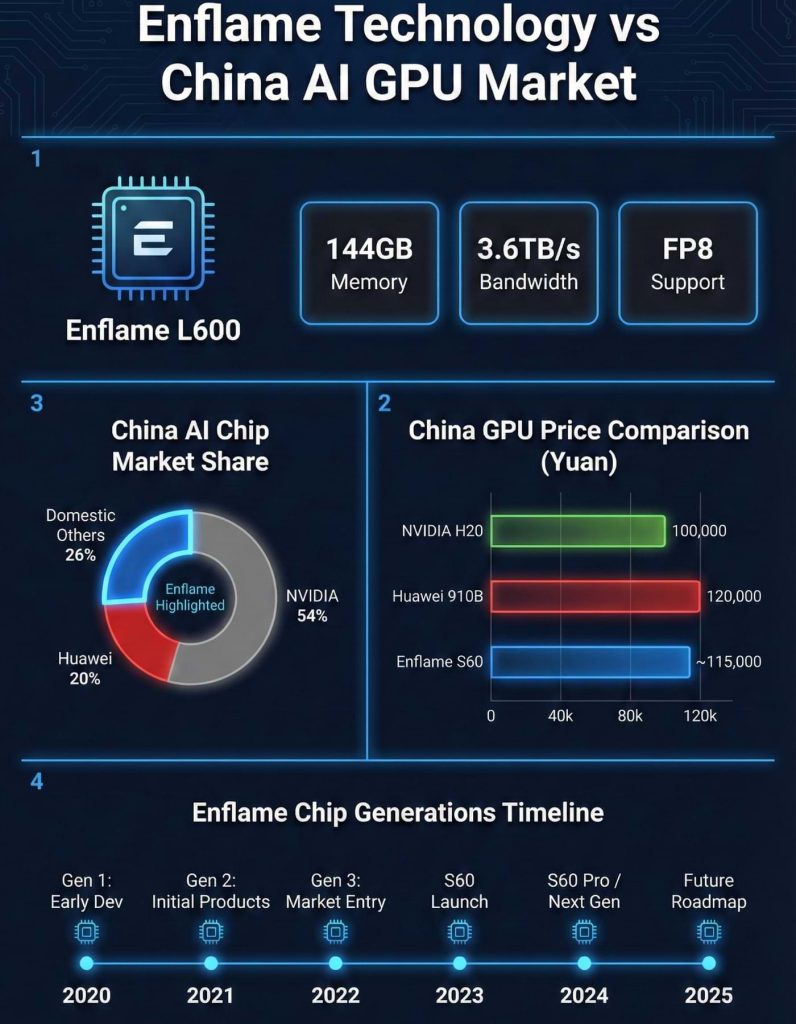
The third-generation S60 has already shipped approximately 70,000 units as of mid-2025, which is a notable milestone for a domestic Chinese chip company outside of Huawei’s Ascend lineup. The fourth-generation L600, unveiled at the World AI Conference in Shanghai in July 2025, packs 144GB of on-chip memory, 3.6TB/s of memory bandwidth, and FP8 support, specs designed specifically to accelerate large-model training while cutting costs for cloud operators.
The IPO Filing That Made Headlines
In January 2026, the Shanghai Stock Exchange accepted Enflame Technology’s application to list on the STAR Market, China’s Nasdaq-style board for science and technology companies. This move completes what analysts are calling the convergence of China’s “Four Dragons”: Enflame, Moore Threads, MetaX, and Biren Technology on the public markets.
The valuation heading into this process was reported at around $1.65 billion, a number that reflects investor confidence despite the company still operating at a loss, as is common among capital-intensive semiconductor firms in scale-up phases. Chinese regulators eased listing rules for unprofitable hardware companies in June 2025, which opened the door for all four companies to pursue public listings faster than expected.
For context on pricing and market size: in the first half of 2025 alone, China’s AI chip-powered server market reached $16 billion in value, with over 1.9 million units shipped, according to IDC.
Who Actually Uses Enflame Chips?
This is where the story gets commercially interesting. Tencent is deploying Enflame chips at scale. Alongside Alibaba and Baidu, Tencent had previously been heavily reliant on NVIDIA for its AI server infrastructure. The shift toward domestic suppliers is now accelerating, driven by a combination of U.S. export restrictions and Beijing’s push for technological self-reliance.
Enflame is not on the U.S. trade entity list, which means it still has access to TSMC for chip fabrication, a crucial advantage over blacklisted competitors like Biren, which was added to the U.S. entity list in 2022 and has seen a slower product iteration cycle as a result.
Beyond Tencent, Enflame’s primary customers are cloud computing infrastructure operators and data centers across China. The company also counts China’s National Integrated Circuit Industry Investment Fund (the “Big Fund”) and Meitu among its notable investors.
How Does Enflame Stack Up Against Rivals?
In a benchmark comparison of Chinese domestic AI accelerators assessed against NVIDIA A100 performance on the Llama 3.3 8B inference task, only four domestic chips cleared the threshold: the Huawei Ascend 910C, the Enflame T20, the MetaX C500, and the Moffett AI SparseOne series. The fact that Enflame’s hardware makes this list alongside Huawei, which commands over 20% of China’s AI chip market. That is a meaningful data point.
That said, the competitive environment is crowded. As of 2025, NVIDIA still holds roughly 54% of China’s AI computing power chip market, with Huawei exceeding 20%, and all domestic players combined accounting for less than 20%. Within that domestic slice, Enflame competes directly with Cambricon, Moore Threads, Biren, MetaX, and Muxi Technology.
If you want to understand how pricing dynamics in China’s robotics and edge AI hardware segment are evolving alongside GPU competition, the analysis on Axera Semiconductor edge AI chips gives useful context on the broader domestic chip pricing landscape.
AI Chip Pricing in China: What These Cards Actually Cost?
Enflame does not publish a public price list. Like most datacenter GPU makers, its chips are sold through enterprise contracts and integrators rather than open retail channels. That said, enough market data has surfaced through distributor reports, IPO prospectus filings, and industry research to give a realistic picture of where Enflame sits in the China AI chip pricing landscape.
The Enflame S60 (third-gen) is estimated to sell in a range comparable to the Huawei Ascend 910B, which distributors have priced at roughly 120,000 yuan (~$16,500) per card. The newer L600 is expected to carry a higher price point given its substantially upgraded specs, though no official figure has been released ahead of Enflame’s STAR Market IPO.
The table below pulls from distributor pricing reports, Reuters sourcing, TrendForce, and SCMP to give a side-by-side look at what China’s AI chip market actually charges, and where Enflame fits in.
China AI GPU Price Comparison Table (Per Card, Estimated)
| Chip | Maker | Memory | Estimated Price (CNY) | Estimated Price (USD) | Status in China | Notes |
|---|---|---|---|---|---|---|
| H100 (SXM5) | NVIDIA | 80GB HBM3 | N/A (banned) | ~$30,000–$40,000 | Export banned | Reference benchmark chip |
| H20 | NVIDIA | 96GB HBM3 | ~100,000 yuan | ~$13,800 | Available (restricted) | Price cut ~10% due to weak demand vs. Huawei |
| Ascend 910B | Huawei | 64GB HBM2e | ~120,000 yuan | ~$16,500 | Widely deployed | Most competitive domestic chip pre-910C |
| Ascend 910C | Huawei | 96GB HBM3 | ~130,000–150,000 yuan est. | ~$18,000–$21,000 est. | Deploying now | Claimed to rival H100 on some workloads |
| Enflame S60 | Enflame | 64GB HBM | ~Comparable to 910B est. | ~$14,000–$16,000 est. | ~70,000 units shipped | No official price; enterprise contract only |
| Enflame L600 | Enflame | 144GB | Not yet disclosed | Not yet disclosed | Announced July 2025 | Benchmarked above H20; mass deploy timeline TBC |
| MetaX C500 | MetaX | 64GB HBM2e | Not publicly listed | Not publicly listed | Limited deployment | One of 4 chips passing A100 inference bar |
| MetaX C600 | MetaX | 144GB HBM3e | Not yet disclosed | Not yet disclosed | Pilot Q4 2025 | Dual-chiplet design; mass production 2026 |
| Moore Threads MTT S4000 | Moore Threads | 48GB GDDR6 | Not publicly listed | Not publicly listed | Available | Gaming + datacenter dual use |
Sources: Reuters, TrendForce, South China Morning Post, WAIC 2025 disclosures. All pricing is distributor-reported or estimated from market intelligence not official manufacturer list prices. CNY/USD conversion at ~7.25.
Key Pricing Takeaways
The H20 vs. domestic gap is closing. When NVIDIA launched the H20 for China in early 2024, it priced the card between $12,000 and $15,000. By mid-2024, weak demand forced a discount of over 10%, pushing street prices to around 100,000 yuan. Huawei’s 910B held firm at 120,000 yuan, meaning Huawei actually commands a price premium over NVIDIA in China right now, something almost unimaginable three years ago.
Enflame’s S60 targets the same price band. Based on its competitive positioning and the fact that Tencent is deploying it at scale, the S60 almost certainly sits in the 100,000 to 130,000 yuan range per card, the current sweet spot for enterprise AI training hardware in China. Pricing above Huawei would be a difficult sell; pricing significantly below would suggest either subsidy pressure or a less capable product.
The L600 will likely price above the H20. With 144GB of memory versus the H20’s 96GB, and claimed performance exceeding the H20, Enflame’s L600 positions itself closer to what Western markets would call an H100-class chip, making a per-card price north of 150,000 yuan a reasonable expectation once Enflame’s prospectus data becomes public through the STAR Market listing process.
Server rack pricing matters more than per-card. In practice, Chinese hyperscalers buy GPU clusters, not individual cards. A server with eight H20 cards runs about 1.4 million yuan. A comparable Huawei 910B server has been quoted at approximately 1.36 million yuan. At rack scale, the difference between competing chips narrows considerably, which is why deployment relationships (like Tencent with Enflame) matter as much as raw pricing.

Challenges: Approval Crackdowns and Market Saturation
Enflame’s path forward is not without friction. Since April 2025, Chinese regulators have issued “window guidance” clamping down on new computing power center construction, with approval rates reportedly below 10% for private applicants. State-owned enterprises and local governments have significantly reduced investment in new GPU clusters.
This matters for Enflame because its main customer base, data centers buying training GPUs, has slowed its purchasing pace. The GPU supply buildup from 2023 to 2024 means many operators already have what they need. New orders depend heavily on large model training cycles, which are driven by a smaller number of hyperscalers and cloud providers rather than a broad market.
The growth of China’s humanoid robotics sector is creating new demand for edge computing and AI inference chips. Our coverage of how consumer robots market size is evolving and the Unitree vs Kepler vs Magic Atom comparison shows where embedded AI inference demand is heading, a segment that could eventually become a meaningful secondary market for companies like Enflame.
What the IPO Means for Pricing Transparency?
One direct benefit of Enflame’s STAR Market listing process is disclosure. As the company files its prospectus, detailed revenue figures, chip shipment volumes, loss margins, and customer concentration data become public. For analysts and researchers tracking China’s AI hardware market, this is the first real look inside Enflame’s business at scale.
For pricing comparisons in the domestic GPU market, the prospectus data, combined with similar filings from Moore Threads, MetaX, and Iluvatar CoreX will let researchers model what domestic AI compute actually costs per unit versus NVIDIA alternatives. This is exactly the kind of pricing intelligence our live tracking tools are built to surface for readers making high-value procurement or investment decisions.