Enflame Technology (云燧科技) is a Shanghai-based AI chip company founded in 2018 that designs GPUs and AI accelerators for large-model training and inference. Backed by Tencent as its largest shareholder, Enflame is one of China’s most closely watched domestic chip makers and one of the few local alternatives being deployed at hyperscaler scale inside China.
| Grade / Item | Low | High | Unit |
|---|---|---|---|
| First-day close (11 September 2026) | 397 | 397 | yuan |
| IPO proceeds | 6.12 | 6.12 | billion yuan |
| Revenue, 2025 | 990.2 | 990.2 | million yuan |
| Net loss, 2025 | 1.16 | 1.16 | billion yuan |
| Tencent share of 2025 revenue | 83.79 | 83.79 | % |
| S60 card price (this page's estimate) | 100,000 | 130,000 | yuan |
A Company Built by AMD Veterans
Enflame was founded in March 2018 by Zhao Lidong and Zhang Yalin, both former AMD executives who left the American chip giant to build China’s domestic AI compute stack. Five months after opening their doors in Zhangjiang, Shanghai, Tencent arrived with a 340 million yuan investment, setting what was then a financing record in China’s chip sector.
That early Tencent backing was not just financial. It signaled a long-term deployment partnership. Today, Tencent is not only Enflame’s largest shareholder but also one of its biggest customers, actively deploying Enflame chips inside its own data centers as it shifts away from NVIDIA hardware.
Chip Generations: From 2020 to the L600
Enflame has moved quickly through multiple chip generations since its first training chip shipped in December 2020.
| Generation | Chip | Year | Type |
|---|---|---|---|
| First Gen | Training chip | 2020 | Training |
| First Gen | Inference chip | 2021 | Inference |
| Second Gen | Updated training + inference | 2022 | Both |
| Third Gen | S60 | 2024 | Training + Inference |
| Fourth Gen | L600 | 2025 | Training + Inference |
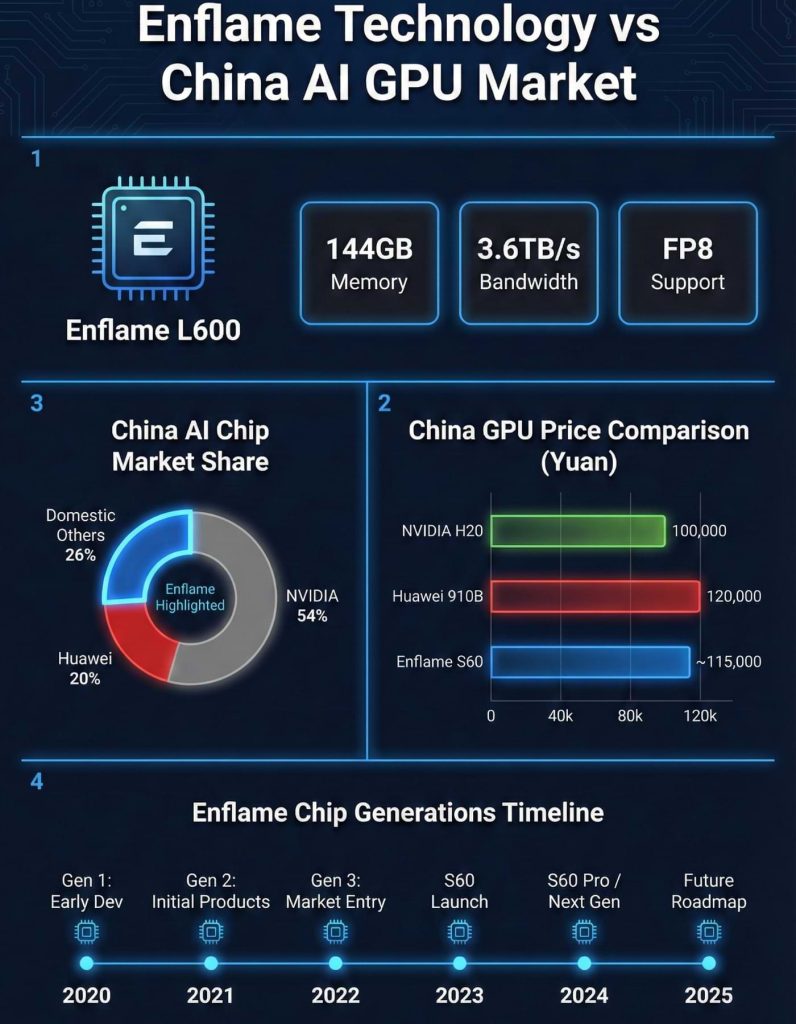
The third-generation S60 has already shipped approximately 70,000 units as of mid-2025, which is a notable milestone for a domestic Chinese chip company outside of Huawei’s Ascend lineup. The fourth-generation L600, unveiled at the World AI Conference in Shanghai in July 2025, packs 144GB of on-chip memory, 3.6TB/s of memory bandwidth, and FP8 support, specs designed specifically to accelerate large-model training while cutting costs for cloud operators.
The IPO Filing That Made Headlines
In January 2026, the Shanghai Stock Exchange accepted Enflame Technology’s application to list on the STAR Market, China’s Nasdaq-style board for science and technology companies. This move completes what analysts are calling the convergence of China’s “Four Dragons”: Enflame, Moore Threads, MetaX, and Biren Technology on the public markets.
The valuation heading into this process was reported at around $1.65 billion in early coverage (a later report put it at about $2.8 billion, citing the Hurun index), a number that reflects investor confidence despite the company still operating at a loss, as is common among capital-intensive semiconductor firms in scale-up phases. Chinese regulators eased listing rules for unprofitable hardware companies in June 2025, which opened the door for all four companies to pursue public listings faster than expected.
For context on pricing and market size: in the first half of 2025 alone, China’s AI chip-powered server market reached $16 billion in value, with over 1.9 million units shipped, according to IDC.
Who Actually Uses Enflame Chips?
This is where the story gets commercially interesting. Tencent is deploying Enflame chips at scale. Alongside Alibaba and Baidu, Tencent had previously been heavily reliant on NVIDIA for its AI server infrastructure. The shift toward domestic suppliers is now accelerating, driven by a combination of U.S. export restrictions and Beijing’s push for technological self-reliance.
Enflame is not on the U.S. trade entity list, which means it still has access to TSMC for chip fabrication, a crucial advantage over blacklisted competitors like Biren, which was added to the U.S. entity list in 2022 and has seen a slower product iteration cycle as a result.
Beyond Tencent, Enflame’s primary customers are cloud computing infrastructure operators and data centers across China. The company also counts China’s National Integrated Circuit Industry Investment Fund (the “Big Fund”) and Meitu among its notable investors.
How Does Enflame Stack Up Against Rivals?
In a benchmark comparison of Chinese domestic AI accelerators assessed against NVIDIA A100 performance on the Llama 3.3 8B inference task, only four domestic chips cleared the threshold: the Huawei Ascend 910C, the Enflame T20, the MetaX C500, and the Moffett AI SparseOne series. The fact that Enflame’s hardware makes this list alongside Huawei, which commands over 20% of China’s AI chip market. That is a meaningful data point.
That said, the competitive environment is crowded. As of 2025, NVIDIA still holds roughly 54% of China’s AI computing power chip market, with Huawei exceeding 20%, and all domestic players combined accounting for less than 20%. Within that domestic slice, Enflame competes directly with Cambricon, Moore Threads, Biren, MetaX, and Muxi Technology.
If you want to understand how pricing dynamics in China’s robotics and edge AI hardware segment are evolving alongside GPU competition, the analysis on Axera Semiconductor edge AI chips gives useful context on the broader domestic chip pricing landscape.
AI Chip Pricing in China: What These Cards Actually Cost?
Enflame does not publish a public price list. Like most datacenter GPU makers, its chips are sold through enterprise contracts and integrators rather than open retail channels. That said, enough market data has surfaced through distributor reports, IPO prospectus filings, and industry research to give a realistic picture of where Enflame sits in the China AI chip pricing landscape.
The Enflame S60 (third-gen) is estimated to sell in a range comparable to the Huawei Ascend 910B, which distributors have priced at roughly 120,000 yuan (~$16,500) per card. The newer L600 is expected to carry a higher price point given its substantially upgraded specs, though we found no official figure in the coverage of Enflame’s STAR Market IPO.
The table below pulls from distributor pricing reports, Reuters sourcing, TrendForce, and SCMP to give a side-by-side look at what China’s AI chip market actually charges, and where Enflame fits in.
China AI GPU Price Comparison Table (Per Card, Estimated)
| Chip | Maker | Memory | Estimated Price (CNY) | Estimated Price (USD) | Status in China | Notes |
|---|---|---|---|---|---|---|
| H100 (SXM5) | NVIDIA | 80GB HBM3 | N/A (banned) | ~$30,000–$40,000 | Export banned | Reference benchmark chip |
| H20 | NVIDIA | 96GB HBM3 | ~100,000 yuan | ~$13,800 | Available (restricted) | Price cut ~10% due to weak demand vs. Huawei |
| Ascend 910B | Huawei | 64GB HBM2e | ~120,000 yuan | ~$16,500 | Widely deployed | Most competitive domestic chip pre-910C |
| Ascend 910C | Huawei | 96GB HBM3 | ~130,000–150,000 yuan est. | ~$18,000–$21,000 est. | Deploying now | Claimed to rival H100 on some workloads |
| Enflame S60 | Enflame | 64GB HBM | ~Comparable to 910B est. | ~$13,800–$17,900 est. (100,000–130,000 yuan at 7.25; this page's estimate) | ~70,000 units shipped | No official price; enterprise contract only |
| Enflame L600 | Enflame | 144GB | Not yet disclosed | Not yet disclosed | Announced July 2025 | Benchmarked above H20; mass deploy timeline TBC |
| MetaX C500 | MetaX | 64GB HBM2e | Not publicly listed | Not publicly listed | Limited deployment | One of 4 chips passing A100 inference bar |
| MetaX C600 | MetaX | 144GB HBM3e | Not yet disclosed | Not yet disclosed | Pilot Q4 2025 | Dual-chiplet design; mass production 2026 |
| Moore Threads MTT S4000 | Moore Threads | 48GB GDDR6 | Not publicly listed | Not publicly listed | Available | Gaming + datacenter dual use |
Sources: Reuters, TrendForce, South China Morning Post, WAIC 2025 disclosures. All pricing is distributor-reported or estimated from market intelligence not official manufacturer list prices. CNY/USD conversion at ~7.25.
Key Pricing Takeaways
The H20 vs. domestic gap is closing. When NVIDIA launched the H20 for China in early 2024, it priced the card between $12,000 and $15,000. By mid-2024, weak demand forced a discount of over 10%, pushing street prices to around 100,000 yuan. Huawei’s 910B held firm at 120,000 yuan, meaning Huawei actually commands a price premium over NVIDIA in China right now, something almost unimaginable three years ago.
Enflame’s S60 targets the same price band. Based on its competitive positioning and the fact that Tencent is deploying it at scale, the S60 would sit, on this page's own estimate, in the 100,000 to 130,000 yuan range per card, the current sweet spot for enterprise AI training hardware in China. Pricing above Huawei would be a difficult sell; pricing significantly below would suggest either subsidy pressure or a less capable product.
The L600 will likely price above the H20. With 144GB of memory versus the H20’s 96GB, and claimed performance exceeding the H20, Enflame’s L600 positions itself closer to what Western markets would call an H100-class chip, making a per-card price north of 150,000 yuan a reasonable expectation once Enflame’s prospectus data becomes public through the STAR Market listing process. That is this page's guess; the reports we read on the September 2026 listing give no chip prices.
Server rack pricing matters more than per-card. In practice, Chinese hyperscalers buy GPU clusters, not individual cards. In May 2024, Reuters reporting carried by the South China Morning Post put an eight-card H20 server at around 1.1 million to 1.3 million yuan and the Huawei 910B equivalent at 1.3 million to 1.5 million yuan. At rack scale, the difference between competing chips narrows considerably, which is why deployment relationships (like Tencent with Enflame) matter as much as raw pricing.

Challenges: Approval Crackdowns and Market Saturation
Enflame’s path forward is not without friction. Since April 2025, Chinese regulators have issued “window guidance” clamping down on new computing power center construction, with approval rates reportedly below 10% for private applicants. State-owned enterprises and local governments have significantly reduced investment in new GPU clusters.
This matters for Enflame because its main customer base, data centers buying training GPUs, has slowed its purchasing pace. The GPU supply buildup from 2023 to 2024 means many operators already have what they need. New orders depend heavily on large model training cycles, which are driven by a smaller number of hyperscalers and cloud providers rather than a broad market.
The growth of China’s humanoid robotics sector is creating new demand for edge computing and AI inference chips. Our coverage of how consumer robots market size is evolving and the Unitree vs Kepler vs Magic Atom comparison shows where embedded AI inference demand is heading, a segment that could eventually become a meaningful secondary market for companies like Enflame.
What the IPO Means for Pricing Transparency?
One direct benefit of Enflame’s STAR Market listing process is disclosure. As the company files its prospectus, detailed revenue figures, chip shipment volumes, loss margins, and customer concentration data become public. For analysts and researchers tracking China’s AI hardware market, this is the first real look inside Enflame’s business at scale.
For pricing comparisons in the domestic GPU market, the prospectus data, combined with similar filings from Moore Threads, MetaX, and Iluvatar CoreX will let researchers model what domestic AI compute actually costs per unit versus NVIDIA alternatives. This is exactly the kind of pricing intelligence our live tracking tools are built to surface for readers making high-value procurement or investment decisions.
Where these figures come from
We re-read the sources for this page on 23 November 2026. The company has listed since the page was written, so the IPO facts are now firm; the chip prices are not.
| Figure on this page | Status | Source |
|---|---|---|
| STAR Market application accepted in January 2026 | Not rechecked. The later steps are confirmed: listing committee approval for a raise of about 6 billion yuan ($888 million) was reported on 15 and 16 June 2026 | The Next Web; Yicai Global |
| Listing | Confirmed: 11 September 2026 on the STAR Market; offer price 142.18 yuan; about 6.12 billion yuan ($911 million) raised from 43 million shares; opened at 410 yuan, peaked at 475 and closed at 397 | The Next Web, 11 September 2026; The Standard |
| Tencent as largest shareholder and a major customer | Confirmed: about 20% before the offering and 17.95% after it; 33%, 38% and 84% of revenue in 2023, 2024 and 2025 | Yicai Global; The Standard |
| Revenue and losses (not on this page before) | 2025 revenue 990.2 million yuan, up 37%; net loss 1.16 billion yuan against 1.51 billion in 2024 | Yicai Global; The Standard |
| Pre-IPO valuation of about $1.65 billion | Not confirmed. The Next Web cites about $2.8 billion (Hurun); at the offer price the company was valued at about 61.2 billion yuan | The Next Web; The Standard |
| NVIDIA H20 at about 100,000 yuan and Huawei Ascend 910B at about 120,000 yuan a card | Confirmed as of May 2024: around 100,000 yuan (US$13,805) for the H20 and above 120,000 yuan for the 910B, varying with order size | South China Morning Post (Reuters), May 2024 |
| Eight-card servers at 1.4 million and 1.36 million yuan | Did not match the source; replaced with 1.1 to 1.3 million yuan (H20) and 1.3 to 1.5 million yuan (910B) | South China Morning Post |
| H20 launch price of $12,000 to $15,000 | Not in the report we read | — |
| Enflame S60 at 100,000 to 130,000 yuan; L600 above 150,000 yuan | This page's own estimates. No source we read gives an Enflame card price | — |
| About 70,000 S60 units shipped by mid-2025 | Not confirmed. The Next Web says only that an earlier model shipped tens of thousands of units | The Next Web |
| NVIDIA at 54% and Huawei above 20% of China's AI chip market; IDC's $16 billion and 1.9 million servers for the first half of 2025 | Not rechecked. The Next Web puts Enflame itself at barely 1% of China's market | The Next Web |
| Ascend 910C and H100 prices; the A100 benchmark comparison; approval rates below 10% | Not rechecked in this update | — |
Our analysis
The listing valued Enflame at about 62 times its 2025 revenue, and the first day almost tripled that.
| Measure | Value |
|---|---|
| Offer price | 142.18 yuan |
| Shares sold | 43 million, about 10% of the company |
| Raised | about 6.12 billion yuan ($911 million) |
| Company value at the offer price | about 61.2 billion yuan |
| First-day close | 397 yuan, 179% above the offer |
| Company value at the first-day close | 170.9 billion yuan ($25.5 billion) |
| 2025 revenue | 990.2 million yuan |
| Value at the offer price, as a multiple of 2025 revenue | 61.8 |
| Value at the first-day close, as a multiple of 2025 revenue | 172.6 |
Forty-three million shares at 142.18 yuan is 6.11 billion yuan, in line with the 6.12 billion reported. The multiples are our arithmetic.
All of the 2025 growth came from Tencent. Revenue rose from about 722 million yuan in 2024 to 990.2 million in 2025. Tencent's share went from about 38% to 83.79%, which is about 274 million yuan rising to about 830 million, a threefold increase. Revenue from every other customer therefore fell from about 448 million yuan to about 160 million, a drop of about 64%. The page describes Tencent as one of the biggest customers; on these figures it is by far the largest.
The loss is still larger than revenue. The 2025 net loss of 1.16 billion yuan is 1.17 times revenue, down from about 2.1 times in 2024 (1.51 billion on about 722 million). The Next Web puts cumulative losses at about 4.29 billion yuan over three years. For the first nine months of 2026 the company forecast revenue of 2.3 billion to 3 billion yuan, which would be 2.3 to 3.0 times the whole of 2025.
The dollar conversions in the price table are dated. The table uses 7.25 yuan to the dollar. The June and September 2026 reports imply about 6.76 (6 billion yuan as $888 million) and 6.72 (6.12 billion yuan as $911 million). At 6.75, 100,000 yuan is about $14,800 rather than $13,800, 120,000 yuan about $17,800 rather than $16,500, and 150,000 yuan about $22,200. The yuan prices themselves date from May 2024.
Cards are about two-thirds to three-quarters of a server's price. Eight H20 cards at 100,000 yuan come to 800,000 yuan, 62% to 73% of the 1.1 to 1.3 million yuan reported for an eight-card server. Eight 910B cards at 120,000 yuan come to 960,000 yuan, 64% to 74% of 1.3 to 1.5 million. The 910B server is 15% to 18% dearer than the H20 server at either end of the range, slightly less than the gap of at least 20% between the cards.
Enflame FAQs
What is Enflame Technology? Enflame Technology is a Shanghai-based AI chip company founded in 2018 that designs GPUs and AI accelerators for large-model training and inference. Tencent is a major shareholder and its main customer.
What is the price of the Enflame S60 GPU? Enflame publishes no price, and none of the reports we read gives one. This page's own estimate is 100,000 to 130,000 yuan a card, in line with the roughly 100,000 yuan reported for the NVIDIA H20 and more than 120,000 yuan for the Huawei Ascend 910B in May 2024.
Is Enflame Technology publicly traded? Yes. It listed on Shanghai's STAR Market on 11 September 2026 at 142.18 yuan a share after raising about 6.12 billion yuan ($911 million). The shares closed the first day at 397 yuan, 179% above the offer price.
How much of Enflame's revenue comes from Tencent? About 84% in 2025 (83.79%), up from 38% in 2024 and 33% in 2023. Tencent held 17.95% of the company after the offering.
Is Enflame profitable? No. It reported a net loss of 1.16 billion yuan on revenue of 990.2 million yuan in 2025, against a loss of 1.51 billion yuan in 2024.
How does Enflame compare with NVIDIA and Huawei? It is far smaller. The Next Web put Enflame at barely 1% of China's AI chip market in June 2026 and said it trails Huawei and Cambricon at home. The market-share figures for NVIDIA and Huawei on this page have not been rechecked.
Sources read 23 November 2026: The Next Web on the debut (11 September 2026), The Standard on the debut (11 September 2026), The Next Web on the approval (15 June 2026), Yicai Global (16 June 2026) and South China Morning Post on H20 and 910B prices (May 2024). This is not investment advice.
First published February 2026; reviewed November 2026. Market data per IDC (China AI server market) and industry reporting as attributed inline; the L600 was unveiled at the World AI Conference, Shanghai, July 2025; STAR Market filing accepted by the Shanghai Stock Exchange in January 2026; Enflame listed there on 11 September 2026 (sources in the section above). Card prices are distributor-reported estimates, labeled as such; Enflame publishes no list prices. Figures change as the IPO progresses.