
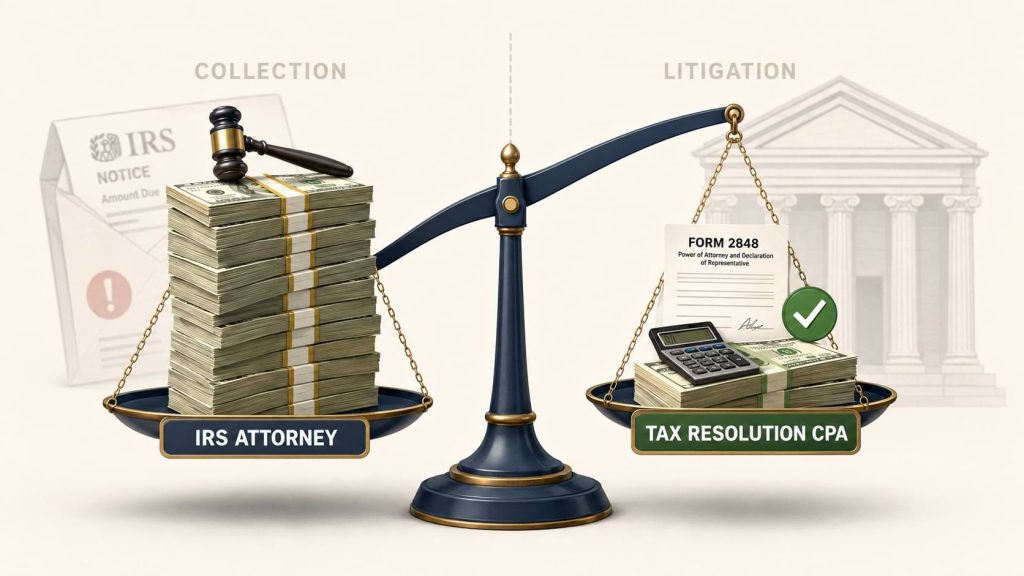
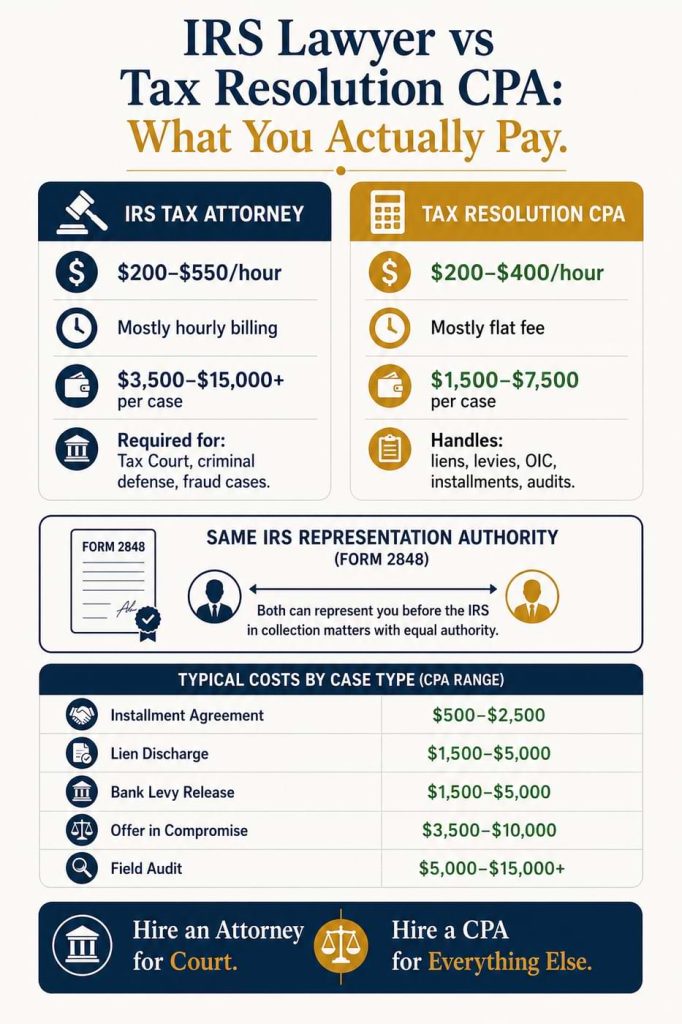
An IRS tax attorney typically charges $200 to $550 per hour, with full case resolution running $3,500 to $15,000 or more, depending on complexity. A tax resolution CPA usually offers flat-fee pricing in the $1,500 to $7,500 range for most collection and lien cases, with attorney involvement only required for criminal exposure, U.S. Tax Court litigation, or contested fraud determinations. For most IRS collection matters (liens, levies, installment agreements, offers in compromise, audits), a CPA-led resolution costs less and resolves faster.
You do not need a lawyer for most IRS problems. You need someone who knows IRS procedure, has the credentials to represent you (CPA, Enrolled Agent, or attorney), and can negotiate with the collections division.
An IRS lawyer becomes essential only when criminal exposure, U.S. Tax Court litigation, or contested fraud claims are on the table. For everything else, a tax resolution CPA delivers the same outcome at lower cost.
Typical Cost Ranges by Case Type
Industry-standard fee ranges for common IRS resolution work:
- Installment agreement (under $50K balance): $500 to $2,500
- Currently Not Collectible status: $1,000 to $3,500
- Offer in Compromise: $3,500 to $10,000+
- Lien subordination, discharge, or withdrawal: $1,500 to $5,000
- Bank levy release (emergency): $1,500 to $5,000
- CDP hearing representation: $2,500 to $5,000
- Audit defense (correspondence or office audit): $2,000 to $7,500
- Field audit defense: $5,000 to $15,000+
- Criminal tax defense (attorney only): $25,000 to $100,000+
Attorney hourly rates run $200 to $550 in most markets. CPA hourly rates typically run $200 to $400, usually replaced by flat fees once scope is defined.
Side-by-Side: IRS Lawyer vs Tax Resolution CPA
| Factor | IRS Tax Attorney | Tax Resolution CPA | Measurement |
| Hourly rate range | $200 to $550 | $200 to $400 | $/hour |
| Pricing model | Mostly hourly | Mostly flat fee | Billing structure |
| Typical full-case cost | $3,500 to $15,000+ | $1,500 to $7,500 | Range |
| IRS representation authority | Yes (Form 2848) | Yes (Form 2848) | Power of attorney |
| U.S. Tax Court litigation | Yes | No | Court access |
| Criminal tax defense | Yes | No | Criminal authority |
| Lien, levy, installment, OIC, audit | Yes | Yes | Same authority |
When You Actually Need an Attorney
Three situations make attorney involvement non-negotiable:
- Criminal investigation by IRS Criminal Investigation Division, or any letter referencing fraud penalties under IRC 6663
- U.S. Tax Court litigation after a Notice of Deficiency
- High-exposure willfulness cases involving FBAR or offshore reporting
In these cases, attorney-client privilege protects communications in ways the practitioner privilege does not. Hire the attorney first. A CPA can support the engagement under a Kovel arrangement.
When a CPA Handles It Just as Well
For most IRS resolution work, a CPA delivers the same outcome at lower cost. That includes:
- IRS federal tax lien resolution (release, withdrawal, discharge, subordination)
- Emergency bank levy and wage garnishment release
- Installment agreements, including Partial Pay
- Offer in Compromise preparation and negotiation
- Currently Not Collectible status
- Penalty abatement requests
- Collection Due Process hearings (Form 12153)
- IRS audits (correspondence, office, and most field audits)
A CPA holds the same IRS representation authority as an attorney through Form 2848. The difference is courtroom access, not collection authority.
Common Mistakes That Inflate Resolution Costs
- Hiring the first 1-800 “tax debt relief” firm that calls after a lien notice (mass marketers often charge $3,000 to $10,000 upfront for work a local CPA finishes for less)
- Paying hourly when the case scope supports a flat fee
- Engaging an attorney for a simple installment agreement
- Waiting until a levy hits to hire help (emergency rates are higher)
- Treating the IRS notice itself as the only deadline (CDP rights expire 30 days after Letter 1058 or LT11)
- Skipping the written scope and fee schedule before signing a retainer
What Determines Your Actual Cost
Every quote depends on five factors:
- Total tax liability and number of years involved
- Whether the IRS has issued a Notice of Federal Tax Lien or initiated levy action
- Complexity of the resolution path (an OIC takes 6 to 12 months; an installment agreement takes weeks)
- Whether collection alternatives have been previously denied
- Whether the case involves trust fund recovery, foreign reporting, or audit defense
A reputable CPA or attorney provides a written scope and fee schedule before any retainer is collected. Walk away from anyone who refuses.
What to Do If You Need Resolution Help Now
For IRS lien, levy, installment, or offer in compromise cases, the most cost-effective path is a CPA with direct IRS resolution experience. The IRS Tax Lien Help service covers lien release, withdrawal, discharge, and subordination on a defined-scope basis. Emergency Bank Levy Help handles same-week levy release for active garnishments.

Speak with a CPA who handles IRS resolution full-time.
Call (786) 265-8578 or visit the contact page for a no-pressure case review. Ed Parsons CPA has 25+ years of IRS tax resolution experience helping individuals and small business owners across all 50 states.
Frequently Asked Questions
1. Is a tax attorney more powerful than a CPA with the IRS?
No. Both can represent you before the IRS under Form 2848 with identical authority. The difference is courtroom access: only attorneys can litigate in U.S. Tax Court.
2. Why are tax attorneys more expensive than CPAs?
Attorneys carry higher overhead (law school debt, bar dues, malpractice insurance, court admission costs) and bill mostly hourly. CPAs in resolution practices often work on flat-fee structures, which keeps costs predictable.
3. Can a CPA represent me in an IRS audit?
Yes. CPAs handle correspondence, office, and field audits routinely. Tax Court litigation after a deficiency requires an attorney.
4. What does an Offer in Compromise actually cost?
Most reputable CPAs charge $3,500 to $7,500 for OIC preparation, negotiation, and follow-through. Mass marketers often charge $5,000 to $10,000 for the same work with less attention.
5. Are nationwide tax relief companies cheaper than a local CPA?
Usually no. Mass marketers advertise low retainers but charge upsells once the file opens. Local CPAs with flat fees often resolve the case for the same or less total cost with direct accountability.
6. When does attorney-client privilege actually matter for tax cases?
Only when criminal exposure is realistic. For civil collection, audit, or compliance work, the federally authorized practitioner privilege under IRC 7525 covers CPA communications in most situations.