Sponsored
This article is sponsored by Ed Parsons CPA. Links to edparsonscpa.com are paid links and are labelled for search engines as sponsored. The payment does not decide the prices or facts we report. This is general cost information, not legal or tax advice. See our editorial policy.
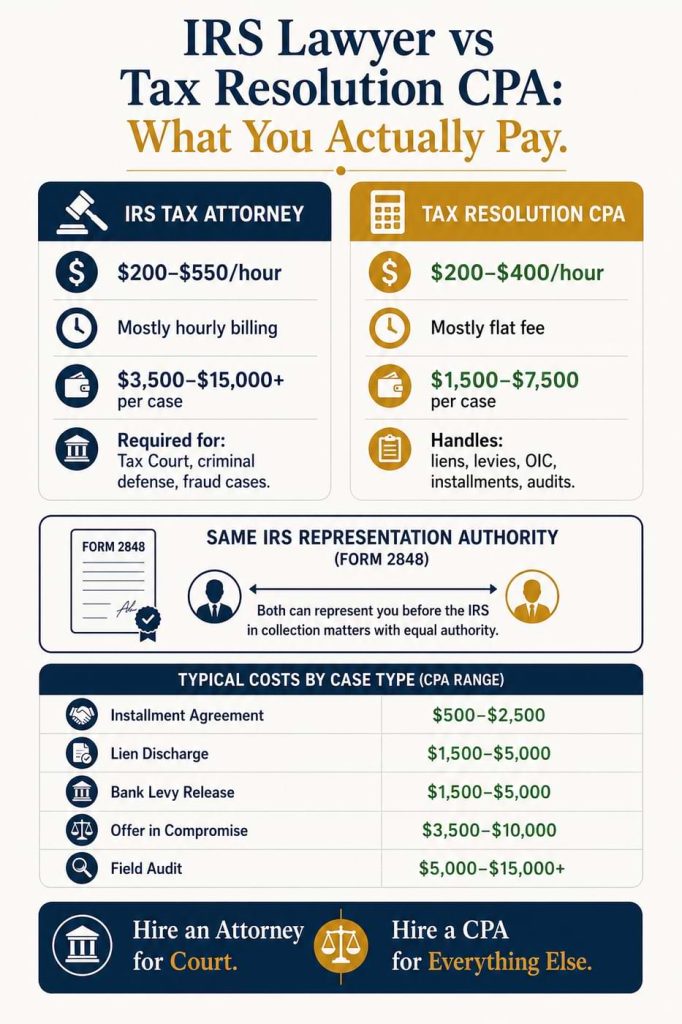
An IRS tax attorney typically charges $200 to $550 per hour, with full case resolution running $3,500 to $15,000 or more, depending on complexity. A tax resolution CPA usually offers flat-fee pricing in the $1,500 to $7,500 range for most collection and lien cases, with attorney involvement only required for criminal exposure, U.S. Tax Court litigation, or contested fraud determinations. For most IRS collection matters (liens, levies, installment agreements, offers in compromise, audits), a CPA-led resolution costs less and resolves faster.
You do not need a lawyer for most IRS problems. You need someone who knows IRS procedure, has the credentials to represent you (CPA, Enrolled Agent, or attorney), and can negotiate with the collections division.
An IRS lawyer becomes essential only when criminal exposure, U.S. Tax Court litigation, or contested fraud claims are on the table. For everything else, a tax resolution CPA delivers the same outcome at lower cost.
Typical Cost Ranges by Case Type
Industry-standard fee ranges for common IRS resolution work:
- Installment agreement (under $50K balance): $500 to $2,500
- Currently Not Collectible status: $1,000 to $3,500
- Offer in Compromise: $3,500 to $10,000+
- Lien subordination, discharge, or withdrawal: $1,500 to $5,000
- Bank levy release (emergency): $1,500 to $5,000
- CDP hearing representation: $2,500 to $5,000
- Audit defense (correspondence or office audit): $2,000 to $7,500
- Field audit defense: $5,000 to $15,000+
- Criminal tax defense (attorney only): $25,000 to $100,000+
Attorney hourly rates run $200 to $550 in most markets. CPA hourly rates typically run $200 to $400, usually replaced by flat fees once scope is defined.
Side-by-Side: IRS Lawyer vs Tax Resolution CPA
| Factor | IRS Tax Attorney | Tax Resolution CPA | Measurement |
| Hourly rate range | $200 to $550 | $200 to $400 | $/hour |
| Pricing model | Mostly hourly | Mostly flat fee | Billing structure |
| Typical full-case cost | $3,500 to $15,000+ | $1,500 to $7,500 | Range |
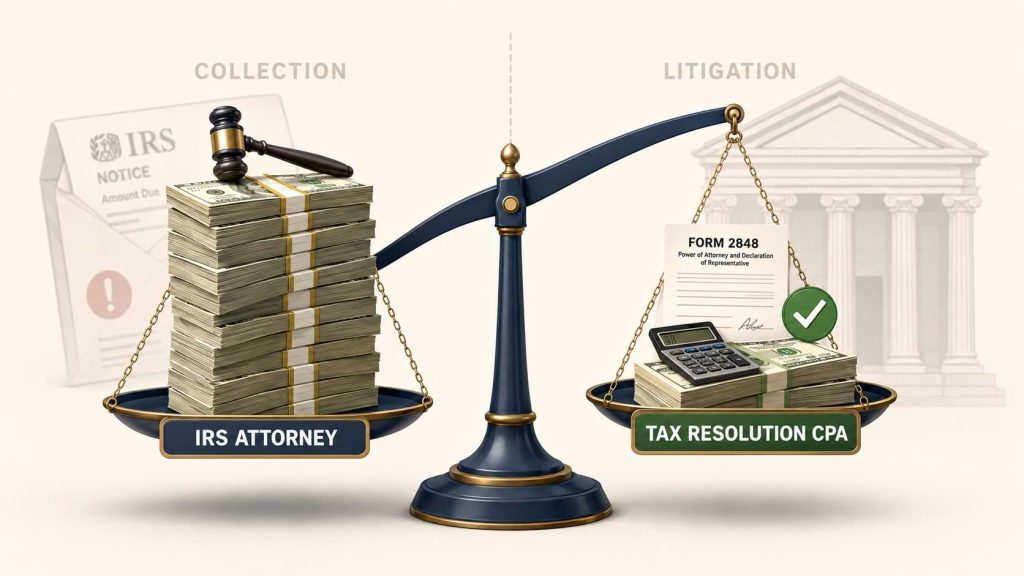
| IRS representation authority | Yes (Form 2848) | Yes (Form 2848) | Power of attorney |
| U.S. Tax Court litigation | Yes | Only if admitted through the Court's nonattorney exam | Court access |
| Criminal tax defense | Yes | No | Criminal authority |
| Lien, levy, installment, OIC, audit | Yes | Yes | Same authority |
When You Actually Need an Attorney
Three situations make attorney involvement non-negotiable:
- Criminal investigation by IRS Criminal Investigation Division, or any letter referencing fraud penalties under IRC 6663
- U.S. Tax Court litigation after a Notice of Deficiency
- High-exposure willfulness cases involving FBAR or offshore reporting
In these cases, attorney-client privilege protects communications in ways the practitioner privilege does not. Hire the attorney first. A CPA can support the engagement under a Kovel arrangement.
When a CPA Handles It Just as Well
For most IRS resolution work, a CPA delivers the same outcome at lower cost. That includes:
- IRS federal tax lien resolution (release, withdrawal, discharge, subordination)
- Emergency bank levy and wage garnishment release
- Installment agreements, including Partial Pay
- Offer in Compromise preparation and negotiation
- Currently Not Collectible status
- Penalty abatement requests
- Collection Due Process hearings (Form 12153)
- IRS audits (correspondence, office, and most field audits)
A CPA holds the same IRS representation authority as an attorney through Form 2848. The main difference is court representation and privilege, not collection authority.
Common Mistakes That Inflate Resolution Costs
- Hiring the first 1-800 “tax debt relief” firm that calls after a lien notice (mass marketers often charge $3,000 to $10,000 upfront for work a local CPA finishes for less)
- Paying hourly when the case scope supports a flat fee
- Engaging an attorney for a simple installment agreement
- Waiting until a levy hits to hire help (emergency rates are higher)
- Treating the IRS notice itself as the only deadline (CDP rights expire 30 days after Letter 1058 or LT11)
- Skipping the written scope and fee schedule before signing a retainer
What Determines Your Actual Cost
Every quote depends on five factors:
- Total tax liability and number of years involved
- Whether the IRS has issued a Notice of Federal Tax Lien or initiated levy action
- Complexity of the resolution path (an Offer in Compromise can take many months to review; an installment agreement is usually much quicker)
- Whether collection alternatives have been previously denied
- Whether the case involves trust fund recovery, foreign reporting, or audit defense
A reputable CPA or attorney provides a written scope and fee schedule before any retainer is collected. Walk away from anyone who refuses.
Official IRS Fees You Pay Whoever Represents You
Some costs are set by the IRS, not by your representative, and apply even if you handle the case yourself. The IRS lists these setup fees for payment plans, checked on 22 November 2026:
| IRS payment option | Apply online | Apply by phone, mail or in person |
|---|---|---|
| Short-term plan, 180 days or less | $0 | $0 |
| Long-term plan, direct debit | $29 | $107 |
| Long-term plan, other payment methods | $69 | $178 |
| Low-income: direct debit / other methods | Waived / $43, which may be reimbursed | Waived / $43 |
Penalties and interest keep accruing until the balance is paid. For an Offer in Compromise, the IRS charges a $205 application fee plus a first payment: 20 percent of the offer amount for a lump-sum offer, or the first instalment for a periodic-payment offer. Individuals who meet the IRS low-income qualifications pay neither the fee nor the initial payment while the offer is considered. Sources: IRS payment plans and IRS Offer in Compromise.
These official fees are small next to professional fees, so a representative’s quote is mostly paying for their time and experience. Ask any quote to separate the IRS’s own fees from the professional fee.
Free and Low-Cost Help
Low Income Taxpayer Clinics, funded through the Taxpayer Advocate Service, represent eligible taxpayers in audits, appeals and collection disputes, before the IRS and in court, for free or a small fee. For 2026 the income ceiling is 250 percent of the federal poverty guidelines, $39,900 for a single person in the 48 contiguous states and D.C., and the amount in dispute is usually under $50,000; each clinic makes the final decision. Source: Taxpayer Advocate Service, Low Income Taxpayer Clinics.
Who Can Represent You in Tax Court
Attorneys are not the only people allowed to practise before the US Tax Court. Taxpayers can represent themselves, and the Court admits non-attorneys who pass its written examination, which has four parts, Tax Court rules, federal taxation, the Federal Rules of Evidence and legal ethics, with a minimum of 70 percent on each. The examination fee is $150 and the admission fee $50. Few pass: the Court’s statistics show 14 of 167 examinees passed in 2025, a rate of 8.38 percent, and 10 of 163 in 2023. In practice, most CPAs are not admitted, so a CPA-led case that goes to Tax Court usually adds an attorney, or a CPA who has passed the exam. Sources: US Tax Court, nonattorney admission and nonattorney exam statistics.
What to Do If You Need Resolution Help Now
For IRS lien, levy, installment, or offer in compromise cases, the most cost-effective path is a CPA with direct IRS resolution experience. The IRS Tax Lien Help service covers lien release, withdrawal, discharge, and subordination on a defined-scope basis. Emergency Bank Levy Help handles same-week levy release for active garnishments.

Speak with a CPA who handles IRS resolution full-time.
Call (786) 265-8578 or visit the contact page for a no-pressure case review. Ed Parsons CPA has 25+ years of IRS tax resolution experience helping individuals and small business owners across all 50 states.
Frequently Asked Questions
1. Is a tax attorney more powerful than a CPA with the IRS?
No. Both can represent you before the IRS under Form 2848 with identical authority. The difference is courtroom access: only attorneys and the few non-attorneys who pass the Court's admission exam can represent you in U.S. Tax Court.
2. Why are tax attorneys more expensive than CPAs?
Attorneys usually bill hourly and offer full attorney-client privilege and court representation. CPAs in resolution practices often work on flat-fee structures, which keeps costs predictable.
3. Can a CPA represent me in an IRS audit?
Yes. CPAs handle correspondence, office, and field audits routinely. If the case goes to U.S. Tax Court, you need an attorney or a practitioner admitted through the Court exam, or you can represent yourself.
4. What does an Offer in Compromise actually cost?
Most reputable CPAs charge $3,500 to $7,500 for OIC preparation, negotiation, and follow-through. Mass marketers often charge $5,000 to $10,000 for the same work with less attention.
5. Are nationwide tax relief companies cheaper than a local CPA?
Usually no. Mass marketers advertise low retainers but charge upsells once the file opens. Local CPAs with flat fees often resolve the case for the same or less total cost with direct accountability.
6. When does attorney-client privilege actually matter for tax cases?
Only when criminal exposure is realistic. For civil collection, audit, or compliance work, the federally authorized practitioner privilege under IRC 7525 covers CPA communications in most situations.
Updated 22 November 2026 with IRS payment-plan and Offer in Compromise fees, Low Income Taxpayer Clinic eligibility and US Tax Court admission rules. Reference: United States Tax Court. This page is for information only.