
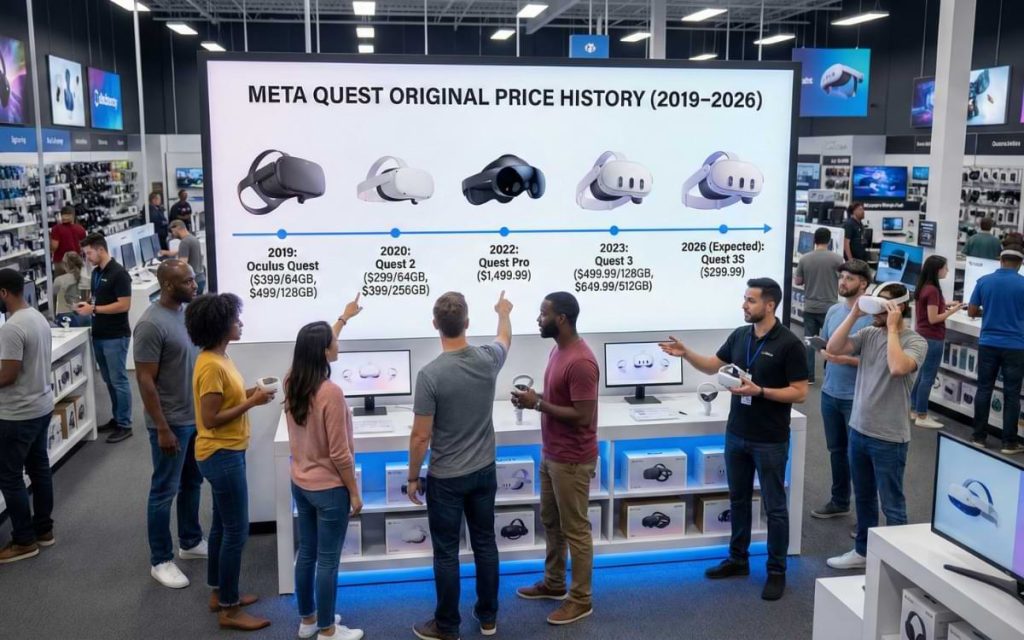
The original Oculus Quest launched in May 2019 at $399 for the 64GB model and $499 for the 128GB model. These all-in-one wireless VR headsets required no external sensors or PC connection, positioning them as the first truly standalone consumer VR system at a mid-range price point. The Quest 2 later launched at a lower $299 price in 2020, while the premium Quest Pro debuted at $1,499 in 2022, and Quest 3 at $499 in 2023.
🥽 Meta Quest Original Price Tracker LIVE
Real-time VR headset price monitoring with automatic monthly updates
🎮 Auto-Update Active: This chart automatically adds new price data on the 1st of each month. The system tracks official Meta pricing changes, promotional periods, and market adjustments. Historical data includes launch prices and all major price changes since 2020.
📊 Launch Prices vs Current (January 2026)
Quest 3 (512GB)
Quest 3 (128GB)
Quest 2 (Final)
Quest Pro (Final)
💰 Price Evolution Over Time
| Device | Launch Price | Current Price | Peak Price | Lowest Price | Total Change |
|---|---|---|---|---|---|
| Quest 3 (512GB) | $499.99 | $499.99 | $499.99 | $499.99 | $0 |
| Quest 3 (128GB) | $499.99 | $429.99 | $499.99 | $429.99 | -$70 |
| Quest 2 (128GB) | $299.99 | $199.99 | $399.99 | $199.99 | -$100 |
| Quest Pro | $1,499.99 | $999.99 | $1,499.99 | $999.99 | -$500 |
📝 Recent Update History
When VR Became Accessible?
In May 2019, Facebook (now Meta) launched a product that would fundamentally reshape the virtual reality market. The Oculus Quest arrived at $399 with a promise that seemed almost too good to be true: full-featured VR gaming with no wires, no external sensors, and no expensive gaming PC required. For an industry that had struggled with $599 PlayStation VR bundles and $799 Oculus Rift setups, the Quest’s pricing represented a watershed moment in consumer accessibility.
Understanding Quest’s original pricing matters because it reveals Meta’s long-term strategy for the VR market, a willingness to subsidize hardware costs to build an ecosystem, similar to traditional console gaming economics, but with even more aggressive pricing. The company’s approach has evolved dramatically over seven years, from the original Quest’s careful market testing to the Quest 2’s mainstream push at $299, the Quest Pro’s failed premium experiment at $1,499, and the Quest 3’s refined positioning at $499 in 2023.
By 2026, the Quest line will have established itself as the dominant force in consumer VR, capturing an estimated 75% of the standalone headset market. This success stems partly from Meta’s willingness to price hardware below cost, an approach that has shaped not just VR economics but expectations around what immersive technology should cost. For consumers evaluating VR purchases today, understanding this pricing history provides critical context for assessing value and anticipating future price trends.
This article examines the complete pricing evolution of Meta Quest headsets from 2019 through 2026, including regional variations, what was included at each price point, how the pricing strategy changed across generations, and what these numbers reveal about the current state and future direction of consumer VR economics.
The Original Oculus Quest (2019): Setting the Foundation
Launch Pricing and Configuration
When Oculus unveiled the original Quest at the Game Developers Conference in March 2019, the pricing announcement generated genuine surprise. Industry observers had expected $499-$599 based on the included hardware specifications. Instead, Facebook positioned the device aggressively:
Original Quest Launch Pricing (May 21, 2019):
| Storage Capacity | US Price | Same as the 64GB model with doubled storage |
|---|---|---|
| 64GB | $399 | Headset, 2 Touch controllers, glasses spacer, charging cable, power adapter |
| 128GB | $499 | Same as 64GB model with doubled storage |
The $399 entry point proved strategically significant. This pricing undercut the PlayStation VR bundle ($349-$399 but requiring a $299 PlayStation 4) while matching the standalone pricing of PC-tethered headsets that demanded $800-$1,200 gaming computers. Facebook essentially made the bet that an all-in-one system at console pricing could expand the VR market beyond early adopters.
What Made the Price Possible?
The Quest’s bill of materials was estimated at $350-$375 by industry analysts, suggesting Facebook sold the device near cost or at a slight loss. Several technical decisions enabled this aggressive pricing:
Hardware Cost Management:
- Qualcomm Snapdragon 835 processor (2017 smartphone chip, purchased at volume discount)
- 1440×1600 per eye OLED displays (lower resolution than PC VR but adequate for standalone)
- Inside-out tracking (eliminated the need for external sensor hardware)
- Fresnel lens optics (cost-effective compared to pancake lenses)
- Standard lithium-ion battery (2-3 hours runtime as an acceptable tradeoff)
The use of a two-year-old mobile processor proved particularly important. By 2019, the Snapdragon 835 was available at steep discounts compared to current flagship chips, while still providing sufficient power for VR at the Quest’s resolution. This approach mirrored how Nintendo Switch original price was achieved partly through strategic component selection that balanced performance with cost control.
Regional Pricing at Launch
The Quest launched simultaneously in 22 countries with typical regional price variations:
North America:
- United States: $399 / $499
- Canada: CAD $549 / CAD $649
Europe:
- UK: £399 / £499 (approximately $516 / $645 USD at 2019 rates)
- Eurozone: €449 / €549 (approximately $506 / $619 USD)
Asia-Pacific:
- Japan: ¥49,800 / ¥62,800 (approximately $454 / $573 USD)
- Australia: AUD $649 / AUD $799 (approximately $449 / $553 USD)
European consumers faced the steepest premiums, paying 20-30% more than US customers after accounting for VAT and regional pricing adjustments. This pattern has persisted throughout the Quest line’s evolution and reflects standard technology hardware pricing disparities seen across gaming products, from PlayStation 5 original price to Xbox console pricing.
Quest 2 (2020): The Aggressive Mainstream Push
Surprising Price Reduction
In September 2020, Facebook announced the Quest 2 with a move that shocked the industry: a lower price despite improved specifications. The Quest 2 launched at:
Quest 2 Launch Pricing (October 13, 2020):
| Storage Capacity | Launch Price | Price Change vs. Quest 1 |
|---|---|---|
| 64GB | $299 | -$100 (-25%) |
| 256GB | $399 | -$100 vs. 128GB model |
This pricing strategy represented Facebook’s commitment to subsidizing VR adoption. The Quest 2 included meaningful hardware improvements, a faster Snapdragon XR2 processor, a higher-resolution LCD display (1832×1920 per eye), and a lighter weight (503g vs. 571g), while costing $100 less than the original model. Industry teardowns estimated the Quest 2’s manufacturing cost at $280-$320, confirming Facebook was selling at or near cost to build market share.
The Facebook Account Requirement Controversy
The lower Quest 2 pricing came with a significant caveat: mandatory Facebook account integration. Users were required to log in with Facebook credentials to use the device, a policy change from the original Quest’s optional Oculus account system. This requirement drew regulatory scrutiny in Europe and consumer backlash, but reflected Meta’s strategy of treating VR hardware as a platform investment rather than a profit center.
The trade-off was explicit: consumers received hardware at subsidized pricing in exchange for deeper integration into Meta’s ecosystem. This approach paralleled how gaming consoles have historically been sold at or below cost, with profits coming from software sales and licensing fees, but with the added dimension of potential data collection and social platform integration.
Price Increases (2022)
The Quest 2’s aggressive initial pricing proved unsustainable. In July 2022, Meta raised prices for the first time in the Quest line’s history:
Quest 2 Price Adjustment (August 1, 2022):
| Storage Capacity | New Price | Original Price | Increase |
|---|---|---|---|
| 128GB (replaced 64GB) | $399 | $299 | +$100 (+33%) |
| 256GB | $499 | $399 | +$100 (+25%) |
Meta attributed the increase to manufacturing cost inflation and component shortages, particularly in RAM and storage components during the 2021-2022 supply chain crisis. The timing coincided with Meta’s pivot toward metaverse investments, requiring hardware profit margin improvements to offset massive Reality Labs losses (approximately $13.7 billion in 2022).
Despite criticism, the adjusted Quest 2 pricing still undercut competitors. At $399 for the 128GB model, it remained $100 cheaper than the original Quest’s equivalent storage option and significantly less expensive than PC-tethered alternatives from HTC and Valve.

Quest Pro (2022): The Premium Pricing Experiment
Positioning and Launch Price
In October 2022, Meta introduced the Quest Pro as a premium alternative targeting professional users, developers, and VR enthusiasts. The pricing shocked consumers:
Quest Pro Launch Pricing (October 25, 2022):
- Single SKU: $1,499 (256GB)
- Full Package: Headset, 2 Quest Pro controllers, compact charging dock, USB-C cable, partial light blockers
The $1,499 price represented a 275% premium over the Quest 2’s base model at the time. Meta justified this through significant hardware upgrades:
Quest Pro Hardware Justifications:
- Qualcomm Snapdragon XR2+ Gen 1 processor (10% performance boost, improved thermal management)
- Pancake lens optics (40% slimmer profile, reduced weight, better edge-to-edge clarity)
- Mixed reality color passthrough cameras (high-resolution external view)
- Eye tracking and face tracking (for social presence and foveated rendering)
- 1800×1920 per eye mini-LED displays (local dimming, improved contrast)
- Quest Pro Touch controllers with TruTouch haptics and dedicated charging docks
Market Reception and Price Collapse
The Quest Pro failed to find its market at $1,499. Sales figures remained undisclosed but were widely reported as disappointing. Several factors contributed:
Why Quest Pro Pricing Failed:
- Unclear Value Proposition: Neither prosumers nor consumers saw compelling use cases worth the premium
- Limited Software: Few applications took advantage of face/eye tracking or improved specs
- Competitive Pressure: Apple’s Vision Pro announcement (June 2023 at $3,499) made Quest Pro seem mid-range without delivering a mid-range experience
- Economic Climate: 2022-2023 tech spending contraction reduced appetite for experimental purchases
Meta responded with aggressive discounting:
- March 2023: Permanent price cut to $999 (-33%)
- June 2023: Retailers offered $899-$949 during sales
- September 2023: Further reduction to $849 bundle pricing
By 2024, the Quest Pro was effectively discontinued for general consumers, with remaining inventory clearing at $599-$699. The experiment revealed that consumer VR markets remained price-sensitive and unwilling to pay premium prices for marginal improvements, particularly without software ecosystem justification.
Quest 3 (2023): The Refined Middle Ground
Strategic Pricing Positioning
Meta launched the Quest 3 in October 2023 with pricing that reflected lessons learned from both Quest 2 and Quest Pro:
Quest 3 Launch Pricing (October 10, 2023):
| Storage Capacity | US Price | Included Content |
|---|---|---|
| 128GB | $499 | Headset, 2 controllers, Asgard’s Wrath 2 ($60 value) |
| 512GB | $649 | Same as 128GB with additional storage |
The $499 entry price positioned Quest 3 as a meaningful upgrade from Quest 2 without approaching Quest Pro’s failed premium positioning. This pricing represented:
- vs. Original Quest: Same price for base model with 3.5 years of technological advancement
- vs. Quest 2 (at 2023 pricing): +$100 for significantly improved specs
- vs. Quest Pro: -$500 for most meaningful features in a consumer-focused package
What Improved at the Same Price
The Quest 3’s $499 price delivered substantial hardware evolution compared to the original Quest’s 2019 hardware at the same price point:
Generational Improvements (Quest 1 vs. Quest 3 at $499):
| Component | Original Quest (2019) | Quest 3 (2023) | Improvement |
|---|---|---|---|
| Processor | Snapdragon 835 | Snapdragon XR2 Gen 2 | ~300% performance |
| Display Resolution | 1440×1600 per eye | 2064×2208 per eye | 110% pixel increase |
| RAM | 4GB | 8GB | 100% increase |
| Lens Technology | Fresnel | Pancake | 40% thinner, better clarity |
| Passthrough | Black and white, low-res | Color, high-resolution | Mixed reality capable |
| Hand Tracking | Basic | Advanced with improved accuracy | Enhanced controller-free use |
This technological density increase at consistent pricing demonstrates how VR hardware has followed similar cost-performance curves to traditional gaming consoles and computing devices. The Quest 3 effectively delivered 2019’s $1,000+ PC VR experience in a standalone package at half the price.
2024 Price Adjustments and Current Pricing
In June 2024, Meta adjusted Quest 3 pricing in response to market conditions and the approaching Quest 3S launch:
Quest 3 Current Pricing (2026):
- 128GB: $429 (regular sales at $399 during promotional periods)
- 512GB: $549 (frequently discounted to $499)
These adjustments reflected Meta’s continued willingness to use pricing as a market expansion tool rather than optimizing for hardware margins. With Quest 3S launching at $299 in late 2024 (a budget variant with Quest 2-level display), Meta established a three-tier pricing structure: Quest 3S at $299 (entry), Quest 3 at $429 (mainstream premium), and occasional Quest Pro inventory at heavily discounted prices for enthusiasts.
Quest 3S (2024): Return to Aggressive Entry Pricing
Filling the Budget Gap
Meta launched Quest 3S in October 2024 at a price point that directly addressed the Quest 2 discontinuation:
Quest 3S Launch Pricing (October 15, 2024):
| Storage Capacity | Price | Key Compromises vs. Quest 3 |
|---|---|---|
| 128GB | $299 | Fresnel lenses (vs. pancake), Quest 2 displays, slightly heavier |
| 256GB | $399 | Same compromises with doubled storage |
The Quest 3S strategy provided an entry point $130 below the Quest 3 while maintaining the newer Snapdragon XR2 Gen 2 processor and color passthrough capabilities. This created clear market segmentation:
Meta’s 2024-2026 Pricing Ladder:
- $299: Quest 3S (entry-level, good enough for most)
- $429: Quest 3 (best overall value, premium features)
- $849-$999: Quest Pro (discontinued, limited availability)
This tiered approach mirrors pricing strategies in other gaming hardware markets, where manufacturers maintain multiple SKUs at different price points to capture various consumer segments. Similar to how Skylanders original price created collection tiers or how Game Boy pricing offered different models at varying costs, Meta’s lineup serves distinct budget categories while maintaining upgrade paths.
Regional Pricing Evolution (2019-2026)
How International Pricing Changed Over Time
Regional pricing for Quest headsets has remained relatively consistent in structure but has seen fluctuations based on currency exchanges and regional economic conditions:
Quest Family Regional Pricing Comparison (2026 Pricing):
| Region | Quest 3S (128GB) | Quest 3 (128GB) | Premium vs. US |
|---|---|---|---|
| United States | $299 | $429 | Baseline |
| Canada | CAD $449 | CAD $649 | +10-15% |
| United Kingdom | £289 | £479 | +15-20% |
| Eurozone | €329 | €549 | +20-25% |
| Japan | ¥39,800 | ¥59,800 | +5-10% |
| Australia | AUD $499 | AUD $799 | +15-20% |
European consumers continue to face the highest premiums, partly due to VAT inclusion (19-25% across EU countries) but also reflecting Meta’s regional pricing strategy and distribution costs. The UK market sits between US and EU pricing, following post-Brexit currency volatility and revised import duty structures.
Why Regional Pricing Matters
These regional disparities have created robust gray markets for Quest headsets, with European consumers purchasing through US retailers and using freight forwarding services to save 20-30% despite shipping costs. Meta has attempted to address this through region-locked software and warranty restrictions, with mixed success.
For consumers, understanding regional pricing reveals that the “original price” of a Quest varies significantly by location, making direct comparisons difficult without accounting for included VAT, warranty coverage, and regional support availability.
Value Proposition Analysis: What Changed Over Seven Years
Cost Per Performance Evolution
The Quest line’s pricing history reveals dramatic improvements in cost-performance ratios:
Performance per Dollar Analysis:
| Model | Launch Price | Relative Performance Index | Cost per Performance Unit |
|---|---|---|---|
| Quest 1 (2019) | $399 | 1.0x (baseline) | $399 |
| Quest 2 (2020) | $299 | 2.1x | $142 |
| Quest Pro (2022) | $1,499 | 3.2x | $468 |
| Quest 3 (2023) | $499 | 3.8x | $131 |
| Quest 3S (2024) | $299 | 3.0x | $100 |
Performance index based on composite score of processor benchmarks, display resolution, and feature capabilities
This data shows that Quest 3S delivers triple the original Quest’s performance at 25% lower cost per performance unit, a remarkable value improvement over five years. Even the premium Quest 3 at $499 provides nearly quadruple the performance for the same price as the original Quest paid in 2019.
Hidden Costs and Total Ownership
While headline prices have remained accessible, total ownership costs have evolved:
Beyond the Headset Price (2026 Typical Costs):
- Quest 3 Headset: $429 (on sale)
- Elite Strap with Battery: $129 (comfort and extended runtime)
- Carrying Case: $49 (protection)
- Prescription Lens Inserts: $79-$149 (if needed)
- First Year Software: $120-$200 (typical game/app purchases)
- Total First-Year Cost: $806-$956
This total ownership calculation reveals that while entry prices have decreased, maximizing the Quest experience requires accessories and software investments that approach the original Quest’s total price. The pattern mirrors how gaming ecosystems from Xbox consoles to Nintendo Switch present accessible entry points while encouraging substantial ongoing spending.
Competitive Positioning: Quest Pricing in the VR Market
How Quest Prices Compare to Alternatives
Meta’s aggressive Quest pricing has fundamentally shaped the consumer VR market by making competing products seem expensive by comparison:
2026 VR Headset Pricing Landscape:
| Headset | Price | Type | Key Differentiator |
|---|---|---|---|
| Meta Quest 3S | $299 | Standalone | Best value entry point |
| Meta Quest 3 | $429 | Standalone | Balanced mainstream option |
| PlayStation VR2 | $549 | Tethered (PS5) | PlayStation exclusive content |
| Apple Vision Pro | $3,499 | Standalone | Premium spatial computing |
| Valve Index | $999 | Tethered (PC) | High-end PC VR experience |
| HTC Vive XR Elite | $1,099 | Hybrid | Professional/enterprise focus |
| Pico 4 | $379 | Standalone | International Quest alternative |
Quest 3’s $429 price sits in a strategic sweet spot, expensive enough to avoid seeming like a toy but affordable enough for mainstream consideration. PlayStation VR2 at $549 faces the additional requirement of a $499 PlayStation 5, creating a $1,048 total entry cost that limits its market reach despite excellent hardware. Apple Vision Pro’s $3,499 pricing positioned it as an aspirational technology showcase rather than a mass-market product, similar to how first-generation consumer technologies often launch at premium prices before costs decline.
The Subsidy Economics Behind Quest Pricing
Meta’s Reality Labs division, which oversees Quest development and sales, has operated at substantial losses since the VR push began:
Reality Labs Financial Performance:
- 2020: -$6.6 billion
- 2021: -$10.2 billion
- 2022: -$13.7 billion
- 2023: -$16.1 billion
- 2024: -$17.3 billion
- 2025: -$15.8 billion (estimated)
Cumulative 2020-2025 Losses: Approximately $79.7 billion
These losses substantially exceed Quest hardware revenues, meaning Meta subsidizes each device sold by hundreds of dollars when factoring in research, development, marketing, and ecosystem investments. The company’s willingness to sustain these losses reflects a long-term bet that VR/AR will become the next major computing platform, justifying current expenditures through future platform control and revenue opportunities.
This subsidy approach differs from traditional console gaming economics, where hardware losses are recovered through software licensing fees within 2-3 years. Meta’s recovery timeline remains unclear as of 2026, with the platform still growing but not yet achieving profitability. The pricing strategy essentially treats Quest as a market development expense rather than a standalone product line.
What Original Quest Pricing Reveals About VR’s Future
Lessons from Seven Years of Quest Economics
The Quest line’s pricing evolution from 2019 to 2026 offers several insights about the VR market and technology pricing broadly:
Key Takeaways:
- Platform Subsidies Work: Meta’s willingness to lose billions on hardware-accelerated VR adoption beyond what market-rate pricing could achieve
- Premium VR Faces Resistance: Quest Pro’s failure at $1,499 demonstrated consumer VR remains price-sensitive above $500-$600
- Entry Points Matter: Quest 2’s $299 price proved more market-expanding than Quest 1’s $399, despite modest specs improvement
- Software Ecosystems Justify Hardware: Quest succeeded where others failed, partly because Meta invested in content exclusive to its platform
- Regional Pricing Creates Friction: Persistent premiums in Europe and other markets limit global adoption and create gray market incentives
Future Pricing Predictions (2026-2028)
Based on current trends and Meta’s stated strategies, Quest pricing likely follows these patterns through 2028:
Expected Quest Pricing Evolution:
- Quest 4 (Late 2026/Early 2027): $499 launch price, maintaining Quest 3’s positioning
- Quest 3S: Remains at $299 as the permanent entry tier
- Quest 4 Premium/Pro (2027-2028): Possibly $699-$899 if Meta attempts another premium tier with better market timing
- Component Cost Reductions: Continued Moore’s Law effects should improve specs at consistent prices rather than reducing prices
- Promotional Pricing: Expect aggressive holiday discounting ($249-$279 for entry models, $379-$429 for mainstream)
Meta’s financial commitment to Reality Labs suggests pricing will remain aggressively positioned below manufacturing costs through at least 2028, with break-even or profitability targets extending into the 2030s.
Frequently Asked Questions
How much did the original Oculus Quest cost at launch?
The original Oculus Quest launched in May 2019 at $399 for the 64GB model and $499 for the 128GB model. Both versions included the headset, two Touch controllers, and all necessary accessories for immediate use without requiring additional purchases.
Why did Quest 2 cost less than Quest 1 despite better specs?
Meta (then Facebook) deliberately subsidized Quest 2 pricing to accelerate VR adoption and build market share. The company sold Quest 2 at or below manufacturing cost, betting that platform control and future software revenues would justify hardware losses. This strategy came with the tradeoff of mandatory Facebook account integration.
What is the cheapest Quest headset in 2026?
The Meta Quest 3S at $299 is the most affordable current Quest model in 2026. It offers Snapdragon XR2 Gen 2 processing and color passthrough capabilities, with compromises in display quality and lens technology compared to the Quest 3. Refurbished Quest 2 units occasionally appear below $249 but are no longer officially sold.
Was Quest Pro worth its $1,499 original price?
Market response indicated no. Quest Pro’s high price lacked sufficient software support and compelling use cases to justify its cost. Meta reduced the price to $999 within five months and effectively discontinued it by 2024. The device found niche adoption among developers and VR enthusiasts but failed to achieve mainstream success.
How does Quest 3 pricing compare to PlayStation VR2?
Quest 3 at $429 costs $120 less than PlayStation VR2 at $549, but more importantly, Quest 3 is standalone while PSVR2 requires a $499 PlayStation 5 console. This creates a total entry cost difference of $669 ($429 Quest 3 only) vs. $1,048 (PSVR2 + PS5), making Quest 3 substantially more accessible.
Will Quest prices continue to decrease?
Unlikely. Meta has stabilized pricing at $299 (entry tier) and $429-$499 (mainstream tier) and seems committed to maintaining these price points while improving specifications rather than reducing costs further. Promotional pricing and sales will continue, but baseline prices appear fixed through 2027-2028.
What did Quest headsets originally include in the box?
All Quest models included the headset, two Touch controllers, a charging cable, a power adapter, and a glasses spacer insert. Quest Pro added a compact charging dock and partial light blockers. Quest 3 includes the Asgard’s Wrath 2 game (a $60 value) as a bundle incentive.