
Short Answer
The BYD Battery Box costs between $600 and $1,000 per kWh installed, depending on the model and region. The entry-level HVS 5.1 starts around $6,000, while the mid-range HVM 13.8 runs about $12,000 to $14,000 with installation. The larger HVL 12.0 begins at $11,000 to $12,000 in the U.S. market. BYD batteries use cobalt-free lithium iron phosphate (LFP) chemistry and come with a 10-year warranty.

What Is the BYD Battery Box?
If you have been shopping for a home solar battery, the BYD Battery Box has probably landed on your radar. BYD (short for Build Your Dreams) started as a battery manufacturer in Shenzhen, China, back in 1995. The company has since grown into one of the largest battery cell producers on the planet, with over 250,000 residential battery installations worldwide.
The Battery Box lineup is BYD’s residential energy storage solution. It pairs with solar panel systems to store excess energy during the day and release it at night or during outages. Unlike competitors that ship a single fixed-capacity unit, BYD takes a modular approach. You pick a base unit and stack additional battery modules on top to match your household’s energy appetite. That flexibility is a big deal for homeowners who want to start small and scale up later.
The entire range runs on cobalt-free lithium iron phosphate (LFP) chemistry. This is the same technology gaining traction across EV pricing markets and grid-scale storage. LFP cells are known for superior thermal stability, longer cycle life, and lower fire risk compared to traditional NMC batteries.
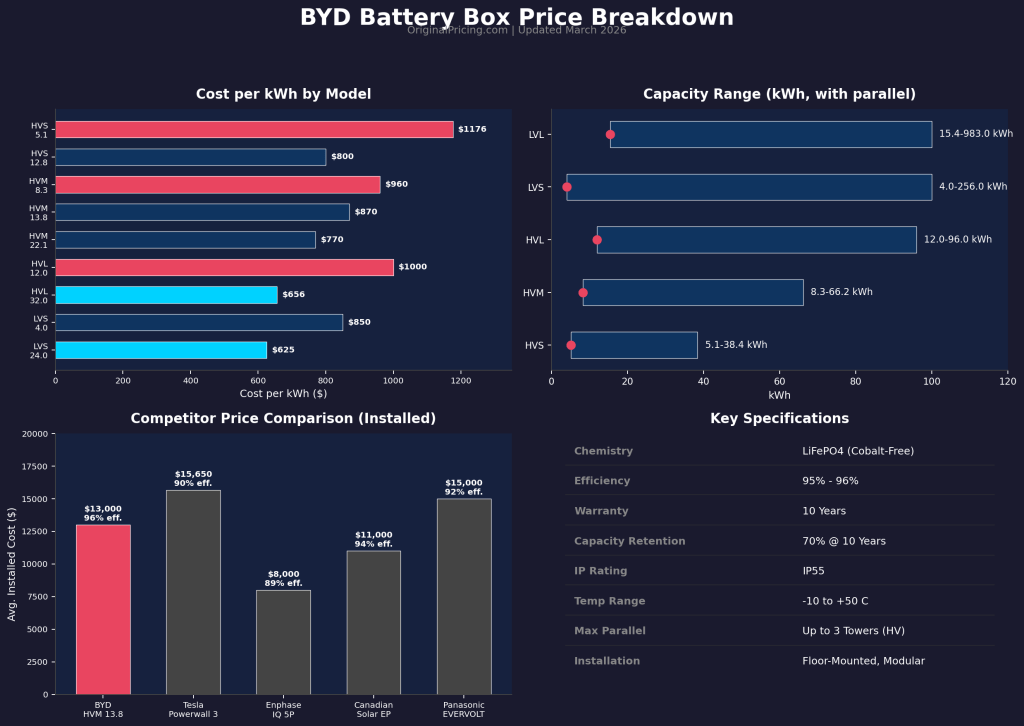
BYD Battery Box Price by Model and Configuration
Pricing varies by region, installer, and whether the battery is bundled with a new solar system. The figures below reflect average installed costs in key markets. Equipment-only pricing will be lower.
| Model | Capacity | Voltage | Approx. Installed Cost | Cost/kWh | Best For |
| HVS 5.1 | 5.1 kWh | High (204V) | $6,000 – $7,500 | ~$1,176/kWh | Small homes, starter systems |
| HVS 10.2 | 10.2 kWh | High (409V) | $8,500 – $10,500 | ~$930/kWh | Average households |
| HVS 12.8 | 12.8 kWh | High (512V) | $9,500 – $11,000 | ~$800/kWh | High-demand homes |
| HVM 8.3 | 8.3 kWh | High (230V) | $8,000 – $10,000 | ~$960/kWh | Mid-size homes |
| HVM 13.8 | 13.8 kWh | High (383V) | $12,000 – $14,000 | ~$870/kWh | Whole-home backup |
| HVM 22.1 | 22.1 kWh | High (614V) | $16,000 – $18,000 | ~$770/kWh | Large homes, heavy use |
| HVL 12.0 | 12.0 kWh | High (384V) | $11,000 – $13,000 | ~$1,000/kWh | U.S. residential |
| HVL 32.0 | 32.0 kWh | High (1024V) | $20,000 – $22,000 | ~$656/kWh | Large-scale residential |
| LVS 4.0 | 4.0 kWh | Low (51.2V) | $2,900 – $4,000 | ~$850/kWh | Off-grid cabins, RVs |
| LVS 24.0 | 24.0 kWh | Low (51.2V) | $14,000 – $16,000 | ~$625/kWh | Commercial off-grid |
| LVL 15.4 | 15.4 kWh | Low (48V) | $10,000 – $13,000 | ~$745/kWh | Commercial, Victron setups |
A clear pattern emerges from the data: the more capacity you stack, the lower your per-kWh cost drops. This makes BYD particularly competitive for larger residential and light commercial setups.
Battery Box Premium HVS vs. HVM vs. HVL: Which One Should You Pick?
HVS (High Voltage Small)
The HVS line uses 2.56 kWh modules stacked in series, ranging from 2 modules (5.1 kWh) to 5 modules (12.8 kWh). You can parallel up to 3 identical HVS towers for a maximum of 38.4 kWh. This series works well for smaller households that want to offset evening energy use without going overboard on capacity.
HVM (High Voltage Medium)
The HVM series uses slightly larger 2.76 kWh modules. You can stack 3 to 8 of them for a range of 8.3 kWh to 22.1 kWh per tower. Like the HVS, up to 3 towers can run in parallel, pushing the theoretical ceiling to 66.2 kWh. The HVM 13.8 is the sweet spot for most families because it closely matches the capacity of competing units like the Tesla Powerwall 3 at 13.5 kWh.
HVL (High Voltage Large)
The HVL is the newest addition to the lineup and the primary model sold in the U.S. and Canadian markets. Each module holds 4 kWh, and you can stack 3 to 8 modules per tower (12 to 32 kWh). Up to three towers in parallel give you a maximum of 96 kWh. The HVL is a DC-coupled battery that requires a compatible hybrid inverter from brands like SMA, Solis, or GoodWe.
How BYD Battery Box Pricing Compares to Competitors?
The home battery market has gotten crowded. Here is how BYD stacks up against the biggest names.
| Battery | Usable Capacity | Installed Cost (est.) | Efficiency | Chemistry |
| BYD HVM 13.8 | 13.8 kWh | $12,000 – $14,000 | 96% | LFP |
| Tesla Powerwall 3 | 13.5 kWh | $14,500 – $16,800 | ~90% | LFP |
| Enphase IQ 5P | 5.0 kWh | $7,000 – $9,000 | ~89% | LFP |
| Canadian Solar EP Cube | 9.9 kWh | $10,000 – $12,000 | ~94% | LFP |
| Panasonic EVERVOLT | 13.5 kWh | $14,000 – $16,000 | ~92% | NMC/LFP |
BYD consistently lands at or below the market average on cost per kWh, while delivering one of the highest round-trip efficiencies at 96%. The trade-off is that BYD requires an external inverter, whereas Tesla bundles one into the Powerwall 3.
What Drives BYD Battery Box Pricing?
Module Count and Configuration
More modules mean more capacity and a lower per-kWh price. A 3-module HVM system costs significantly more per kWh than an 8-module setup because the BCU (Battery Control Unit) and base are fixed overhead costs regardless of how many modules you stack.
Inverter Compatibility
BYD batteries are DC-coupled, which means you need a compatible hybrid inverter. Popular choices include Fronius, SMA, GoodWe, Kostal, SolarEdge, and Sungrow. The inverter brand you choose can swing the total system cost by $1,000 to $3,000. This is something to factor in when comparing against AC-coupled systems like the Tesla Powerwall, which comes with its inverter built in. For more on how dynamic pricing affects product costs across markets, we have covered this topic in detail.
Regional Pricing Differences
BYD batteries tend to be cheaper in Australia (where the brand has a strong installer network) than in the U.S. (where the HVL is relatively new). In Australia, average installed costs hover around AU$1,002 per kWh. European pricing falls somewhere in between. Government rebates also play a significant role: the Australian federal battery rebate can knock roughly 30% off upfront costs, while U.S. buyers may qualify for the federal Investment Tax Credit (ITC) when pairing the battery with a solar system.
Installation Complexity
Floor-mounted, modular systems like the BYD Battery Box are generally straightforward to install. But factors like electrical panel upgrades, permitting, and the physical location (garage, outdoor wall, utility closet) can add $1,000 to $2,500 to the final bill.
Key Specs Across the BYD Battery Box Range
- Chemistry: Cobalt-free Lithium Iron Phosphate (LiFePO4) across all models
- Charge/discharge efficiency: 95% to 96% (among the highest in the market)
- Operating temperature: -10 to +50 degrees Celsius
- IP rating: IP55 (dust-tight, water jet resistant)
- Warranty: 10 years product warranty with 70% capacity retention guarantee
- Certifications: UL1642, UL1973, TUV IEC62619, CE, FCC, RCM, CEC, VDE 2510-50
- Modular design: Patented plug-in system with no internal wiring required
- Compatible inverters: Fronius, SMA, GoodWe, Kostal, SolarEdge, Sungrow, Victron (model dependent)
BYD’s approach to modular battery design mirrors trends across the broader energy tech sector. The company’s renewable energy momentum has accelerated significantly, as covered in our analysis of China’s renewable energy targets.
Is the BYD Battery Box Worth the Price?
The short answer: yes, for most homeowners who want a scalable, safety-first battery without paying the Tesla premium.
BYD’s strengths are clear. The modular design means you are not locked into a single capacity tier. LFP chemistry is safer and lasts longer than NMC alternatives. And the 96% round-trip efficiency means less wasted energy on every charge cycle.
The downsides are equally real. BYD’s brand recognition in North America trails behind Tesla, which can make finding certified installers trickier. The units are heavier and bulkier than a Powerwall. And you will need a separate inverter purchase, which adds cost and complexity.
For homeowners already running a solar system with a compatible inverter, adding a BYD Battery Box is one of the most cost-effective ways to store energy. If you are building a system from scratch and want the simplest all-in-one experience, the Tesla Cybertruck and EV ecosystem integration might be more appealing, but you will pay more for that convenience.
BYD Battery Box Premium LVS: The Low-Voltage Option
Not every installation needs high voltage. The LVS line operates at 51.2V and is designed for off-grid cabins, backup systems, and setups using inverters from Victron Energy, SMA, Sungrow, or GoodWe. Each LVS module provides 4 kWh, and you can stack 1 to 6 modules per tower for 4 to 24 kWh. For larger commercial projects, up to 16 towers of 4 modules each can be paralleled, reaching 256 kWh.
The LVS 4.0 starts at approximately $2,900 for the module alone, making it one of the most affordable entry points in the entire BYD lineup. But remember that low-voltage systems are slightly less efficient than their high-voltage counterparts, typically running at 95% round-trip versus 96% for the HV range.
Frequently Asked Questions
How long does a BYD Battery Box last?
BYD provides a 10-year warranty guaranteeing at least 70% capacity retention. Real-world LFP batteries commonly exceed this, with many systems operating effectively for 12 to 15 years under normal cycling conditions.
Can I expand my BYD battery later?
Yes. The modular plug-in design lets you add modules or entire parallel towers at any time without replacing existing equipment. This is one of the biggest advantages over fixed-capacity competitors.
Does the BYD Battery Box qualify for tax credits?
In the U.S., the BYD Battery Box qualifies for the federal Investment Tax Credit (ITC) when installed with a solar panel system. In Australia, the federal battery rebate can reduce costs by around 30%. Various state-level incentives may also apply depending on your location.
What inverters work with the BYD Battery Box?
The high-voltage models (HVS, HVM, HVL) are compatible with hybrid inverters from Fronius, SMA, GoodWe, Kostal, SolarEdge, and Sungrow, among others. The low-voltage LVS and LVL lines work with Victron Energy, SMA, and GoodWe inverters. Always confirm compatibility with your installer before purchasing.
Is BYD a reliable battery brand?
BYD is the world’s largest rechargeable battery manufacturer and a major EV producer. The company has been selling home batteries in Australia since 2017 and has over 250,000 residential installations globally. It received top marks in the HTW Berlin Energy Storage Inspection for efficiency. If you are curious about how Chinese technology companies are reshaping global markets, our coverage of Dreame Technology pricing and consumer robotics market trends offers more context.
The Bottom Line on BYD Battery Box Pricing
The BYD Battery Box is one of the most flexible and cost-effective home battery systems available right now. With installed costs ranging from $600 to $1,000 per kWh (before rebates), modular scalability from 4 kWh all the way to 96 kWh, and industry-leading LFP safety, it checks the boxes that matter most to practical homeowners.
The best value sits in the mid-to-large configurations. The HVM 13.8 and HVL 12.0 hit the sweet spot between capacity, cost, and daily household coverage. Smaller systems like the HVS 5.1 or LVS 4.0 work for budget-conscious buyers or specific off-grid applications, but the per-kWh math improves dramatically as you add modules.
Before purchasing, get quotes from at least three certified installers, confirm inverter compatibility, and factor in all available rebates. The battery market is competitive and moving fast, so locking in current pricing before the next wave of demand shifts is a smart play.
Sources and References
BYD Battery-Box Official Product Page (bydbatterybox.com)
Solar Choice Australia – BYD Battery Independent Review
SolarReviews.com – BYD Battery Box HVL Expert Review
Solar Calculator Australia – BYD Battery 2026 Buying Guide