
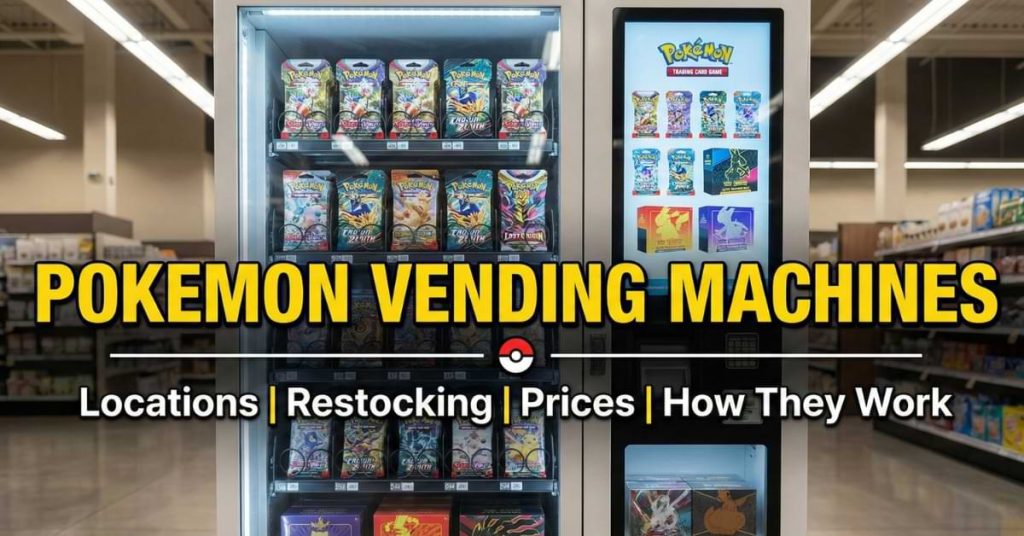
Pokemon vending machines are automated retail kiosks operated by The Pokemon Company International that sell official TCG products like booster packs, Elite Trainer Boxes, and tins at retail prices. They’re located in grocery stores across more than 25 U.S. states and expanding internationally. Machines typically restock every 7 to 14 days, accept credit/debit cards and mobile payments, and don’t offer returns.
What Are Pokémon Vending Machines?
If you’ve walked into a Safeway, Kroger, or H-E-B recently and spotted a tall, brightly colored machine stocked with Pokemon cards, you’ve found one. These aren’t third-party gumball-style dispensers. They’re officially operated by The Pokemon Company International and carry genuine TCG products at manufacturer-suggested retail prices.
The machines function like any standard vending unit, but they’re loaded with sealed Pokemon products. Browse items on a touchscreen, pay with a card, and the product drops into the collection tray. It’s designed to give collectors access to authentic cards without hunting through retail shelves. The concept of verifying what you’re paying against what a product’s original price really means applies here too, since these machines sell at true MSRP with no markup.
How Do Pokémon Vending Machines Work?
The process is simple. Walk up to the machine, browse the touchscreen showing available products, select what you want, and pay. The machine dispenses your item through a secure delivery system that prevents damage to packaging.
Most U.S. machines accept credit cards, debit cards, and contactless mobile payments like Apple Pay and Google Pay. In Japan, where these machines originated as “Pokemon Stands” in train stations, some units accept cash. However, the standard U.S. machines are primarily cashless.
One detail worth knowing: the machines have cameras that count foot traffic, but according to The Pokemon Company’s privacy policy, no video is stored or transmitted. Store employees can’t help with machine issues. If something goes wrong, contact the dedicated support line at 866-872-4790.
Do Pokemon Vending Machines Take Cash?
In the United States, most official machines do not accept cash. They’re designed for card and contactless payments only. In Japan and parts of Asia, some machines accept coins and bills, but that’s the exception for U.S. locations.
Pokemon Vending Machines Located
The official Pokemon Vending Machine Locator (vending.pokemon.com) is the most reliable way to find machines near you. As of the latest data, machines are confirmed across more than 25 U.S. states. The biggest concentrations are in Texas, California, Washington, Oregon, Illinois, Pennsylvania, and Colorado.
Pokemon Vending Machine Availability by State (Selected)
| State | Key Retailers | Notable Cities |
| Texas | H-E-B, Kroger | Dallas, Austin, Arlington |
| California | Safeway, Albertsons | Los Angeles, Sacramento |
| Washington | Fred Meyer, Safeway | Seattle, Tacoma |
| Illinois | Jewel-Osco, Mariano’s | Chicago metro area |
| Oregon | Fred Meyer, Safeway | Portland, Salem |
| Pennsylvania | Giant Eagle | Pittsburgh, Philadelphia |
| Colorado | King Soopers | Denver metro area |
Texas stands out with the densest network, featuring dozens of machines statewide. Several states still lack machines, including Florida, New York, Alabama, Alaska, and Hawaii. The Pokemon Company hasn’t commented on expansion plans, so the locator tool remains the best source.

International Availability
Japan has the longest history with Pokemon vending, where “Pokémon Stands” have operated in airports and train stations for years, carrying plush toys and TCG products. Spain launched official machines in Madrid in 2025. The UK and other European countries have independent, unofficial card machines in shopping centers.
When Do Pokemon Vending Machines Restock?
This is the question every collector asks, and the honest answer is: there’s no fixed public schedule. The Pokemon Company’s official FAQ states they don’t have a set restocking timeline but are “working diligently to restock them in a timely manner.”
Based on community reports across Reddit and collector forums, most machines restock every 7 to 14 days. High-traffic locations tend to see weekly restocks, often on Mondays or Fridays. Machines in quieter areas may go two to three weeks between refills. During major set releases, restocking frequency sometimes increases.
How to Track Restocks
Your best bets are community-driven. Subreddits like r/PokemonTCG share restock sightings regularly. Fan-built tools like PokeVend (pokevend.us) and PokeFindr (pokefindr.app) track machine locations with periodic refreshes. The dynamics of pricing and availability in retail apply here too. Demand surges around new launches create temporary scarcity that normalizes within weeks.
What Products Do These Machines Sell?
Official U.S. machines carry a rotating selection of Pokemon TCG products at standard retail pricing. Common items include single booster packs, booster bundles, Elite Trainer Boxes, tins, and collection boxes. Recent sets spotted in machines include Prismatic Evolutions, Journey Together, Destined Rivals, and the 151 set.
Typical Product Prices at Pokemon Vending Machines
| Product Type | Typical Price (MSRP) |
| Single Booster Pack | $4.49 – $6.99 |
| Booster Bundle (6-pack) | $24.99 – $29.99 |
| Tin (3-4 packs + promo) | $14.99 – $19.99 |
| Elite Trainer Box (ETB) | $44.99 – $59.99 |
| Collection Box | $24.99 – $49.99 |
Because these machines are officially operated, every product is authentic and sealed. That’s a significant advantage over third-party sellers where counterfeit or resealed products can be a concern. For collectors who care about verifying what they’re paying, this kind of pricing transparency matters.
What If a Pokemon Vending Machine Is Down?
Machines occasionally go offline due to technical issues or empty inventory. If you encounter a non-functioning machine, contact The Pokemon Company’s dedicated support at 866-872-4790 or submit a request through the Pokemon Center support portal. Store employees can’t help with these machines since they’re owned and maintained entirely by The Pokemon Company International.
Can You Return Products?
No. The Pokemon Company does not accept returns from any vending machine purchase. Once dispensed, the sale is final. Keep this in mind before purchasing higher-priced items like Elite Trainer Boxes.
Vending Machines Matter for Collectors
These machines solve a real problem. For years, collectors have dealt with scalpers clearing shelves, inflated resale prices, and counterfeit products. Vending machines offer guaranteed authenticity at retail pricing in a format that’s harder for resellers to exploit. They’re especially valuable in areas without dedicated card shops. For anyone who tracks collectible pricing closely, whether it’s Skylanders figures or Pokemon ETBs, these machines represent one of the most reliable ways to buy at fair value.
How Much Does a Pokémon Vending Machine Cost to Buy?
The official automated retail machines operated by The Pokemon Company are not for sale. They’ve confirmed there are no plans to sell them. However, if you’re a business owner looking to run your own card vending operation, third-party commercial machines are widely available at various price points.
Pokemon Vending Machine Prices (Third-Party Commercial Units)
| Machine Type | Price Range | Capacity | Payment Options |
| Mechanical (Coin-Op) | $150 – $450 | 50 – 200 cards | Coins only |
| Mini Digital (Wehoo-style) | $320 – $650 | Up to 2,000 cards | Coins, cards, Nayax |
| Mid-Range Touchscreen | $920 – $1,650 | 300 – 600 packs | Card, mobile, QR code |
| Full Digital (Elevator) | $1,100 – $2,500 | 400 – 650 items | Card, Apple Pay, QR |
| High-Capacity Commercial | $2,500 – $5,000+ | 650+ items, 54 slots | Full cashless + cash |
China-based manufacturers like Wehoo Vending and suppliers on Alibaba dominate the lower and mid-range market, with global shipping available. U.S.-based companies like VMFS USA offer premium units with advanced inventory tracking. Operators report recovering their machine investment within two to three months at high-traffic locations, making it an attractive side business with economics comparable to other automated entertainment investments.