
The BYD Sealion 7 is a fully electric mid-size SUV with up to 482 km of WLTP range, priced from A$54,990. The BYD Sealion 6 is a plug-in hybrid (PHEV) mid-size SUV with a 1.5L petrol engine plus electric motors, priced from A$42,990 with a combined range exceeding 1,100 km. Choose the Sealion 7 if you want zero tailpipe emissions and fast charging. Choose the Sealion 6 if you want petrol backup, lower entry price, and unlimited highway range without charging stops.
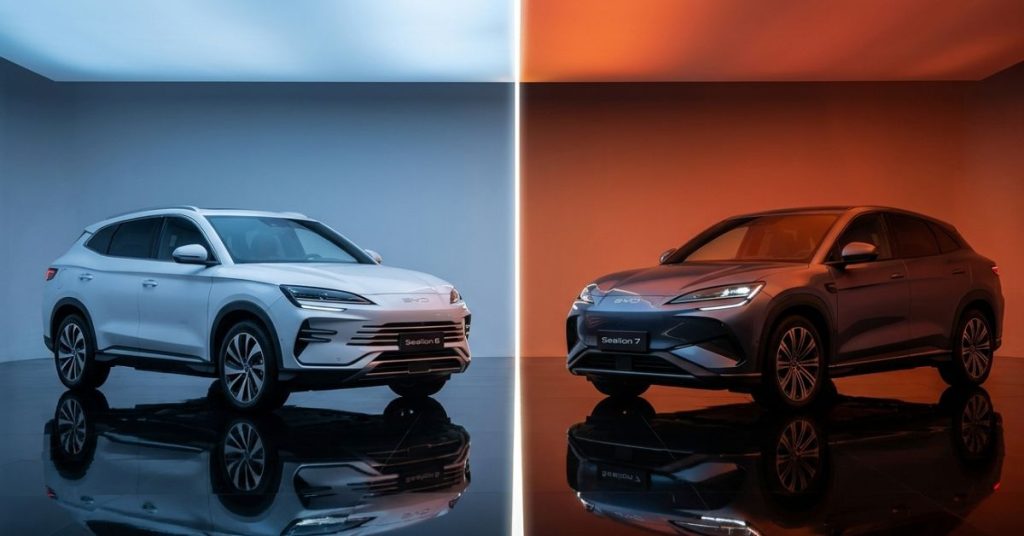
The Fundamental Difference
Despite sharing the “Sealion” name and a similar body size, these are two completely different vehicles underneath. The Sealion 7 is a ground-up battery electric vehicle (BEV) built on BYD’s e-Platform 3.0. The Sealion 6 is a plug-in hybrid using BYD’s DM-i architecture, combining a petrol engine with electric motors.
That powertrain split affects everything: range, refuelling, running costs, driving feel, and who each car actually suits. For a broader view of how BYD splits its electric and hybrid naming across models BYD Sealion vs Seal comparison.
Full Specification Comparison Table
| Measurement | BYD Sealion 7 | BYD Sealion 6 |
|---|---|---|
| Powertrain type | Fully electric (BEV) | Plug-in hybrid (PHEV) |
| Starting price (AU) | From A$54,990 + ORC | From A$42,990 + ORC |
| Top variant price (AU) | A$63,990 (Performance AWD) | A$52,990 (Premium AWD) |
| Engine | None (pure electric) | 1.5L 4-cylinder petrol + electric motors |
| Max power | 230 kW (Premium) / 390 kW (Performance) | 160 kW (Essential) / 238 kW (Premium) |
| Max torque | 380 Nm / 690 Nm | 300 Nm / 550 Nm |
| 0 to 100 km/h | 6.7 sec (Premium) / 4.5 sec (Performance) | 8.5 sec (Essential) / 5.9 sec (Premium) |
| Battery capacity | 82.56 kWh LFP Blade | 18.3 kWh LFP Blade (PHEV) |
| Electric-only range | 456–482 km WLTP (full EV) | 81–92 km EV mode |
| Total combined range | 456–482 km (battery only) | 1,100+ km (petrol + electric combined) |
| Fuel consumption | 0 L/100 km | 0.8–1.1 L/100 km (combined) |
| DC fast charging | Up to 150 kW | Not applicable |
| Body length | 4,830 mm | 4,775 mm |
| Wheelbase | 2,930 mm | 2,765 mm |
| Boot space | 500 L + 58 L frunk | 425 L (no frunk) |
| Towing capacity | 750 kg (braked) | 1,300 kg (braked, Premium) |
| Drivetrain options | RWD or AWD | FWD or AWD |
| Vehicle warranty | 6 years / 150,000 km | 6 years / 150,000 km |
| Battery warranty | 8 years / 160,000 km | 8 years / 160,000 km |
Price: A$12,000 Gap at Entry Level
The Sealion 6 Essential starts at A$42,990, making it one of Australia’s cheapest PHEVs. The Sealion 7 Premium opens at A$54,990. That A$12,000 gap narrows at the top end, where the Sealion 6 Premium AWD (A$52,990) sits only A$11,000 below the Sealion 7 Performance AWD (A$63,990).
For buyers stretching between the two, the decision often comes down to whether you value total range flexibility (Sealion 6) or zero-emission driving with faster technology (Sealion 7).
Range and Charging: Two Very Different Approaches
The Sealion 7 runs purely on battery power. Its 82.56 kWh Blade Battery delivers 456 to 482 km of WLTP range depending on the variant. DC fast charging at up to 150 kW refills 10 to 80% in roughly 32 minutes.
The Sealion 6 takes a different path entirely. Its smaller 18.3 kWh battery provides 81 to 92 km of electric-only driving, enough for most daily commutes. When the battery runs low, the 1.5L petrol engine kicks in seamlessly, extending total range beyond 1,100 km. There’s no DC fast charging port because the car doesn’t need one.
Size, Boot Space, and Towing
Both are mid-size SUVs, but the Sealion 7 is slightly longer (4,830 mm vs 4,775 mm) with a significantly longer wheelbase (2,930 mm vs 2,765 mm). That translates to more rear legroom in the Sealion 7.
- Boot space: Sealion 7 offers 500 litres plus a 58-litre frunk; Sealion 6 offers 425 litres with no frunk
- Towing: Sealion 6 wins here at 1,300 kg braked (Premium); Sealion 7 is rated at just 750 kg
- Seats folded: Sealion 6 expands to 1,440 litres; Sealion 7 to approximately 1,450 litres
If you tow a small trailer, camper, or boat regularly, the Sealion 6’s nearly double towing capacity is a genuine advantage.
Driving Feel
The Sealion 7 rides on double-wishbone front and multi-link rear suspension with Frequency Selective Damping (FSD) shock absorbers. It feels planted and firm, tuned for Australian roads.
The Sealion 6 received suspension updates after launch and now offers a more balanced ride, leaning toward comfort over sportiness. The PHEV powertrain means you also get engine sound, which some buyers prefer over the pure silence of the Sealion 7.
Interior and Technology
Both share BYD’s rotating central touchscreen, digital driver display, wireless Apple CarPlay and Android Auto, and leather interiors. Key differences:
- Sealion 7: 15.6-inch screen, W-HUD head-up display, Dynaudio 12-speaker audio
- Sealion 6: 15.6-inch (Premium) or 12.8-inch (Essential) screen, Infinity 10-speaker audio
- Both: Wireless phone charging, OTA updates, NFC card key, RGB mood lighting
Who Should Buy Which?
Buy the Sealion 7 if you:
- Want fully electric, zero-emission driving
- Have reliable home or workplace charging
- Prioritise a sportier, coupe-style SUV design
- Need more rear legroom and boot space
- Don’t tow anything heavier than 750 kg
Buy the Sealion 6 if you:
- Want petrol backup for long trips without charging anxiety
- Need to tow up to 1,300 kg
- Prefer a lower entry price with PHEV flexibility
- Don’t have access to regular charging infrastructure
- Drive long regional distances where DC chargers are sparse
Common Mistakes Buyers Make
- Assuming the Sealion 6 and 7 share a platform. They don’t. The 7 is e-Platform 3.0 (electric), the 6 is DM-i (hybrid). Completely different architecture.
- Choosing the 7 without home charging. Public charging works, but the ownership experience is far smoother with overnight AC charging at home.
- Ignoring towing needs. If you tow anything regularly, the Sealion 6’s 1,300 kg rating is nearly double the 7’s.
- Forgetting about fuel savings. The Sealion 7 uses zero fuel ever. At current petrol prices, that can offset the higher purchase price over 3 to 5 years.
- Skipping the test drive. The electric silence of the 7 and the hybrid versatility of the 6 feel very different from behind the wheel.
Questions Real Buyers Are Asking
“Is the Sealion 7 worth the extra A$12,000?”
If you have home charging and don’t tow, yes. Zero fuel costs and more boot space make the price gap close over 3 to 5 years.
“Can the Sealion 6 drive fully electric?”
Yes, for 81 to 92 km depending on the variant. Many owners complete their entire daily commute without burning petrol.
“Which one sells more in Australia?”
Both are in BYD’s top sellers. The Sealion 7 was the second-best-selling EV in 2025, while the Sealion 6 led the PHEV segment.