
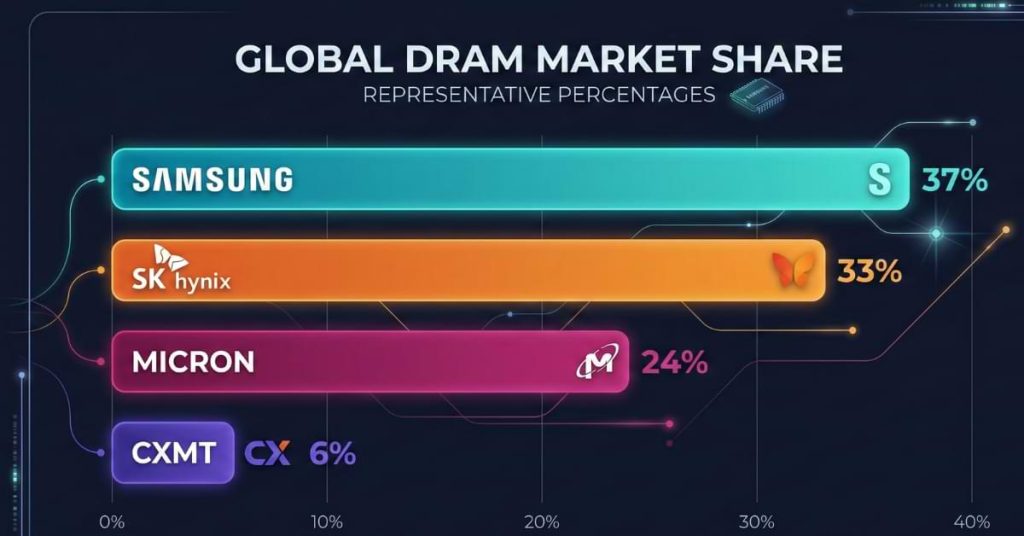
ChangXin Memory Technologies (CXMT) is China’s largest DRAM manufacturer and the world’s fourth-largest by market share. The company produces DDR5 memory at speeds up to 8,000 MT/s and LPDDR5X at up to 10,667 MT/s. CXMT DDR5 kits from brands like KingBank currently retail between $400 and $650 (for 32 GB DDR5-6000 configurations), roughly 7 to 10 percent cheaper than equivalent kits from Samsung, SK hynix, or Micron-based modules. A planned $4.2 billion IPO and a massive new Shanghai fab signal aggressive expansion ahead.

What Is CXMT and Why Does It Matter for DDR5 Pricing?
If you have been tracking RAM prices during the ongoing shortage, you have probably stumbled across the name CXMT. ChangXin Memory Technologies, headquartered in Hefei, China, is the country’s largest and most advanced DRAM chipmaker. Founded in 2016 with significant government backing, CXMT has grown from producing basic DDR4 chips on a 19 nm process to unveiling a full DDR5 and LPDDR5X product stack that directly challenges the big three memory giants.
The company captured roughly 8 percent of the global DRAM market share by Q3 of last year and was producing around 720,000 wafers per quarter by the end of that period. Its rapid ascent matters to consumers because CXMT represents the only significant new source of DDR5 supply outside Samsung, SK hynix, and Micron, all of which have been diverting capacity toward high-margin AI memory products like HBM.
CXMT History: From DDR4 Startup to DDR5 Contender
CXMT’s timeline reads like a crash course in semiconductor catch-up. The company broke ground on its Hefei fab in 2017 after a $7.2 billion investment, installed production equipment by late that year, and began shipping DDR4 on a 19 nm (called 10G1) process using IP originally licensed from Qimonda. LPDDR4 followed in 2020.
The real turning point came when Beijing designated domestic production of high-end DRAM as a national priority. Within roughly 11 months, CXMT developed and publicly demonstrated DDR5 at the IC China exhibition in late November of last year, unveiling seven high-end products. South Korean media noted that the technology gap between Chinese and Korean DRAM makers in the general market had shrunk to less than a year. That speed surprised analysts across the semiconductor industry.
CXMT Key Milestones
| Year | Milestone |
| 2016 | Company founded in Hefei, Anhui with government backing |
| 2017 | $7.2B fab construction begins; equipment installed by year-end |
| 2019 | DDR4 mass production begins on 19 nm (10G1) process; 3,000+ employees |
| 2020 | LPDDR4X added to product portfolio |
| 2022 | U.S. NDAA bans federal procurement of CXMT chips |
| 2024 | DDR4 ramp-up via Taiwanese distributors; policy pivot to DDR5 begins Q4 |
| 2025 (Late) | DDR5 and LPDDR5X officially unveiled at IC China; ~8% global DRAM share; 720K wafers/quarter |
| 2026 (Current) | $4.2B IPO filed for Shanghai STAR Market; DDR4 phase-out by mid-year; HBM3 targeted for Q4 |
CXMT DDR5 Full Product Lineup
CXMT’s DDR5 portfolio is surprisingly comprehensive for a newcomer. The chips come in 16 Gb and 24 Gb die densities and reach speeds of up to 8,000 MT/s, which sits above the 6,400 MT/s mainstream high-end tier. On-die ECC and enhanced anti-interference design are built in. The company also introduced LPDDR5X at up to 10,667 MT/s with 12 Gb and 16 Gb densities, targeting laptops, compact AI edge devices, and embedded platforms.
| Module Type | Form Factor | Target Market | Max Speed | Die Density |
| DDR5 UDIMM | Desktop | Consumer PC | 8,000 MT/s | 16/24 Gb |
| DDR5 SODIMM | Laptop | Consumer/OEM | 8,000 MT/s | 16/24 Gb |
| DDR5 RDIMM | Server | Data Center | 8,000 MT/s | 16/24 Gb |
| DDR5 MRDIMM | Server | Enterprise | 8,000 MT/s | 16/24 Gb |
| DDR5 TFF MRDIMM | Server | Enterprise | 8,000 MT/s | 16/24 Gb |
| DDR5 CUDIMM | Desktop | Workstation/OC | 8,000 MT/s | 16/24 Gb |
| DDR5 CSODIMM | Laptop | Workstation/OC | 8,000 MT/s | 16/24 Gb |
| LPDDR5X | BGA Package | Mobile/AI Edge | 10,667 MT/s | 12/16 Gb |
The CUDIMM and CSODIMM variants follow the JEDEC standard and integrate a CKD (clock driver) chip for improved signal integrity at higher frequencies. This is a forward-looking design choice that positions CXMT modules for next-generation platforms from both AMD and Intel.
Manufacturing Process and Technical Considerations
CXMT currently manufactures DDR5 using its G3 process (roughly 17.5 nm), with reports indicating around 80 percent yield, a figure considered quite mature. The company is also developing a G4 (comparable to 1z, or ~16 nm) process and a future G5 node. However, there is a critical caveat that affects pricing.
Without access to EUV lithography (restricted by U.S. export controls), CXMT relies on older DUV-based methods like SAQP (self-aligned quadruple patterning) and aggressive binning. According to igor’sLAB, this results in die areas roughly 40 to 50 percent larger than comparable products from SK hynix or Samsung. Larger dies mean fewer chips per wafer, which directly drives up manufacturing costs.
CXMT DDR5 Pricing: What You Actually Pay?
Early reports suggested CXMT was selling DRAM at roughly $138 per module, while average prices elsewhere ranged from $300 to $400. That created massive hype, particularly on Reddit’s PC Master Race community. The reality is more nuanced.
| Kit / Configuration | Approx. Price (USD) | IC Source |
| KingBank 32 GB DDR5-6000 CL36 | ~$422 – $450 | CXMT |
| G.Skill Trident Z Neo 32 GB DDR5-6000 CL30 | ~$490 | SK hynix |
| Kingston 32 GB DDR5-5200 CL40 | ~$350 – $400 | Micron/Various |
| Juhor 16 GB DDR5-5600 (AliExpress) | ~$220 (single stick) | CXMT/Various |
| Adata XPG 16 GB DDR5-6000 (DHgate) | ~$195 (single stick) | Various |
The savings are real but modest, typically 7 to 10 percent below comparable kits using Samsung or SK hynix ICs. CXMT’s limited production capacity (roughly 5 percent of global supply) means the company cannot afford to dump prices without depleting inventory. As TechSpot noted in testing, CXMT is now operating like a typical for-profit entity, which was probably inevitable given its constraints. For a deeper look at how value bifurcation shapes pricing tiers in tech hardware, CXMT’s positioning fits squarely in the mid-value segment.
Where to Buy CXMT DDR5 RAM?
CXMT does not sell directly to consumers. Instead, its ICs appear in modules from Chinese brands like KingBank, Juhor, Gudga, and Ymeiton. Here is where buyers currently find these kits:
AliExpress: The largest selection of CXMT-based DDR5 kits outside China. Brands include KingBank (Sawblade series), Juhor, and Gudga. Pricing varies widely, and sorting by price does not always work reliably on the platform.
Taobao: More options but harder to navigate for non-Chinese speakers. Some of the lowest domestic prices appear here first.
DHgate and Temu: Limited DDR5 selection. Temu stocks mostly DDR4. DHgate occasionally carries Adata (Taiwanese brand) sticks at competitive prices.
Local Retailers (Australia, Asia): KingBank kits have appeared in Australian retailers at around 599 to 650 AUD for 32 GB DDR5-6000 configurations. Availability is inconsistent.
U.S. buyers face additional complications. The 2022 NDAA bans federal procurement of CXMT chips, and U.S. restrictions prevent major Western brands like Corsair, G.Skill, and Kingston from officially using CXMT ICs.
Gaming and Workstation Performance
Independent testing from Hardware Unboxed (via TechSpot) and other outlets has confirmed that CXMT DDR5 performs within a few percentage points of premium alternatives in real-world gaming. A KingBank DDR5-6000 CL36 kit paired with AMD’s Ryzen 7 9800X3D delivered frame rates virtually identical to G.Skill’s DDR5-6000 CL26 kit in titles like Cyberpunk 2077, Rainbow Six Siege, and Horizon Zero Dawn.
When paired with the Ryzen 7 9700X (more memory-sensitive), the CXMT kit still matched or came within 1 to 2 percent of the SK hynix-based competition, and outperformed entry-level DDR5-5200 by up to 17 percent.
CXMT vs. Competitors: The Big Three
| Factor | CXMT | Samsung | SK hynix | Micron |
| Global DRAM Share | ~8% | ~40% | ~30% | ~22% |
| DDR5 Max Speed | 8,000 MT/s | 8,400+ MT/s | 8,400+ MT/s | 8,000+ MT/s |
| Process Node | ~17.5 nm (G3) | ~12 nm (EUV) | ~13 nm (EUV) | ~13 nm (EUV) |
| HBM Status | HBM3 targeted Q4 | HBM3E shipping | HBM4 prep | HBM4 samples |
| EUV Access | No (restricted) | Yes | Yes | Yes |
| Consumer Pricing | 7-10% below avg | Premium | Premium | Mid-Premium |
YMTC (Yangtze Memory Technologies) is also entering the DRAM space, constructing a third fab in Wuhan with roughly half its capacity dedicated to DRAM. YMTC plans to focus on advanced HBM packaging rather than competing directly on process technology, creating a complementary domestic ecosystem. For a broader look at how Chinese chipmakers are reshaping AI chip pricing and competition, the parallels with CXMT’s trajectory are striking.

What Comes Next for CXMT?
CXMT’s roadmap is aggressive. The company has filed for a $4.2 billion IPO on the Shanghai STAR Market, with proceeds earmarked for a massive new Shanghai fab expected to be two to three times larger than the existing Hefei facility. Volume production from the new site is targeted for 2027.
Key upcoming milestones include phasing out DDR4 for server and PC use by mid-year (already underway), ramping DDR5 to over 60 percent of total output, beginning HBM3 mass production by Q4 using the G4 (16 nm) process, and targeting 300,000 wafers per month capacity. The company has also reportedly delivered HBM samples to domestic AI customers, including Huawei.
Frequently Asked Questions
Is CXMT DDR5 RAM safe to use in a gaming PC?
Yes. Independent testing from Hardware Unboxed and others confirms that CXMT-based DDR5 modules work reliably with standard XMP/EXPO profiles on AMD AM5 platforms. Gaming performance matches premium SK hynix-based kits within 1 to 2 percent in most titles.
Can I buy CXMT DDR5 in the United States?
You can purchase CXMT-based modules through platforms like AliExpress and DHgate. However, major U.S. retailers do not stock them, and Western brands like Corsair and G.Skill are currently restricted from using CXMT ICs. Warranty and RMA support may be limited for imported kits.
Why is CXMT DDR5 not much cheaper than Samsung or SK Hynix?
CXMT’s lack of EUV access forces it to use older lithography methods, resulting in die sizes 40 to 50 percent larger than competitors. This drives up per-chip costs. Combined with limited production capacity (roughly 5 percent of global supply), aggressive price-cutting would simply drain inventory without generating enough revenue to fund expansion.
Does CXMT DDR5 support overclocking?
Overclocking headroom has not been fully validated by independent reviewers. The modules work reliably at rated EXPO speeds (tested up to DDR5-6000 CL36), but pushing beyond rated specs remains uncharted territory. High clock rates up to 8,000 MT/s are achievable through heavy binning, which can have thermal trade-offs.
Will CXMT fix the DDR5 shortage?
Not in the short term. While CXMT is expanding aggressively (new Shanghai fab, IPO funding, 300K wafers/month target), roughly 20 percent of its future output is allocated to HBM3 for AI applications. Meaningful consumer price relief likely depends on the new fab reaching volume production, currently targeted for 2027.
Is CXMT DDR5 available on Amazon?
Not officially through major brand listings. Some third-party sellers may offer imported CXMT-based modules, but availability is inconsistent and buyer protections may differ from those of established brands. AliExpress and Taobao remain the primary retail channels.