
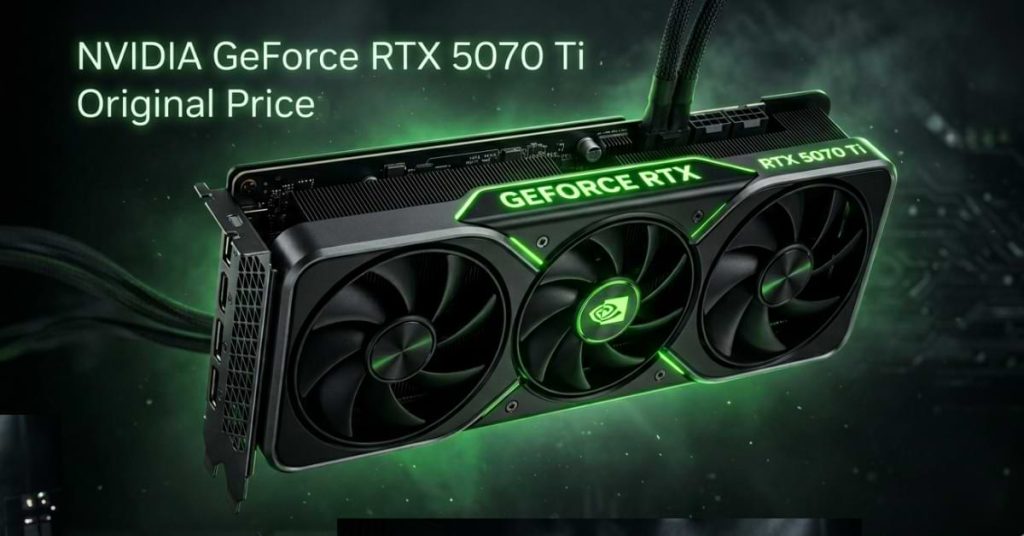
The NVIDIA GeForce RTX 5070 Ti launched at an official MSRP of $749. As of 2026, real-world retail prices sit between $880 and $1,069 depending on the retailer and model, with some AIB variants pushing past $1,200. The card released on February 20, 2025, built on the Blackwell architecture with 16 GB of GDDR7 memory and 8,960 CUDA cores.
NVIDIA RTX 5070 Ti Price Tracker LIVE
Real-time MSRP vs street price monitoring – Blackwell GPU market tracker with auto monthly updates
OriginalPricing.com – Full RTX 5070 Ti Pricing GuideMonthly Auto-Update Active: This tracker monitors RTX 5070 Ti pricing across MSRP, average new retail (Amazon/Newegg/Best Buy), and used/eBay market. Data auto-updates each month based on real market movement driven by GDDR7 supply, NVIDIA production volumes, and retailer inventory. Toggle off to pause.
Recent Update History
Release Price and Launch Details
NVIDIA set the RTX 5070 Ti at $749, making it $50 cheaper than the RTX 4070 Ti Super it replaced. That looked like a solid deal on paper. The card runs on the GB203 die (the same silicon found in the RTX 5080, just with fewer enabled cores) and comes loaded with 16 GB of GDDR7 across a 256-bit memory bus. Bandwidth clocks in at 896 GB/s, a 78% jump over the previous generation.
There is no Founders Edition for this model. NVIDIA handed all production to board partners like ASUS, MSI, Gigabyte, and Zotac. That decision removed the traditional MSRP anchor that usually keeps third-party pricing honest during launch windows.
Full Spec Breakdown
Here is a look at the core hardware under the hood of the RTX 5070 Ti desktop card.
| Specification | RTX 5070 Ti |
| Architecture | Blackwell (GB203) |
| CUDA Cores | 8,960 |
| Tensor Cores | 280 (5th Gen) |
| RT Cores | 70 (4th Gen) |
| VRAM | 16 GB GDDR7 |
| Memory Bus | 256-bit |
| Memory Bandwidth | 896 GB/s |
| Memory Speed | 28 Gbps |
| Boost Clock | 2,452 MHz |
| TDP | 300W |
| Recommended PSU | 750W minimum |
| AI Performance | 1,406 TOPS |
| Interface | PCIe 5.0 x16 |
| MSRP (USD) | $749 |
| Release Date | February 20, 2025 |
The 5th-generation Tensor Cores bring support for DLSS 4 with Multi Frame Generation, which is one of the major selling points of the entire Blackwell lineup. The 4th-gen RT Cores handle hardware-accelerated ray tracing, and the card supports HDMI 2.1b and DisplayPort 2.1b for modern monitor connections.

What Does the RTX 5070 Ti Actually Cost Right Now?
Finding this card at $749 is basically impossible at this point. A global DRAM shortage has squeezed GPU supply across the board, and the RTX 5070 Ti has been hit especially hard. Prices peaked around $1,220 in mid-2025, dropped briefly near MSRP at select retailers in late 2025, and have since climbed again.
| Retailer / Channel | Price Range (USD) | Notes |
| Amazon (new) | $1,069+ | Limited models available |
| Best Buy (new) | $1,000 – $1,300 | Most under-$1K models sold out |
| Newegg (new) | $990 – $1,300 | Stock fluctuates daily |
| B&H Photo (new) | $829 – $1,170 | Occasional sub-$900 deals |
| Walmart (new) | $830 – $1,100 | Windforce OC spotted at $830 |
| eBay (used) | $880+ | Pre-owned / open-box |
| Micro Center (in-store) | $749 – $900 | Rare MSRP finds, pickup only |
The ongoing DDR5 and DDR4 memory crisis has made things worse. GDDR7 chips compete for the same production capacity as system RAM, and manufacturers are struggling to source enough memory modules. Rumors about the RTX 5070 Ti reaching end-of-life surfaced in early 2026, though both NVIDIA and ASUS pushed back, confirming the card remains in production (just at lower volumes).
RTX 5070 Ti Price by Country
Pricing varies significantly by region. TechSpot’s global GPU pricing analysis found an average 25% price increase for the RTX 5070 Ti since November 2025, with some markets seeing hikes closer to 40%. Here is a snapshot of what the card costs across major markets.
| Country | Currency | MSRP (Equiv.) | Street Price (Mar 2026) |
| United States | USD | $749 | $880 – $1,069 |
| United Kingdom | GBP | £729 | £809 – £1,060 |
| Europe (EU) | EUR | €809 | €924 – €1,100+ |
| Canada | CAD | CA$1,022 | CA$1,219 – $1,409 |
| Australia | AUD | AU$1,349 | AU$1,550 – $1,800 |
| India | INR | ₹80,000 | ₹83,000 – ₹1,30,000 |
| Germany | EUR | €809 | €920 – €1,100 |
| Japan | JPY | ¥115,000 | ¥135,000 – ¥160,000 |
| UAE | AED | AED 2,750 | AED 3,200 – 4,000 |
| Brazil | BRL | R$4,500 | R$5,200 – R$6,800 |
Australia and Canada have been hit particularly hard. In Australia, reports indicate that restocked RTX 5070 Ti units could jump to AUD 1,800 once current inventory clears. India offers some of the widest price ranges, with budget AIB models starting around Rs. 83,000 and premium variants pushing well past Rs. 1,20,000.
Why Is It So Far Above MSRP?
Three factors are driving the gap. First, limited production runs from board partners mean fewer cards hitting shelves. Second, the absence of a Founders Edition gives AIB partners free rein to set prices without a reference anchor. Third, the memory supply crunch is affecting every card with 16 GB of VRAM, which includes both the RTX 5070 Ti and the RTX 5060 Ti 16 GB variant.
This pattern mirrors what happened with CXMT DDR5 RAM pricing, where supply constraints pushed costs well beyond official targets. The semiconductor memory market is deeply interconnected, and GPU pricing is feeling the downstream effects.
RTX 5070 Ti vs. Previous Generation
The generational jump from the RTX 4070 Ti Super to the 5070 Ti is meaningful, but comes with trade-offs at current street prices.
| Spec | RTX 4070 Ti Super | RTX 5070 Ti |
| CUDA Cores | 8,448 | 8,960 |
| VRAM | 16 GB GDDR6X | 16 GB GDDR7 |
| Memory Bandwidth | 672 GB/s | 896 GB/s |
| TDP | 285W | 300W |
| DLSS Support | DLSS 3 (Frame Gen) | DLSS 4 (Multi Frame Gen) |
| Original MSRP | $799 | $749 |
Native rasterization performance is roughly 20% better, and ray tracing sees an even larger uplift thanks to the new RT core architecture. The jump to GDDR7 gives a 78% bandwidth boost, which pays dividends at 4K. DLSS 4 with Multi Frame Generation is the headline feature, though it relies on AI-generated frames rather than raw rendering improvement.

RTX 5070 Ti vs. AMD Radeon RX 9070 XT
AMD’s RX 9070 XT launched at $599, making it $150 cheaper at MSRP. In raw rasterization across large benchmark suites, the RTX 5070 Ti leads by roughly 5% on average, though results swing wildly by title. Some games favor AMD by double-digit margins; others give NVIDIA a 30-40% lead (particularly in ray-traced scenarios). When upscaling tech is factored in, the gap narrows to about 2-3% using DLSS 4 versus FSR 4 at quality presets.
Where the RTX 5070 Ti pulls clearly ahead is in AI workloads and content creation. Tasks like Stable Diffusion inference and Blender rendering run 30-50% faster on the NVIDIA card thanks to its Tensor Cores and CUDA ecosystem. For pure gaming on a budget, the 9070 XT offers better value per dollar. For creators and professionals who also game, the 5070 Ti justifies its premium.
RTX 5070 vs. RTX 5070 Ti: Is the Upgrade Worth $200?
The standard RTX 5070 sits at $549 MSRP (currently around $649 on Amazon). It uses the smaller GB205 die with 6,144 CUDA cores, 12 GB of GDDR7 on a 192-bit bus, and 672 GB/s bandwidth. The 5070 Ti brings 45% more CUDA cores, 33% more VRAM, a wider memory bus, and significantly higher bandwidth. That hardware gap translates to roughly 25-35% better gaming performance depending on the title and resolution.
For 1080p and 1440p gaming, the RTX 5070 handles most modern titles comfortably. The 5070 Ti becomes the smarter pick when you are pushing 4K, running heavy ray tracing, or doing professional rendering. The 12 GB VRAM limit on the standard 5070 is also a growing concern as newer games and AI-driven applications demand more memory.
RTX 5070 Ti Laptop Variant
The mobile version runs on the GB205 chip (not the desktop’s GB203) with 5,888 CUDA cores and 12 GB of GDDR7 on a 192-bit bus. Clock speeds range from 847 to 1,995 MHz, depending on the laptop’s thermal design. Performance lands about 15% above the mobile RTX 5070 in gaming and roughly 23% faster in synthetic benchmarks. It trails the desktop RTX 5070 Ti by around 34%, which is a typical gap for mobile GPU variants.
RTX 5070 Ti Super: What We Know?
NVIDIA did not announce any new desktop GPUs at CES 2026, and the latest speculation suggests the entire RTX 50 Super refresh has been put on hold indefinitely. The memory shortage is the primary reason. Until GDDR7 supply stabilizes, a higher-spec Super variant with potentially more VRAM or additional cores is unlikely to hit production. No pricing or release window has been confirmed.
Who Should Buy the RTX 5070 Ti Right Now?
If you are upgrading from an RTX 3070 or older and can find the card near $830-$900, the 5070 Ti is a strong buy. The Blackwell architecture, 16 GB of GDDR7, and DLSS 4 support set it up well for the next several years of gaming and professional work. Pairing it with a capable CPU and fast memory makes a real difference, and the current shift toward AI-accelerated computing across the semiconductor industry means GPU compute power is becoming more valuable beyond just gaming.
For anyone coming from an RTX 4070 Ti or 4070 Ti Super, the generational leap is modest enough that waiting for prices to settle (or for the Super refresh) probably makes more sense. And if budget is the primary factor, AMD’s RX 9070 XT delivers nearly identical gaming performance for significantly less money.
The GPU market is in a strange spot. Premium products like the iPhone 17 Pro Max face similar pricing volatility driven by component shortages, and graphics cards are no exception. The RTX 5070 Ti remains one of the better-balanced cards in the Blackwell lineup, but only if you can stomach paying well above what NVIDIA originally promised.