
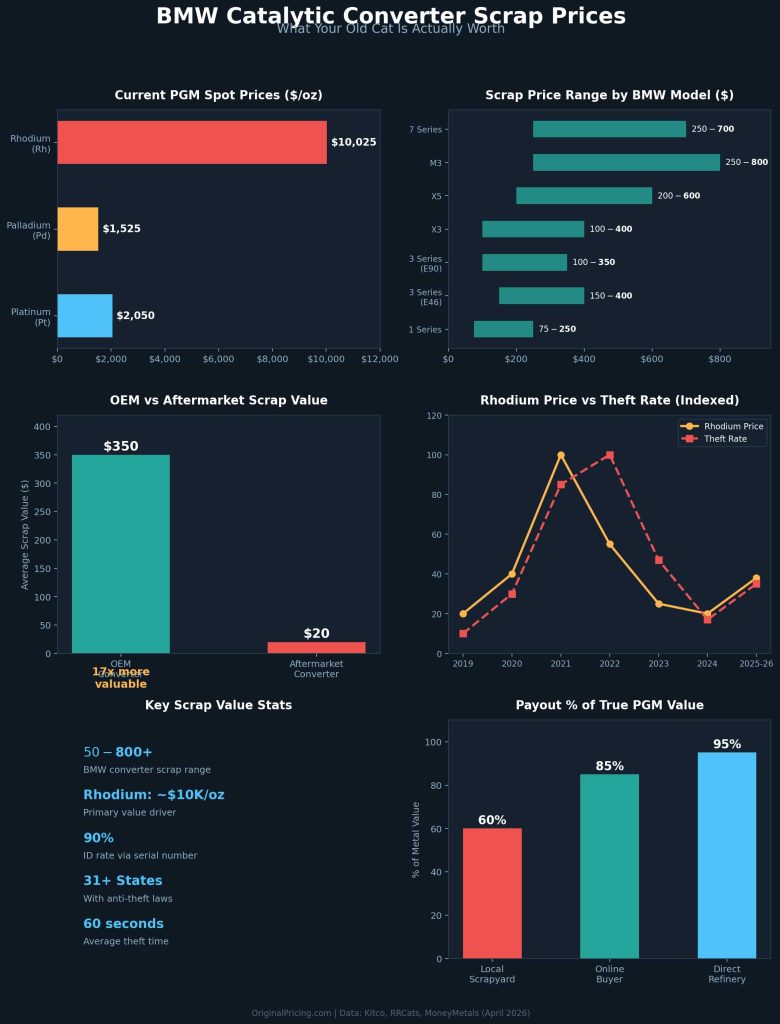
A scrap BMW catalytic converter is worth anywhere from $50 to $800+, depending on the model, engine size, converter type (OEM vs. aftermarket), and current precious metal spot prices. BMW converters contain platinum, palladium, and rhodium, and their scrap value fluctuates daily alongside these metals. Larger OEM units from models like the X5 or 7 Series tend to command higher prices, while smaller 4-cylinder converters from the 3 Series typically sit at the lower end of the range.
| Grade / Item | Low | High | Unit |
|---|---|---|---|
| BMW OEM range | $50 | $800 | USD/unit |
| Large foreign grade | $90 | $456 | USD/unit |
| Aftermarket | $5 | $50 | USD/unit |
| Country | Typical Range | Per Tonne | Cur. |
|---|---|---|---|
| United States | $50 – $450 /unit (typical OEM) | — | USD |
| Canada | C$65 – C$600 /unit | — | CAD |
| United Kingdom | £40 – £350 /unit | — | GBP |
| Germany / EU | €45 – €400 /unit | — | EUR |
| Australia | A$75 – A$650 /unit | — | AUD |
| India | ₹4,000 – ₹35,000 /unit | — | INR |
| UAE / Dubai | 180 – 1,600 AED /unit | — | AED |
Rates for every other converter are collected in the complete scrap metal price index.
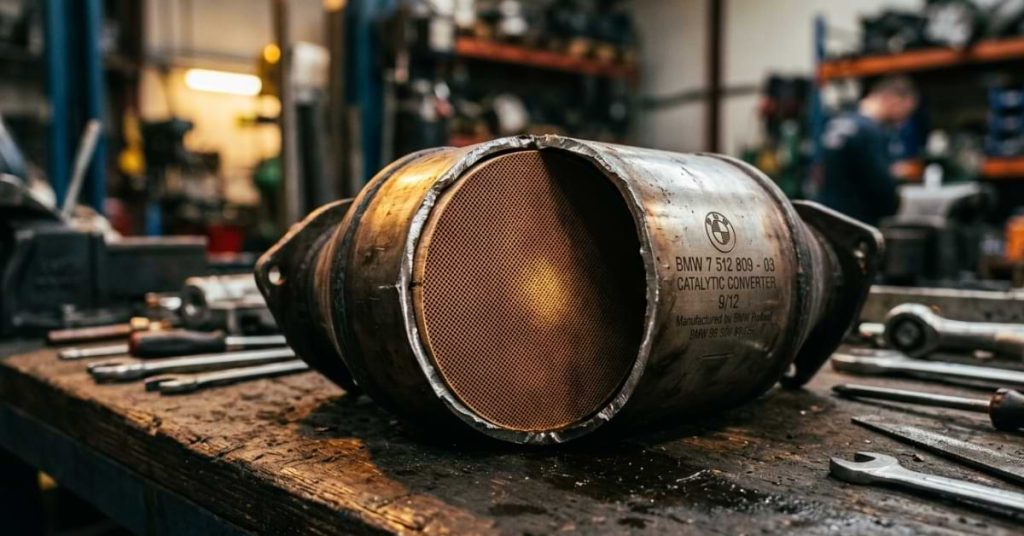
Why BMW Catalytic Converters Hold Serious Scrap Value?
If you’ve ever priced a replacement catalytic converter for a BMW, you already know these parts aren’t cheap. But here’s what most people don’t realize: your old, worn-out converter still holds real value because of the precious metals locked inside it.
Every BMW catalytic converter contains a ceramic or metallic honeycomb core coated with platinum group metals (PGMs). These three metals, platinum, palladium, and rhodium, do the heavy lifting of converting toxic exhaust gases into less harmful emissions. Even after 100,000+ miles of use, those metals don’t just disappear. They’re recoverable through recycling, and that’s exactly what gives your scrap converter its price tag.
The scrap market for converters is directly tied to the commodities market. When PGM prices climb, your old BMW cat becomes more valuable overnight. When they dip, so does your payout.
Current Precious Metal Prices Driving Scrap Values
Here’s a quick snapshot of where the key metals stand right now. These numbers change daily, so always check live pricing before selling.
| Metal | Spot Price (per oz) | Role in Converter |
| Platinum (Pt) | ~$2,044 – $2,058 | Oxidation catalyst |
| Palladium (Pd) | ~$1,507 – $1,544 | Reduction catalyst |
| Rhodium (Rh) | ~$9,600 – $10,450 | NOx reduction |
Rhodium is the real heavy hitter here. At roughly $10,000 per ounce, even a tiny amount inside your converter can make a meaningful difference in scrap value. This is the single biggest reason catalytic converter scrap prices have rebounded sharply since early 2025, after a dip from the 2021 highs.
BMW Catalytic Converter Scrap Price by Model
Scrap prices vary significantly across BMW models because different engines use different converter sizes and PGM loadings. Here’s an estimated range based on current market conditions and typical OEM converter configurations.
| BMW Model / Chassis | Est. Scrap Range | Engine Type | Converter Count | PGM Loading |
| 3 Series (E46) 325i/330i | $150 – $400 | I6 (M54) | 2 (pre + main) | Medium |
| 3 Series (E90) 328i | $100 – $350 | I6 (N52) | 2 | Medium |
| 3 Series (E90) 335i | $150 – $450 | I6 Turbo (N54) | 2 | Medium-High |
| 3 Series (F30) 328i/335i | $100 – $400 | I4/I6 Turbo | 1-2 | Medium |
| 5 Series (E60) 525i/530i | $150 – $500 | I6 (N52/N53) | 2 | Medium-High |
| X3 (E83/F25) | $100 – $400 | I6/I4 Turbo | 2 | Medium |
| X5 (E53/E70/F15) | $200 – $600+ | V8/I6 | 2-4 | High |
| M3 (E46/E90/E92) | $250 – $800+ | I6/V8 (S54/S65) | 2-4 | High-Very High |
| 7 Series (E65/F01) | $250 – $700+ | V8/V12 | 4 | Very High |
| 1 Series (E87) 120i/130i | $75 – $250 | I4/I6 | 1-2 | Low-Medium |
Note: Prices are estimates based on OEM converters in sellable condition. Aftermarket converters typically fetch $10-$30.
A few patterns jump out from this table. V8 and V12 models (X5, 7 Series, M3) command the highest scrap prices because they use more converters with heavier PGM loadings. The turbocharged inline-6 models (335i, 535i) also tend to pay well. Meanwhile, smaller 4-cylinder BMWs from the 1 Series or F30 328i sit at the lower end.
If you’re comparing scrap metal values more broadly, check out our breakdown of aluminum scrap prices to see how other recyclable materials stack up against catalytic converters.
What Actually Determines Your BMW Converter’s Scrap Value?
Not all BMW converters are created equal. Here are the factors that move the needle on your payout:
- OEM vs. Aftermarket: Original equipment converters from BMW contain significantly more PGMs than cheap aftermarket replacements. An aftermarket cat might only fetch $10-$30 at scrap, while the OEM unit from the same car could be worth $300+.
- Serial Number Identification: BMW stamps a logo and serial number directly onto the converter shell. These serial numbers (often starting with “7” or “1”) allow buyers to look up the exact PGM content and provide accurate quotes. If corrosion hides the number, steel wool can clean it up.
- Engine Size and Configuration: Bigger engines produce more exhaust, which means bigger converters with more precious metal coating. A V8 BMW X5 converter will almost always outprice a 4-cylinder 320i unit.
- Converter Condition: Buyers want intact honeycomb substrates. If the ceramic core has been removed, damaged, or rattles loose inside the shell, your price drops dramatically.
- Number of Converters: Many BMWs run dual or quad converter setups. A complete set from a V8 model can be worth considerably more than a single unit.
- Current PGM Spot Prices: This is the biggest variable. When rhodium was near $30,000/oz in 2021, converter scrap prices skyrocketed. The current rhodium price near $10,000/oz still supports strong payouts.
BMW Catalytic Converter Scrap Prices by Year and Generation
2000-2006 Models (E46, E53, E65)
The E46 3 Series (320i, 325i, 330i) used inline-6 engines with manifold-mounted and underbody converters. These are among the most commonly scrapped BMW cats on the market today. Expect $150-$400 for a complete OEM set in decent condition.
The E53 X5 from this era, especially the 4.4L and 4.8L V8 versions, carries some of the most valuable converters in the BMW lineup. Four converters with high PGM loading can push total scrap value past $600.
2007-2013 Models (E90, E70, F01)
This generation introduced turbocharged engines (N54, N55) alongside the naturally aspirated N52. The E90 328i with the N52 engine is one of the most commonly listed converters at recyclers, with prices ranging from $100-$350 per unit.
The E90 335i (N54 twin-turbo) tends to fetch a premium because its converters handle higher exhaust temperatures and volumes. The E92 M3 with the S65 V8 sits at the top of this generation, with individual converters sometimes exceeding $200 each.
If you’re curious about how vehicle pricing works across the broader automotive market, our Kelley Blue Book pricing guide covers how trade-in and resale values are calculated for everyday buyers.
2014-Present Models (F30, F15, G20, G05)
Newer BMW models use increasingly efficient converter designs with different PGM blends. The F30 3 Series converters are generally smaller and lighter than their E90 predecessors, which means slightly lower scrap values in the $100-$400 range.
However, the F15/G05 X5 continues to use large, high-value converters, particularly in the 50i V8 variants. Diesel BMW converters (320d, 530d) also contain PGMs, though their loading profile differs, with higher platinum and lower palladium content compared to gasoline models.
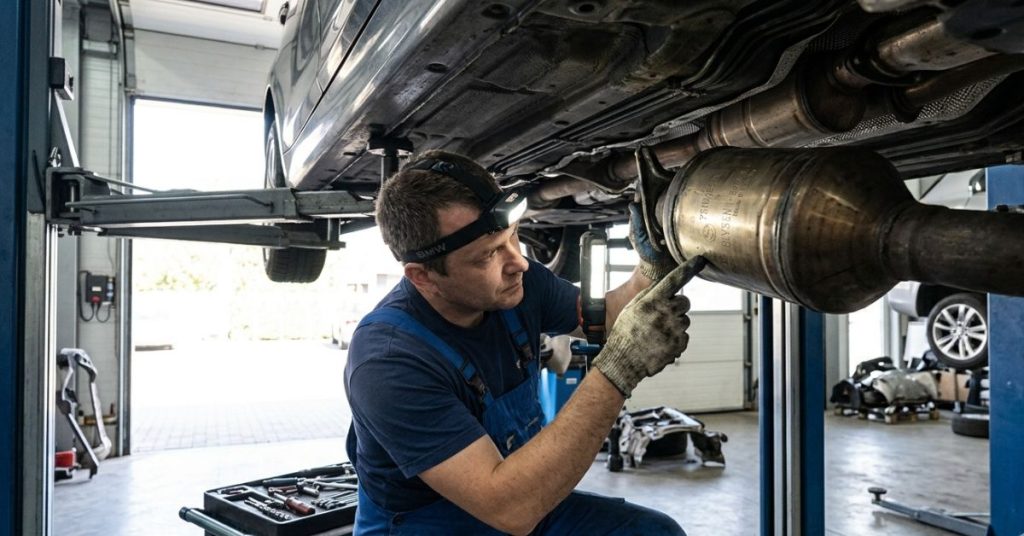
How to Identify Your BMW Catalytic Converter?
Getting an accurate quote starts with proper identification. Here’s what to look for on your BMW converter:
- BMW Logo: OEM units will have the BMW roundel or “BMW” text stamped directly onto the metal shell. If you don’t see a BMW logo, you likely have an aftermarket replacement.
- Serial Number: Look for a stamped alphanumeric code on the converter body. BMW serial numbers often start with “7” (e.g., 7516730, 7571521) or “1” (e.g., 1840-7518665). These numbers correspond to specific PGM assay data that recyclers use for pricing.
- Shape and Size: BMW converters are typically rectangular or foil-style units, which look different from the round “torpedo” converters found on many American vehicles.
- Cleaning Tip: If rust and road grime have covered the stampings, use steel wool or a wire brush to reveal the serial number. Buyers can grade about 90% of BMW converters using serial numbers alone.
Where to Sell Your BMW Catalytic Converter for Scrap?
You’ve got a few options, and the one you pick will directly impact your payout.
Local Scrapyards
The most convenient option, but usually the lowest paying. Local yards offer quick cash but often lack the XRF analysis equipment needed to accurately assess your converter’s PGM content. You’re essentially accepting their best guess.
Online Catalytic Converter Buyers
Platforms like RRCats, AutoCatalystMarket, and Ecotrade Group offer serial-number-based pricing tied to live PGM market rates. You photograph the converter, submit the serial number, get a quote, ship the unit, and receive payment. This approach consistently delivers higher payouts than local scrapyards because pricing is transparent and competition-driven.
Direct Refinery Sales
For high-volume sellers (mechanics, shops, junkyards), selling directly to a PGM refinery offers the best per-unit pricing. Refineries use XRF spectroscopy and fire assay to precisely measure metal content. However, they typically require minimum batch sizes and longer processing times.
The shift toward electric vehicles is gradually reshaping the automotive parts market, including converter supply. To understand how EV adoption is affecting the industry, take a look at our EV pricing shakeup analysis.
Common Mistakes That Kill Your Scrap Value
Avoid these pitfalls when selling your BMW catalytic converter:
- Gutting the Converter: Removing or damaging the internal honeycomb substrate destroys the recoverable metal. Always sell converters intact.
- Not Knowing OEM vs. Aftermarket: If you replaced your converter with an aftermarket unit at some point, that’s what you’re selling, not the valuable OEM piece. Check for the BMW logo stamp.
- Selling Without a Serial Number: Buyers can’t provide accurate quotes without the serial number. Take 5 minutes to clean and photograph the stampings.
- Accepting the First Offer: Scrap prices can vary by 30-50% between buyers. Get at least 2-3 quotes before committing.
- Ignoring Legal Requirements: Multiple states now require proof of ownership, VIN documentation, and licensed buyer transactions for catalytic converter sales. Failing to comply can result in misdemeanor or felony charges.
Legal Considerations for Selling Scrap Converters
The catalytic converter theft epidemic pushed lawmakers to tighten regulations across the board. As of now, 31+ states have passed converter-specific theft and possession laws. Some key points to be aware of:
California’s AB 1740 requires VIN engraving on converters and increases penalties for buyers who can’t prove legal acquisition. Texas made converter theft a standalone criminal offense with up to 2 years in state jail, potentially escalating to 2-10 years for repeat offenders. The federal PART Act is also working through Congress, which would establish nationwide traceability requirements.
For legitimate sellers (vehicle owners, licensed mechanics, authorized recyclers), these laws shouldn’t create any obstacles. Just keep your documentation: proof of vehicle ownership, purchase receipts for replacement converters, and records of any transactions. Understanding how original pricing actually works on used parts can help you negotiate fair deals with buyers.
Why Rhodium Drives the Entire Market?
Rhodium is the wild card in catalytic converter pricing. It’s one of the rarest metals on Earth, with annual production around 1% of gold’s output. And it’s the most effective catalyst for reducing nitrogen oxide (NOx) emissions.
When rhodium hit nearly $30,000/oz in 2021, catalytic converter theft spiked 1,700% nationally. Insurance claims topped $1.2 billion. When rhodium crashed 77% from that peak, theft dropped 83%. Now with rhodium back above $10,000/oz, theft is rebounding, with one Minnesota city reporting a 193% increase despite strict anti-theft laws remaining in place.
This cycle directly affects what your BMW converter is worth. When rhodium prices surge, your old cat becomes more attractive to buyers. When rhodium dips, payouts shrink. It’s the same supply-and-demand dynamic that drives pricing across all commodities, from metals to Ford F-150 trim packages.
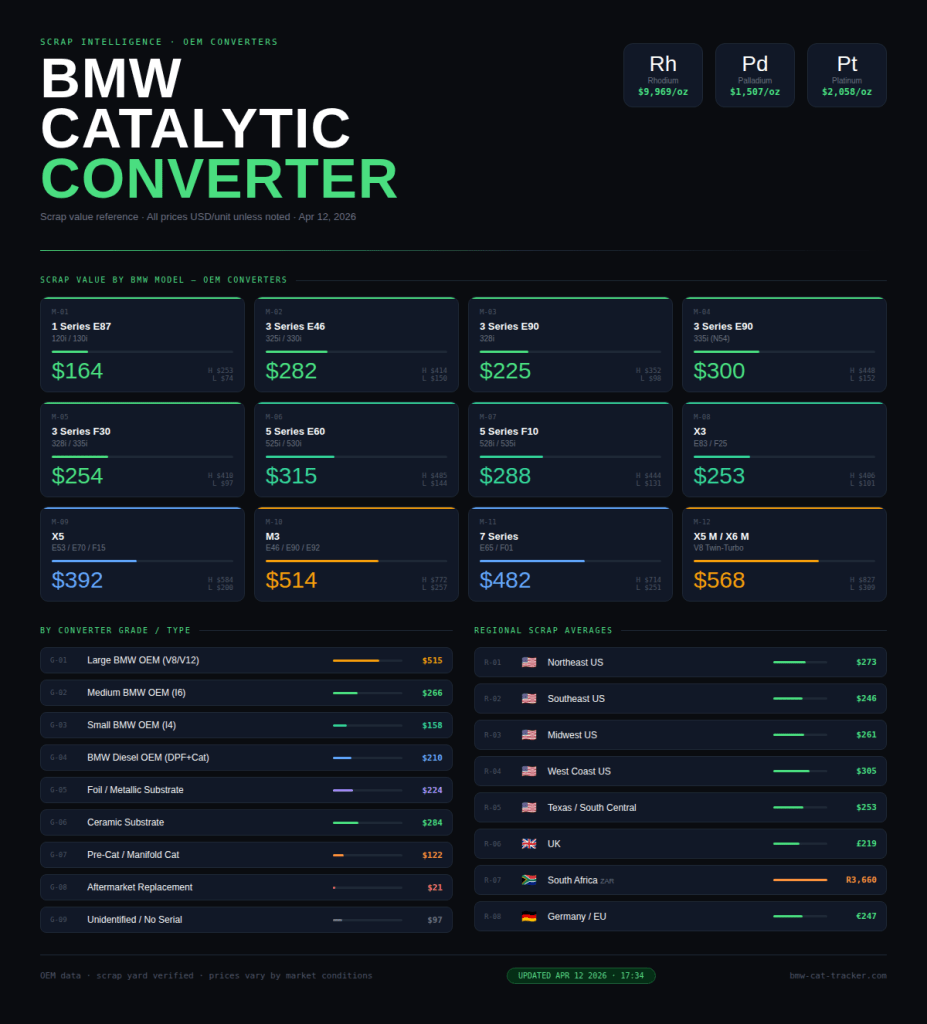
Diesel vs. Gasoline BMW Converters: Does It Matter?
Yes, it matters. BMW diesel models (318d, 320d, 530d, X5 30d) use converters with a different PGM blend than their gasoline counterparts. Diesel converters tend to be heavier on platinum and lighter on palladium, while gasoline converters lean more heavily on palladium and rhodium.
With platinum currently trading above $2,000/oz, diesel BMW converters are holding strong scrap values. BMW stamps its logo on diesel converters too, so identification works the same way as gasoline units.
Protecting Your BMW’s Catalytic Converter from Theft
With converter theft rebounding, protection matters. Here are practical steps for BMW owners:
- Park in well-lit areas or locked garages whenever possible. Thieves can cut a converter off in under 60 seconds with a battery-powered reciprocating saw.
- Consider a catalytic converter shield or cage. These bolt-on steel plates add a physical barrier that makes removal significantly harder. Cost: $150-$500 installed.
- Look into VIN etching services. Many police departments offer free etching events that engrave your vehicle identification number onto the converter, creating traceability that deters buyers.
- Set up a car alarm with tilt/vibration sensitivity. Some aftermarket systems can detect the sawing vibration specifically.
Getting the Best Price for Your BMW Converter
The difference between a lowball scrapyard offer and a fair market price can be hundreds of dollars. Your best approach is simple: find the serial number, photograph the converter from multiple angles, and request quotes from at least 2-3 online catalytic converter buyers who price based on real PGM assay data.
Don’t sell during a PGM price dip if you can afford to wait. Track rhodium and palladium spot prices for a week or two and sell when the market favors you. And always make sure you’re complying with local and state regulations, especially if you’re selling more than one unit.
Your old BMW catalytic converter isn’t just exhaust system junk. It’s a small package of some of Earth’s rarest metals, and the market is paying real money for it.