
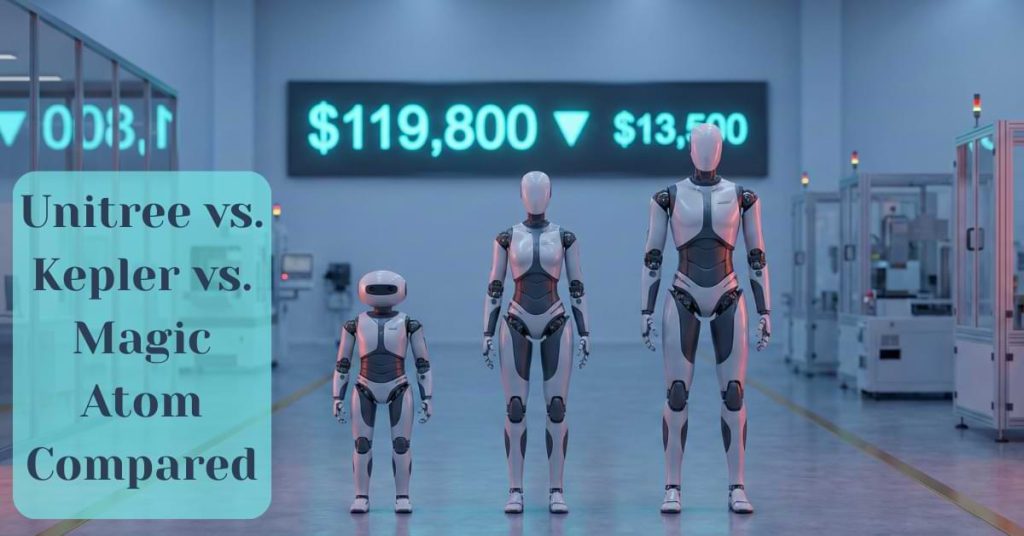
Unitree’s G1 starts at $13,500 and shipped 5,500+ units in 2025. Kepler’s K2 costs about $34,000 with an 8-hour battery. MagicLab’s MagicBot G1 runs around $119,800. China now controls over 85% of global humanoid shipments heading into 2026.
Something wild happened on Chinese New Year’s Eve this year. Over 23 billion people watched humanoid robots perform kung fu, backflips, and comedy sketches on the 2026 Spring Festival Gala. Not clunky demonstrations. Actual choreographed routines with swords, nunchucks, and trampoline somersaults.
Within two hours of the broadcast, robot searches on JD.com jumped 300%. Orders spiked 150%. Delivery dates got pushed to April. We covered the full story behind how Unitree became China’s most searched company overnight after the Gala, and the demand surge hasn’t slowed down since.
A year ago, these same robots were wobbling through folk dances. Now they’re doing drunken boxing and wall-run backflips. The progress is real, and three companies are leading the charge at very different price points.
Side-by-Side: What You Actually Get for the Money
| Spec | Unitree G1 | Kepler K2 | MagicBot G1 |
| Price | From $13,500 | ~$34,000 | ~$119,800 |
| Height | 127 cm (4’2″) | 178 cm (5’10″) | 174 cm (5’9″) |
| Weight | ~35 kg | 85 kg | ~67.5 kg |
| Degrees of Freedom | 23 to 43 | Up to 52 | 42 |
| Battery Life | ~2 hours | ~8 hours | 4 to 5 hours |
| Arm Payload | 3 kg/arm | 15 kg/hand | 20 kg/arm |
| Top Speed | 2 m/s | ~1.5 m/s | ~1.5 m/s |
| Best For | Research labs | Factory floors | Multi-use fleets |
| Shipping Since | August 2024 | Q3 2025 | Mid-2025 |
Unitree G1: $13,500 and Already Everywhere
Unitree is the name most people know. The Hangzhou company started making robot dogs back in 2016, launched the H1 humanoid in 2023, and then dropped the G1 in August 2024 at a price that turned heads.
At $13,500 for the base model (84,900 yuan in China), the G1 costs less than a used car. That’s how it ended up at Amazon’s robotics lab, Stanford, MIT, and UT Austin. About 5,500 units shipped in 2025 alone. CEO Wang Xingxing told 36Kr he’s targeting 10,000 to 20,000 shipments this year.
Here’s the catch, though That $13,500 base model doesn’t come with SDK access. You can’t program it. You can’t upgrade it to the EDU variant either because the motor mounts and wiring are completely different. If you need actual development tools with ROS 2 and Python support, you’re looking at $43,500 for the G1 EDU Standard or up to $73,900 for the Ultimate.
Unitree also dropped the R1 in July 2025 at just $5,900. TIME named it one of the Best Inventions of 2025. That kind of rapid price drop is reshaping the entire consumer robots market, which analysts now expect to grow well beyond earlier forecasts.
One concern worth noting: security researchers found in September 2025 that the G1 sends sensor data without telling the operator. A Bluetooth vulnerability also lets nearby attackers take control of multiple Unitree models. The U.S. Congress has requested an investigation into the company’s possible military ties, though no restrictions have been imposed as of February 2026.
Kepler K2: $34,000 and Built for Full Shifts
Shanghai Kepler took the opposite approach from Unitree. Instead of chasing researchers and hobbyists, they went straight to factory managers.
The K2 “Bumblebee” stands at full human height (178 cm), weighs 85 kg, and runs for about 8 hours on a single charge. That last number is the big deal. When your robot can work an entire factory shift without swapping batteries, the ROI math changes fast.
Kepler prices the K2 at RMB 248,000, which works out to roughly $34,000. For that you get 52 degrees of freedom, hands with 12 DOF each, and 96 tactile sensors per fingertip, plus proprietary planetary roller screw actuators pushing 8,000 Newtons of thrust.
The K2 is already doing real work. It’s been running inspection and assembly support at the SAIC-GM plant in Shanghai, where they build Buicks, Chevrolets, and Cadillacs. Kepler says they’ve locked in framework agreements for thousands of units.
The robot’s hybrid architecture hits 81.3% energy efficiency with its straight-knee gait. Kepler’s ability to hit this price while maintaining quality speaks to the same manufacturing advantage that’s driving China’s broader export dominance in 2025. Vertical supply chain control keeps costs down in ways that Western competitors can’t easily replicate.
Three funding rounds since early 2025 brought in investors across the supply chain, from motor manufacturers to sensor makers. Kepler isn’t just building robots. They’re building the ecosystem to keep costs dropping.
MagicLab MagicBot: $119,800 Premium Play
MagicLab (also called Magic Atom Robotics Technology) is the dark horse. Founded in late 2023 in Wuxi, they pulled in RMB 150 million in angel funding and moved fast. Really fast.
Within six months of opening sales, MagicLab reported RMB 500 million in letters of intent and RMB 130 million in firm orders. They’ve partnered with over 100 organizations worldwide on proof-of-concept pilots.
Their flagship MagicBot G1 stands 174 cm tall, packs 42 degrees of freedom, and handles 20 kg per arm (40 kg total). Battery lasts 4 to 5 hours. The standard edition runs about $119,800, which puts it firmly in the enterprise category.
The smaller MagicBot Z1, launched in July 2025, is more accessible at 177,800 yuan (around $24,500). It stands 1.4 meters tall with up to 50 degrees of freedom and was the one that stole the show at the Spring Festival Gala. MagicLab’s Z1 pulled off a Thomas 360-degree rotation on live TV, a first for any humanoid that size.
The Numbers Behind China’s Lead
Let’s put some hard data on this.
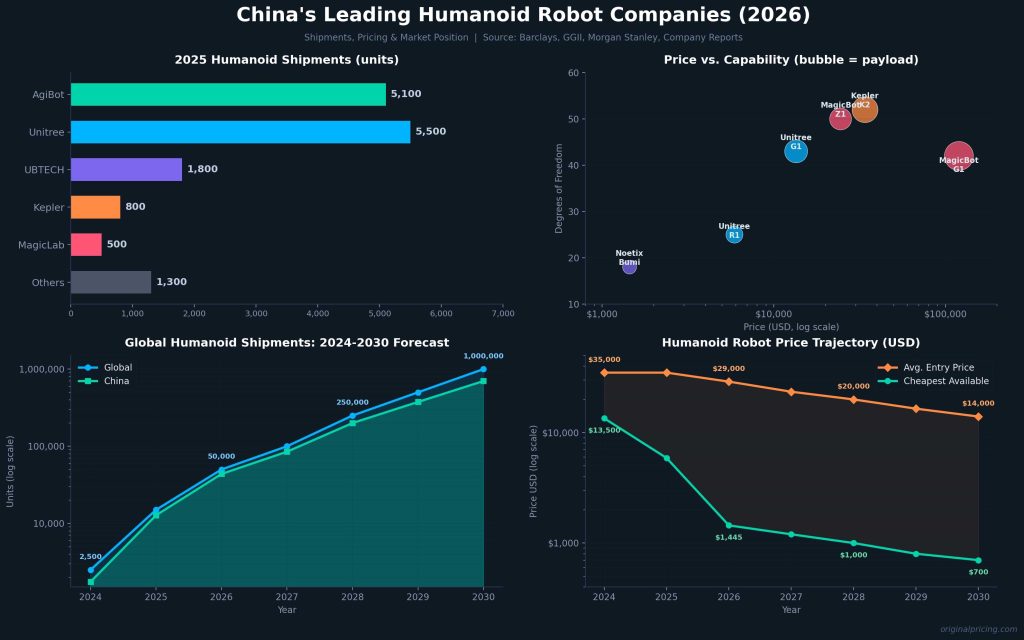
Barclays estimates China accounted for 85%+ of the roughly 15,000 global humanoid installations in 2025. AgiBot alone shipped over 5,100 units, grabbing 39% of the global market. Unitree and UBTECH round out the top three.
China’s Ministry of Industry and Information Technology counts more than 140 domestic humanoid robot manufacturers with 330+ models released. Morgan Stanley doubled its 2026 China sales forecast to 28,000 units. GGII projects 62,500 domestic shipments this year, up from about 18,000 in 2025. That’s a 247% jump.
Bank of America thinks average humanoid prices will drop from $35,000 in 2025 to $17,000 by 2030. Goldman Sachs sees production costs falling from $250,000 to $150,000 per unit in just the first year at scale. Here’s what the full timeline looks like:
Humanoid Robot Market Snapshot: 2024 to 2030
| Year | Global Shipments | China Share | Avg. Entry Price | Cheapest Model | Avg. Production Cost | Key Milestone |
| 2024 | ~2,500 units | ~70% | $16,000 | Unitree G1 ($13,500) | ~$250,000 | G1 mass production begins |
| 2025 | ~15,000 units | 85%+ | $35,000 | Unitree R1 ($5,900) | ~$150,000 | Kepler K2, MagicBot ship |
| 2026 (est.) | 40,000–62,500 | 85–90% | $28,000–$30,000 | Noetix Bumi ($1,445) | ~$100,000 | Unitree IPO, 62.5K China units |
| 2027 (proj.) | 100,000+ | ~85% | $22,000–$25,000 | Sub-$5,000 expected | ~$70,000 | Tesla Optimus scale ramp |
| 2028 (proj.) | 250,000+ | ~80% | $18,000–$22,000 | Sub-$3,000 expected | ~$50,000 | Home-use pilots begin |
| 2029 (proj.) | 500,000+ | ~75% | $15,000–$18,000 | Sub-$2,000 expected | ~$35,000 | 1M units/yr in reach |
| 2030 (proj.) | 1,000,000+ | ~70% | $10,000–$17,000 | Sub-$1,500 expected | ~$20,000–$30,000 | Appliance-level pricing |
Sources: Bank of America, Goldman Sachs, Morgan Stanley, GGII, Barclays, Omdia. Projections for 2027–2030 based on analyst consensus and announced production targets.
The price trajectory looks a lot like what we’ve tracked across lab-grown diamond prices and RAM prices in 2026. When production scales, prices fall. Humanoid robots are already showing up among Alibaba’s top-selling product categories, which tells you where mainstream demand is heading.
So Which One Makes Sense for You?
University labs on a budget: Unitree G1 EDU at $43,500. Full SDK, active dev community, and more units deployed in research settings than anything else on the market. Skip the $13,500 base model unless you just need a demo unit.
Factory pilots and manufacturing: Kepler K2 at $34,000. The 8-hour battery and 15 kg per hand payload make it the only option that can realistically handle a full shift. Already proven at SAIC-GM.
Enterprise multi-robot deployments: MagicLab MagicBot lineup. The fleet coordination through MagicNet is the differentiator. If you need several robots working together across a warehouse or campus, this is where the premium price starts to justify itself.
Just want to watch: Unitree R1 at $5,900 or Noetix Bumi at $1,445. Entry-level humanoids that won’t break the bank.
Frequently Asked Questions
What’s the cheapest humanoid robot you can buy in 2026?
Noetix Bumi at about $1,445 for a small companion robot. For a full-size humanoid, the Unitree R1 at $5,900 is the cheapest on the market right now.
Can these robots actually work in a factory today?
In limited roles, yes. Kepler’s K2 is doing inspection and assembly support at a GM plant in Shanghai. MagicLab has robots handling material transport and barcode scanning. But fully autonomous factory work without human oversight is still years away.
Should I worry about security with Chinese robots?
It’s a real concern. Researchers found data collection issues and Bluetooth vulnerabilities in Unitree’s models in 2025. The U.S. Congress requested an investigation into possible military ties. No bans exist yet, but buyers should keep compliance records.
How fast are prices falling?
Fast. Entry-level humanoids went from $13,500 in late 2024 to $5,900 by mid-2025. Bank of America projects average prices hitting $17,000 by 2030. Analysts expect capable humanoids under $5,000 within three to five years.
Who shipped the most humanoid robots in 2025?
AgiBot led with 5,100+ units (39% global share), followed by Unitree with 5,500+ units and UBTECH in third. Combined, Chinese companies accounted for over 85% of worldwide humanoid installations.