
U.S. grocery prices are projected to rise 3.0% overall in 2026, according to the USDA’s January 2026 Food Price Outlook. But the increases aren’t spread evenly. Beef and veal are forecast to jump 9.4%, coffee prices climbed 21% year-over-year through late 2025, and Italian pasta faces a combined tariff of roughly 107% after new anti-dumping duties took effect in January 2026.
Ground beef hit a record $6.23 per pound in September 2025, and analysts at Spins warn the full tariff impact won’t reach grocery shelves until mid-to-late 2026 due to a 12 to 18 month pricing lag in the food supply chain.
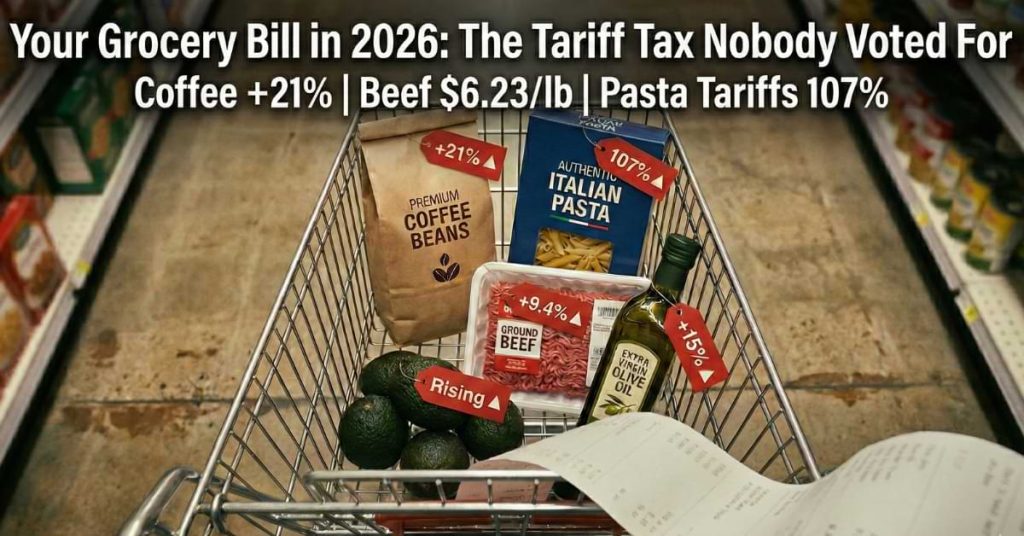
How Tariffs Are Hitting Your Grocery Bill in 2026?
If your grocery receipts feel heavier than they did a year ago, you’re not imagining it. The combination of trade tariffs, supply chain disruptions, and commodity shortages is creating a perfect storm at the checkout line. But here’s what most people miss: the price increases you’re seeing right now are mostly from tariffs imposed in 2025. The real impact from “Liberation Day” tariffs (announced April 2, 2025) hasn’t fully hit shelves yet.
According to analysis from Spins, a market research firm tracking CPG trends, tariff costs in food categories typically lag 12 to 18 months before reaching consumers. That puts the heaviest price pressure arriving between April and October 2026. As Spins VP Ben Lerman put it: “It is not that there was no impact from tariffs because we didn’t see consumer prices rise in 2025. It is just that they haven’t had time to flow through the system yet.”
This delayed impact is something we track across multiple product categories. The same real-time pricing algorithms that adjust tech and consumer goods are increasingly being applied to food distribution, making price changes faster and harder to predict once they start.
Grocery Items Hit Hardest by 2026 Tariffs
Here’s a data-driven breakdown of which items are seeing the biggest price swings and what’s driving each increase:
| Item | 2025 Price / Change | 2026 Forecast | Tariff Rate | Key Driver |
| Ground Beef | $6.23/lb (record) | +9.4% (USDA) | Indirect | Smallest U.S. cattle herd in 70 years |
| Coffee | +21% YoY (CPI) | Easing (tariffs lifted) | 50% on Brazil (was) | Brazil drought + tariffs (now partially lifted) |
| Italian Pasta | Stable (pre-duty) | Up to 2x retail | ~107% combined | 91.74% anti-dumping + 15% base tariff |
| Olive Oil | +15-20% (est.) | Rising | 15% on EU | U.S. imports vast majority consumed |
| Avocados | Volatile | Rising | 25% on Mexico | 80%+ of U.S. supply from Mexico |
| Eggs | $2.86/dz (down from $6.23) | Declining (USDA) | Minimal | Bird flu subsiding, supply recovering |
| Frozen Seafood | +11.6% YoY | Rising | Varies (China, Vietnam) | High tariffs on key import sources |
| Sugar | Rising | Rising | Tariffs + India | India diverting sugarcane to ethanol |
Sources: USDA Food Price Outlook (Jan 2026), Bureau of Labor Statistics CPI, St. Louis Federal Reserve, GOBankingRates.
Understanding how these price shifts interact with shrinkflation tactics is critical. Many brands are quietly reducing package sizes rather than raising sticker prices, meaning your actual cost-per-ounce is climbing even faster than CPI numbers suggest.
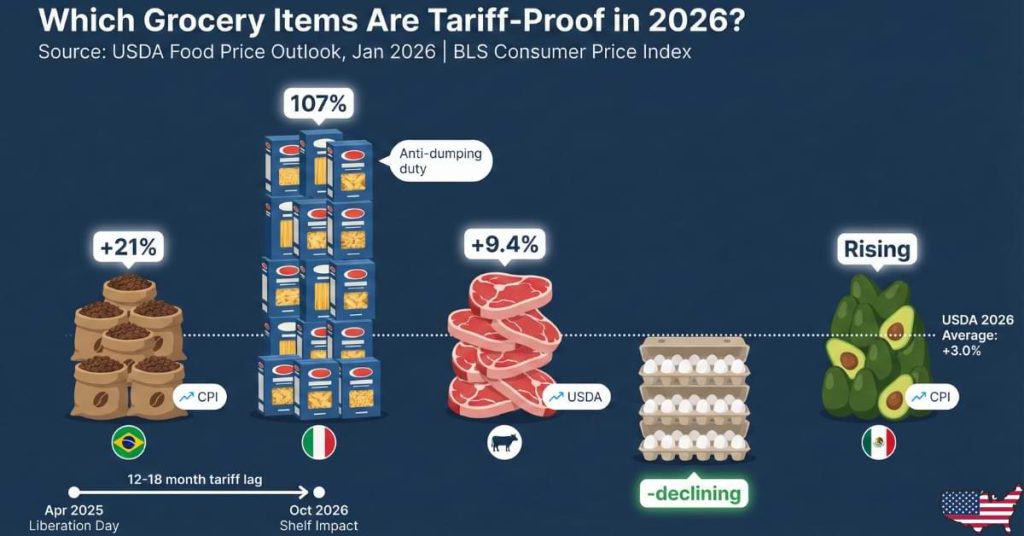
The Italian Pasta Problem: How a 107% Tariff Works?
This one caught a lot of people off guard. Starting January 2026, 13 of Italy’s largest pasta exporters face a 91.74% anti-dumping duty on top of the existing 15% base tariff on EU agri-food imports. That’s a combined rate of roughly 107%. According to reporting from Yahoo Finance, this could more than double the retail cost of authentic Italian pasta brands for American consumers.
To put that in grocery terms: a $3 box of imported De Cecco or Barilla (Italian-made) could climb toward $6 or higher once the full tariff flows through distribution. Domestic pasta brands won’t see the same pressure, but they may raise prices anyway since their imported competitors just got significantly more expensive. This is textbook dynamic pricing at the commodity level, where reduced competition on imported goods gives domestic producers room to push margins.
Coffee Prices: The 21% Spike and What’s Next
Coffee has been one of the most visible tariff casualties. CPI data showed a 21% year-over-year price increase through late 2025, driven by a combination of the 50% tariff on Brazilian imports and severe drought conditions in Brazil and Vietnam. America produces virtually no coffee domestically, making it entirely dependent on imports.
There’s a glimmer of good news here. The Trump administration issued agriculture exemptions in November 2025 that lifted tariffs on several food categories, including Brazilian coffee. World Bank projections show Arabica and Robusta prices declining in 2026 as production recovers from extreme weather. However, as the Food Navigator analysis points out, the tariff removal doesn’t mean instant price relief. Roasters and retailers locked in contracts at higher prices during the tariff period, and those costs take months to work through the system.
If you’re tracking coffee costs at home, our commodity price tracking tools show how premium imported goods move through similar pricing cycles. The pattern is remarkably consistent: prices spike fast on bad news but take 6 to 12 months to come back down.
Beef at Record Highs: $6.23/lb and Climbing
Beef is the one grocery category where tariffs aren’t the primary villain. The USDA reports that the U.S. cattle herd is at its smallest level in roughly 70 years, and consumer demand hasn’t slowed. Ground beef hit a record $6.23 per pound in September 2025 according to St. Louis Federal Reserve data, with beef and veal prices up 16.4% year-over-year as of December 2025.
The USDA’s January 2026 forecast projects beef and veal prices to rise another 9.4% this year, with a wide prediction interval of 0.4% to 19.6%. The uncertainty reflects just how tight supply remains. Rebuilding herd sizes requires taking female cows out of production, which temporarily constrains supply even further. As food economist David Ortega explained: “When you add that supply issue with strong demand for beef, that’s why we’re seeing those record-high beef prices.”
For consumers comparing prices across retailers, tools like our price calculator can help figure out whether bulk purchases or alternative cuts actually save money once you account for per-serving costs.
What’s Actually Getting Cheaper in 2026?
It’s not all bad news. The USDA predicts price declines in three food-at-home categories this year:
- Eggs: After bird flu sent prices to $6.23 per dozen in early 2025, supply has recovered and prices dropped to $2.86. The USDA forecasts continued price declines in 2026.
- Pork: Prices fell 1.4% from November to December 2025 and are projected to decrease 0.3% overall in 2026.
- Dairy: Milk, cheese, and butter prices are expected to decline as feed costs moderate and production stabilizes.
Gas prices are also providing some relief. The Energy Information Administration projects regular gasoline will average about $3.00 per gallon in 2026, down from $3.11 in 2025. That matters for grocery budgets because transportation costs are baked into the price of every item on the shelf. Fed Chair Jerome Powell has suggested tariff-driven inflation will peak in early 2026 and behave as a “one-time” price adjustment rather than a sustained spiral.
How to Protect Your Grocery Budget?
The smartest thing you can do right now is understand which categories face tariff exposure and which don’t. Imported goods like coffee, olive oil, wine, pasta, and produce from Mexico and Central America carry the highest risk. Domestically produced staples like eggs, pork, and dairy are trending in the right direction.
- Stock up strategically: Nonperishable imports like olive oil and pasta are likely to get more expensive as 2026 progresses. Buying ahead at current prices makes financial sense.
- Watch for shrinkflation: Brands often reduce package sizes before raising prices. Compare unit prices (cost per ounce) rather than sticker prices.
- Shift toward less-affected proteins: Pork, chicken, and eggs are all projected to hold steady or decline. Beef is heading the other direction.
- Track prices over time: Understanding what original price actually means helps you spot inflated “sale” prices that aren’t real savings.
The USDA’s overall food-at-home forecast of +1.7% is actually below the 20-year historical average of 2.6%. But averages hide the extremes. When beef is up 9.4% and pasta costs double, the families who rely on those specific items feel far more than 1.7%. The key is knowing where the pressure is and adjusting before it arrives. For a broader look at how common pricing mistakes cost consumers money during volatile periods like this, our research tracks the patterns most people miss.
Frequently Asked Questions
How much will grocery prices rise in 2026?
The USDA projects overall food prices to increase 3.0% in 2026 and food-at-home (grocery) prices specifically to rise 1.7%. However, individual categories vary dramatically: beef and veal are forecast at +9.4% while eggs and pork are expected to decline.
Why is Italian pasta getting so expensive?
Starting January 2026, 13 major Italian pasta exporters face a 91.74% anti-dumping duty on top of a 15% base tariff, creating a combined rate of roughly 107%. This could more than double the retail cost of imported Italian pasta brands.
Are coffee prices going to come down?
Likely yes, but slowly. The 50% tariff on Brazilian coffee was lifted in November 2025, and World Bank projections show production recovering from drought. However, roasters locked in contracts at higher prices, so relief will take several months to reach retail shelves.
When will the full tariff impact hit grocery shelves?
Analysts at Spins estimate a 12 to 18-month lag between tariff imposition and consumer price impact. That places the heaviest pressure from April 2025’s “Liberation Day” tariffs arriving between April and October 2026.