
The EU and the U.S. have taken fundamentally different approaches to Chinese electric vehicle imports in 2026. The EU launched a “price undertaking” framework on January 12, 2026, allowing Chinese automakers to sell above a minimum price floor instead of paying tariffs up to 45.3%.
The U.S. maintains a flat 100% tariff on all Chinese-made EVs, effectively banning them from the market. European consumers can buy a BYD Dolphin Surf starting around €19,990 ($22,000). American buyers have zero access to Chinese passenger EVs at any price. Research from the Centre for Economic Policy Research found that EU tariffs didn’t actually raise Chinese EV consumer prices in Europe, while U.S. tariffs historically raised consumer prices almost dollar-for-dollar.
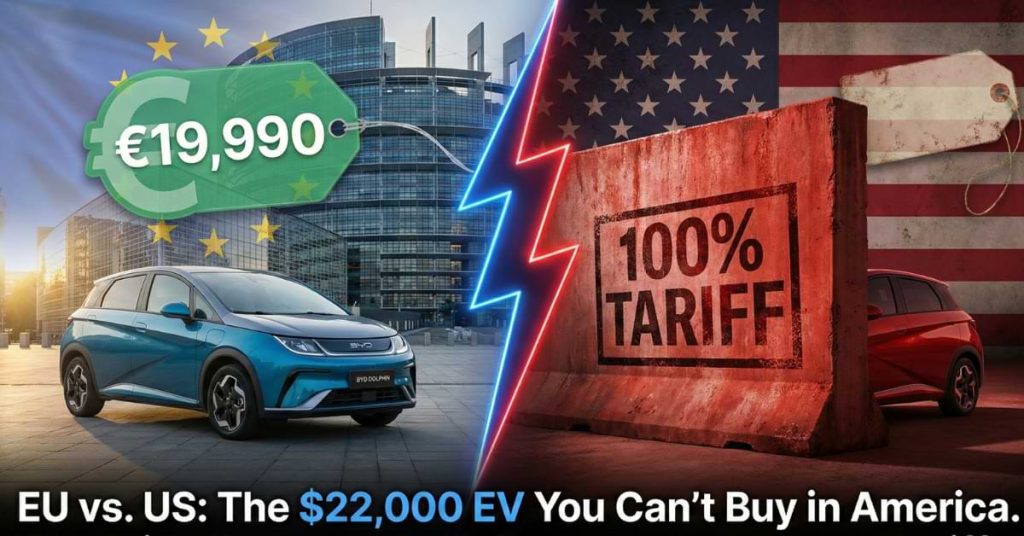
Two Superpowers, Two Completely Different Playbooks
There’s a reason Reddit threads on r/worldnews and r/cars keep calling this the “Green Cold War.” The world’s two largest Western economies are staring at the same problem, the rapid rise of Chinese EV manufacturing, and arriving at opposite solutions. Their choices will reshape what consumers pay for electric cars for the rest of this decade.
The EU’s approach is built on negotiation. After imposing countervailing duties ranging from 7.8% to 35.3% (on top of a standard 10% import duty) in October 2024, the European Commission spent over a year negotiating directly with Beijing. The result was a formal guidance document published January 12, 2026, outlining how Chinese manufacturers can submit “price undertaking” offers. If accepted, the manufacturer commits to selling above a set minimum price and gets exempt from tariffs entirely.
The first real test came on February 10, 2026, when the Commission accepted Volkswagen (Anhui)’s price undertaking for the CUPRA Tavascan, a Chinese-built EV now allowed into the EU at a minimum import price without paying the 20.7% countervailing duty. The deal also requires VW to limit import volumes and invest in EU-based EV projects.
America’s approach is blunt force. The 100% tariff on Chinese-made EVs has been in place since 2024 and shows no sign of softening. When you combine that with the expiration of the $7,500 federal EV tax credit in late 2025, the U.S. is running the most protectionist EV market among major economies. For a deeper breakdown of how these tariff changes are hitting American car buyers right now, see our full EV pricing shakeup analysis.
EU vs. U.S. EV Trade Policy: Side-by-Side Comparison
| Policy Factor | European Union (2026) | United States (2026) |
| Tariff on Chinese EVs | 7.8% to 35.3% + 10% base (up to 45.3%) | 100% flat tariff |
| Alternative mechanism | Price undertaking (minimum price floor) | None available |
| Consumer EV tax credit | Varies by country (Germany: €3B program) | $7,500 credit expired (late 2025) |
| Chinese EV access | Open (BYD, Xpeng, Nio sell actively) | Effectively blocked |
| BYD entry-level price | Dolphin Surf from €19,990 | Not available at any price |
| Chinese EV market share | ~10%+ and growing (H2 2025) | 0% (passenger vehicles) |
| Local factory incentive | Yes (BYD Hungary plant, 2026) | No pathway for Chinese OEMs |
| Price impact on consumers | Chinese EV prices fell despite tariffs (CEPR) | Prices rose nearly 1:1 with tariff (historical) |
Sources: European Commission, CEPR, Cox Automotive, Electrek. Data current as of February 2026.
The BYD Factor: What a $22,000 EV Looks Like (If You Can Buy One)
BYD is the clearest illustration of how these two policies produce radically different consumer outcomes. In Europe, BYD outsold Tesla in battery-electric registrations for the first time in May 2025, logging 7,231 units versus Tesla’s 7,165. The company’s European lineup starts with the Dolphin Surf at roughly €19,990 and scales up through the ATTO 3 (~€38,000) and the Seal sedan (~€42,700 to €48,200). Even with the EU’s 17% additional tariff on BYD specifically, these prices land right in the sweet spot for European buyers, competitive with the Dacia Spring, Fiat 500e, and Volkswagen ID.3.
In the United States, BYD sells exactly zero passenger cars. The 100% tariff means a hypothetical $11,000 BYD Seagull would cost over $22,000 before it even hits a dealer lot, and that’s before shipping, compliance costs, and margin. There’s no regulatory pathway, no price undertaking option, and no political appetite to create one. This gap is a textbook case of how trade policy creates value bifurcation across markets, where identical products carry wildly different price tags based purely on geography.
BYD isn’t sitting still either. The company is targeting 1.3 million overseas sales in 2026, up from 1.05 million in 2025. Its Hungary factory, expected to ramp up production in 2026 with capacity for 800,000 units annually, will let it bypass EU tariffs entirely by producing locally. That strategy of China’s export dominance is reshaping how global pricing works across every category, not just automobiles.
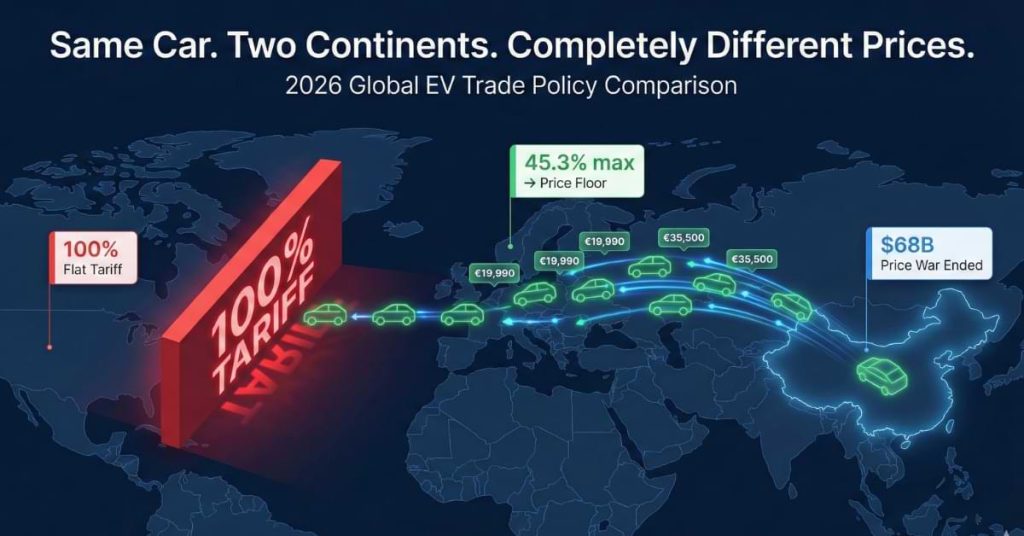
Who Actually Benefits? The Data Tells a Surprising Story?
Here’s where the debate gets uncomfortable for both sides.
The EU’s price floor sounds consumer-friendly, but the Centre for Economic Policy Research (CEPR) called it a “poor policy choice” in a January 2026 analysis. Their argument: a minimum price floor “keeps consumer prices artificially high, effectively transferring income from European consumers to Chinese producers.” Under tariffs, at least the revenue (estimated at over 1% of the EU’s annual budget) flowed to Brussels. Under price undertakings, that money goes straight into BYD’s and SAIC’s margins.
But here’s the counterpoint: CEPR’s own data showed that Chinese EV consumer prices in Europe didn’t actually increase after tariffs were imposed. Chinese manufacturers absorbed the costs to protect market share. Meanwhile, historical research on U.S. tariffs from 2018 to 2019 found that consumer prices rose almost one-for-one with tariff levels. In other words, American tariffs make things more expensive for American buyers. European tariffs, at least on EVs, didn’t.
Analysts at Brussels Signal report that replacing tariffs with minimum prices would likely “lower consumer prices while raising margins of European manufacturers and Chinese exporters.” European automotive analyst Matthias Schmidt noted that since most Chinese manufacturers had already absorbed tariffs, the shift to minimum prices would primarily “boost their profits than sticker prices.”
This kind of dynamic pricing behavior is exactly what makes global trade analysis so tricky: the sticker price doesn’t always move the way policy intends.
The Bigger Picture: A Fractured Global EV Market
What we’re watching unfold in 2026 isn’t just about cars. It’s about whether the global economy is heading toward cooperation or fragmentation. The EU and China signing a price undertaking framework while the U.S. maintains a 100% tariff wall, creates what investors are calling distinct “trade blocs” in the EV space.
China’s own domestic market adds another layer. On February 12, 2026, Beijing’s SAMR banned below-cost vehicle sales, ending a price war that cost the industry an estimated $68 billion. China’s January 2026 passenger car sales dropped nearly 20% month-over-month. S&P projects Chinese light vehicle sales could decline up to 3% this year. With domestic growth stalling, Chinese automakers are pivoting aggressively to exports, exactly the scenario that triggered the trade tensions in the first place.
For consumers tracking where global pricing pressure is heading, this connects directly to how top-selling products from Chinese manufacturers are priced across international markets. The same supply chain advantages driving $10,000 EVs in Shenzhen are powering competitive pricing across electronics, industrial goods, and consumer products worldwide.
Canada’s recent decision to cut Chinese EV tariffs from 100% to 6.1% for a limited annual quota of 49,000 vehicles offers a third model, a controlled opening that neither fully blocks nor fully embraces Chinese imports. Whether the U.S. eventually adopts something similar remains the biggest open question in the global pricing landscape heading into the second half of 2026.
Frequently Asked Questions
What is the EU’s price undertaking for Chinese EVs?
It’s a framework where Chinese automakers commit to selling EVs in Europe above an agreed minimum price. In exchange, they’re exempt from countervailing duties that can reach up to 35.3%. The European Commission published the formal guidance on January 12, 2026, and accepted the first undertaking (Volkswagen Anhui’s CUPRA Tavascan) on February 10, 2026.
How much are U.S. tariffs on Chinese EVs?
The U.S. imposes a 100% tariff on all Chinese-manufactured electric vehicles. This effectively doubles the import cost and blocks Chinese brands like BYD from selling passenger cars in the American market. There’s currently no alternative mechanism like the EU’s price undertaking.
Can Americans buy a BYD electric car?
No. BYD does not sell consumer passenger EVs in the United States. While BYD supplies electric buses and commercial vehicles under different trade rules, the 100% tariff on passenger EVs makes retail sales economically impossible. The cheapest BYD (the Seagull at ~$10,000 in China) would cost over $22,000 after tariffs alone.
Which approach is better for consumers?
Data suggests the EU approach produces better consumer outcomes. CEPR research found that Chinese EV prices in Europe didn’t increase despite tariffs, as manufacturers absorbed costs. Historical U.S. tariff data shows consumer prices rose nearly dollar-for-dollar with tariff levels. However, critics argue the EU’s price floor still keeps prices artificially higher than a truly open market would.