
DiDi Global, China’s dominant ride-hailing platform, has staged one of the most dramatic corporate recoveries in recent tech history. After a devastating regulatory crackdown in 2021 that led to app removals, a $1.2 billion fine, and a forced NYSE delisting, DiDi has rebuilt its business to record-breaking levels. The company now processes over 35 million daily transactions, posted full-year revenue of RMB 206.8 billion in 2024, and is actively deploying L4 autonomous robotaxis in major Chinese cities.
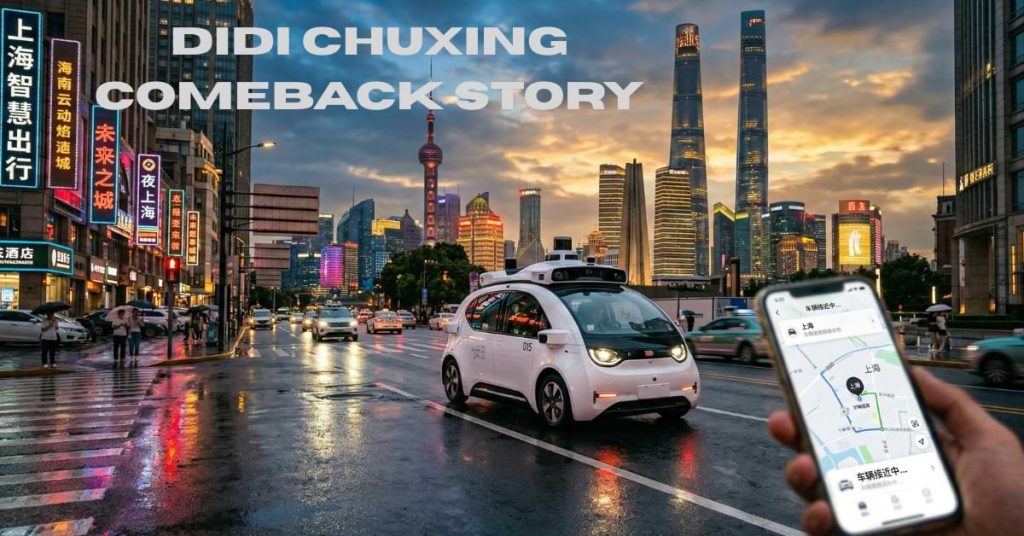
What Happened to DiDi in 2021?
DiDi’s crisis started just days after its June 2021 IPO on the New York Stock Exchange. Chinese regulators launched a cybersecurity investigation into the company, citing concerns about data security and national interests. The fallout was swift and severe.
Authorities ordered all app stores to remove 25 DiDi-operated apps, including the main Didi Chuxing platform and Uber China. New user registrations were frozen. By mid-2022, the Cyberspace Administration of China had levied a fine of 8.026 billion yuan (roughly $1.2 billion) for data security violations. DiDi delisted from the NYSE in June 2022, and its plans to re-list in Hong Kong stalled after regulators signaled the company still hadn’t met security requirements.
For a company that once commanded a valuation north of $60 billion, it was a staggering fall. Revenue dropped 25% in 2022 as the combined effects of the app ban and China’s strict COVID lockdowns crushed ride demand.
The Road Back: Timeline of DiDi’s Recovery
| Date | Milestone |
| July 2021 | Apps removed from Chinese app stores; cybersecurity probe launched |
| July 2022 | $1.2 billion fine imposed by regulators for data security violations |
| June 2022 | Delisted from the New York Stock Exchange |
| Jan 2023 | Apps restored to app stores; new user registrations resume |
| Q1 2024 | Revenue hits RMB 49.1 billion; adjusted profit of RMB 900 million |
| Q4 2024 | Record 35.3 million average daily transactions |
| Q1 2025 | Revenue rises 8.5% to RMB 53.3 billion; net income of RMB 2.4 billion |
| Q3 2025 | Revenue reaches RMB 58.6 billion; profit of RMB 1.5 billion |
| Jan 2026 | First batch of R2 robotaxis delivered with GAC Aion; pilot operations begin |
Financial Recovery: The Numbers Tell the Story
DiDi’s financial turnaround has been methodical. After revenue bottomed out at around $20.4 billion in 2022, the company posted $27.1 billion in 2023 (a 33% jump) and climbed to $28.8 billion in 2024. Trailing twelve-month revenue through mid-2025 reached approximately $30 billion, with consistent quarter-over-quarter growth.
The profitability shift is even more telling. In Q1 2025, DiDi reported net income of RMB 2.4 billion, compared to a loss of RMB 1.4 billion in the same period a year earlier. The company’s adjusted EBITDA hit RMB 3.1 billion that quarter. By Q3 2025, DiDi maintained its momentum with RMB 1.5 billion in profit on revenue of RMB 58.6 billion.
| Metric | 2022 | 2023 | 2024 |
| Annual Revenue (USD) | ~$20.4B | ~$27.1B | ~$28.8B |
| YoY Growth | -25.2% | +32.7% | +6.2% |
| Full-Year Revenue (RMB) | ~146.4B | 192.4B | 206.8B |
| Q4 Daily Transactions | N/A | ~30M | 35.3M (Record) |
Source: DiDi Global quarterly earnings reports and MacroTrends financial data

What’s Driving the Comeback?
Domestic Market Strength
DiDi still controls the largest share of China’s ride-hailing market. Despite competition from aggregation platforms like Gaode Dache and rivals such as Caocao Chuxing and T3 Chuxing, DiDi’s ride volume has remained hard to dislodge. The platform’s user stickiness and driver network create a flywheel that competitors have struggled to replicate.
The company has also diversified its domestic offerings. Recent additions include intercity buses, intracity minibuses, pet-friendly rides, and chartered cars. These niche services help DiDi capture demand that traditional ride-hailing misses.
Aggressive International Expansion
DiDi’s international segment has been a standout performer. In Q4 2024, international gross transaction value grew 15.8% year-over-year (32% on a constant currency basis), with Brazil and Mexico serving as primary growth markets. The company has also expanded into Hong Kong and is exploring other overseas markets to reduce its dependence on the competitive Chinese landscape.
This push into new markets mirrors broader trends in EV pricing and global mobility shifts that are reshaping transportation costs worldwide.
The Robotaxi Bet
Perhaps the boldest piece of DiDi’s comeback strategy is its push into autonomous driving. Through its subsidiary DiDi Autonomous Driving, the company has been developing self-driving technology since 2016. That effort is now producing tangible results.
In collaboration with Volvo, DiDi deployed its first-generation R1 robotaxis for public use in Guangzhou starting in late 2025. These modified Volvo XC90 vehicles offer fully autonomous rides around the clock in designated zones.
The bigger milestone came in January when DiDi and GAC Aion delivered the first batch of their jointly developed R2 robotaxi. Built on GAC’s Aion V electric platform, the R2 carries 33 sensors, including LiDAR, cameras, and 4D millimetre-wave radar, with computing power exceeding 2,000 TOPS. It’s rated at SAE Level 4 autonomy and represents the first mass-produced robotaxi born from a joint venture between a major automaker and an autonomous driving company in China.
The autonomous driving race in China involves multiple players, and DiDi’s approach parallels the competitive dynamics seen in the humanoid robotics sector where Chinese firms are rapidly scaling from prototypes to commercial deployment.
DiDi is reportedly seeking fresh funding for its autonomous vehicle unit at a valuation around $5 billion, signaling confidence that this technology could become a significant revenue driver. The company plans to produce tens of thousands of robotaxis and integrate them alongside human-driven cars on its existing platform.
Market Position and Stock Performance
DiDi now trades on the OTC market under the ticker DIDIY. As of late February, shares sit around $4.56, giving the company a market capitalization of roughly $32.5 billion. Analysts have initiated coverage with overweight ratings, citing robust growth potential and margin expansion.
The company has also been buying back shares. As of mid-2024, DiDi had repurchased approximately $152.4 million worth of American depositary shares under a $1 billion buyback program.
For consumers tracking how tech platform valuations affect product pricing, the connection between corporate recovery and end-user costs is explored in our analysis of how tariff policies ripple through grocery and consumer markets.
What Could Go Wrong?
DiDi’s recovery isn’t without risks. The Chinese ride-hailing market is maturing, and growth rates are slowing. Competition from aggregation platforms continues to nibble at market share. The international business, while growing fast, still operates at a loss. And the regulatory environment that nearly destroyed DiDi once could shift again.
Pricing pressure from competitors and shifting consumer expectations echo similar patterns in dynamic pricing models that affect industries far beyond transportation.
The autonomous driving push also carries execution risk. While the technology is progressing, scaling from pilot programs to profitable city-wide deployment requires massive capital investment and regulatory approvals across multiple jurisdictions.
The Bigger Picture
DiDi’s story is ultimately about resilience. A company that lost access to its own apps, paid a billion-dollar fine, and got kicked off the New York Stock Exchange has rebuilt itself into a profitable, growing business with a clear path toward autonomous mobility.
The comeback also says something broader about China’s tech sector. After years of aggressive regulatory crackdowns, companies that survived are emerging leaner, more focused, and more strategically aligned with government priorities around AI, autonomous driving, and domestic technology supply chains.
This trend of technology companies adapting to new market realities connects to the broader landscape of outcome-based pricing models reshaping how tech services are valued globally.
With 550 million users served worldwide, operations spanning Asia-Pacific and Latin America, and robotaxis rolling off production lines, DiDi’s second act may end up being more consequential than its first.
FAQ
Is DiDi still operating?
Yes. DiDi fully resumed operations in early 2023 after its apps were restored to Chinese app stores. The company now processes over 35 million rides per day and operates in multiple countries across Asia and Latin America.
Is DiDi publicly traded?
DiDi delisted from the NYSE in June 2022. It currently trades on the OTC market under the ticker symbol DIDIY, with a market cap of approximately $32.5 billion.
How much was DiDi fined?
DiDi was fined 8.026 billion yuan (approximately $1.2 billion) by China’s Cyberspace Administration in 2022 for data security violations related to its unapproved U.S. IPO.
Does DiDi have robotaxis?
Yes. DiDi operates autonomous R1 vehicles (modified Volvo XC90s) in Guangzhou and recently began delivering its next-generation R2 robotaxi developed with GAC Aion. Both are rated at SAE Level 4 autonomy.
How does DiDi compare to Uber?
DiDi is often called China’s Uber. It acquired Uber’s China operations in 2016 and dominates the Chinese ride-hailing market. While Uber focuses on Western markets, DiDi’s strength lies in China, Southeast Asia, and Latin America. DiDi’s trailing twelve-month revenue exceeds $30 billion.
Sources